
The complete guide to K-12 procurement
Understand how K-12 procurement works, who makes buying decisions, and how to engage districts months before an RFP is published.

K-12 districts spend over $900 billion a year. That number makes the market one of the largest purchasing ecosystems in the country. Yet, the rules governing how districts spend that money are published in board policies, state education codes, and public budget documents that most vendors never read.
This is a problem because K-12 procurement follows predictable patterns. Budget cycles repeat according to the same schedule every year. Buying signals surface in public records months before anyone posts a formal solicitation. Decision-makers’ names and roles are publicly documented. The vendors that learn to read these patterns can get ahead of competitors and act six to 18 months before vendors that wait for a Request for Proposal (RFP) alert.
This guide walks through how K-12 procurement actually works, who controls purchasing decisions at the district level, where the money comes from and when it moves, and how the best vendors position themselves to win deals before formal solicitation even begins.
What is K-12 procurement, and how does it work?
K-12 procurement is the structured, rules-governed process school districts follow to source and purchase goods and services, from curriculum materials and edtech software to transportation, food services, and facilities maintenance.
K-12 procurement is formal, regulated, and governed by multiple overlapping authorities. State education codes set the baseline rules. Local board policies add district-specific requirements. Federal funding sources layer on additional compliance obligations. Every purchase above a defined threshold must follow a documented, auditable process to protect taxpayer money and ensure fair competition.
For vendors, this means every school district deal you close moves through a system designed for accountability, not speed. The good news is that the system is predictable. Once you understand the procurement lifecycle, you can prepare your company for each stage instead of scrambling to respond after an RFP drops.
The procurement lifecycle from a vendor’s perspective
The K-12 procurement lifecycle has eight distinct phases. Most vendors engage with only one or two of them (typically the solicitation and proposal stages), but the highest-value phases occur long before a district publishes an RFP.
During needs identification, a district recognizes a gap. A superintendent mentions cybersecurity concerns at a board meeting. A curriculum director flags declining literacy scores in a strategic plan.
These conversations happen in public, in documents anyone can read, but almost no one monitors them at scale.
Budget allocation follows. The district assigns funding to address the need. This shows up as a line item in a preliminary budget, a grant application, or a board-approved spending plan. By the time this happens, the district has already begun forming opinions about potential solutions.
| Procurement phase | What the district does | Vendor action |
|---|---|---|
| Needs identification | Recognizes a gap through meetings, plans, or data | Monitor board minutes and strategic plans for category mentions |
| Budget allocation | Assigns funding to the need | Track budget documents and grant awards for relevant line items |
| Vendor evaluation | Researches solutions informally | Be visible through content, conferences, and direct outreach |
| Solicitation (RFP/RFQ/IFB) | Publishes a formal request | Respond if you shaped the criteria; otherwise, evaluate carefully |
| Proposal review | Scores vendor submissions | Ensure compliance, references, and differentiated value |
| Contract award | Selects a vendor and negotiates terms | Finalize pricing, SLA, and implementation timeline |
| Implementation | Deploys the solution | Deliver on promises; this determines renewal |
| Renewal | Evaluates whether to continue or rebid | Maintain the relationship year-round |
The vendors who engage during needs identification and budget allocation have a structural advantage. They educate the buyer on what is possible, build trust, and often influence the evaluation criteria that appear in the eventual RFP. The vendor who waits for the solicitation is usually competing against someone who has been in the account for months.
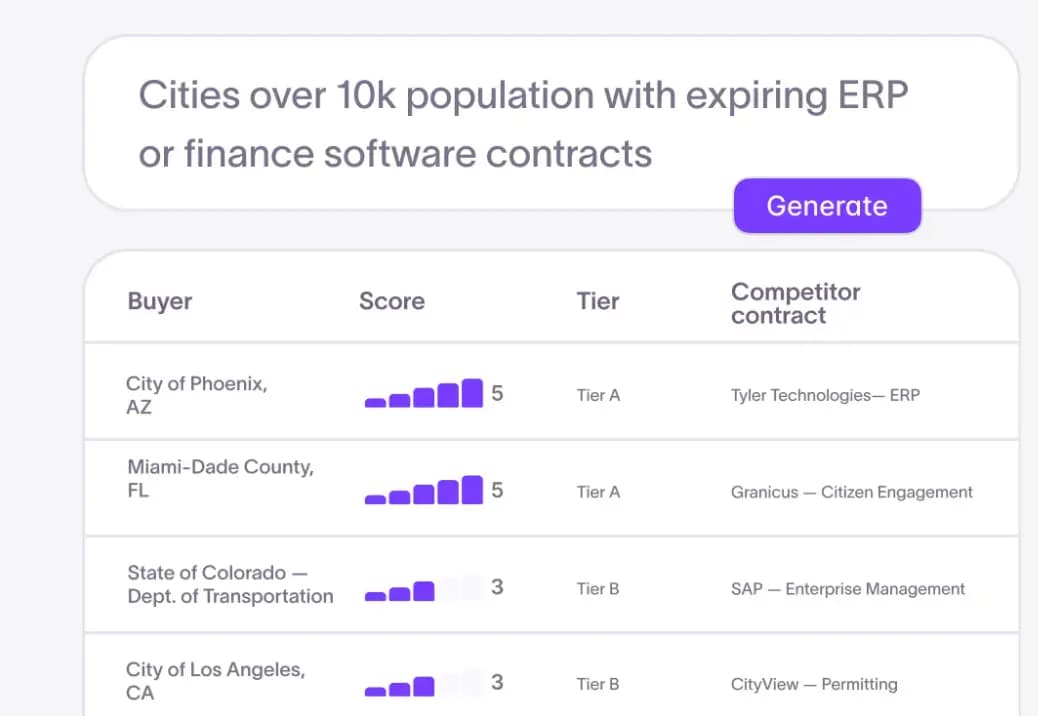
Starbridge’s Buying Signal Monitor tracks these early-phase buying signals across more than one million government and education entities to surface board meeting discussions, budget approvals, and grant awards. This makes it easy for vendors to engage during the phases that actually determine who wins.
Regulations and compliance requirements vendors must understand
K-12 procurement operates under three layers of regulation, and vendors need to understand all of them.
State procurement statutes define the rules for competitive bidding. Every state sets its own thresholds, processes, and exceptions. What qualifies as a sole-source purchase in Texas may require a full RFP in California. Vendors selling across multiple states need to track these differences or risk proposing deals that cannot move through procurement.
Local board policies add another layer. Individual districts set their own purchasing thresholds, approval workflows, and vendor requirements within the boundaries of state law. A $25,000 purchase might need board approval in one district and only require a department head’s signature in another.
Federal grant compliance governs purchases made with federal dollars. Title I, IDEA, E-Rate, and other federal programs come with specific procurement requirements. These include documentation, competitive bidding, and audit trails that go beyond what state or local rules require.
On the compliance side, districts increasingly require FERPA compliance for any product that touches student data. SOC 2 certification has become table stakes for technology purchases to ensure security. Many states have also adopted their own student data privacy frameworks that add requirements beyond FERPA. Vendors who do not have this documentation ready before engaging a district will stall at the IT review stage.
Districts also evaluate vendors on training, onboarding support, and implementation planning. A product that scores well on features but poorly on implementation readiness will lose to a competitor who demonstrates a clear plan to get teachers or staff using the tool within the first 90 days.
Who decides what gets purchased in a K-12 district
Districts distribute purchasing authority in K-12 across multiple stakeholders. Who controls the decision depends on the purchase type, dollar amount, funding source, and district size. A $5,000 classroom software purchase moves through a different path than a $500,000 district-wide platform implementation.
In nearly every K-12 deal, you will encounter three distinct buyer roles, each evaluating your product through a different lens.
| Buyer role | Typical titles (small district) | Typical titles (large district) | What they evaluate |
|---|---|---|---|
| End user | Teacher, librarian, counselor | Department head, curriculum specialist | Daily workflow fit, ease of use, student outcomes |
| Economic buyer | Superintendent, business manager | Assistant superintendent, CFO, director | ROI, budget alignment, strategic fit |
| IT buyer | Technology coordinator (often one person) | CIO, CISO, IT director | Security, FERPA compliance, integration, infrastructure |
IT is often a decision-maker in K-12, not merely an evaluator. If your product touches student data, IT holds veto authority regardless of how enthusiastic the end user or economic buyer may be. Prepare your FERPA documentation, SOC 2 report, and integration specs before your first meeting with a district technology team.
Who you contact first depends on your product category. An instructional tool typically undergoes vetting by the curriculum directors. A district-wide operations platform needs the superintendent’s approval. A cybersecurity solution starts with IT.
Getting this wrong does not just waste time. In a market of roughly 13,600 districts, reaching the wrong person with the wrong message damages your credibility with the entire buying committee.
The challenge is finding the right person in the first place. Sales reps spend hours hunting through district websites that are often outdated, poorly organized, or missing staff directories entirely. Generic databases scrape LinkedIn, which barely covers K-12 educators and administrators. The contact data that does exist goes stale fast as roles turn over.
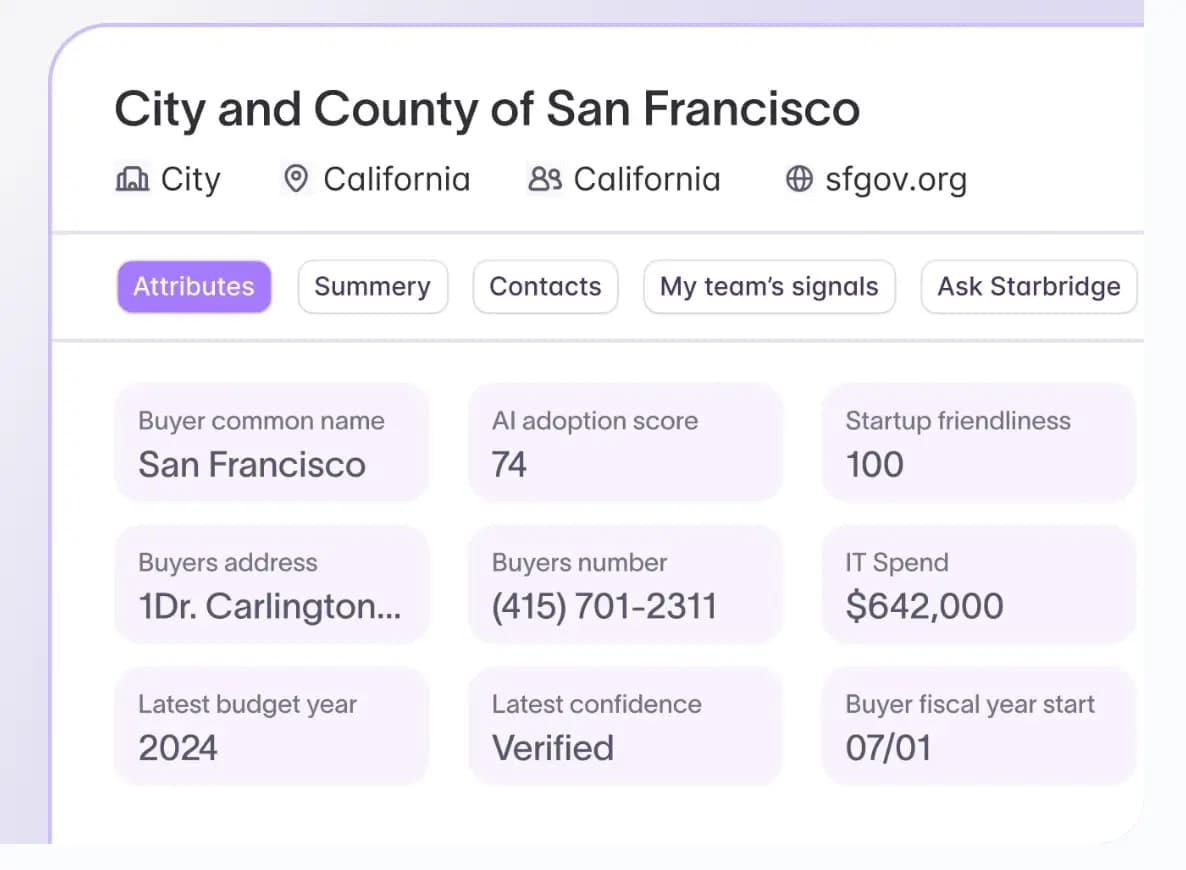
Starbridge’s Contacts & Company Data solves this with proprietary web-agent technology that crawls district websites directly to extract verified contacts. This feature delivers 98% email accuracy compared to the 15-25% bounce rates typical of general B2B data providers. Within days of onboarding, Storage Scholars built a fully enriched total addressable market (TAM) database and identified over 350 opportunities, replacing weeks of manual research with verified, outreach-ready contact data.
Budget cycles, funding sources, and when to engage
Budget cycles in K-12 create specific engagement windows that repeat every year. Vendors who understand the calendar build pipeline year-round. Vendors who ignore it wonder why deals stall for months.
The K-12 fiscal year and budget planning timeline
Most K-12 districts operate on a July-to-June fiscal year. Budget planning starts in January and February, when district administrators begin identifying priorities and estimating costs. Preliminary budgets take shape in March and April. Boards typically approve the final budget in May or June, just before the new fiscal year begins.
This timeline creates a clear engagement framework for vendors:
| Month | District activity | Vendor action |
|---|---|---|
| January-February | Needs assessment, priority setting | Share thought leadership, begin relationship building |
| March-April | Preliminary budget drafts, internal reviews | Present ROI data, request pilot conversations |
| May-June | Board budget approval, final allocations | Confirm funding, advance procurement discussions |
| July-August | New fiscal year begins, back-to-school prep | Execute contracts, begin implementation |
| September-November | Mid-year reviews, spending against budget | Check in on adoption, position for renewals |
| December | Year-end reviews, early planning for next cycle | Gather success data, plant seeds for expansion |
Vendors who start outreach after the June budget approval period are already behind. The districts have already committed their dollars, and the vendors who influenced that budget during the January-April planning window are the ones with purchase orders in hand.
Federal and state funding sources that create purchasing windows
K-12 districts draw from multiple funding streams, each with its own timeline and spending rules:
- Title I funds serve low-income students and are allocated annually. Districts typically know their Title I allocation by spring and must spend within the fiscal year.
- IDEA (Individuals with Disabilities Education Act) funds support special education. Spending follows federal fiscal year timelines and requires specific compliance documentation.
- Title III targets English language learners with annual allocations and defined spending categories.
- E-Rate provides discounts on telecommunications and internet access. The application window opens in fall, with funding decisions in spring.
- State grants vary widely. Some are annual, others are one-time competitive awards tied to specific initiatives like school safety or STEM expansion.
- Local bonds are voter-approved and often fund capital improvements, technology infrastructure, or large-scale purchases over multi-year timelines.
Elementary and Secondary School Emergency Relief (ESSER) funds have expired, but the pattern they created remains instructive. When large, one-time federal grants appear, districts spend quickly, often without established procurement relationships. The vendors who tracked those grant awards early captured an outsized share.
Each funding source creates its own buying signal. A grant award means new money with a spending deadline. A budget line item means the district has already committed to a category. These buying signals are the earliest indicators of purchase intent, surfacing months before any RFP appears.
Monitoring these manually across thousands of districts is not scalable. Starbridge built its Buying Signal Monitor to solve exactly this problem, enabling vendors to track grant awards, budget releases, and funding approvals automatically across the K-12 market. Kaizen Labs saw a 10-20% lift in monthly quota attainment after shifting to a signal-driven approach that caught these funding windows early. Similarly, Hapara’s sales team used meeting intelligence to time outreach around district planning conversations, driving 20% higher response rates by reaching administrators when the topic was already on their agenda.
How vendors navigate RFPs, cooperative contracts, and sole-source purchases
K-12 districts use multiple procurement paths, and successful vendors understand them all. Knowing which path fits a specific deal can be the difference between a six-week close and a six-month RFP process.
RFPs are triggered when a purchase exceeds the district’s sole-source threshold, which ranges from $2,000 to $50,000 or more, depending on the state and district. An RFP asks vendors to propose a solution. A Request for Quote (RFQ) requests pricing for a defined scope. An Invitation for Bid (IFB) is the most rigid format, awarding to the lowest responsive bidder. Understanding which format a district uses helps you position your response.
Most K-12 RFPs are scattered across outdated district portals, state procurement websites, and third-party bid boards. Finding them manually means checking dozens of sources daily and still missing opportunities.
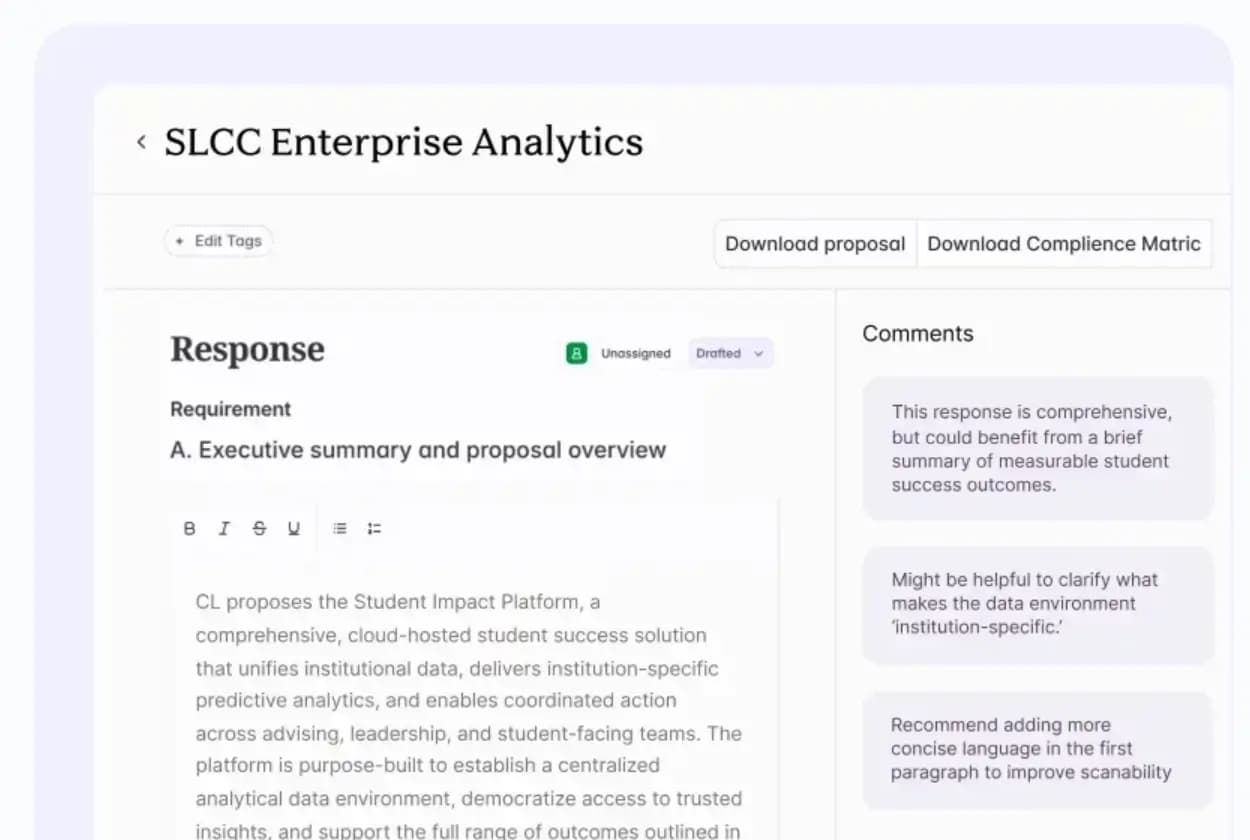
Starbridge’s AI RFP Finder & Proposal Writer aggregates K-12 RFPs into a single feed and uses AI to draft response sections, so teams spend less time searching and more time writing winning proposals. After adopting automated RFP discovery, the HousingCloud team increased its discovery rate by 30% and saved 8-10 hours per RFP.
One critical nuance here is that many K-12 RFPs are written with a specific vendor in mind. The district consulted that vendor during the needs identification phase, and the evaluation criteria reflect that vendor’s strengths. If you are seeing an RFP for the first time when it is published, there is a good chance a competitor shaped the requirements. The best practice is to focus your RFP effort on solicitations that originated from your own pre-RFP conversations.
Cooperative purchasing agreements offer a faster path. Vehicles like Sourcewell, TIPS, OMNIA Partners, E&I Cooperative Services, and NASPO ValuePoint allow districts to purchase through pre-negotiated master contracts without running their own RFP. For vendors, this means a district that wants your product can buy it through an existing cooperative agreement, cutting months off the procurement timeline.
Over 70% of large districts use at least one cooperative or reseller contract to simplify purchasing. Cooperative contracts work as an objection handler. When a champion says, “procurement wants an RFP,” you can respond, “we are on Sourcewell, which satisfies your competitive bidding requirement.”
Getting started with cooperative contracts does not require a massive channel strategy. Reverse-engineer how your current customers purchased. You will likely hear the same one or two cooperatives and one or two resellers repeatedly. Start there. Pick one or two cooperative vehicles relevant to your market and establish one reseller relationship with a firm like Carahsoft, CDW-G, or SHI. Resellers typically take a 3-12% margin and handle the procurement paperwork.
Starbridge’s Public Spend Intelligence surfaces which districts use which cooperative vehicles and resellers, so you can match your channel strategy to how your target accounts actually buy.
Sole-source purchases happen below the competitive bidding threshold. If a district can buy your product without triggering an RFP requirement, the deal closes in weeks rather than months. Thresholds vary by state and district, so ask about the sole-source threshold early in every conversation. If your initial deal can be structured below that line, you bypass the competitive process entirely. This is one of the most underused levers in K-12 sales: pricing as a procurement decision, not just a budget decision.
How to get ahead of K-12 procurement before it starts
The highest-value window in K-12 sales is six to 18 months before a formal solicitation. During this period, districts are identifying needs, allocating budgets, and forming opinions about potential solutions. The vendor who shows up during this window builds the relationship, earns trust, and shapes the criteria. The vendor who shows up after the RFP drops is playing catch-up.
Pre-RFP buying signals that reveal district intent
Buying signals are early indicators that a district is planning to spend. In K-12, many of these buying signals are public record, published in documents that anyone can access but few vendors systematically monitor.
The strongest buying signals, ordered by how early they appear in the procurement cycle:
- Board meeting discussions where a problem or initiative is raised publicly for the first time
- Budget line items that allocate funding to a specific category or project
- Grant awards that create new money with a defined spending deadline
- Leadership changes that shift priorities and open doors for new vendors
- Strategic plan language naming a capability or initiative that the district wants to pursue
- Contract expirations that legally require the district to evaluate alternatives
- Bids and RFPs that signal the district is already deep in the procurement process
The challenge is not that these buying signals are hidden. The challenge is scale. Monitoring board minutes, budget documents, and grant databases across thousands of districts manually is not feasible for any sales team.
Starbridge’s Buying Signal Monitor tracks buying signals across the most comprehensive dataset of public-sector buyers and buying signals, covering more than one million government and education entities. Every signal is delivered with a verified contact, the reason it matters, and AI-generated outreach copy so reps can act the same day. GovWell’s revenue team booked five meetings in their first week using pre-RFP buying signals and now attributes 15% of their total qualified pipeline to signal-driven outbound.
Finding and verifying decision-maker contacts at scale
As previously discussed, finding the right K-12 contact data is notoriously difficult. In a market of roughly 13,600 districts, every bad email takes time and energy. You cannot afford to burn through your addressable market with unreliable data.
Starbridge’s Contacts & Company Data uses proprietary web-agent technology to crawl district websites directly, extracting and verifying contacts from the source. The result is 98% email accuracy with a 2% bounce rate. Bi-directional CRM integrations with Salesforce and HubSpot automatically sync, clean, and enrich contact records, keeping your database current without manual effort.
Frontline Education cut account research time by 90% after replacing manual contact hunting with Starbridge’s verified data. This freed reps to spend time on conversations instead of working on spreadsheets.
Researching accounts and competitive intelligence without burning reps
Before reaching out, reps need context to have a successful conversation. These include:
- What has this district spent on similar products?
- Who is the incumbent?
- What did the board discuss last quarter?
- When does the current contract expire?
Answering these questions manually can take hours per account, pulling reps away from the outreach and conversations that actually generate pipeline.
Starbridge’s Public Spend Intelligence automates this research by surfacing purchase order data, competitor contracts with pricing and expiration dates, and procurement vehicle preferences across the K-12 market. Instead of filing FOIA requests and waiting weeks for a response, reps get the competitive intelligence they need in seconds.
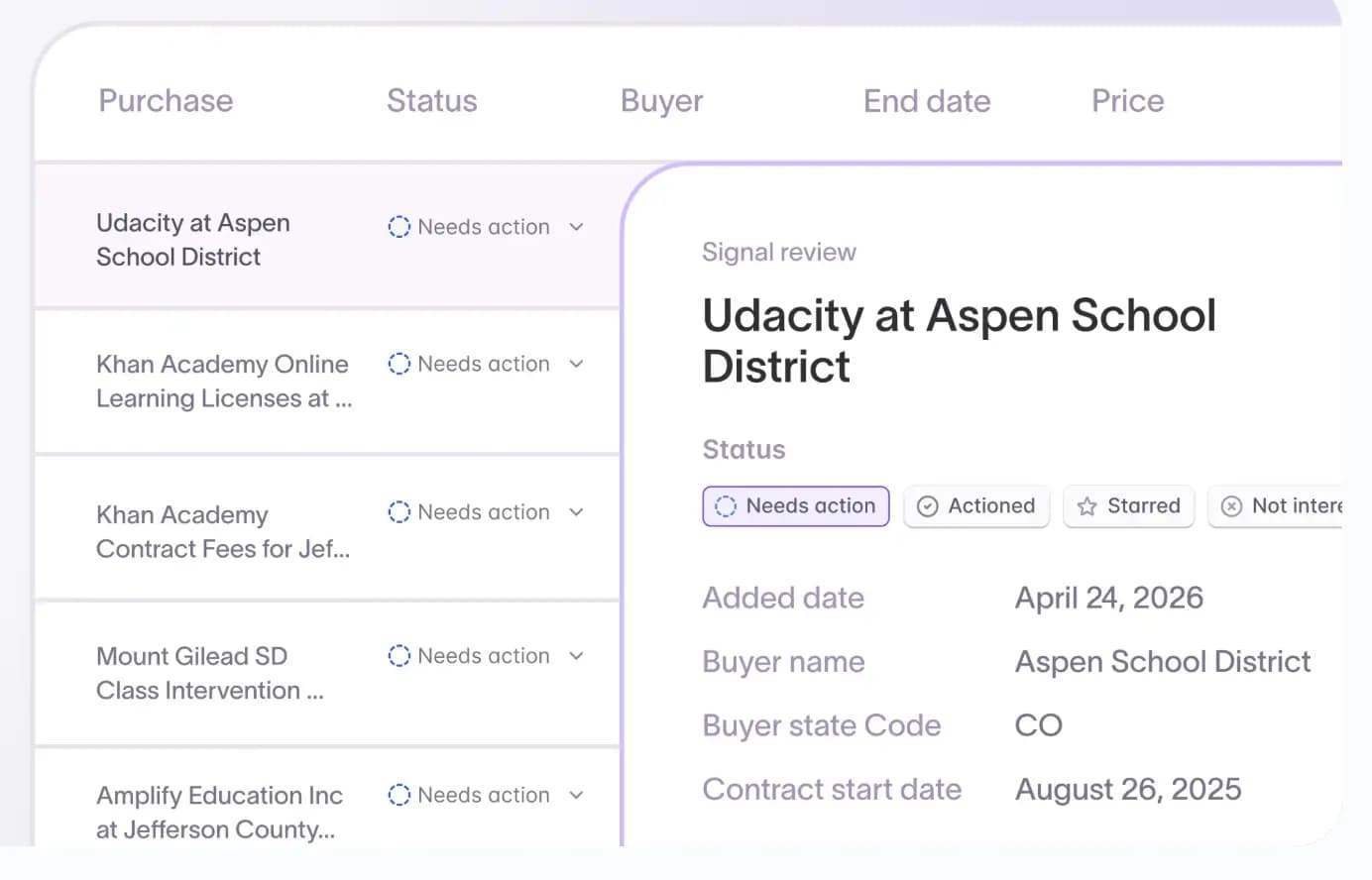
In their first quarter with Starbridge, the InquirED team generated $200,000 in new pipeline. Rather than spending hours on manual board-document research, the team automated account-intelligence tasks to identify which districts were actively ready to buy.
The vendors who read procurement first win procurement first
The difference between vendors who build a consistent K-12 pipeline and those who struggle is not access to information. The information is public. The difference is the ability to turn that information into prioritized accounts, verified contacts, and timely outreach at scale.
Starbridge is the AI sales intelligence platform built for companies selling to state and local government, K-12, and higher education. Book a demo to see how your team can act on K-12 procurement intelligence before the competition.
Frequently asked questions
The timeline depends on the procurement path. Sole-source purchases below the competitive dollar threshold can close in two to four weeks. RFP-driven purchases typically take two to six months from solicitation to contract award. Purchases funded by federal grants may take longer due to additional compliance requirements.
A Request for Proposal (RFP) asks vendors to propose a solution and is scored on multiple factors, including features, experience, and price. A Request for Quote (RFQ) requests pricing for a defined scope of work. An Invitation for Bid (IFB) is the most rigid, awarding the contract to the lowest responsive bidder that meets all requirements.
Yes, and the best vendors do. Districts are not experts in every solution they buy, so they consult vendors early to understand what is possible. Pre-RFP engagement through conferences, informational meetings, and thought leadership is standard practice. The key is to provide value and education without pushing a hard sell.
Cooperative purchasing agreements are pre-negotiated contracts that multiple districts can use to buy without running their own RFP. Vehicles like Sourcewell, TIPS, and OMNIA Partners satisfy competitive bidding requirements. For vendors, holding a cooperative contract means districts can purchase your product faster and with less procurement friction.
Explore our use case library
 Automate account research with AI agentsStop manually researching accounts. Starbridge AI agents automate account research by monitoring buying signals 24/7 and surfacing the right contacts.
 Identify competitor contract expiration datesThe RFP is usually a formality. Starbridge surfaces competitor contract expiration dates so your reps reach accounts before the renewal cycle closes.
 Create a conference campaignTurn conference badge scans into pipeline. Import your contact list, surface buying signals across every account you met, and follow up with context.