
How to find and win local government contract opportunities
Discover how to find local government contracts before competitors by tracking buying signals, identifying decision-makers, and prioritizing opportunities.

Local government contract opportunities have no central home. They’re fragmented across thousands of jurisdictions, inconsistently published, and easy to miss until it’s too late.
But the process of finding them has evolved well beyond manually checking bid boards and procurement portals. Winning teams combine traditional discovery channels with early buying signals, verified contacts, and account-level context to engage before the competition shows up.
This guide walks through five steps to find and pursue local government contract opportunities, from registering on the right platforms to turning intelligence into pipeline.
1. Register on procurement portals and set up automated alerts
The public sector procurement ecosystem is extensive. State and local contracts appear on a broad range of state-specific e-purchasing systems and third-party bid aggregation platforms. Third-party bid aggregation platforms attempt to pull these together, but no single source covers every municipality, county, and school district. Your first move should be to register on every portal relevant to your target market and product category.
Once registered, configure saved searches and email alerts. Use keyword filters, set-aside status, and geographic region to get automatic delivery of relevant solicitations. The more specific your filters, the less noise your team has to sort through.
Small businesses should check for set-aside programs at both the state and local level. Many state and local governments and school districts reserve a percentage of contracts for businesses that qualify under one or more of the following designations:
- Small business
- Minority-owned business
- Veteran-owned or service-disabled veteran-owned business
- Women-owned business
These programs reduce competition on eligible bids and can be a strong entry point for companies new to government sales.
Cooperative contract vehicles offer another path. Vehicles like NASPO ValuePoint, Texas DIR, and New York OGS let buyers skip competitive solicitation entirely. Having a reseller relationship with Value-Added Reseller (VAR) firms like Carahsoft or CDW, and being specific about which vehicle fits, dramatically smooths the conversation with buyers. Reps should ask about cooperative vehicles early in every engagement.
| Portal type | Examples | Coverage | Primary limitation |
|---|---|---|---|
| State e-procurement | BidExpress, state purchasing portals | State-specific bids and contracts | Each state has its own system, so there is no single view |
| Aggregation platforms | GovWin and others | Multi-state bid aggregation | Opportunities often surface late |
| Cooperative vehicles | NASPO ValuePoint, Texas DIR, New York OGS | Pre-negotiated contracts across multiple states | Requires reseller relationship to access |
These resources will keep you informed, but portals publish opportunities after the procurement process has already begun. The remaining steps in this guide cover the strategies that top-performing teams layer on top of portal monitoring to find and engage opportunities earlier.
2. Identify buying signals before RFPs are published
Government and education buyers are rarely experts in every solution they procure. They consult vendors early to learn what’s possible, and the vendor who educates the buyer ends up influencing the requirements. By the time an RFP is published, a competitor has often already shaped the evaluation criteria. Responding to a posted RFP puts sellers in a reactive position against someone who has been in the account for months.
There are a number of buying indicators that reveal intent weeks or months before solicitations, including:
- Board meeting discussions
- Contract expirations
- Grant awards
- Budget allocations
- Leadership changes
- Strategic plan language
- Bids
A school board discussing chronic absenteeism in a public meeting, a city receiving a federal cybersecurity grant, or a county’s fleet management contract expiring in six months are all actionable entry points.
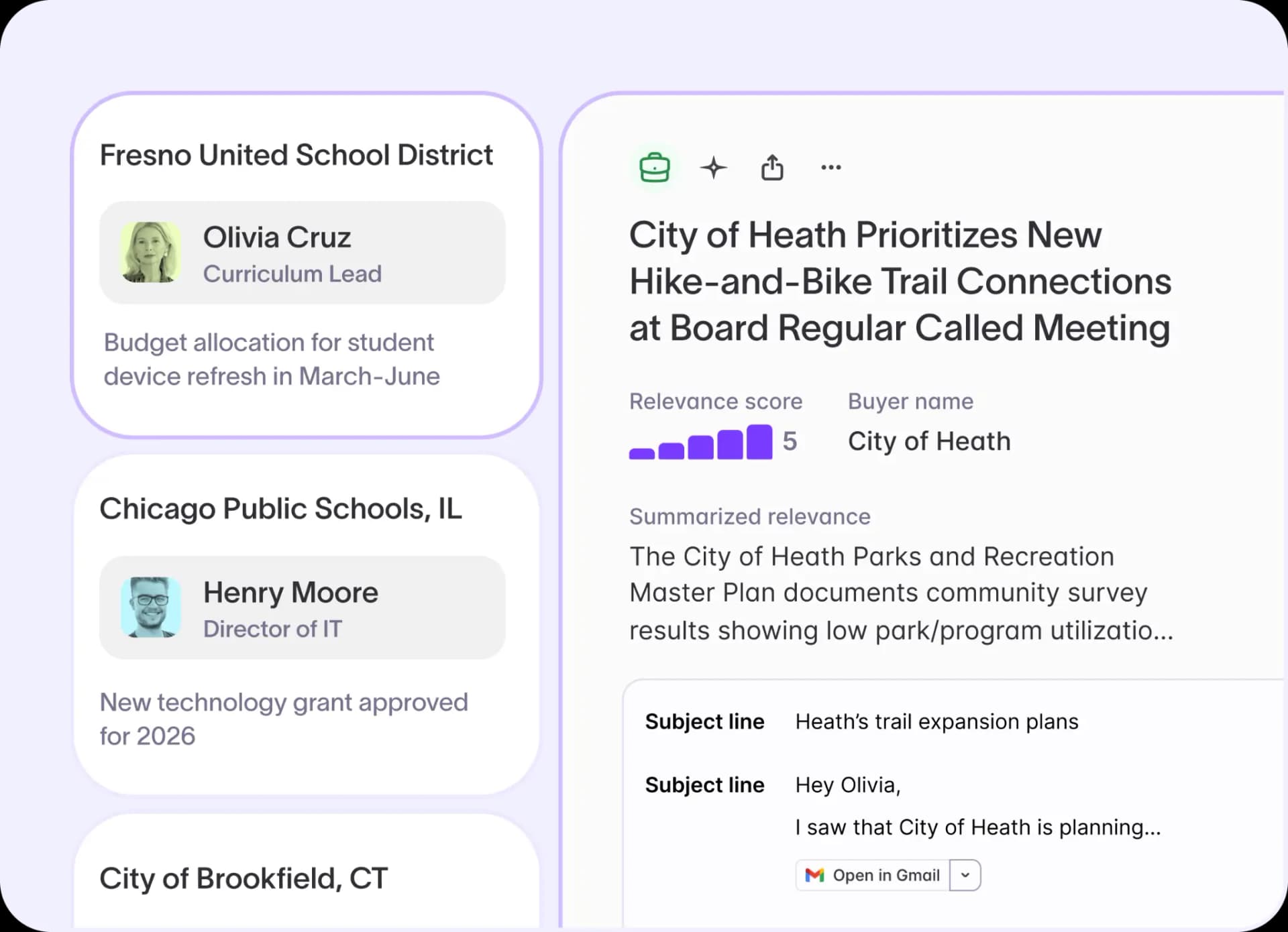
The challenge is that tracking these indicators manually does not scale. Scouring district websites, reading board meeting PDFs, and monitoring news across hundreds of thousands of entities can eat hours per account. For most teams, the research burden means opportunities surface too late or never surface at all.
Starbridge, an AI sales intelligence platform built exclusively for companies selling to state and local government, K–12, and higher education, solves this problem. Its Buying Signal Monitor tracks over 320k public sector entities around the clock, surfacing buying indicators from meetings, contract expirations, grants, budgets, procurement rules, contact data, and bids.
Teams get real-time alerts on high-intent activity, with priority accounts routed directly to the right reps. The platform also captures buyer intent directly from meeting transcripts, processing formats that general-purpose AI tools cannot scrape. Meeting intelligence is one of the strongest indicators because it reflects stated buyer intent, not inferred activity.
Response rates jumped 20% for Hapara after the team used Starbridge’s meeting intelligence to identify districts actively discussing competitor solutions, replacing generic outreach with campaigns grounded in actual buyer conversations.
Monitoring buying indicators systematically shifts contract discovery from a reactive exercise to a structured, repeatable process. Teams that track pre-RFP activity at scale consistently reach decision-makers during the window when requirements are still being defined.
3. Get verified contact data for government and education decision-makers
Finding a local government contract opportunity is only useful if you can reach the right person. Government and education decision-makers are structurally different from commercial buyers: sparse LinkedIn coverage, wildly varying titles across jurisdictions, and frequent role changes tied to elections, retirements, and reorganizations.
Generic B2B databases were built for commercial sales. They scrape LinkedIn and commercial sources, which barely cover government and education roles. The result is stale contacts, missing decision-makers, and zero visibility into buying indicators or procurement context. When reps send outreach to someone who left the role two years ago, it wastes time, lowers deliverability scores, and reduces sequence performance.
Starbridge’s Contacts & Company Data tool was built specifically for this market. The platform uses proprietary web-agent technology to continuously crawl government sites, school district portals, and university websites. The result is 98% email delivery success, validated across a 14,000-email test, with continuous bounce-checking to keep data current. Meanwhile, generic B2B data providers see bounce rates of 15-25%.
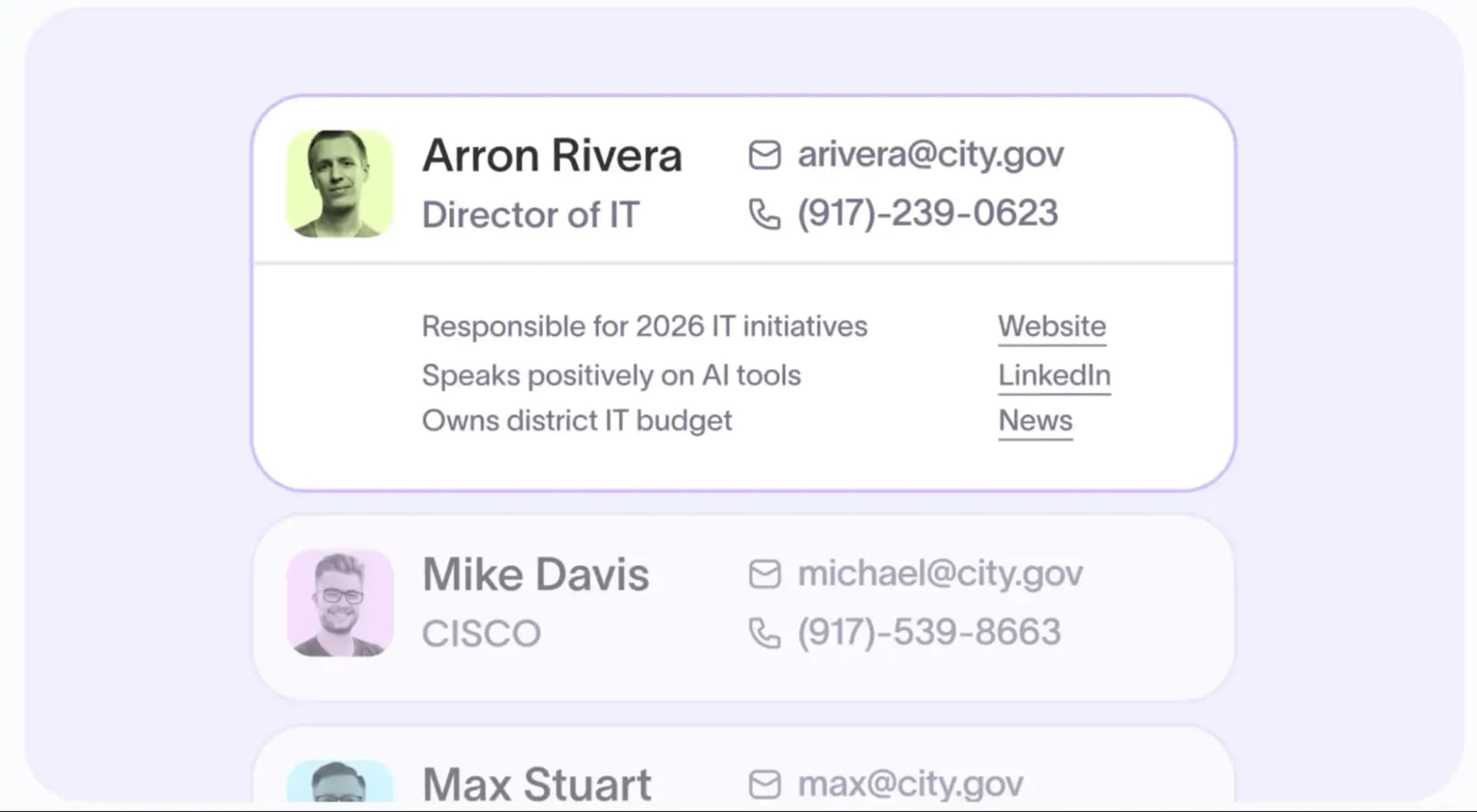
Accurate contacts eliminate wasted rep time, protect sender reputation, and enable campaigns without manual verification loops. Storage Scholars replaced thousands of hours of SDR research time with a fully enriched TAM database, just days after setting up Starbridge.
In a market where LinkedIn barely covers the buyer base and roles turn over with elections and retirements, contact accuracy is not a nice-to-have. It is the prerequisite for every outbound motion that follows.
4. Score and prioritize opportunities worth pursuing
With thousands of entities in your total addressable market, finding contracts is only the first challenge. Winning teams score and rank accounts by buying-readiness indicators, not just firmographic data like population or enrollment.
Build a scoring model around 5-7 attributes per account. The most predictive indicators sit closer to buying readiness:
- Competitor contract expirations (an expiring contract forces an evaluation)
- Competitor presence (displacement outreach beats a cold intro)
- Budget trends (increasing line items signal investment; flat or shrinking means wait)
- Grant awards (new money with a spending deadline)
- Leadership changes (new leaders bring new priorities and vendor reviews)
- Procurement readiness (sole-source thresholds, cooperative vehicle availability)
- Job postings (hiring signals capacity building for new initiatives)
Incumbent vendor analysis and public spend data help assess win probability. Knowing the current vendor, contract expiration date, spend amount, and any documented dissatisfaction turns a generic pitch into a precision play.
Starbridge’s AI RFP Finder & Proposal Writer centralizes thousands of bid portals into one personalized feed, scores RFPs by product fit and win likelihood, and drafts proposals using your product knowledge base. With access to 100+ buying indicators spanning spend, leadership, contracts, and procurement activity, the platform enables teams to define scoring criteria in plain language and generate scores that update as new indicators arrive. All of this syncs natively into your CRM, so reps act on prioritized accounts without switching tools.
Within its first quarter on Starbridge, InquirED uncovered $200K in new pipeline by replacing manual research with signal-driven account scoring. The team caught a district forming a teacher evaluation committee, reached out before the evaluation rubric was written, and helped design the rubric itself.
Scoring shifts territory planning from a static exercise done once a quarter to a dynamic process that updates as new buying indicators arrive. The result is a prioritized account list that reflects current purchasing activity, not last year’s enrollment numbers.
5. Push intelligence into your CRM and outreach workflow
Isolated intelligence never reaches the rep at the right moment. Starbridge integrates natively with Salesforce and HubSpot through bi-directional integration to sync, clean, and enrich your CRM without manual imports.
The end-to-end workflow collapses hours of research into minutes: a buying signal fires, a prioritized alert surfaces with full account context, a verified contact is attached, and AI-generated outreach is ready to send.
This compounds over time. Buying indicators, contacts, spend data, and engagement history accumulate in your CRM, building a living territory map. Teams can scale from one state to national coverage without proportionally growing headcount.
The highest-performing outbound plays in this workflow include:
- Targeted lists segmented by account characteristics and scoring tier
- Meeting discussion references that prove you did your homework
- Strategic plan language that mirrors the buyer’s own priorities
- Nearby account wins that give risk-averse buyers peer validation
- Job changes at target accounts that open new conversations
- Conference attendance lists enriched with verified contacts
Government and education buyers are risk-averse and look to peers before making decisions. Close one account and every similar nearby account becomes dramatically more likely to buy. Lead with the reference every time.
RFP response time dropped by 8-10 hours for HousingCloud after the team started drafting submissions from their product knowledge base inside Starbridge.
When buying indicators, verified contacts, and account context live inside the CRM rather than a separate dashboard, outreach becomes a byproduct of the system itself. Teams that get this right can scale government pipeline in a way that manual processes simply don’t allow.
From contract discovery to a consistent government and education pipeline
Winning local government contracts consistently requires the right discovery channels, buying signal intelligence, verified contacts, and account context working together. Teams that engage earlier close more deals with less competition.
Evaluate where your process breaks down. Is it discovery? Timing? Contacts? Prioritization? If your team sells to state and local government, K–12, and higher education and spends more time on research than conversations, that gap is costing you pipeline every week.
Starbridge helps companies selling to local government, K–12, and higher education identify opportunities before the competition. Book a demo to see how signal-driven pipeline works in practice.
Frequently asked questions
There is no single best website because local government contracts are spread across thousands of portals. State-specific e-procurement systems and aggregation platforms cover state and local bids most broadly. The most effective approach combines portal monitoring with early buying indicators that surface opportunities before they become formal solicitations.
Start by registering on state and local procurement portals relevant to your target geography. Explore set-aside programs for small, minority-owned, veteran-owned, and women-owned businesses. Cooperative purchasing vehicles like NASPO ValuePoint can also simplify the process by letting buyers purchase without a full RFP.
A buying signal is an early indicator that a state or local government agency, school district, or university is planning to spend. Examples include board meeting discussions about a specific need, budget line items for a new initiative, grant awards with spending deadlines, contract expirations with incumbent vendors, and leadership changes tied to purchasing authority. These indicators surface months before an RFP ever appears.
B2G sales cycles typically range from 2 to 18 months after the economic buyer says yes, depending on deal size, procurement path, and the specific entity. Smaller purchases below sole-source thresholds can close in weeks. Deals requiring a formal RFP take significantly longer, which is why engaging before the RFP is written gives teams the biggest timing advantage.
An RFP (Request for Proposal) evaluates vendors on multiple criteria including technical fit, experience, and pricing. An RFI (Request for Information) is a pre-solicitation tool buyers use to learn about available solutions before defining requirements. An ITB (Invitation to Bid) awards strictly on lowest price and is most common for commodities, not software or professional services.
Explore our use case library
 Automate account research with AI agentsStop manually researching accounts. Starbridge AI agents automate account research by monitoring buying signals 24/7 and surfacing the right contacts.
 Identify competitor contract expiration datesThe RFP is usually a formality. Starbridge surfaces competitor contract expiration dates so your reps reach accounts before the renewal cycle closes.
 Create a conference campaignTurn conference badge scans into pipeline. Import your contact list, surface buying signals across every account you met, and follow up with context.