
A tactical playbook for B2G lead generation in 2026
A tactical guide to B2G lead generation, covering how to identify high-intent leads, reach the right buyers, and turn public-sector signals into pipeline.

Most B2G lead generation advice sounds like it was written a decade ago. Watch bid boards. Show up at conferences. Build relationships.
That’s table stakes, not a strategy.
The teams pulling ahead aren’t generating more leads. They’re detecting buying activity earlier and reaching verified decision-makers before competitors know an opportunity exists.
The core challenge hasn’t changed though. Buying information from school boards, city councils, and state agencies is scattered across outdated directories, agency websites, and PDFs. AI-powered platforms can now turn that mess into an unfair advantage.
This article will help revenue teams sell to federal, state, and local governments, K–12 school districts, and higher education institutions. It covers how to redefine what a B2G lead actually is. How to score and prioritize accounts. How to detect early buying signals, like a new grant award or a contract about to expire. And how to run the workflows that turn all of it into booked meetings.
What a qualified B2G lead actually looks like
In most B2B sales, a “lead” is a form fill, a hand-raise, or a contact that matches an ICP filter. In B2G lead generation, that definition produces noise and ill-timed outreach.
A qualified B2G lead in 2026 requires three components working together:
| Component | What It Means | Example |
|---|---|---|
| Account-level buying signal | Something has changed at the account that indicates movement toward a purchase | A school board discussing “modernizing student information systems” or a city council reviewing cybersecurity posture |
| Verified contact | A specific person in the right role, with a confirmed email, sourced from official records | A district CTO identified through the district’s own website, not scraped from a three-year-old LinkedIn profile |
| Outreach context | A concrete, timely reason to reach out that connects your solution to the buyer’s current situation | Referencing a grant award, a board discussion, or a nearby customer win |
This reframing shifts the team’s focus from lead volume to lead quality. Fifty signal-backed opportunities with verified contacts will outperform 500 names from a purchased list every time.
How to build and score your target account list
Before chasing early demand signals or running sequences, teams need a ranked list of every account in their total addressable market. Most B2G teams skip this step or barely scratch the surface.
Defining your total addressable market
The government and education TAM is finite and knowable. There are 13,598 school districts in the U.S. and 128,966 K–12 schools, including 99,239 public schools and 29,727 private schools. Add thousands of higher-ed institutions and tens of thousands of cities, counties, and state agencies.
The question isn’t “who might buy” but “who is most likely to buy now.”
Start by categorizing your full addressable market by segment: K-12 districts, higher education institutions, and state and local government agencies. Then layer in the attributes that actually matter for each, like district size, institution type, agency budget, departmental structure, and existing vendor usage.
Begin with accounts most similar to your existing customers. Government and education buyers look to peers before making decisions.
Scoring accounts by buying likelihood
Most B2G teams score accounts using enrollment, population served, or operating budget. These metrics feel intuitive, but they don’t predict whether an account is ready to buy.
A large district isn’t necessarily an active buyer. A city with a big operating budget might be bleeding money and freezing new projects. Operating budgets are calculated differently everywhere.
Account scoring that actually drives pipeline focuses on indicators closer to buying readiness.
- Competitor contract expirations. An expiring contract forces the account to renew or evaluate alternatives. That creates a natural window for outreach.
- Competitor presence. Accounts running a competitor already have a use case for your category. Displacement outreach beats a cold intro every time.
- Budget trends. Track the direction of spend, not a single snapshot. An increasing line item signals investment. A flat or shrinking one tells you to wait. Starbridge publishes free budget trends reports for cities, counties, school districts, and higher ed that show which accounts are increasing investment right now.
- Leadership and personnel changes. New leaders bring new priorities. Vendor relationships that were locked often reset overnight.
- Procurement readiness. Sole-source thresholds, cooperative contracts, and reseller relationships matter. They determine how fast an account can move from interest to purchase order. Starbridge’s vendor procurement guides for cities, K-12 districts, and higher ed break down how each segment buys.
Starbridge is the AI GTM platform that automates this across your full addressable market. It aggregates buying-readiness indicators into a single scored view so sales leaders can plan territories around accounts that are actually heating up.
Scores sync directly to Salesforce or HubSpot through Starbridge’s bi-directional CRM integration. Every rep gets a prioritized book of business grounded in real activity rather than static firmographic data.
The early buying signals that create a pre-RFP lead pipeline
By the time an RFP drops, a competitor has already been in the room. They helped shape the spec. The teams winning B2G deals are engaging 6–18 months before procurement begins by monitoring buying signals in the public record.
Here’s each buying signal type, what it reveals, and what it means for outreach:
- Board meeting discussions and agendas. A school board discussing “modernizing student information systems” or a city council reviewing cybersecurity posture. Active problem recognition, months before procurement.
- Budget approvals and line items. New allocations or increases in specific categories reveal where the money is going next fiscal year.
- Grant awards and federal or state funding. Grants create both budget and urgency. The money has an expiration date, and the recipient needs to spend it.
- Contract expirations and renewals. A contract expiring in 12 months is one of the strongest timing signals. The account must renew or evaluate alternatives.
- Leadership and personnel changes. A new superintendent, CTO, or city manager brings new priorities and a mandate to reevaluate vendors.
- Strategic plans and committee activity. Published strategic plans reveal multi-year priorities before they translate into procurement.
Not all signals warrant the same outreach. A board discussion about a pain point calls for education. A contract expiring in six months calls for a direct pitch.
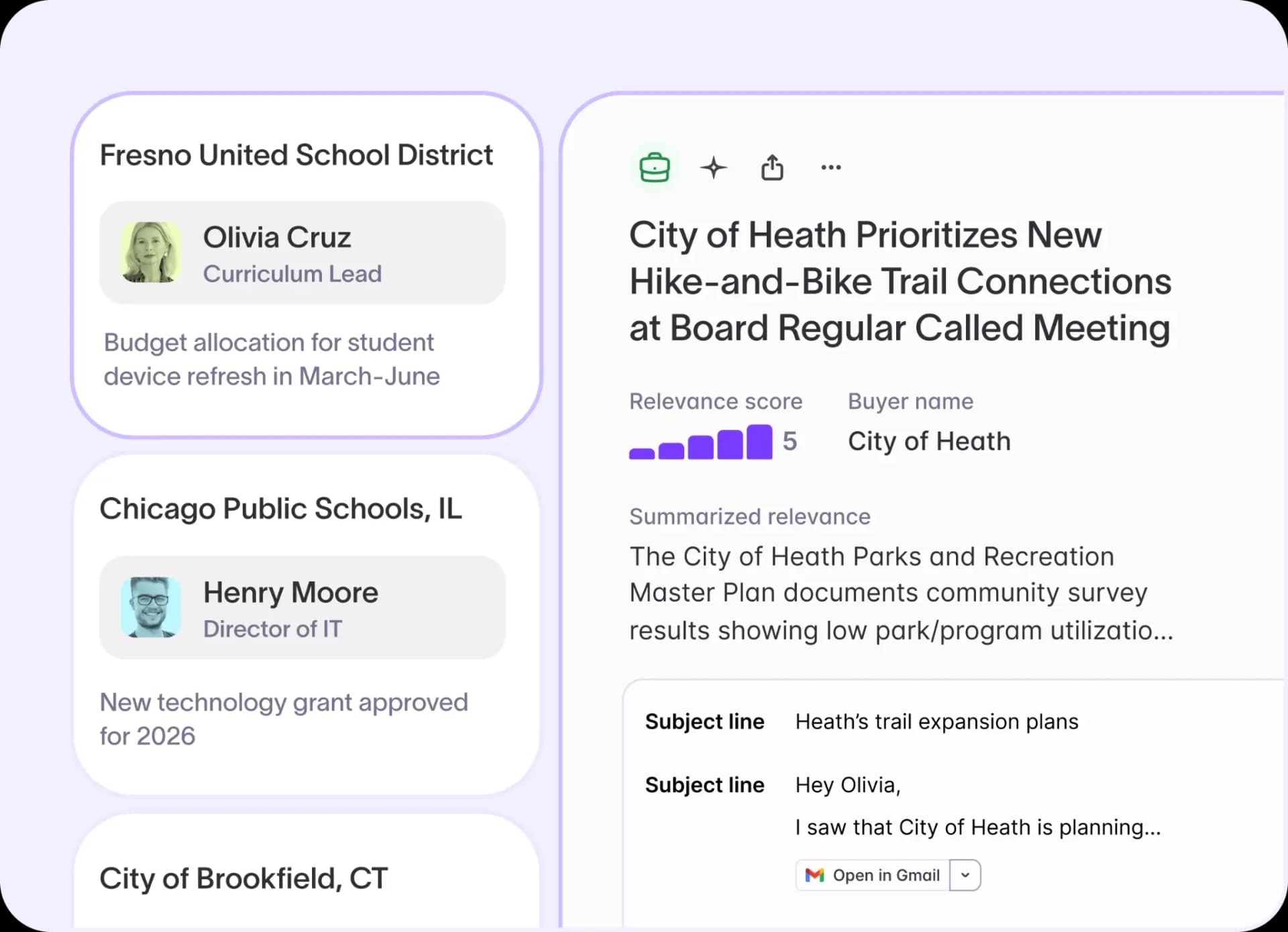
Starbridge lets teams act on these signals before competitors see them. Its Buying Signal Monitor tracks hundreds of thousands of local and state agencies and schools in real time for meeting discussions, contract expirations, grants, budgets, procurement rules, contact data, and bids. Pre-RFP indicators across all 50 states get surfaced in one platform.
Finding and reaching the right decision-makers
Even when teams identify the right account at the right time, B2G lead generation still fails if they can’t reach the right person with a valid email address. This is the single biggest day-to-day bottleneck for SDRs and AEs selling to government and education.
Generic contact databases like ZoomInfo weren’t built for this market. Government and education roles barely exist on LinkedIn. Elections and leadership transitions make whatever data does exist go stale fast.
On top of that, every B2G deal involves three buyer roles. Your value prop needs to land differently with each one:
| Buyer Role | What They Evaluate | Messaging Focus |
|---|---|---|
| End user | Functionality, workflow fit, daily usability | How the product improves their daily work |
| Economic buyer | ROI at the organizational level: outcomes for constituents/students, time savings, cost reduction | Broader organizational impact and strategic value |
| IT/Security stakeholder | Security posture, compliance, technical integration | Security certifications, architecture, integration requirements |
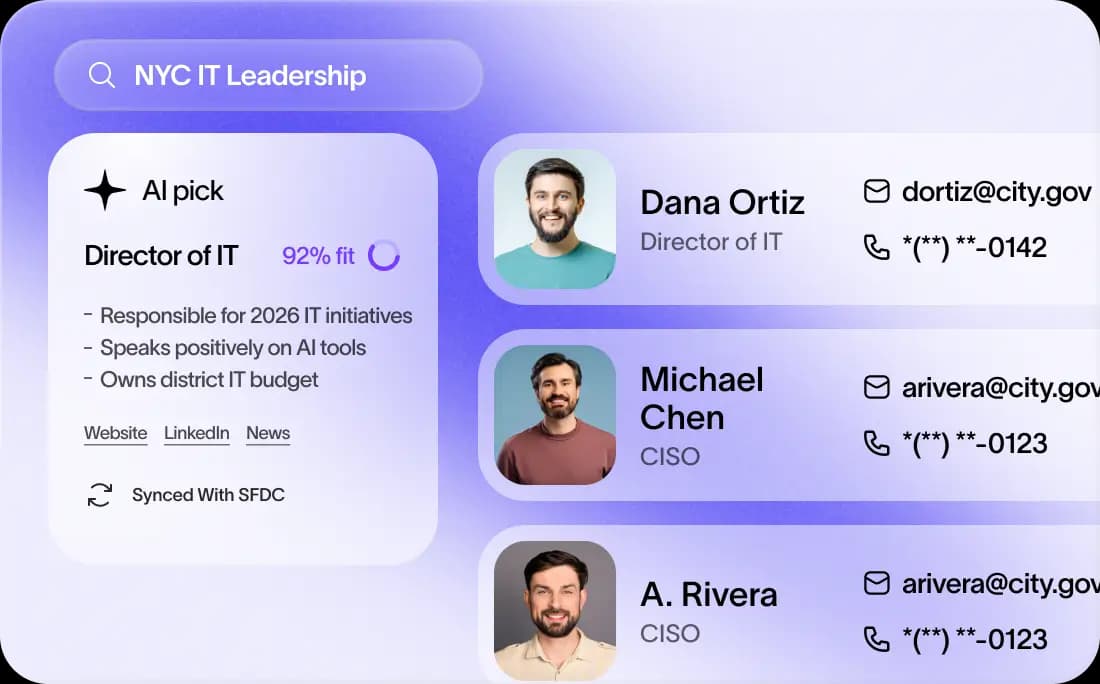
Starbridge solves the contact problem at the source. Its proprietary AI web agents crawl official agency and district sites to extract verified contacts by department and program area. The result is a 2% bounce rate, validated across a 14,000-email test. User-reported bounce rates for tools like ZoomInfo run from 15 to 25%.
The B2G outbound execution workflow
Some B2G teams are booking 2–2.5x more meetings with repeatable workflows that convert every demand signal into an outbound action inside the tools their reps already use. Three channels can help drive a lot of the B2G pipeline.
Reference-led outbound and warm introductions
Government and education buyers are herd-driven. A nearby win carries more weight than any feature pitch.
After each closed deal, identify the most similar nearby accounts and lead with the reference. “We just partnered with the City of Sacramento” lands harder with a prospect in Northern California than a list of capabilities ever will.
Build this into a repeatable motion. Every time you close a deal, pull a list of similar accounts in the same region. Same segment, same size, same pain. Run outbound with the new customer win as the hook.
Warm intros are even more effective, but they’re rare. When you do get one, make it count. A referral from someone actually using the product beats one from an advisor or board member every time. Because the buyer will inevitably ask, “Why aren’t you using it yourself?”
Conferences as a pipeline channel
Conferences aren’t brand-building exercises. In government and education, they’re the one place where buyers are accessible in ways they never are via email or phone.
Start selectively. Pick events where your actual economic buyers attend, not general industry conferences.
For lean teams, suitcasing works. Skip the booth. Buy a ticket. Work the floor. Walk up to buyers at other booths or in hallways. It requires being more aggressive than feels comfortable. The access to decision-makers makes it worth it.
The highest-converting conference play is account-based personalized handouts. Enrich a conference attendee list in advance, then create one-pagers tailored to each account. Reference a nearby customer win, pull a line from the account’s strategic plan, and include their logo. Buyers immediately see you’ve done the homework.
Starbridge’s Conference Intelligence helps teams find the right events, enrich attendee lists with verified contacts and ICP scores, and sync that data directly into their CRM before the event starts. Reps show up prepared instead of prospecting blind.
Scaled email and cold call sequencing
Set up your email sending infrastructure properly before scaling volume. Create multiple sending domains with warmed-up mailboxes and separate them from your primary domain to protect SEO and deliverability. A sequencer like HubSpot, Instantly, or SmartLead can manage cadence.
The highest-performing outbound plays for B2G lead generation include:
- Board meeting references. Pull a line from a recent meeting agenda as a personalization hook. Instant situational awareness.
- Nearby customer wins. Name a specific account. Local social proof outperforms generic pitches every time.
- Job changes. New superintendent, new CTO, new priorities. Reach them before they settle on a vendor.
- Conference attendance. Use an upcoming event as a reason to request an in-person meeting.
- Contract expirations. The strongest urgency driver. A competitor’s deal is ending and the account has to evaluate alternatives.
Keep emails short. A strong personalized hook, a customer reference, and a simple CTA. Nothing else. Strip everything that doesn’t earn a response. Here’s an example of a cold email we sent to our prospect:
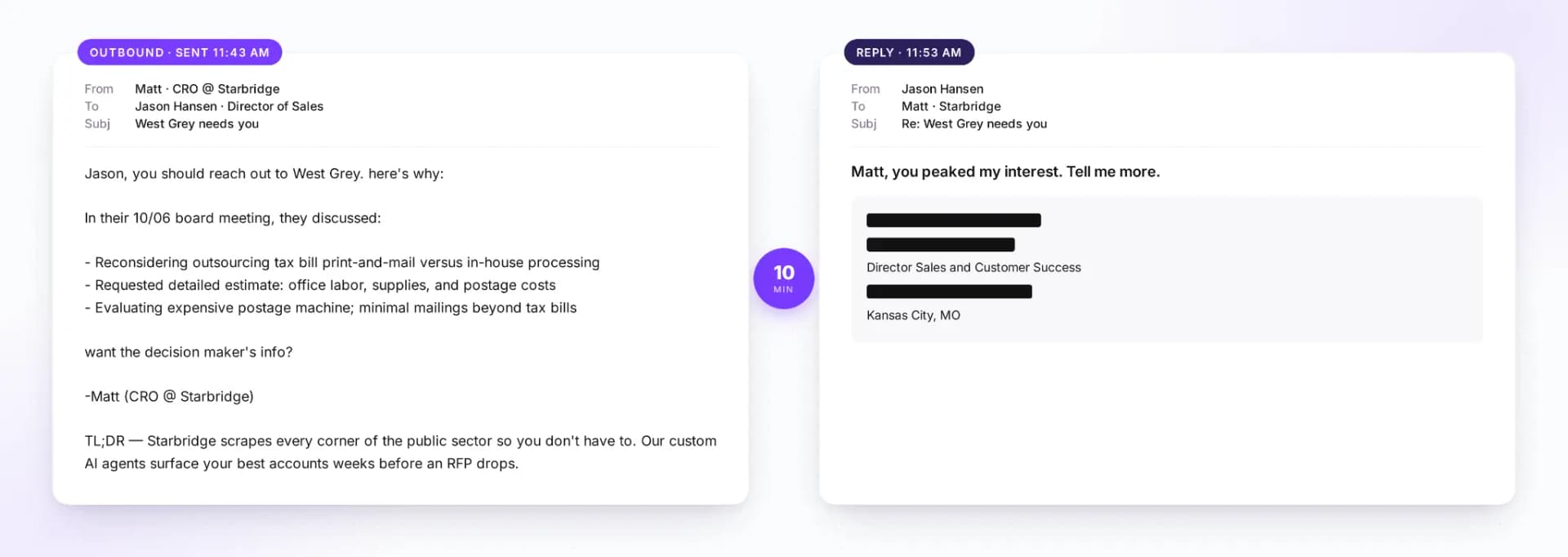
Layer cold calls on top. The most effective approach: send the personalized email first, then call the same day with the same hook. The email creates familiarity, and the call creates urgency.
Starbridge’s bi-directional Salesforce and HubSpot integration makes this workflow automatic. Verified contacts, buying indicators, and RFP alerts sync, clean, and enrich directly inside existing CRM workflows. Reps get prioritized lists with timing context and AI-generated outreach copy. They act in minutes, not hours.
How Starbridge powers B2G lead generation from signal to pipeline
Most teams selling to state and local government, K–12, and higher education are still stitching together manual research, generic databases, and disconnected tools. They find opportunities too late. They reach the wrong person. They lose deals before they know they existed.
This article laid out how the teams pulling ahead have solved it. A scored target account list. Pre-RFP signal monitoring. Verified contacts sourced from official records. Execution workflows that turn intelligence into booked meetings.
Starbridge runs this entire motion in one platform. Teams prioritize the right accounts, act on early buying intent, engage verified decision-makers, and turn insight into execution. Customers are booking 2–2.5x more meetings and cutting account research time by 90%.
Bi-directional Salesforce and HubSpot integration ensures every signal, contact, and alert lands in the tools your reps already use. No tab-switching. No manual imports. No missed opportunities.
If you’re selling to government and education and want to book more meetings, build more pipeline, and win more deals, book a free 30-minute demo.
Frequently asked questions
B2G lead generation is the process of identifying and engaging potential buyers within state and local government, K–12, and higher education. Unlike B2B lead generation, it requires strategies tailored to government procurement frameworks, budget cycles, and multi-stakeholder decision-making structures.
B2G sales cycles typically range from 2 to 18 months after the economic buyer says yes, depending on deal size, procurement path, and the specific agency. Decisions involve multiple stakeholders, formal reviews, and approval layers that don’t exist in commercial sales. Procurement is public and process-driven, meaning timing, compliance, and relationships carry more weight than speed-to-close.
The highest-converting channels, in priority order. Warm introductions from existing customers. Reference-led outbound to similar nearby accounts. Industry-specific conferences. Personalized email and cold call sequences. RFP responses as a later-stage complement. Warm intros carry the most weight because government and education buyers are herd-driven and want peer validation before making a decision.
Generic databases like ZoomInfo underperform in this market because they rely on LinkedIn, which barely covers government and education roles. The most effective approach is sourcing contacts directly from official agency, district, and university websites, along with board meeting records and agency directories. Starbridge automates this with proprietary AI web agents that crawl these official sources and deliver a 2% bounce rate, validated across a 14,000-email test.
The six most actionable pre-RFP buying signals. Board meeting discussions and agendas. Budget approvals and line items. Grant awards. Contract expirations and renewals. Leadership changes. Published strategic plans. Each appears in the public record months before a formal solicitation, giving teams time to build relationships and shape requirements.
Starbridge is an AI GTM platform built for companies selling to state and local government, K–12, and higher education. It aggregates buying signals from thousands of fragmented sources, connects them to verified decision-makers, and helps teams prioritize the right accounts, act on early buying intent, and turn insight into execution. Bi-directional Salesforce and HubSpot integration ensures every signal, contact, and alert syncs directly into existing workflows. Customers are booking 2–2.5x more meetings and cutting research time by 90%.
The best B2G teams begin engaging 6–18 months before a formal RFP appears. Early signals like board discussions and strategic plan references warrant educational outreach. Mid-stage signals like budget line items and grant awards call for discovery conversations. By the time an RFP is published, you should already have a relationship with the buyer and an understanding of their evaluation criteria.
Explore our use case library
 Automate account research with AI agentsStop manually researching accounts. Starbridge AI agents automate account research by monitoring buying signals 24/7 and surfacing the right contacts.
 Identify competitor contract expiration datesThe RFP is usually a formality. Starbridge surfaces competitor contract expiration dates so your reps reach accounts before the renewal cycle closes.
 Create a conference campaignTurn conference badge scans into pipeline. Import your contact list, surface buying signals across every account you met, and follow up with context.