
The vendor’s guide to public sector procurement
Learn how public sector procurement actually works from early buying signals to contract award - and how to get ahead of the competition in government and education sales.

Sales leaders often see procurement as the thing that slows every government deal down. Long cycles, rigid rules, and evaluation committees that move at their own pace. It feels like a system designed to work against you.
It is not. Procurement is designed to be predictable. The rules are public. The timelines are knowable. The buying indicators show up months before a solicitation is published.
The vendors who win in state and local government, K–12, and higher education do not win despite procurement. They win because they learned to read it first.
This guide breaks down how public procurement actually works. It covers the lifecycle, the windows where you can still shape the outcome, the jurisdiction-level differences, and the data gaps that keep most sales orgs perpetually behind.
What public sector procurement is and why it exists
State and local government, K–12, and higher education are markets defined by formal purchasing rules. Cities, counties, state entities, school districts, and universities all spend taxpayer or tuition dollars. That creates an obligation for transparency, fairness, and accountability in every purchase.
Procurement exists because these buyers cannot simply swipe a corporate card. Every purchase above a certain dollar amount must follow a documented process. That process should protect the buyer from favoritism, ensures competitive pricing, and creates an auditable record.
In reality, the procurement process is often neither transparent nor competitive. Government and education entities post opportunities across outdated websites in formats that are hard to navigate at scale.
The result? Vendors with pre-existing relationships are often the only ones who even know an opportunity exists. And with no competitive pressure, they can charge excessive prices. It’s a system that rewards access over innovation, and it’s exactly the problem Starbridge was built to solve.
Even in its imperfect form, procurement should not be an obstacle for vendors. It is a system with patterns you can learn to read and act on earlier than your competition, if you understand how it works.
The procurement lifecycle from a vendor’s perspective
Government and education purchasing follows a predictable sequence. Every deal you close will move through some version of it.
Knowing where you are in the lifecycle matters. Knowing where you should have been six months earlier matters more. That gap is the difference between winning and reacting.
The three phases below map directly to how your pipeline should be staged.
Needs identification and budget planning
The buying process starts long before anyone publishes a solicitation. It starts when a school board discusses chronic absenteeism in a public meeting, or when a city council approves a strategic plan that names cybersecurity as a priority.
Budget cycles are the clock that governs everything. Many state and local entities operate on a July 1 fiscal year. K–12 districts typically align with the school year. Universities vary by institution. If you are not tracking budget planning six to nine months before the fiscal year begins, you are already behind.
The early buying indicators that matter most at this stage include meeting discussions, strategic plans, grant awards, budget line items, and leadership changes tied to purchasing authority. These all surface before a formal solicitation ever appears.
The problem is that tracking these indicators manually does not scale. Fragmented data sources and hours of research per account lead to poor prioritization and missed opportunities. By the time your team finds a signal, the window may already be closing.
What teams need is a way to prioritize the right accounts. The key is to identify which buyers are most likely to purchase based on comprehensive buying indicators, directly in the CRM where reps already work.
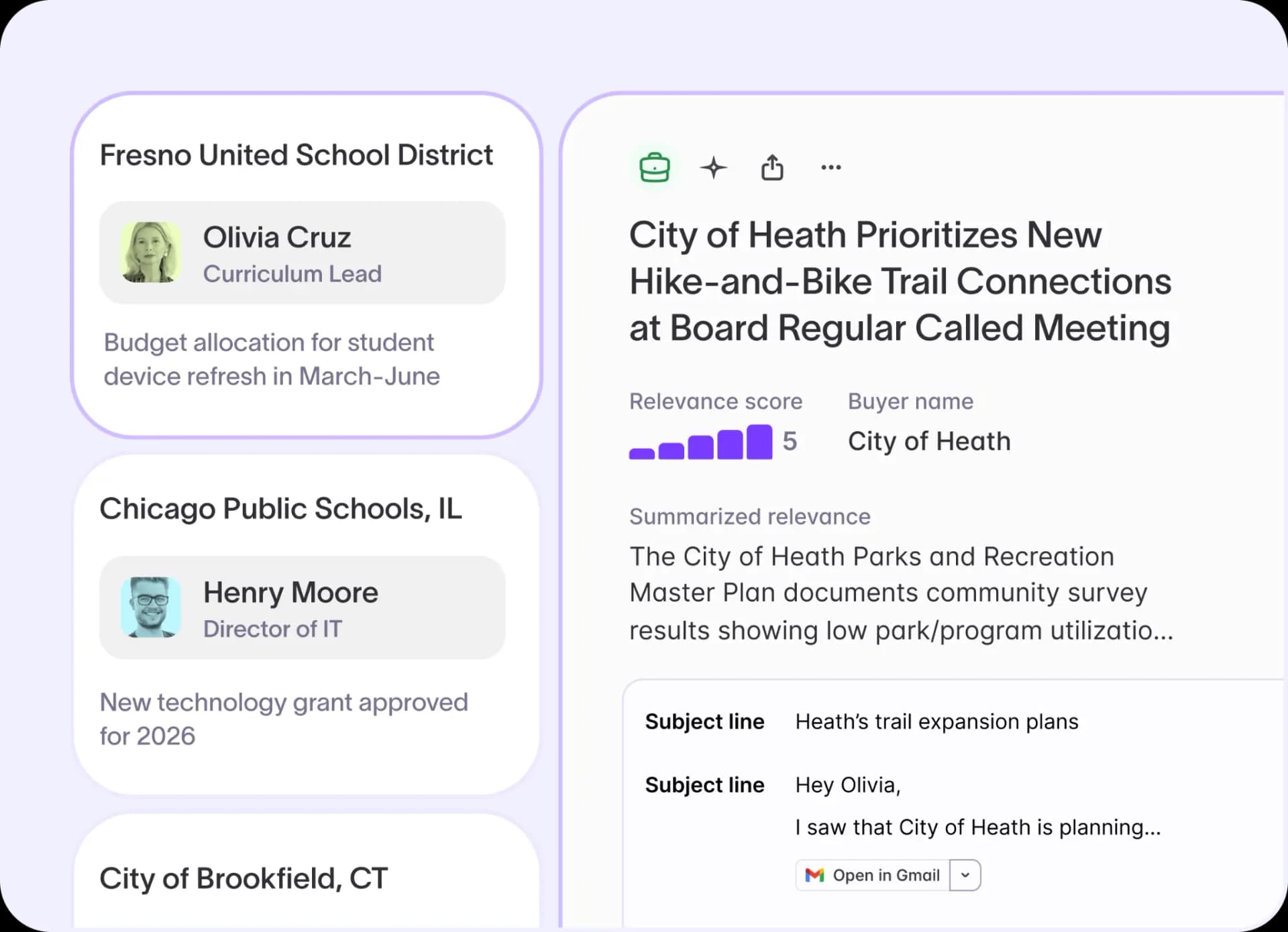
Starbridge’s Buying Signal Monitor delivers exactly that. It tracks buying indicators automatically across 320k+ entities in the USA using 100+ signal types spanning spend, leadership, contracts, and more. The platform surfaces early demand signals, uses dynamic account scoring to rank accounts by propensity to buy, and merges that intelligence directly into your CRM. Every signal comes with verified contacts and AI-generated outreach copy.
Mantra Health, for instance, managed to 3x their data enrichment coverage by connecting their Salesforce instance bidirectionally to Starbridge. It enriched contacts, accounts, and intent signals specific to their business.
Solicitation and vendor outreach
Once a need is funded and approved, buyers move to solicitation. The form it takes depends on dollar amount, complexity, and jurisdiction.
Here is how the main solicitation types break down.
| Solicitation type | When it is used | What to know as a vendor |
|---|---|---|
| RFP (Request for Proposal) | Complex purchases where evaluation criteria go beyond price | Most common for technology. Vendors submit detailed proposals scored by evaluation committees. |
| RFQ (Request for Quote) | The buyer knows exactly what they want and is comparing pricing | Less complex than an RFP. Faster timeline but less room to differentiate on capabilities. |
| IFB (Invitation for Bid) | Commoditized purchases where the lowest price wins | Rarely used for software or professional services. Common for construction and equipment. |
| Sole-source purchasing | Purchase falls below a dollar threshold or only one vendor meets a documented need | No competitive bidding required. The fastest path to close if your deal qualifies. |
Sole-source thresholds are one of the most underused levers in government and education sales. In many jurisdictions, purchases under $25,000 to $50,000 can bypass the RFP process entirely. Some go higher.
A district in Texas might sole-source up to $50,000. A city in California might allow $100,000. Knowing these thresholds before you price your proposal can mean the difference between a 30-day close and a 12-month procurement cycle. The RFP evasion playbook covers how to avoid triggering an RFP whenever possible.
Starbridge can help with that. It provides procurement navigation data for every buyer, including sole-source limits and cooperative purchasing history. That intelligence lets your team price strategically and recommend the right purchasing vehicle before the buyer even asks.
Contract evaluation and award
When a formal solicitation goes out, proposals are typically scored by a cross-functional evaluation committee. The committee tends to include the end user who will work with the product daily, the economic buyer who evaluates ROI at the organizational level, and an IT evaluator who assesses security, compliance, and technical integration.
Scoring criteria vary, but most committees weight the factors shown below.
| Factor | What evaluators look for |
|---|---|
| Technical fit | Does the solution meet all stated requirements? |
| Experience | Has the vendor done this before in a similar environment? |
| Pricing | Is the total cost competitive and clearly structured? |
| References | Can the vendor prove success with similar buyers? |
| Implementation plan | Is the timeline realistic with adequate support resources? |
Here is the timeline reality that catches most vendors off guard. Once your economic buyer says yes, you have roughly an 80% chance of closing. However, the procurement process itself can take 2 to 18 months after that verbal commitment, depending on deal size, procurement path, and the specific entity.
Once a deal reaches legal review, close probability jumps to approximately 90%. At that stage, use your own MSA. Negotiating on the buyer’s paper will be heavily slanted against you.
Knowing who sits on the evaluation committee can help you navigate this process. But outdated contacts, role changes, and missing buyers are one of the most common reasons vendors lose deals they should have won.
Generic databases return contacts who left two years ago or never held the title listed. In a finite market where reputation travels fast, sending outreach to the wrong person may damage credibility.
The outcome you need is clean, accurate, up-to-date data on the key decision-makers at every target account, synced directly into your CRM.
Starbridge’s Contacts & Company Data delivers that. It provides verified names, emails, and phone numbers for decision-makers across 320k+ public sector entities and syncs that data bidirectionally into your CRM through native Salesforce and HubSpot integrations. Your contact database is kept clean and current without manual upkeep.
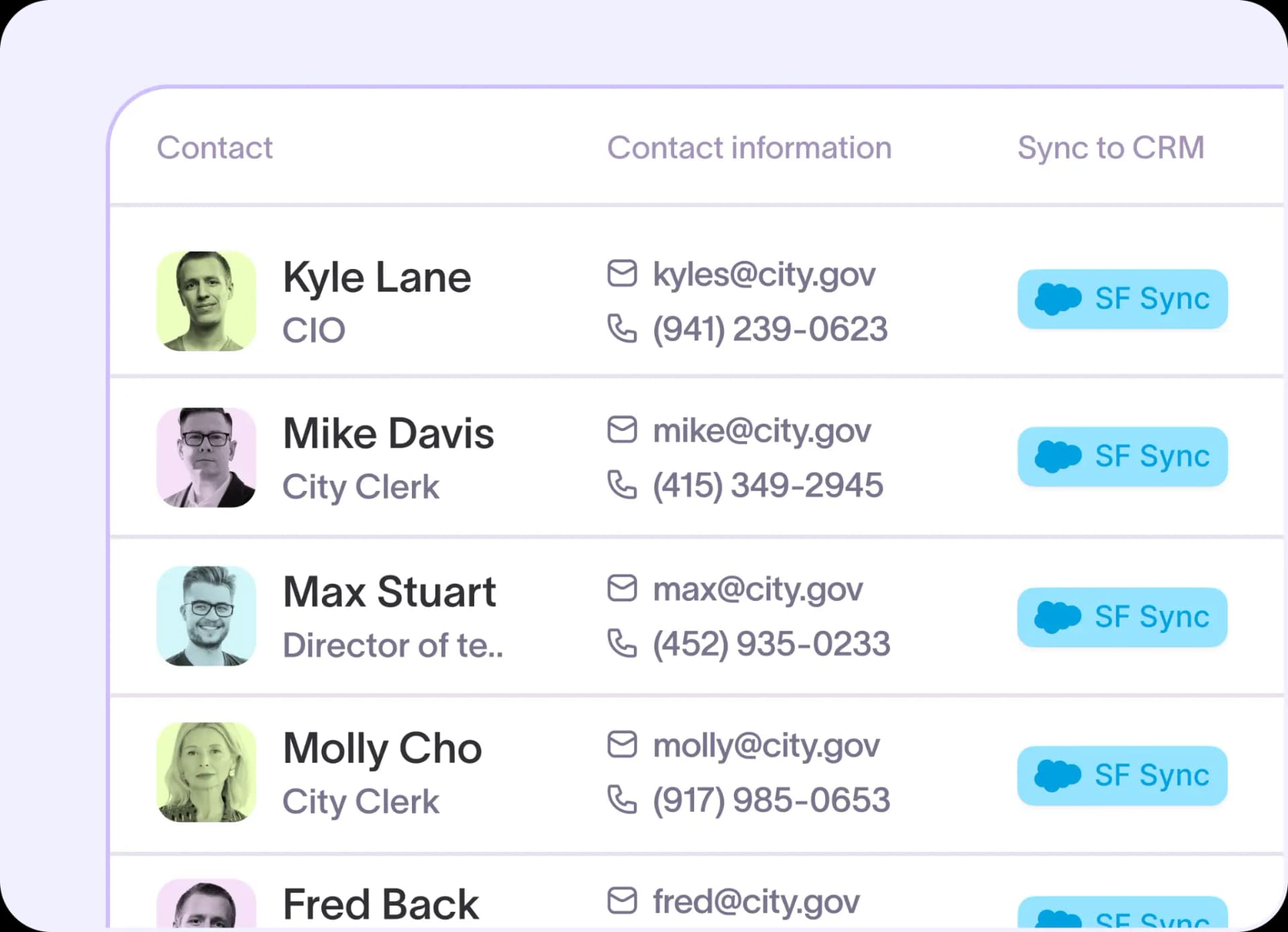
Starbridge sources contacts directly from agency, district, and university websites using proprietary web-agent technology rather than LinkedIn. Reps walk into evaluations knowing the end user, the economic buyer, and the IT decision-maker by name before the solicitation ever drops.
Storage Scholars, for example, had access to a fully enriched TAM database within days of setup. Contact enrichment got fully automated and replaced thousands of hours of SDR time. Starbridge then identified over 350 opportunities and generated personalized outreach campaigns for each one.
Where vendors can still influence the outcome
The strategic question in government and education sales is not how to respond to an RFP faster. It is how to get into the account before the RFP ever exists.
Most vendors spend their time reacting to published solicitations. The best vendors have already built the relationship, shaped the evaluation criteria, and positioned their solution months before procurement formally begins.
The pre-RFP engagement window
The highest-value window for vendor engagement opens 6 to 18 months before procurement formally begins. A school board adopts a strategic plan. A city receives a new grant. An entity starts discussing a pain point in public meetings. All of these are entry points.
Here is a simple framework for recognizing where a buyer sits in the cycle.
- Discovery phase (12-18 months out): The buyer is discussing a problem internally. Meeting minutes and strategic plans reference the issue. No budget allocated yet.
- Planning phase (6-12 months out): Budget discussions begin. Line items appear in draft budgets. Job postings signal capacity building.
- Procurement phase (0-6 months out). Requirements are defined. The buyer drafts solicitation documents. If you are not already part of this conversation, you are already behind.
The vendors who win consistently are the ones who show up during the discovery and planning phases with relevant intelligence, useful context, and a clear point of view on the buyer’s problem.
The core problem here is that most buying indicators surface when RFP decisions are already in motion. Teams that rely on published solicitations as their primary signal are too late.
What you need is the ability to act on early buying intent. This requires getting real-time alerts on signals like meeting mentions, leadership changes, and contract expirations that let you engage accounts before opportunities go to RFP.
Starbridge’s Buying Signal Monitor delivers this across all three phases. It flags board meeting discussions, grant awards, job postings, contract expirations, and other intent signals at the right moment.
Starbridge sends real-time alerts on buying activity across your target accounts, and routes priority accounts to the right reps with a clear explanation of why timing is right. Reps also receive daily digest emails with a prioritized view of top accounts.
Many companies have found a great use for this functionality. GovWell, for instance, used buying signals to book 5 meetings within the first week of using Starbridge.
Building credibility before solicitations open
There are several structural ways to establish yourself as a known, trusted vendor before any solicitation is published.
Get on approved vendor lists. Many jurisdictions maintain lists of pre-vetted vendors. Being on the list does not guarantee business, but it removes friction when a buyer is ready to move.
Pursue cooperative purchasing agreements. These agreements let buyers skip the RFP process by purchasing off a contract that was competitively bid at the state or national level. The most important vehicles for technology vendors include NASPO ValuePoint, Omnia Partners, Texas DIR, New York OGS, and ERIE BOCES. If a buyer can purchase through one of these vehicles, you eliminate months of procurement delay.
Build reseller relationships. Resellers like Carahsoft and CDW provide access to cooperative vehicles and handle procurement logistics. One important reality is that resellers expect a live deal in hand before they will formalize a relationship.
Show up at conferences with purpose. Conferences are a high-converting channel when you approach them strategically. One conference play is account-based personalized handouts using enriched data. Reference their district’s strategic plan, their upcoming contract expiration, or their recently awarded grant.
The challenge is that most teams treat conferences as brand awareness events rather than pipeline channels. Without enriched attendee data, reps waste time on low-fit conversations and lose the follow-up window.
The goal is to turn every conference dollar into a qualified pipeline.
Starbridge’s Conference Intelligence is built for this exact play. It surfaces the right events for your buyer type, enriches attendee lists with verified contacts and ICP scores, and pulls the account context reps need to walk up to any booth with something specific to say.
After the event, Starbridge generates personalized follow-up outreach grounded in event notes and account context. It then syncs prioritized leads directly to your CRM.
Jurisdiction-level differences that shape vendor strategy
No two jurisdictions procure the same way. The rules that govern a city in Texas are different from those in a school district in New York. Understand these differences so you don’t get surprised.
Sole-source thresholds alone range from $5,000 to $150,000 depending on the state, municipality, or district. A vendor who prices at $45,000 might close in 30 days in one jurisdiction and trigger a full RFP in another.
Piggyback clauses allow one jurisdiction to purchase off another jurisdiction’s competitively bid contract. If a city in Florida awarded a contract through a competitive process, a city in Georgia with a piggyback clause might purchase from the same vendor without issuing its own solicitation.
K–12 procurement is often tied to state education codes, which add layers of approval. A district may need school board approval for any purchase above $10,000. Your timeline depends not just on the procurement office but on the school board’s meeting schedule.
Universities tend to have more flexibility. Many large universities operate their own procurement departments with higher sole-source thresholds and more discretion. Higher ed procurement is often the fastest path to an initial contract.
The data problem that makes government and education sales hard
If you have sold commercial B2B software, you are used to various tools giving you direct dials, verified emails, and org charts on demand. That data is harder to come by for government and education buyers.
This data problem has multiple layers.
LinkedIn scraping misses government and education buyers. Most contact enrichment tools pull from LinkedIn profiles. But government employees, school administrators, and university staff rarely maintain LinkedIn profiles, and many do not use the platform at all. The sourcing method that works for commercial B2B simply does not reach this market.
Procurement portals are fragmented. There is no single database of government solicitations, contracts, or spending. Every state, county, and district has its own portal, its own format, and its own update cadence. Reps who try to monitor these manually spend hours per day on research that still misses critical opportunities.
Spending data is buried in PDFs. Purchase orders, contracts, and budget documents are public record. These records are locked in scanned PDFs, buried in FOIA responses, and scattered across thousands of entity websites. Turning that raw data into actionable intelligence requires automation at a scale that no sales team can do manually.
The cost of this broken data infrastructure is real. Reps waste hours per day on research. Emails bounce at 15-25% rates when using tools like ZoomInfo. By the time a team finds a relevant opportunity, a competitor with better intelligence got there first.
What teams need is instant access to account, competitive, and spend context across one comprehensive dataset. Time is wasted searching across disconnected tools and fragmented portals.
Starbridge was built to solve this problem. Built on the most comprehensive dataset of government and education buyers and buying signals, the platform delivers 98% email accuracy, validated across a 14,000-email test. Customers report a 90% reduction in research time. Teams using Starbridge book 2-2.5x more meetings because they are reaching the right person with the right context at the right time.
That kind of performance is possible due to Starbridge’s Vendor Spend Intelligence capability. It uses AI-assisted FOIA automation and continuous web crawls to pull purchase orders, full competitor contracts, and budget data out of the PDFs and portals where they actually live. Reps see contract expirations, competitor pricing, and incumbent risk in one clean view.
Need quick context on any account or signal? Ask Starbridge Chat lets reps pull buyer research with natural language queries without switching tools. Responses are context-aware and tailored to your business, products, and market, so reps get answers they can act on immediately. It is available in-app and directly in Slack.
Turn procurement knowledge into pipeline
The vendors who build a predictable pipeline in this market track early buying indicators months before solicitations appear. They understand the procurement rules, price strategically, and show up to every buyer conversation with context their competitors do not have.
Procurement knowledge without execution infrastructure is just theory. You need the intelligence, the contacts, and the workflows to act on what you know.
Starbridge is the AI sales intelligence platform built for companies selling to state and local government, K–12, and higher education. It helps teams prioritize the right accounts, engage the right people earlier, and identify high-intent opportunities before the competition. Book a demo to see how procurement intelligence becomes pipeline, and how this translates into more meetings, more pipeline, and more deals.
Frequently asked questions
Government and education procurement is the formal process that state and local government, school districts, and universities use to purchase goods and services. It is governed by transparency and fairness requirements because these organizations spend taxpayer or tuition dollars. For vendors, understanding this process is the foundation of building pipeline in government and education.
Once an economic buyer agrees to purchase, the procurement process typically takes 2 to 18 months depending on deal size, procurement path, and the specific entity. Smaller purchases below sole-source thresholds can close in weeks. Larger deals requiring a formal RFP take significantly longer.
An RFP (Request for Proposal) evaluates vendors on multiple criteria including technical fit, experience, and pricing. An RFQ (Request for Quote) compares pricing when the buyer already knows what they want. An IFB (Invitation for Bid) awards to the lowest price and is most common for commodities, not software.
Yes, and the most successful vendors do exactly this. The pre-RFP window of 6 to 18 months before a solicitation is the highest-value engagement period. Vendors who wait for the RFP to drop are typically competing against someone who helped shape the requirements.
Cooperative purchasing agreements like NASPO ValuePoint, Omnia Partners, Texas DIR, and New York OGS let government and education buyers purchase off a contract that was already competitively bid. For vendors, the buyer can skip issuing their own RFP, reducing the sales cycle by months.
Sole-source thresholds define the dollar amount below which a buyer can purchase from a single vendor without competitive bidding. These range from $5,000 to $150,000 depending on jurisdiction. Smart vendors price strategically relative to these thresholds and ask about sole-source eligibility early in the sales process.
The strongest buying indicators include board meeting discussions that reference your product category, budget line items allocated to relevant initiatives, grant awards tied to your use case, and leadership changes in key departments. Contract expirations with incumbent vendors and strategic plan priorities also surface before formal procurement begins. These give vendors a timing advantage over competitors who wait for published solicitations.
Explore our use case library
 Automate account research with AI agentsStop manually researching accounts. Starbridge AI agents automate account research by monitoring buying signals 24/7 and surfacing the right contacts.
 Identify competitor contract expiration datesThe RFP is usually a formality. Starbridge surfaces competitor contract expiration dates so your reps reach accounts before the renewal cycle closes.
 Create a conference campaignTurn conference badge scans into pipeline. Import your contact list, surface buying signals across every account you met, and follow up with context.