
The B2G sales manual for selling to government and education
A practical guide to B2G sales, covering how businesses can understand government buyers, navigate procurement, and build stronger B2G sales strategies.

State and local government, K–12, and higher education collectively represent one of the largest buyer markets in the United States. Trillions flow through formal procurement every year. Yet most sales teams chasing this market still run playbooks built for commercial buyers and wonder why nothing converts.
Business-to-government (B2G) sales is a distinct go-to-market discipline. It’s built around public procurement rules, budget cycles, and relationship timing. The teams that build relationships before an RFP ever drops are the ones who consistently win.
This article covers both the foundational concepts of B2G sales and a practical strategy for generating pipeline in government and education accounts. We’ll move from definitions and procurement mechanics through buying intent-driven strategy, the revenue channels that actually work, and how to put the entire motion into practice.
What B2G sales means and who the buyers are
B2G sales is the practice of selling products or services to government entities and publicly funded institutions. That includes cities, counties, state and federal agencies, K–12 school districts, and colleges and universities.
A SaaS company selling a permitting platform to a city. A consulting firm selling professional development to a school district. A cybersecurity vendor selling endpoint protection to a state agency. All B2G.
B2G differs from B2B and B2C at a structural level. Procurement is formalized and governed by transparency rules. Buying timelines follow fiscal year budget cycles and board approval calendars. Multiple stakeholders with competing priorities are involved in every decision. And there is far less room to negotiate custom terms.
For most companies entering this market, state and local government, K–12, and higher education represent the fastest path to revenue. Federal sales require a materially different compliance investment and a longer ramp.
How government and education procurement actually works
Procurement in government and education is structured, rule-bound, and designed around transparency and fairness.
The standard procurement mechanisms reps encounter include RFPs (Requests for Proposal), RFIs (Requests for Information), ITBs (Invitations to Bid), and informal solicitations for smaller purchases.
And there are three types of procurement methods: informal (for micro-purchases and simplified acquisitions), formal (through sealed bids or proposals), and noncompetitive. Each has different documentation requirements, timelines, and competitive expectations.
Sole-source thresholds are one of the most tactically important and underused levers in B2G sales. Most agencies and districts have a dollar amount below which they can purchase without a competitive process.
B2G sellers should expect compliance requirements. Security questionnaires, certifications (SOC II, FERPA, StateRAMP, FedRAMP), insurance minimums, and legal review are all common.
Reps also need to sell to three distinct buyer roles in every deal.
| Buyer Role | Focus Area | Messaging Approach |
|---|---|---|
| End user | Daily workflow and functionality | How the product improves their day-to-day work |
| Economic buyer (director, VP, executive) | Organizational ROI | Cost savings, time savings, better outcomes |
| IT / CIO / CSO | Security, compliance, integration | Technical architecture, certifications, data governance |
Lastly, the key procurement decision is whether an RFP is required. Reps should proactively ask about sole-source justification or cooperative vehicles before the process escalates. Once an RFP is triggered, it can add months and force a competitive process that didn’t need to happen.
A four-part B2G sales strategy that starts before the RFP
By the time a government agency or school district publishes an RFP, a competitor has usually already been in the room. They’ve helped shape the evaluation criteria and positioned themselves as the frontrunner.
The real competitive advantage in B2G sales is building relationships before procurement formally begins. That means identifying early buying signals (such as a new grant or a contract about to expire), mapping the right stakeholders, scoring accounts systematically, and building an outbound motion that scales.
Pre-RFP buying signals that reveal real demand
State and local government, school districts, and universities generate public information that reveals buying intent weeks or months before a formal solicitation appears. The best B2G sales teams treat these early demand signals as their primary pipeline source.
Here are the most valuable pre-RFP buying signals and what each tells a rep about timing and intent:
- Board meeting minutes and agendas: Discussions about new initiatives, pain points with current tools, challenges surfaced by citizens, or vendor dissatisfaction
- Budget documents and line items: Funded priorities, new allocations for technology or services
- Strategic plans: Multi-year goals that require vendor solutions to achieve
- Grant awards: New money earmarked for specific projects, often with a spending deadline
- Leadership changes: A new superintendent, city manager/admin, mayor, or CIO often triggers vendor reviews and fresh buying cycles
- Job postings: Hiring for roles that suggest a new initiative, tool adoption, or expansion
- Contract expirations: Incumbent agreements ending, creating a natural opening for competitive evaluation
- News: Layoffs, hiring freezes, and hiring sprees
Discovering these buying signals manually requires scouring district websites, reading board meeting PDFs, and monitoring news across 320,000+ government and education entities. That research burden is one of the biggest drags on rep productivity in B2G sales.
Starbridge’s AI-powered GTM intelligence platform helps solve this problem. It enables government and education sales teams to monitor hundreds of thousands of state and local government agencies and schools in real time for meeting discussions, contract expirations, grants, budgets, procurement rules, contact data, and bids. Sales teams can then identify, prioritize, and engage high-intent opportunities before the competition.
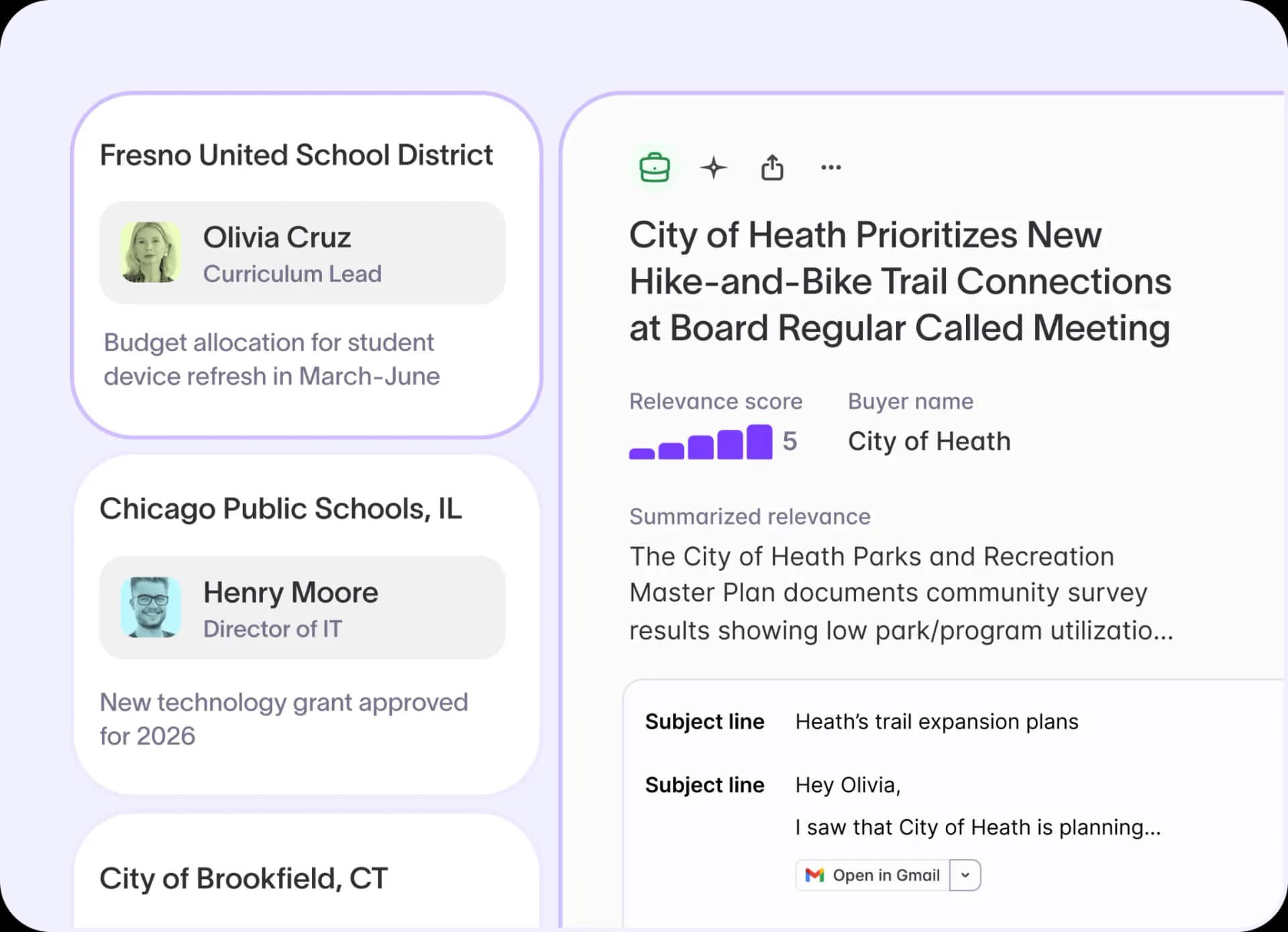
Starbridge’s Buying Signal Monitor surfaces pre-RFP buying activity across all of these buying signal types so teams can engage while requirements are still taking shape. On average, Starbridge customers see public sector booked meeting rates increase by 20%, with many customers booking five or more meetings within their first week.
Mapping and identifying key stakeholders inside government and education accounts
Government and education deals involve multiple stakeholders with different priorities and authority levels. Reps need to map and identify the full buying committee early.
Here are the key roles to identify and engage in any B2G deal:
- Decision-makers: The person or body with final authority over the budget. Depending on the sector, this is typically a CIO, Provost, Superintendent, or County Executive, or a governing body like an elected board or city council.
- Economic buyers: Directors, VPs, or department heads focused on organizational ROI and budget justification
- End users: Staff who interact with the product daily and whose adoption determines success
- Blockers: Stakeholders who can slow or kill a deal — a risk-averse procurement officer, an incumbent-loyal department head, or a board member with competing priorities
Contact data for key stakeholders is notoriously incomplete in government and education. LinkedIn is often insufficient because public sector employees frequently don’t maintain updated profiles. The most trustworthy sources are agency directories, staff directories, board minutes, PDFs, and verified .gov and .edu domains.
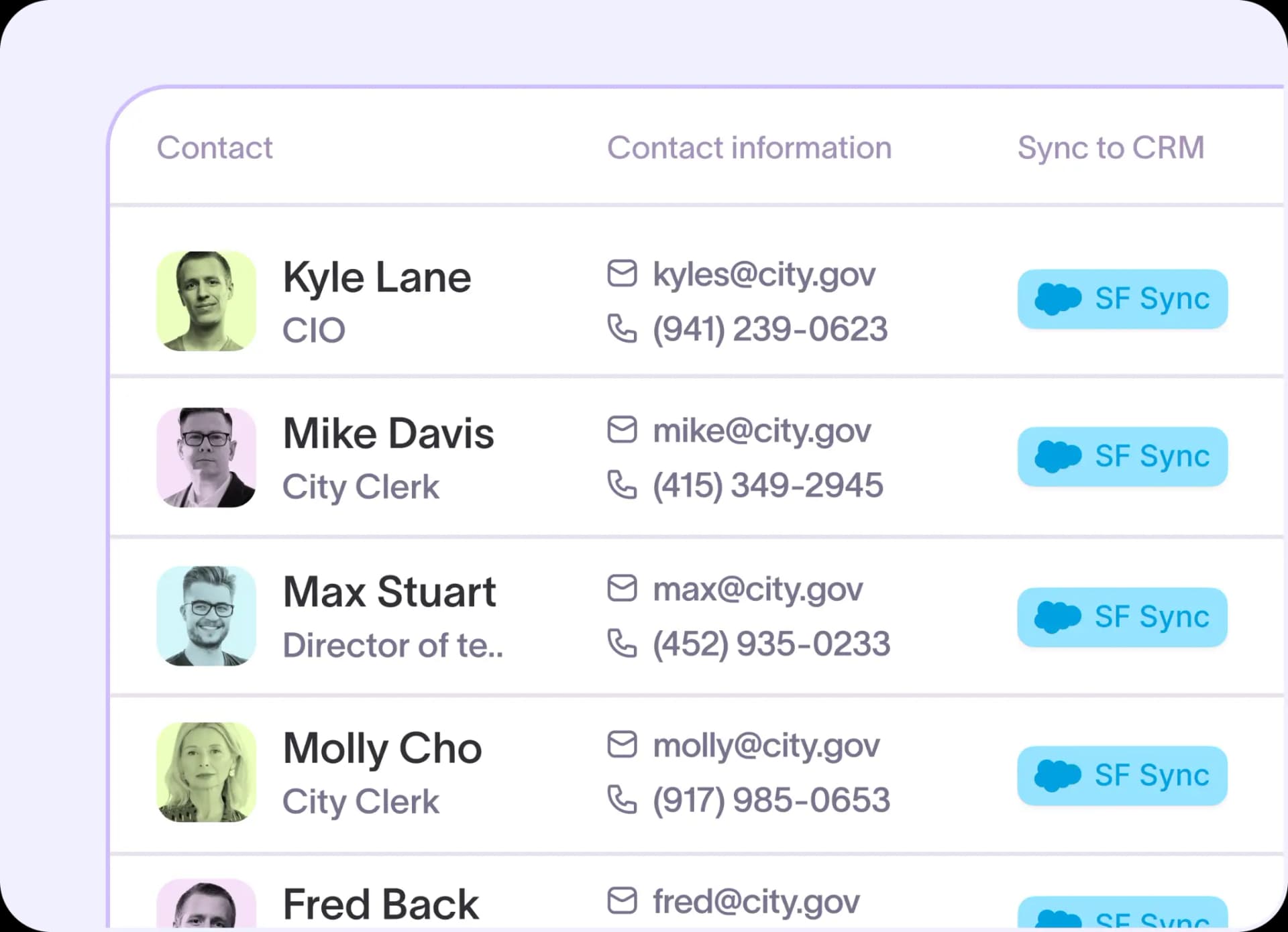
Starbridge’s contact agent systematically extracts and enriches contact information from thousands of these directories at scale. That’s why Starbridge has 2% bounce rate. User-reported bounce rates of tools like ZoomInfo are often between 15%-25%, which is considered industry standard.
How to rank your entire TAM from best to worst
With thousands of potential accounts, B2G reps need a systematic way to prioritize who to call first. Defaulting to geography or gut feel doesn’t scale.
A practical account scoring model uses several attributes per account:
| Priority Level | Buying Signal: Use Case & Pain | Buying Signal: Budget & Capacity | Competitive Signal |
|---|---|---|---|
| High (9-10) | Direct Alignment:Strategic plan or meeting minutes explicitly name your category as a “top priority” for the fiscal year. | Allocated Funds: Budget documents show a specific line item or a “hiring spree” in the relevant department. | Takeout Opportunity: Incumbent contract is expiring in <12 months or public “pain” with current vendor is documented. |
| Medium (5-8) | Implicit Need:High-level goals, e.g. “Improve Safety,” suggest a need, but no specific project is named yet. | General Capacity:Large operating budget or recent “Open to Spend” status, but no specific line item for your solution. | Stable Incumbent:Competitor is present but the contract isn’t expiring soon; requires a “value-add” entry point. |
| Low (1-4) | No Mention:No evidence of your use case in recent public transcripts or strategic documents. | Fiscal Constraint:Budget freezes, layoffs, or “cost-cutting” mandates mentioned in recent news. | New Incumbent: Competitor just signed a 5-year deal; account is likely “locked” for the near future. |
Scored accounts drive every downstream decision. Rank the full TAM from best to worst, sync to your CRM, then use those rankings to prioritize daily call lists, select conferences, and segment outbound campaigns.
Once you know which competitor each account uses, you can run differentiation campaigns tailored to each incumbent. “Noticed your district uses [Tool X]. Here’s how our approach differs on [specific capability].” That kind of specificity turns a generic cold email into a conversation starter.
And you can score and prioritize accounts on almost any factor available on the web. Selling modernization of patrol car tech? Scan city council meeting minutes for keywords like “officer safety” or “civilian oversight.” Then reach out to the cities discussing it.
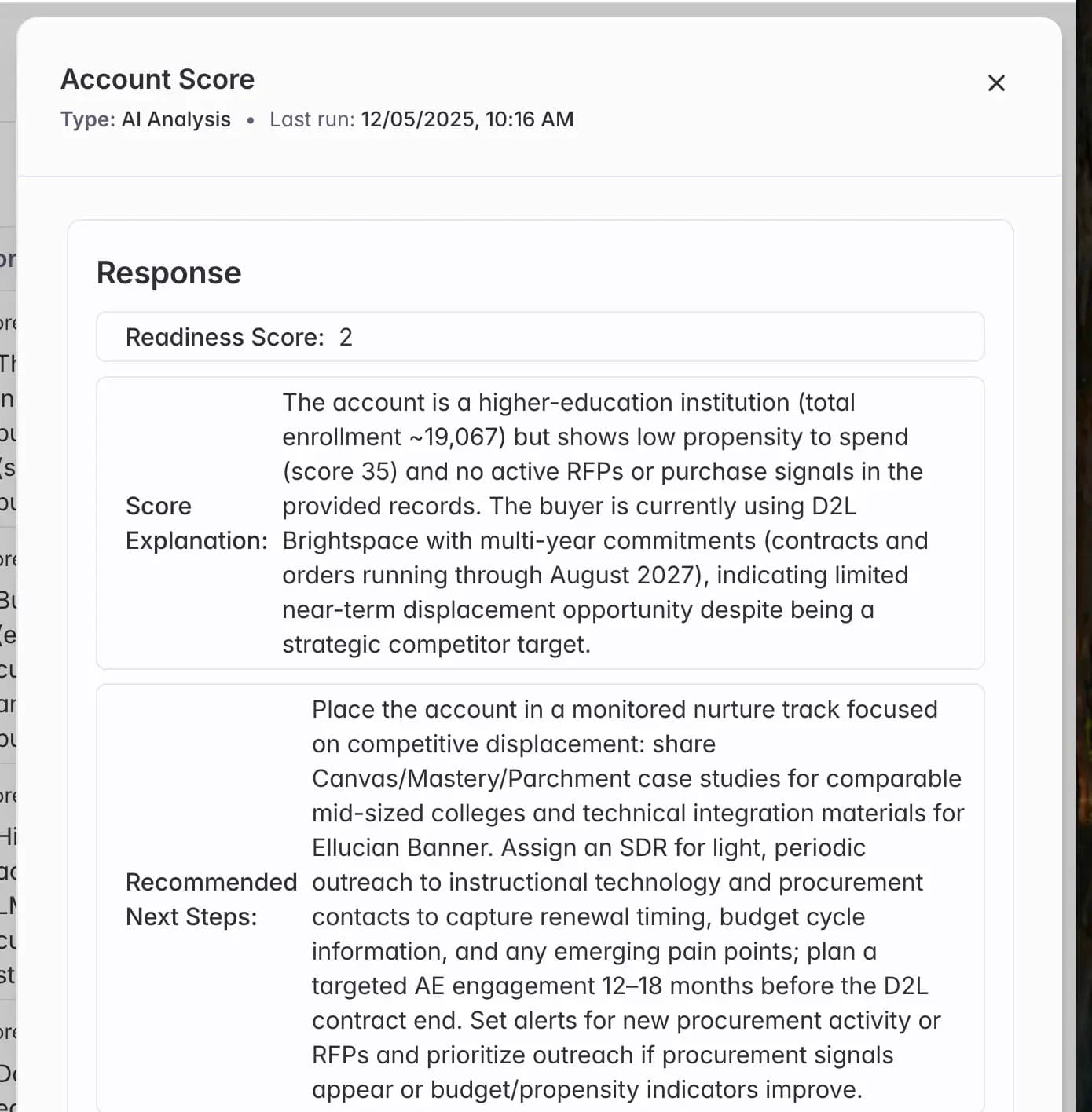
Starbridge lets teams define their scoring criteria in plain language directly in the platform through a Buyer Bridge, which is Starbridge’s core building block for configuring AI-powered GTM workflows.
That bridge generates a score for every account across the full total addressable market, drawing on enrichment data like enrollment trends, budget figures, propensity to spend, and incumbent vendor usage. Scores update automatically as new signals come in, such as a leadership change, a new initiative, or a contract approaching expiration.
Here’s an example of an account score:
How to monitor B2G opportunities
B2G sales cycles are long and often opaque, but treating in-progress deals as black boxes is a mistake. There are concrete indicators of deal readiness you can monitor before any formal procurement begins:
- Use-case fit: Does the account’s stated needs align with your product’s core strengths?
- Budget reality: Is there a funded budget for this initiative, or is it still aspirational?
- Timing: Where is the agency or district in its fiscal year budget cycle? When do existing contracts come up for renewal?
- Incumbent risk: Is there a current vendor? How entrenched are they? Is a contract expiring?
- Procurement path: Can this deal be sole-sourced, or will it require an RFP? Is a cooperative vehicle available?
- Stakeholder coverage: Have you reached the economic buyer, end user, and IT — or just one contact?
- Compliance readiness: Do you have the certifications and security posture this specific buyer will require?
Most of the buying signals needed to qualify deals live outside your CRM. Board minutes, budget documents, and contract timelines are scattered across thousands of public sources. Reps end up triangulating between tabs and spreadsheets, which means signals get missed and follow-up lags.
Starbridge’s native CRM integrations solve this by bi-directionally syncing, cleaning, and enriching verified contacts, buying indicators, account scores, and RFPs directly into Salesforce and HubSpot. Reps qualify deals and track progress inside their system of record instead of managing disconnected tools.
Three revenue channels that drive B2G pipeline
Not all pipeline sources convert equally in government and education sales. The most effective B2G sales teams layer multiple channels deliberately.
Social proof campaigns: In government and education, name-dropping a nearby win carries a lot of weight. After each closed deal, identify the most similar nearby accounts and lead with a relevant reference. “We just partnered with the City of San Jose” lands harder with a prospect in Northern California than any feature pitch. Warm intros are even more effective, but they’re rare.
Conferences and in-person outreach: Conferences are one of the highest-converting B2G pipeline channels, but only if you pick the right events. Attend events where your actual decision-makers show up, not general industry conferences. Starbridge’s Conference Intelligence enriches conference attendee lists so teams can prepare account-based outreach for every event.
Scaled email and cold calling: Email & cold calls are the most scalable channel in B2G sales, but you have to cut through the noise. Expect 0.5–1% book rates. Start with 100 manually researched, deeply personalized emails to understand what messaging resonates before automating anything.
The best B2G sales teams don’t pick one channel. They layer multiple channels, feeding each with the account intelligence and contact data that makes outreach relevant and timely.
Resellers and cooperative contract vehicles (coops) like NASPO ValuePoint help you close the deals sourced through the channels above. Coops let government and education buyers skip the RFP process entirely using pre-negotiated contracts that cover all 50 states.
State-specific equivalents like Texas DIR and New York OGS work the same way. Resellers like Carahsoft, CDW, and Insight are your access point, but they won’t engage until there’s a real deal in play, ideally six figures or more.
Once you have a handful of contracts, approach a reseller with a specific live deal in hand. Use that conversation to identify the right cooperative vehicle and formalize the relationship fast. Then, whenever an RFP looks likely, you can recommend the appropriate coops.
Starbridge gives B2G sales teams an unfair advantage
B2G sales rewards teams that show up before the RFP. The playbook is straightforward: monitor pre-RFP buying signals, map the full buying committee, identify the right contacts, score your accounts systematically, and qualify deals against a repeatable framework. Then, layer your pipeline channels rather than betting on any single source.
The structural realities of this market, long cycles, multi-stakeholder decisions, and formal procurement, aren’t going away. They’re what make early positioning so valuable. Teams that build relationships and shape requirements before procurement begins don’t just win more deals. They win them faster, with less competition.
If your team sells to state and local government, K–12, or higher education and you’re tired of chasing RFPs, book a demo with Starbridge to see how buying signal-driven B2G pipeline actually works.
Frequently asked questions
B2G sales, or business-to-government sales, is the practice of selling products or services to government agencies and publicly funded institutions such as cities, counties, state agencies, K–12 school districts, and universities. It differs from B2B and B2C because procurement is governed by transparency rules, budget cycles, and formal solicitation processes.
A SaaS company selling a permitting platform to a city government is a common example. Other examples include an edtech company selling scheduling software to a school district, a cybersecurity vendor providing endpoint protection to a state agency, or a consulting firm delivering strategic planning services to a county government.
B2G sales cycles typically range from 2 to 18 months after the economic buyer says yes, depending on deal size, procurement path, and the specific agency. Deals that require a formal RFP process take longer than those that can be sole-sourced or routed through a cooperative contract vehicle. Building relationships before procurement begins is the most effective way to shorten the cycle.
Not always. Many government and education purchases happen below the sole-source threshold, through cooperative contract vehicles, or through informal solicitations that don’t require a full RFP. The most successful B2G sales teams focus on building relationships and demonstrating value before the RFP is written. That way, when formal procurement begins, they’ve already shaped the evaluation criteria.
Starbridge’s AI-powered platform helps sales teams identify, track, and pursue opportunities in the public sector by consolidating data from thousands of fragmented sources. By surfacing opportunities well before traditional RFP cycles, Starbridge empowers companies to engage proactively and strategically with government and education buyers. It combines buying signal monitoring, verified contact data, public spend intelligence, RFP discovery, and conference enrichment into a single platform.
Generic sales intelligence platforms scrape LinkedIn and commercial databases, which barely cover the public sector. Starbridge pulls contacts directly from official government and school websites, delivering 98% email accuracy versus 75–85% from generic providers. It also surfaces public-sector-specific buying signals — board meeting discussions, budget allocations, contract expirations — that tools built for private-sector selling simply don’t track.
Yes. Starbridge bi-directionally integrates natively with Salesforce and HubSpot, syncing, cleaning, and enriching verified contacts, buying indicators, account scores, and more, directly into your CRM. It also connects with Apollo, Outreach, Slack, and Zapier, so intelligence flows into the tools your reps already use without requiring a separate workflow.
Explore our use case library
 Automate account research with AI agentsStop manually researching accounts. Starbridge AI agents automate account research by monitoring buying signals 24/7 and surfacing the right contacts.
 Identify competitor contract expiration datesThe RFP is usually a formality. Starbridge surfaces competitor contract expiration dates so your reps reach accounts before the renewal cycle closes.
 Create a conference campaignTurn conference badge scans into pipeline. Import your contact list, surface buying signals across every account you met, and follow up with context.