
A signal-driven strategy to public sector sales
Learn how to win public sector sales with a signal-driven strategy that helps teams identify buying intent, prioritize accounts, and engage before RFPs drop.

Most advice on selling to government and education sounds like it was written for commercial B2B and then lightly rebranded. Plug in a mailing list. Send a sequence. Wait for the RFP. That playbook fails in a market where LinkedIn barely covers the buyer base, RFPs are written for a competitor who was already in the room, and procurement timelines take 2 to 18 months.
The teams that win here treat public sector sales as its own discipline. They prioritize accounts using buying indicators, not static firmographics. They act on early demand signals weeks or months before procurement begins. They engage verified decision-makers before the RFP ever drops.
This article first breaks down how government and education procurement actually works. Then, it lays out a signal-driven strategy for getting into accounts before the competition.
How government and education procurement actually works
Government and education procurement rules are different from commercial B2B. The teams that learn them early close faster.
Government and education entities use three primary procurement methods.
| Procurement Method | How It Works |
|---|---|
| Informal solicitations | Fall below a dollar threshold and are often sole-source eligible, meaning the buyer can choose a vendor without a competitive process. |
| Formal solicitations | Include RFPs, RFIs, and ITBs, and are triggered when the purchase price exceeds the agency's sole-source threshold. |
| Noncompetitive or sole-source purchases | Happen when an agency can justify buying from a specific vendor without competition. |
The key decision procurement makes is whether an RFP is required. RFPs are triggered when the price exceeds the agency’s sole-source threshold. Avoiding an RFP saves months.
You can consider pricing below the threshold or asking about sole-source justification, which depends on the procurement team’s risk tolerance.
Cooperative contract vehicles and reseller partnerships let buyers skip the RFP entirely. Vehicles like NASPO, Omnia, and state-specific options such as Texas DIR and New York OGS give agencies a pre-approved path to purchase. Reseller partnerships with firms like Carahsoft, CDW, and Insight provide the distribution infrastructure.
Once you have a handful of contracts, build a reseller relationship. The primary value is access to these cooperative vehicles, not having someone else sell for you.
Government and education purchasing is driven by fiscal year calendars and appropriation cycles that vary by state and entity type.
B2G sales cycles typically range from 2 to 18 months after the economic buyer says yes. The timeline depends on deal size, procurement path, and the specific agency. Planning your outbound around these cycles is critical.
A signal-driven public sector sales strategy that starts before the RFP
Government and education buyers rarely start the procurement process as experts in the solution they need. Before any RFP is written, they talk to vendors to understand what’s possible, what to look for, and what fair pricing looks like. The vendor who helps with that education builds trust and, in many cases, directly influences the evaluation criteria that end up in the solicitation.
That’s why responding to an RFP is often too late. By the time it’s published, the buyer already has a preferred vendor. The deal may already have been decided.
The teams that win consistently engage weeks or months before procurement begins. They spot the early buying indicators, build relationships with decision-makers, and position their solution while the entity is still defining what they need.
Monitor pre-RFP buying signals
Buying signals are early indicators that a school district, university, or state or local agency is preparing to spend. Signals surface before an RFP ever appears. They’re the highest-value input for any government and education sales team.
Here are some of the buying indicators that matter.
- Board meeting discussions where a problem or initiative is raised. When a school board discusses “modernizing student information systems” or a city council reviews cybersecurity posture, that’s an early demand signal.
- Budget allocations and line items that fund a new category. A specific budget line for your solution category means money is already earmarked.
- Leadership changes. A new mayor, superintendent, or CIO shifts spending priorities. These transitions often trigger new vendor evaluations.
- Strategic plan language that names a capability your product delivers. Districts and agencies publish multi-year plans that signal future purchases.
- Grant awards that create new funding. A district that just received a School Safety Grant has both the budget and the mandate to buy.
- Contract expirations that open the door to displacement. When an incumbent’s contract is ending, the agency is legally required to evaluate alternatives.
- Job postings that signal a new initiative. A “fleet manager” posting that lists “EV experience preferred” tells you a city is moving toward electrification.
- Bids and RFPs. The lowest-priority buying indicator, because by this point the process is already underway and a competitor has likely shaped the requirements.
The problem is scale. Manually tracking these indicators across thousands of school districts, cities, counties, and agencies is impossible. Most teams default to watching bid boards and reacting to RFPs, which means they’re always late.
Starbridge, an AI sales intelligence platform built exclusively for companies selling to state and local government, K–12, and higher education, solves this with its Buying Signal Monitor. It tracks over 320k public sector entities around the clock and surfaces buying indicators automatically from board meeting minutes, strategic plans, budget data, grants, job postings, contract expirations, and news alerts.
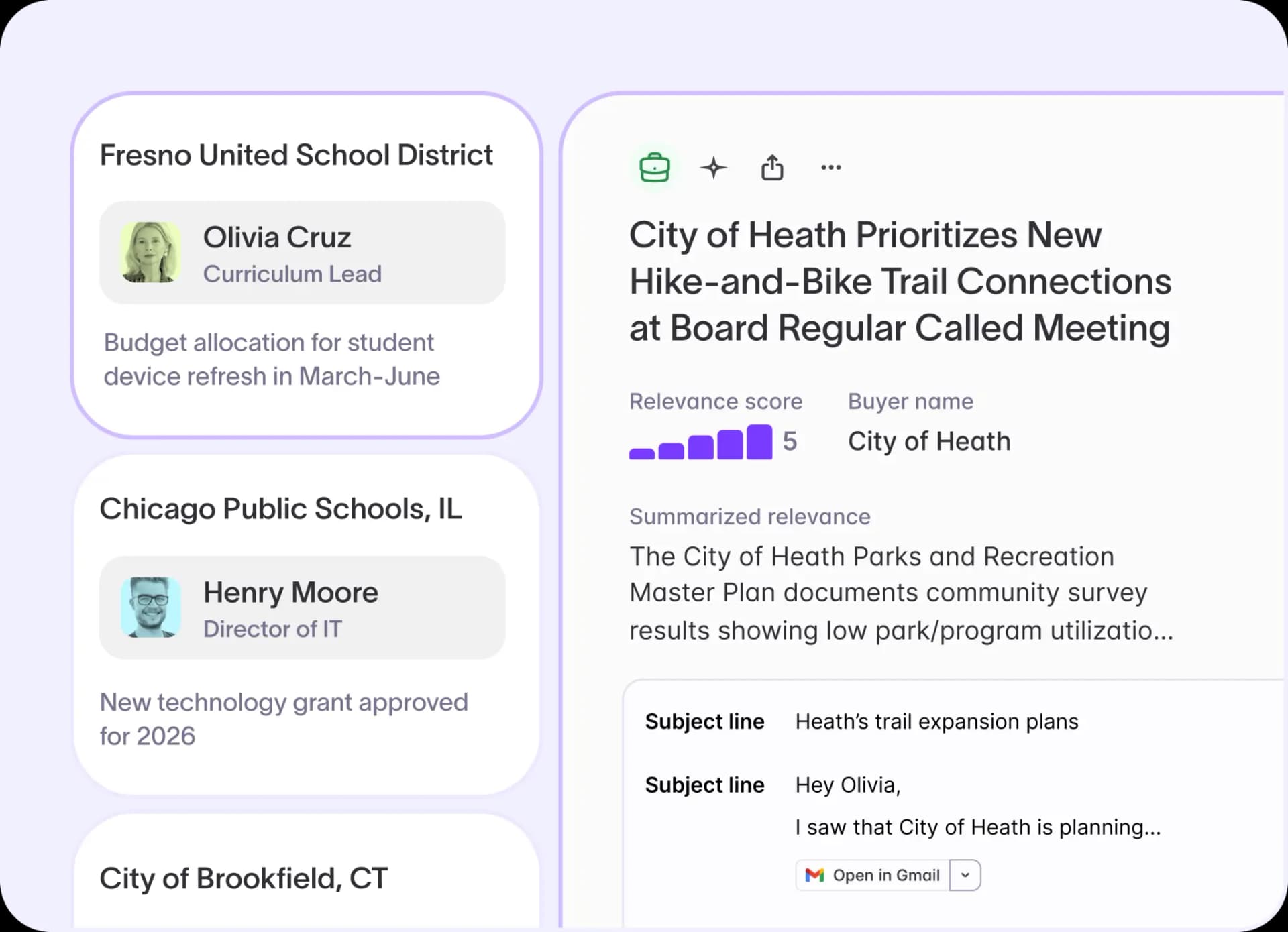
Every indicator is delivered as a prioritized alert to each rep’s territory. Reps receive real-time notifications on buying activity across their target accounts, with a clear explanation of why the timing is right. Priority accounts get routed to the right reps automatically.
Many companies have found this approach transformative.
Within the first week on Starbridge, GovWell’s team booked five meetings sourced directly from pre-RFP buying indicators. Their reps stopped waiting for bid boards and started acting on signals before the competition showed up.
Score accounts to prioritize your TAM
With thousands of school districts, cities, counties, and agencies in your total addressable market, your reps have no reliable way to rank who to call first. They default to geography or company size and miss accounts that are actually ready to buy right now.
Static attributes like population, enrollment, or operating budget describe account size. They don’t predict purchase readiness. A city might have a large budget but be in a spending freeze. A smaller agency might have just received grant funding for exactly what you sell.
Sales teams need the ability to prioritize the right accounts. Prioritization can be done by scoring accounts using a range of attributes, such as:
- Competitor contract expirations. An incumbent contract expiring in under 12 months is one of the strongest buying indicators of purchase readiness.
- Competitor presence. Knowing who the current vendor is helps you tailor positioning and timing.
- Budget trend. A specific line item for your solution category is the strongest budget signal. Growing budgets suggest opportunity. Budget freezes or cuts suggest the opposite.
- Leadership changes. New leadership often triggers vendor evaluations and new spending priorities.
- Procurement readiness. Does the agency have sole-source thresholds that let them buy without an RFP? Are they on a cooperative vehicle you can use?
- Strategic plan alignment. Does the agency’s published strategic plan name a capability your product delivers?
- Custom buying indicators. Any category-specific indicator available on the web. A school district with a documented rise in absenteeism and new grant funding is a must-call for a student mental health platform. A city that passed a Climate Action Plan with a 2030 deadline is a top account for EV infrastructure companies.
Every account in your TAM should be ranked from best to worst. Use scores to prioritize calls, pick conferences, segment email campaigns, and allocate rep time. The goal is to give every rep a short list of top accounts every week, ranked by propensity to buy.
Starbridge delivers on this through dynamic account scoring. It ranks accounts based on over 100 buying indicators spanning spend, leadership, contracts, and more.
The platform’s Contacts & Company Data layer provides comprehensive information on government and education buyers and activity. This intelligence is then merged directly into your CRM.
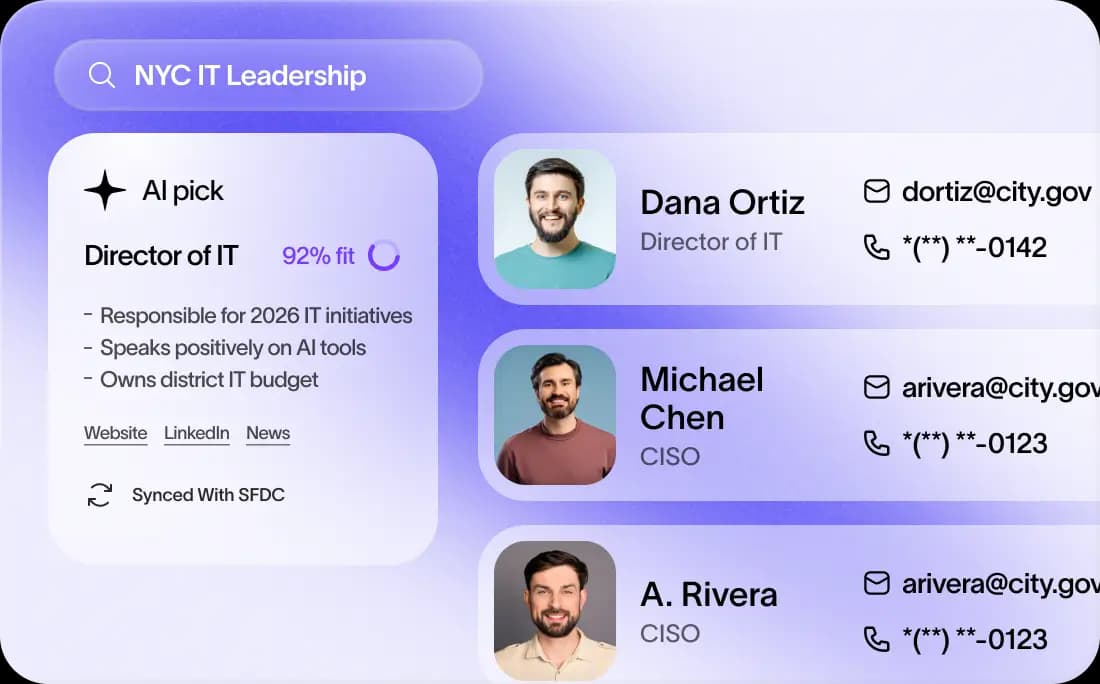
Native, bi-directional integrations with Salesforce and HubSpot sync, clean, and enrich your account data. Reps see prioritized accounts in the tools they already use.
After connecting their Salesforce instance to Starbridge, Mantra Health tripled their data enrichment coverage. Contacts, accounts, and intent signals specific to their business all flowed in automatically, giving reps a complete picture of every account without manual research.
Find and verify the right contacts
Contact accuracy matters disproportionately in government and education. This is a finite market in which buyers talk to each other.
Reaching out to someone who left two years ago or never held the listed role wastes your time and might erode credibility with the agency.
Generic contact databases like ZoomInfo and Apollo scrape LinkedIn, which barely covers government and education. Roles change, titles are inconsistent, and the data goes stale quickly. The result is outreach that erodes trust with prospects you may need to sell to for years.
Sales teams need CRMs with accurate, up-to-date data on key decision-makers.
Starbridge’s Contacts & Company Data capability is built specifically for this need. It runs continuous web crawls using proprietary web-agent technology across government department sites, school district portals, university websites, and board minutes. The result is verified names, emails, and phone numbers for decision-makers across over 320k public sector entities.
Starbridge delivers 3-4x data enrichment coverage versus alternatives. It maintains a 2% email bounce rate, compared to 15-25% user-reported bounce rates for tools like ZoomInfo, based on a validated test of 14,000 emails.
Enriched contact data syncs directly into Salesforce and HubSpot through a native, bi-directional integration. CRM records are kept accurate without manual effort.
Days after Starbridge setup, Storage Scholars had a fully enriched TAM database. Automated contact enrichment replaced thousands of hours of SDR time, and Starbridge identified over 350 opportunities with personalized outreach campaigns generated for each one.
Execute the outbound playbook
Standard cold email and phone sequences produce near-zero engagement with government buyers. The advice to “build relationships” is correct but incomplete. Relationships are the outcome of well-timed, well-researched outreach, not a strategy on their own.
The problem most teams face is that their insights sit only in a dashboard. Data tools that stop at a report still require reps to figure out what to do next. Teams need the ability to turn insight into execution at scale.
Start with a structured cadence. Send a personalized email first with a strong hook, a customer reference, and a simple CTA.
Here’s an example of a cold email we sent to our prospect:
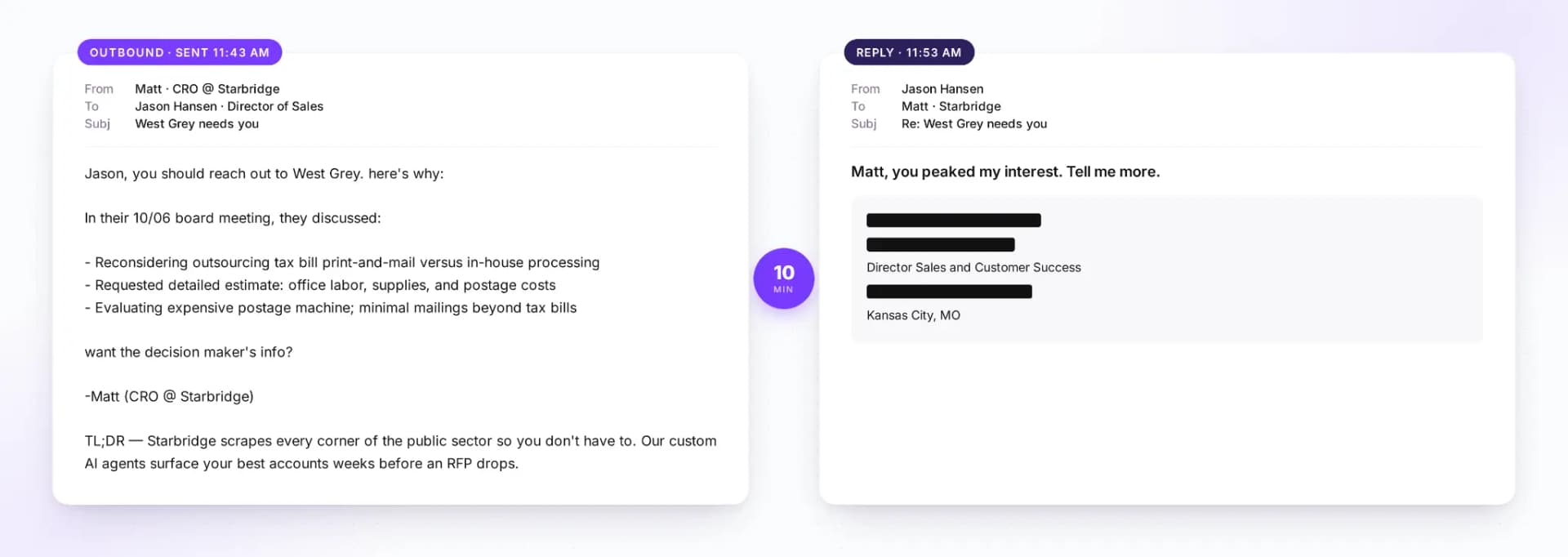
Expect roughly 0.5-1% email book rates and 10% connect-to-book rates on calls. Calls are less scalable but far higher converting.
Here’s what a strong outbound email looks like in practice.
If you sell to cities and just closed New York City, your email to a nearby city might read:
“Hi Sally, I’m the founder of XYZ. We help cities with [value proposition]. We just brought on New York City and I’ll be in the area for an implementation onsite. Would you be open to connecting?”
The highest-performing outbound plays for government and education include the following.
- Nearby account wins. Government and education buyers are influenced by what their peers are doing. “We just brought on [nearby similar account]” is one of the strongest hooks available.
- Targeted lists by account characteristics. Build lists around specific buying indicators. Companies using a specific competitor. Districts that just received grant funding. Agencies with contracts expiring in the next 12 months.
- Board meeting discussion signals. When a school board discusses a problem your product solves, that’s your hook. Reference the specific discussion in your outreach.
- Strategic plan references. Pull a one-sentence snippet from an agency’s strategic plan that aligns with your value proposition. It shows you did your homework.
- Job changes at target accounts. New leadership means new priorities. Reaching out within the first 90 days of a leadership change catches decision-makers when they’re evaluating their options.
- Upcoming conference attendance. Use conference attendance as a meeting wedge. “I see you’ll be at [conference]. Can we grab 15 minutes?”
Hapara, for example, drove 20% higher response rates after switching to signal-timed, personalized outreach using Starbridge. Instead of running arbitrary cadences, their team timed every touchpoint to a buying indicator, and engagement increased significantly as a result.
Starbridge closes the gap between intelligence and execution. Every buying indicator comes paired with a verified contact, a reason for outreach, and AI-generated personalized copy ready to send. Reps receive a prioritized pipeline through personalized email digests delivered each morning.
Native, bi-directional integrations with Salesforce and HubSpot sync, clean, and enrich your CRM data, while direct connections to Apollo and Outreach turn buying indicators into outreach without extra work.
Expand beyond outbound with conferences and referrals
Outbound isn’t the only channel that drives government and education pipeline. The smartest teams layer in referrals, conferences, and scaled email to build a multi-channel motion. Here are the four primary revenue channels, ranked by conversion rate.
| Channel | How It Works |
|---|---|
| Warm intros and referrals | The highest-converting channel. Ask every happy customer for referrals. Mine your LinkedIn connections. Make it dead simple by sending a pre-written forwardable email that the referrer can send with one click. |
| Outbound to similar accounts after recent wins | Government and education buyers are influenced by what their peers are doing. Close a community college in New York, and every other New York community college becomes dramatically more likely to buy. |
| Conferences and in-person events | Start selective. Pick events where your actual economic buyers attend, not general industry conferences. |
| Scaled email and cold calling | The most scalable channel. At 0.5–1% book rates across thousands of emails, it can become an important pipeline source. |
The conference strategy can be particularly powerful. The highest-converting play is account-based personalized handouts.
If you’re at a conference of Florida cities, your Sarasota handout should reference your work with a nearby city, include their logo, and pull a one-sentence snippet from Sarasota’s strategic plan. It shows you did your homework and makes the buyer feel valued.
Starbridge Conference Intelligence feature can be your ally here. It discovers relevant conferences, scores attendees by ICP fit, enriches attendee lists with verified contact data, and generates personalized follow-up outreach grounded in event notes and account context. Leads sync directly into your CRM, tied to pipeline, so every conference dollar produces qualified opportunities.
Today, 50% of Zencity’s cold meetings come from Starbridge. Their enterprise sales team layered signal-driven intelligence into both conference and outbound motions, transforming pipeline generation at scale.
Use public spend data to displace incumbents
Before a discovery call, a good rep wants to know what the prospect is spending today, who the incumbent vendor is, what the board has been discussing, and whether a contract is about to expire. That research used to take hours per account. Sales teams need that context instantly.
Knowing the current vendor’s contract value, expiration date, and scope transforms a cold call into an informed conversation. Instead of asking “who handles your permitting today?” you can say “I see your contract with [competitor] for [dollar amount] expires in six months. Here’s how we compare.”
Timing outreach around contract expirations catches agencies when they’re most likely to evaluate alternatives.
Starbridge’s Public Spend Intelligence surfaces 360-degree spend data, full competitor contracts, and raw unredacted vendor proposals through automated FOIA requests. It is one of the platform’s most powerful features for competitive displacement. Teams use it to size the market, identify incumbent vendors, understand what buyers are paying competitors, and time outreach around contract expirations.
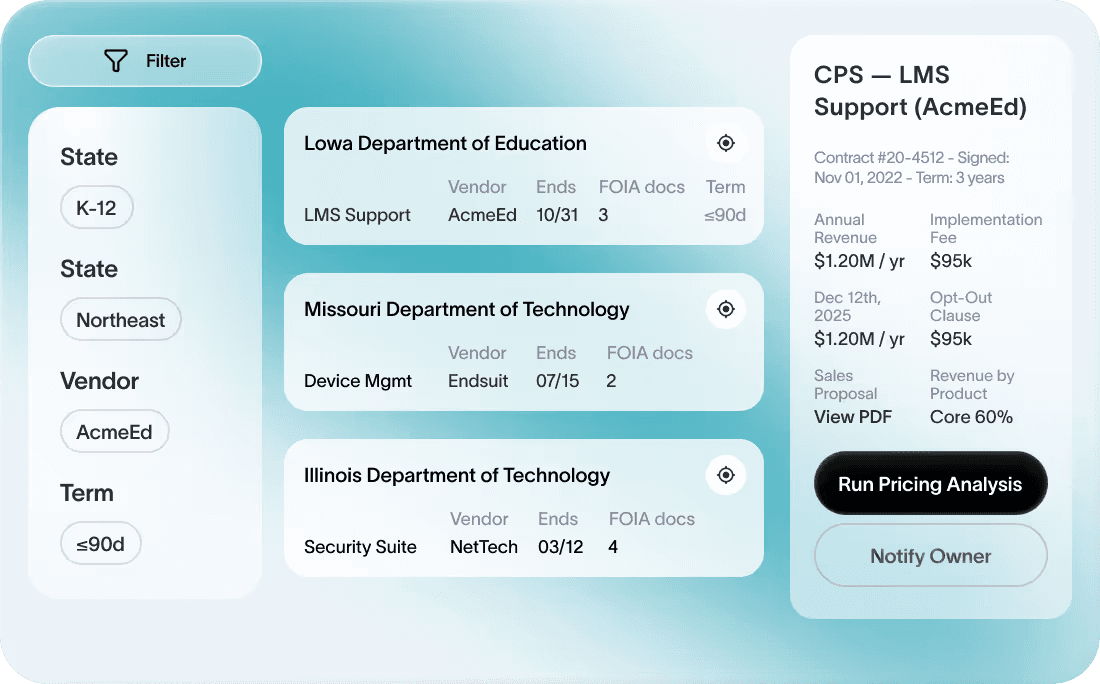
Ask Starbridge Chat lets reps pull buyer research instantly with natural language queries. Responses are tailored to their business, products, and market. The Slack integration means reps can access intelligence without switching tools.
Frontline Education cut research time by 90% with Starbridge. Their reps now walk into meetings already knowing what the buyer cares about, so the conversation starts at the problem, not the introduction.
Abnormal AI saw similar results. The company cut research time by 10 hours per week by centralizing account context, competitive intelligence, and procurement data in one platform.
From intelligence to pipeline without extra work
The teams winning government and education deals don’t treat intelligence as background research. They treat it as the pipeline engine itself.
Reps no longer need to spend hours digging through district websites and government portals. Starbridge provides buying indicators paired with a verified contact, a reason for outreach, and AI-generated copy pushed directly into Salesforce, HubSpot, Apollo, or Outreach.
Book a demo with Starbridge to win more state and local government, K–12, and higher education contracts by prioritizing the right accounts, engaging decision-makers earlier, and acting faster on high-intent opportunities.
Frequently asked questions
Public sector sales is the practice of selling products or services to federal, state, and local government, K–12 school districts, and higher education institutions. It differs from traditional B2B because procurement is formalized and governed by transparency rules, buying timelines follow fiscal year budget cycles, and multiple stakeholders with competing priorities are involved in every decision.
Buying signals are early indicators that a school district, university, or state or local agency is preparing to spend. Examples include board meeting discussions, budget allocations, leadership changes, grant awards, and contract expirations. They matter because teams that act on these indicators engage decision-makers weeks or months before procurement begins, while competitors are still waiting for the RFP.
B2G sales cycles typically range from 2 to 18 months after the economic buyer says yes. The timeline depends on deal size, procurement path, and the specific agency. Once your champion says yes, procurement’s job is compliance, not negotiation.
ZoomInfo and Apollo scrape LinkedIn, which barely covers government and education. Roles change, titles are inconsistent, and the data goes stale quickly. These tools were built for commercial B2B, not government procurement patterns. Starbridge delivers 3-4x data enrichment coverage versus these alternatives and maintains a 2% email bounce rate, compared to 15-25% user-reported bounce rates for tools like ZoomInfo.
Monitor pre-RFP buying indicators like board meeting discussions, budget allocations, leadership changes, grant awards, and contract expirations. These surface months before formal procurement begins. Pair each indicator with a verified contact and a specific reason for outreach, then reach out while the agency is still defining what they need.
Starbridge is the AI sales intelligence platform built on the most comprehensive dataset of government and education buyers and buying signals. It monitors over 1 million entities around the clock for buying indicators, provides verified contact data with 98% email accuracy, surfaces public spend and competitor intelligence, and pushes prioritized opportunities directly into Salesforce, HubSpot, Apollo, and Outreach. Customers book up to 2.5x more meetings and reduce research time by up to 90%.
Yes. Starbridge offers native, bi-directional integrations with both Salesforce and HubSpot that sync, clean, and enrich your CRM data. Account scores, verified contacts, buying indicators, and competitive intelligence all flow directly into your CRM so reps can act without switching tools.
Explore our use case library
 Automate account research with AI agentsStop manually researching accounts. Starbridge AI agents automate account research by monitoring buying signals 24/7 and surfacing the right contacts.
 Identify competitor contract expiration datesThe RFP is usually a formality. Starbridge surfaces competitor contract expiration dates so your reps reach accounts before the renewal cycle closes.
 Create a conference campaignTurn conference badge scans into pipeline. Import your contact list, surface buying signals across every account you met, and follow up with context.