
Edtech sales strategy: How to win deals before the RFP
Most edtech companies respond to RFPs they've already lost. Here's the founder-tested strategy for getting into deals months before your competitors.

At CourseDog, I spent six months building something the registrar didn’t want.
I was convinced we had a product problem. We didn’t. We had an entry-point problem. We were building in isolation, talking to the wrong people, showing up after decisions had already been made. The fix wasn’t a better product. It was getting into conversations before anyone else knew a need existed.
By the time an RFP drops in K-12 or higher ed, the winning vendor already helped write the spec. If you’re responding to solicitations you didn’t see coming, you’re not competing. You’re filling out paperwork for someone else.
This guide covers what actually works for edtech sales across K-12 and higher ed. The entry points, the stakeholders, the procurement levers, and the tools that matter. It draws from building CourseDog and from watching hundreds of edtech teams build pipeline at Starbridge. These tactics are specific enough to use this week.
What Is an Effective Edtech Sales Strategy?
An effective edtech sales strategy focuses on entering accounts before the RFP is posted, building relationships across multiple stakeholders who each evaluate you separately, and pricing to avoid triggering formal competitive procurement. The companies that win consistently are in district and campus conversations 6 to 12 months before a solicitation goes public.
Why edtech sales are different from commercial SaaS
In commercial SaaS, you find a champion, build a business case, and close. In K-12 and higher ed, that same process runs through formal procurement rules, fiscal-year budget calendars, multi-stakeholder committees, and compliance requirements before anyone writes a check.
The economic buyers in education don’t move on individual authority. A curriculum director who loves your product still needs board approval above $10,000 in most districts. A VP of Student Affairs at a university needs IT security sign-off and procurement registration before the contract executes. The timeline isn’t slow because buyers are difficult. It’s slow because the system requires it.
The edtech sales teams that compress that timeline understand the system well enough to work around it before it activates.
K-12 vs. higher ed — where the differences change your sales motion
K-12 usually runs on fiscal years ending June 30. Budget planning starts in January for the following year, which means your best pipeline conversations happen January through May. Higher ed timelines vary by institution, but most large universities tie purchases to their own budget cycles and require vendor registration through a central procurement office before any contract executes.
Federal funding is a K-12 lever that higher ed mostly doesn’t have. Title I, IDEA, and Title IV-A funds each have application and spending cycles that create predictable purchase windows. If your product serves English language learners and a district just received Title III funding, that’s not just a lead. That’s a deal waiting to close.
For a detailed breakdown of selling to school districts, see our guide to K-12 sales.
Who Actually Controls the Edtech Buying Decision?
Getting this wrong is the most common reason edtech sales cycles stall. Three stakeholders control every K-12 deal, and they don’t evaluate you on the same criteria.
The three-stakeholder model in K-12
The end user, often a curriculum director, department head, or teacher, evaluates whether your product improves their daily work and fits their students’ needs. They’re frequently your champion and the person who initiated the evaluation. Their enthusiasm is necessary but not sufficient.
The economic buyer, typically a CFO, deputy superintendent, or superintendent, thinks in terms of organizational impact. What does this cost, what does it save, and what does it cost politically if it fails. They control the budget line and may require board approval for anything above the district’s threshold.
The IT buyer is often the actual decision-maker in K-12, not just an evaluator. If your product touches student data, the CTO or IT director may hold outright veto authority. Their lens is data privacy. FERPA compliance, state privacy frameworks, and SOC 2 certification are all required before IT signs off. Engage IT early. The vendors who treat IT as a late-stage check lose deals that were won on every other dimension.
How stakeholder roles shift in higher ed
In higher ed, the same three stakeholders exist, but a fourth layer appears. The central procurement office at most universities requires vendor registration, a security review, and sometimes addition to an approved vendor list before a contract executes. That process alone takes 4 to 8 weeks.
Department champions at universities often have strong opinions about what they want but limited budget authority. A director of academic affairs can champion your product enthusiastically and still need the provost’s office to approve funding. Map budget authority early. The person who initiates the conversation is rarely the person who signs the PO.
Small vs. large districts
In small districts (under 5,000 students), the superintendent often controls the budget, makes the call, and sometimes handles procurement directly. You can run a more compressed sales motion. In large districts, those roles split across departments, and the person who agrees on a discovery call often can’t approve the contract alone.
Know which type of district you’re in before you plan your motion. A three-stakeholder process in a small district looks very different from the same process in a 50,000-student urban district with its own procurement department.
How Do You Find Edtech Sales Opportunities Before the RFP?
Here’s the dynamic that kills most edtech pipelines. By the time the RFP drops, the relationship’s already set. The vendor who wins was in conversations with the district or campus six months earlier. They helped frame the problem. They may have influenced the evaluation criteria. If you’re discovering opportunities when the solicitation posts, you’re starting from behind.
Why most edtech reps show up after the decision is made
The RFP is not an opportunity. It’s an announcement that someone else already had the opportunity. Nine times out of ten, when an RFP drops for a specific technology category, a vendor already has a relationship with the account, and the specification was written around what that vendor does well.
This isn’t pessimism about procurement. It’s how procurement actually works. The buyers who write an RFP draw on conversations they’ve already had, demos they’ve already seen, and reference checks they’ve already made. Your job is to be part of those earlier conversations, not to scramble when the document drops.
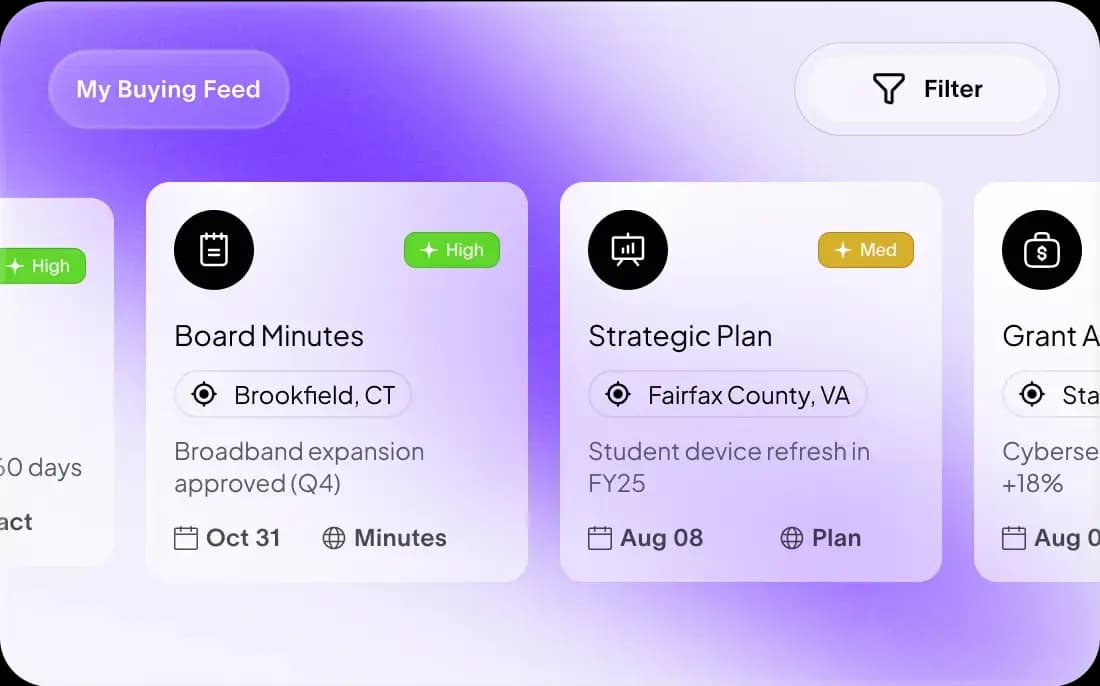
How to read board meeting minutes for buying signals
School board meeting minutes are public record. Every month, district boards discuss priorities, review technology committee recommendations, and reference their strategic plans. Technology purchasing discussions appear in board minutes 6 to 12 months before a solicitation is posted. A district whose technology committee is discussing student information system modernization in January is probably issuing an RFP in August.
Look for technology committee reports, curriculum discussions that reference specific gaps, budget line items for evaluation or piloting, and agenda items labeled “future priorities.” These early demand signals don’t require a source inside the district. They’re in public documents anyone can read.
The January to March window is when this matters most. Districts are finalizing budget priorities for the next fiscal year. The conversations happening in board meetings right now are turning into purchase decisions this summer and RFPs next fall.
Federal funding cycles as your entry point
In K-12, federal funding isn’t just a budget source. It’s a procurement signal. Title I, IDEA, Title III, and Title IV-A each have application cycles and spending timelines. When a district receives a new grant or holds an open funding line, they often need to spend it, and your product may fit exactly what that grant is intended to fund.
Before every K-12 call, ask yourself which funding sources the district is using for the relevant initiative. If you can connect your product to a specific grant the district already holds, you’re removing the budget objection and simplifying their procurement path. A district with Title I funds allocated to curriculum support has a budget line waiting. Your job is to be the obvious way to spend it.
The end-of-year surge
April through June is the most underestimated window in K-12 sales. Districts are spending down current-year budgets before the June 30 fiscal year close. These “use it or lose it” funds need to be committed quickly. Deals that would normally require a 90-day procurement process close in weeks when a district has remaining funds and a hard deadline.
These purchases often land under the board approval threshold, which means no competitive bid required. A district that won’t start a formal evaluation in March will sometimes execute a sole-source contract in May if the deal is sized correctly.
Getting into accounts at the right moment requires monitoring buying indicators most edtech reps never see.
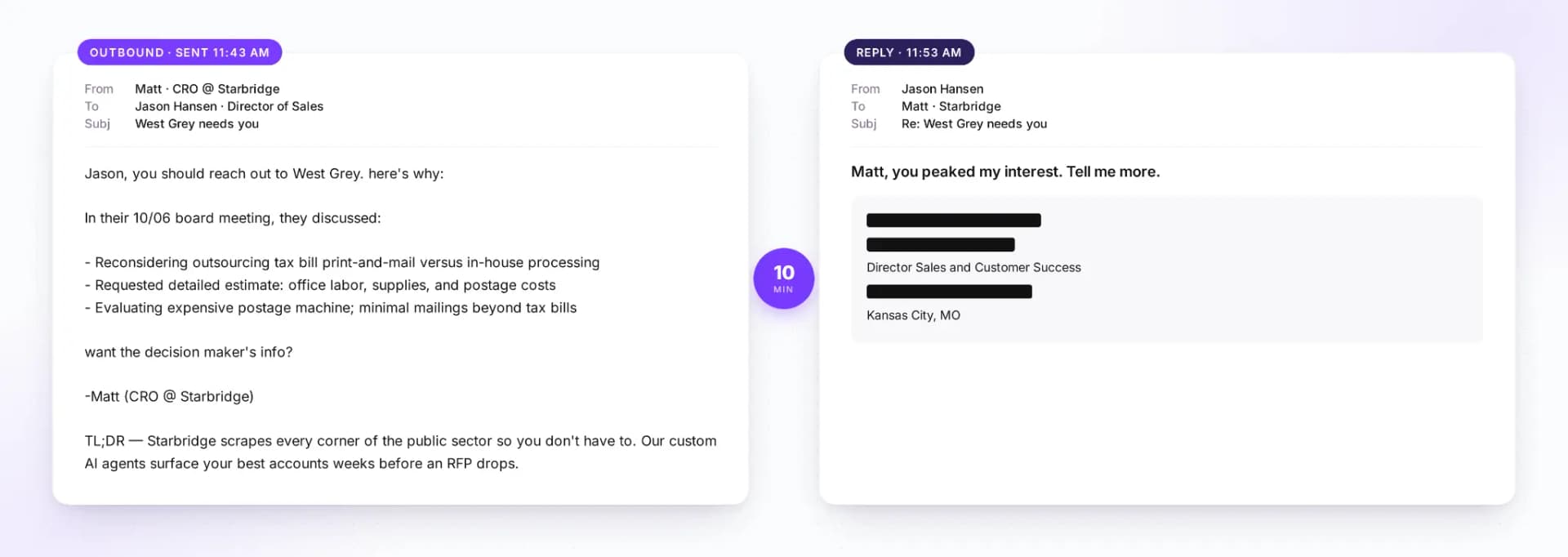
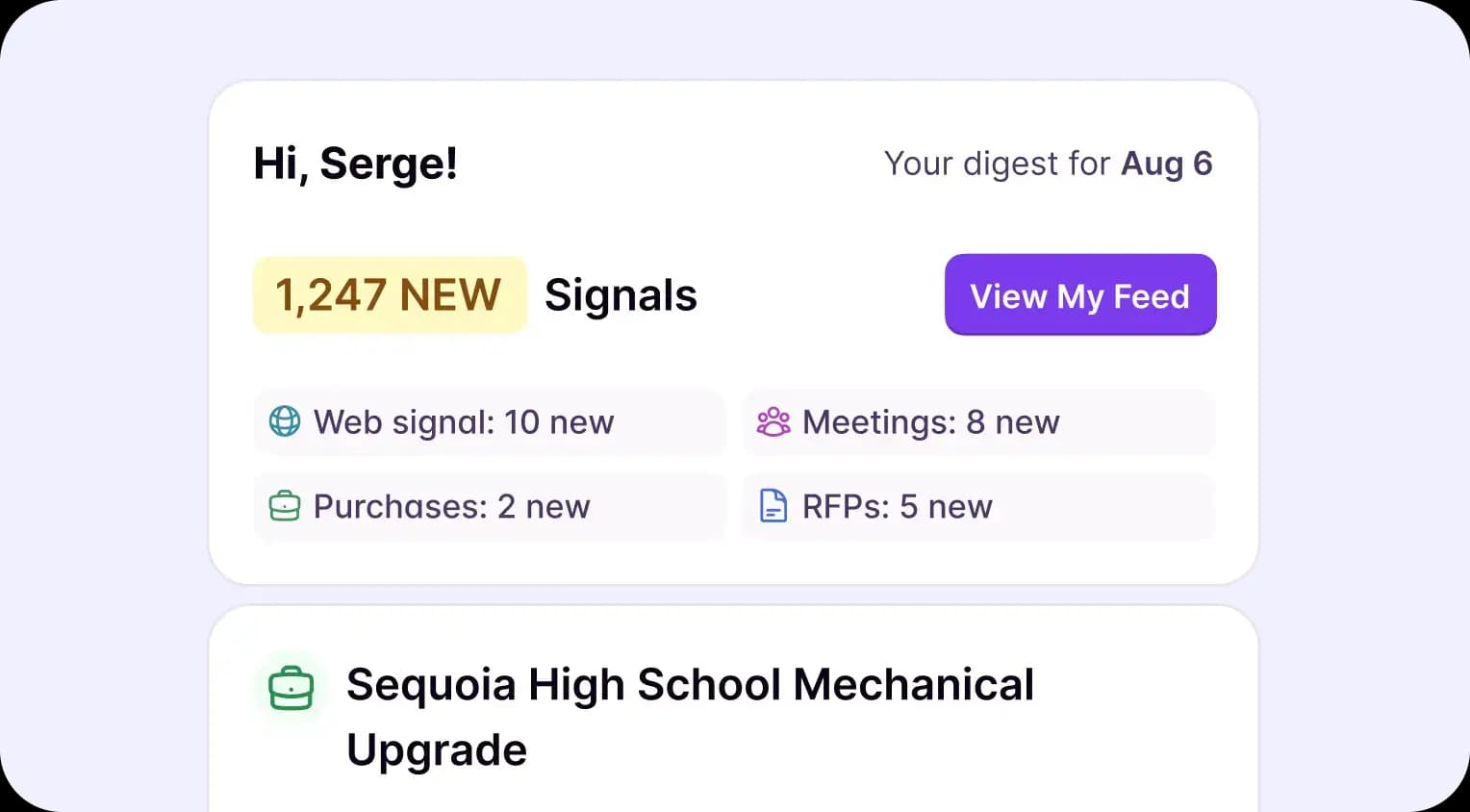
Starbridge, the AI sales intelligence platform built on the most comprehensive dataset of government and education buyers and buying signals, surfaces those indicators before your competitors know they exist. Its Buying Signals Monitor tracks board meeting minutes, contract expirations, and leadership changes across every K-12 district and higher ed institution in the country, delivering alerts when accounts move into active buying mode.
ClearGov generated $300,000 in pipeline from a single email campaign built on Starbridge intelligence, replacing generic mass outreach with campaigns grounded in specific account activity across their entire addressable market.
The earliest entry wins more often than the best pitch.
What Tools Do Edtech Sales Teams Use?
Most edtech sales teams use tools built for commercial B2B markets, then wonder why the data is wrong and the timing is off. The tools that matter for edtech surface what’s happening inside accounts before those accounts signal their intent anywhere public.
The pre-RFP intelligence stack
The buying indicators that matter in K-12 and higher ed aren’t in generic sales databases. They’re in board meeting agendas, technology committee reports, federal spend data, and contract expiration timelines. Monitoring those sources manually takes 20 to 30 minutes per account per call. At any reasonable territory size, it’s not possible.
The edtech teams running the most efficient sales motions pull board meeting summaries, account scoring, and contact enrichment directly into their CRM rather than running parallel research across browser tabs.
Why horizontal tools miss education data
LinkedIn barely covers K-12 and higher ed decision-makers, and what coverage exists goes stale fast. Most B2B databases were built for commercial enterprise sales and have limited penetration into education. Bounce rates of 20 to 25 percent are common when running outreach from generic database contacts in K-12. One in four emails you send never reaches anyone.
The problem isn’t just contact accuracy. It’s the absence of the buying indicators that matter in education. A commercial sales tool can tell you a company raised a Series B. It can’t tell you a school district’s technology committee discussed a specific platform in last month’s board meeting, or that a university’s incumbent contract expires in nine months.
Integrating intelligence into your CRM and outreach
A rep who walks into a discovery call knowing a district’s technology priorities, current vendor relationships, and budget alignment is a fundamentally different salesperson from one who spent the night before manually searching for context. The gap between those two reps isn’t skill. It’s information.
The account scoring model that works in K-12 runs on enrollment trends, competitor contract expiration timing, and how frequently a specific technology category appears in the district’s board discussions. Score your entire addressable market on those dimensions and prioritize calls accordingly.
Edtech teams that shift from generic databases to education-specific intelligence don’t just get cleaner data. They change how their reps work.
Starbridge’s Contacts and Company Data is built specifically for K-12 school districts and higher ed institutions, with a 98% email accuracy rate across a test of 14,000 contacts. The underlying data is built entirely from public-sector sources, not scraped from LinkedIn — giving reps accurate contact coverage across all 13,598 U.S. school districts and every higher ed institution.
InquirED, an edtech company selling curriculum solutions to K-12 districts, drove $200,000 in new pipeline in their first quarter after replacing manual board document research with Starbridge’s signal-driven account scoring. Frontline Education cut research time by 90%, with reps now walking into meetings already knowing what each buyer cares about.
The right intelligence doesn’t find more accounts. It tells you which ones are actually ready to buy.
How Do You Close Edtech Deals Faster?
The procurement system in K-12 and higher ed is predictable. The vendors who close fast have learned to use it rather than fight it.
There are three ways to avoid triggering a competitive bid: price below the district’s sole-source threshold, get your company onto a cooperative purchasing vehicle before the deal comes up, or route the deal through a distributor who already holds the right contract. Most edtech teams only know the first one.
How long are edtech sales cycles?
The range is wide. Formal RFP processes add 3 to 9 months to any deal cycle, putting total timelines at 6 to 18 months from first conversation to signed contract. Sole-source contracts and cooperative purchasing vehicles close in 4 to 8 weeks. The primary driver isn’t product complexity or deal size. It’s procurement path.
Cycle length is largely determined by decisions you make before you present pricing. Know the procurement path before you name a number.
Sole-source thresholds — the most underused lever in edtech
Every K-12 district and higher ed institution has a dollar threshold above which competitive procurement is required. Below that threshold, the buyer can purchase from a single vendor without issuing an RFP. This is the most underused closing lever in edtech sales.
The thresholds vary considerably. Most K-12 districts require school board approval for purchases above $10,000, which means anything below that can often be executed by a single administrator without a board vote. California state entities can often sole-source up to $100,000. Texas state agencies go to about $50,000. Universities generally have higher thresholds and more flexibility.
Know the threshold before you price the proposal. A first contract at $9,500 in a district with a $10,000 board approval requirement closes in four weeks. The same deal at $12,000 requires a board meeting, a public agenda item, and a vote, adding 30 to 60 days minimum.
Cooperative purchasing vehicles — the RFP bypass
For deals that exceed the sole-source threshold, cooperative purchasing vehicles are the fastest path to close. A cooperative contract means the buyer purchases off a contract that was already competitively bid at the state or national level, skipping their own RFP process entirely.
The major vehicles include NASPO ValuePoint (national, all 50 states), Omnia Partners, Sourcewell, Texas DIR, New York OGS, and state-specific equivalents. If your company holds a NASPO contract, a district anywhere in the country can buy from you without issuing their own solicitation.
Getting onto a cooperative vehicle typically requires a distributor relationship with Carahsoft, CDW, or Insight. Traditional distributors won’t engage without a live deal in hand, ideally six figures or more. Prioritize this once you have a signed contract at that level. Every subsequent deal can then bypass competitive procurement.
Should edtech companies offer free pilots?
No. In my experience, free pilots fail 98% of the time.
At CourseDog, every free pilot we ran was unsuccessful. Not because the product wasn’t good enough. Because without financial commitment, districts don’t allocate the staff time, IT resources, or administrative attention an implementation requires. Offering something for free signals that you don’t believe it’s worth paying for.
Once we moved to market-competitive pricing in multi-year agreements, close rates went up. The payment wasn’t the barrier. It was a commitment signal that changed how buyers engaged with the rollout.
When you do offer a pilot, define measurable success criteria before it starts. Teacher adoption rate, reduction in admin hours, specific student outcome metrics. Require a financial commitment, even a small one. Build a clear expansion decision date into the pilot agreement. Discounting to win a pilot trains the buyer to expect discounts at renewal.
For the deals that do go to a formal RFP, Starbridge’s AI RFP Finder and Proposal Writer surfaces relevant solicitations and helps edtech teams respond faster.
Conclusion
The edtech deals that close are rarely the ones that started at the RFP. They started with a technology committee agenda, a federal funding cycle, an end-of-year budget surplus, or a new superintendent who needed a quick win.
Three things determine whether you win before the solicitation posts: whether you’re monitoring accounts early enough, whether you’ve built relationships across all three stakeholders before IT becomes a blocker, and whether you know the procurement paths available to bypass a competitive bid — through threshold pricing, cooperative vehicles, or the right distributor relationships.
The best edtech sales teams aren’t faster responders. They’re earlier entrants. Get into the right accounts before your competitors know those accounts are in market, and the close is rarely the hard part.
To see how Starbridge helps edtech teams surface pre-RFP early demand signals across K-12 school districts and higher ed institutions, visit the Buying Signals Monitor.
Frequently asked questions
An effective edtech sales strategy focuses on entering accounts before the RFP is posted, building relationships across end users, economic buyers, and IT stakeholders independently, and pricing to avoid triggering competitive procurement. Companies that win consistently are in K-12 and higher ed conversations 6 to 12 months before a solicitation goes public.
Edtech sales cycles range from 6 to 18 months with a formal RFP, or 4 to 8 weeks with a sole-source contract or cooperative purchasing vehicle. Cycle length is primarily driven by procurement path, not product complexity. Pricing below the district’s sole-source threshold and using cooperative purchasing vehicles are the two fastest ways to compress timelines.
Monitor public school board meeting minutes for technology committee discussions, which surface 6 to 12 months before a solicitation is posted. Layer in the K-12 fiscal calendar (peak purchase window: January to May) and federal funding cycles (Title I, IDEA, Title IV-A) to identify districts with open budget lines. April to June is also high velocity for end-of-year sole-source contracts.
There are three ways to avoid competitive procurement: price below the district’s sole-source threshold, get on a cooperative purchasing vehicle (NASPO ValuePoint, Omnia Partners, Sourcewell, or state DIR programs), or route the deal through a distributor like Carahsoft or CDW who already holds the right contract. Most edtech teams only use the first lever.
No. Free pilots fail 98% of the time. Without financial commitment, buyers don’t allocate the staff time or resources needed for a successful implementation. Require a small payment, define measurable success criteria before the pilot starts, and include a clear expansion decision date in the agreement. Price at market rate from the first conversation.
The core stack for edtech sales intelligence includes board meeting minute monitoring, contract expiration tracking, leadership change alerts, and education-specific contact enrichment. Generic B2B databases run 20 to 25% bounce rates in K-12. Effective edtech teams deliver these buying indicators directly into Salesforce or HubSpot so reps act without switching tools.
Explore our use case library
 Automate account research with AI agentsStop manually researching accounts. Starbridge AI agents automate account research by monitoring buying signals 24/7 and surfacing the right contacts.
 Identify competitor contract expiration datesThe RFP is usually a formality. Starbridge surfaces competitor contract expiration dates so your reps reach accounts before the renewal cycle closes.
 Create a conference campaignTurn conference badge scans into pipeline. Import your contact list, surface buying signals across every account you met, and follow up with context.