
A tactical guide on how to sell to schools
Learn how to sell to schools with a tactical guide covering K-12 procurement, account scoring, buying signals, and outreach strategies that drive meetings before RFPs drop.

K-12 districts in the United States spend tens of billions of dollars on technology, services, and curriculum every year. Yet most sales teams chasing that market run the same commercial B2B playbooks they use everywhere else. Low win rates, stalled deals, and months of effort with nothing to show for it.
Selling to schools is a distinct discipline. Districts follow formal procurement rules. Budgets lock to rigid fiscal-year calendars. Purchasing decisions pass through multi-stakeholder committees where an assistant superintendent, a technology director, and a curriculum coordinator may all hold veto power.
This guide will help you learn how to sell to schools. You will learn how K-12 buying decisions actually get made, how to prioritize which districts to target, where to find accurate contact data, how to spot pre-RFP buying signals, how to build outreach that earns responses, and how to turn a single pilot into a district-wide contract.
1. Learn how K-12 buying decisions actually get made
Most deals stall because reps treat a school district like a single buyer. It is not. Every district has a committee of stakeholders who each evaluate your product through a different lens.
Understanding who they are and how they interact is the first step to building a real pipeline.
In small districts (under 5,000 students), a superintendent often doubles as the economic buyer and the strategic decision-maker. In mid-size and large districts, the roles split across departments. A curriculum director or principal serves as the end user. A CFO, deputy superintendent, or school board controls the budget. And a CTO or IT director evaluates security, integration, and infrastructure fit.
| Buyer Role | Title Examples | What They Evaluate |
|---|---|---|
| End User | Principal, Curriculum Director, Department Head | Workflow fit, ease of adoption, impact on students or teachers. |
| Economic Buyer | CFO, Deputy Superintendent, School Board | ROI, total cost, budget alignment, political risk. |
| IT Buyer | CTO, IT Director, Network Administrator | Security compliance, integration requirements, data privacy. |
IT is often a decision-maker in K-12, not merely an evaluator. If your product touches student data, the IT buyer may have outright veto authority.
Budget cycles drive timing. Most districts operate on a July-to-June fiscal year, with budget planning starting in January or February. Federal funding sources add complexity.
Title I funds target low-income schools. IDEA funds support special education. Title III supports English learners. State grants and local bond measures create additional windows. Aligning your sales motion to these funding streams is not optional.
Before any vendor conversation moves forward, districts will ask about data privacy and security compliance. At a minimum, expect questions about FERPA compliance, a security questionnaire, and your data handling policies. Many districts now require SOC 2 certification and state-specific privacy frameworks.
Building your compliance documentation in this order gives you a clear path forward. Start with your security deck, then FERPA documentation, then SOC 2 certification, and finally StateRAMP compliance.
Once the economic buyer says yes, procurement can still take 2 to 18 months depending on deal size, procurement path, and district policies. Reps who understand this timeline plan accordingly rather than forecast deals that slip quarter after quarter.
2. Prioritize which districts to target first
There are over 13,000 school districts in the United States. No team can cover them all. Yet most reps default to sorting by enrollment or geography and calling down the list.
That approach wastes cycles on districts that have no budget, no need, or a five-year contract with a competitor already in place.
A better approach is building a scoring model around 5 to 7 attributes that reveal actual buying readiness. The two core questions are simple. Is there a use case for my product? And is there a budget?
| Priority Level | Use Case and Pain Indicators | Budget and Capacity Indicators | Competitive Indicators |
|---|---|---|---|
| High (9–10) | Board minutes or strategic plan explicitly names your category as a priority. | Budget documents show a specific line item or a hiring spree in the relevant department. | Incumbent contract expiring in under 12 months, or public pain with the current vendor. |
| Medium (5–8) | High-level goals suggest a need, e.g. “Improve student outcomes,” but no specific project named. | Large operating budget or recent grant award, but no line item for your solution. | Competitor is present but contract is not expiring soon. |
| Low (1–4) | No evidence of your use case in recent public documents. | Budget freezes, layoffs, or cost-cutting mandates in recent news. | Competitor just signed a multi-year deal. |
The buying signals that feed this model are hiding in plain sight. Board meeting agendas, budget documents, grant awards, strategic plans, and contract expirations are all public record. The problem is that finding them manually across thousands of districts is not sustainable.
Starbridge, the AI sales intelligence platform built on the most comprehensive dataset of government and education buyers and buying signals, solves this at scale. Its Public Spend Intelligence functionality aggregates procurement and spend data across districts so teams can see which accounts are actively buying in their category. Starbridge lets teams define scoring criteria in plain language, and scores update automatically as new buying signals arrive.
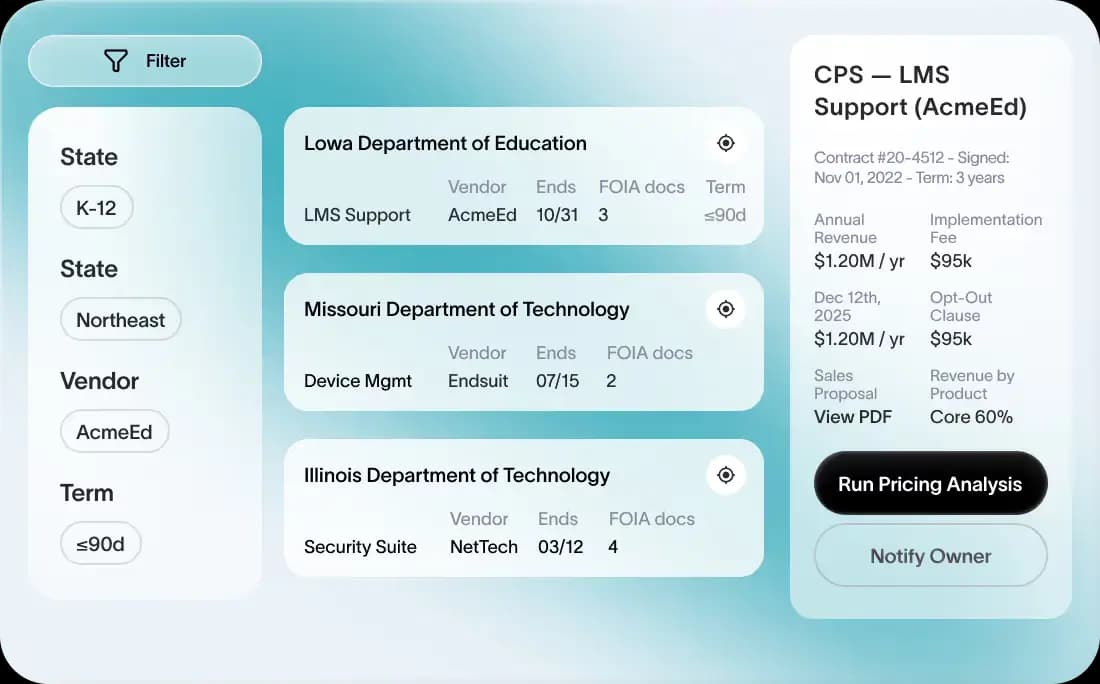
Mantra Health, for instance, saw 3x data enrichment coverage after switching to Starbridge. The team got a complete view of their addressable market for the first time.
Scored accounts drive every downstream decision. They determine your call list, your conference strategy, your outbound segmentation, and where you invest time building relationships. Get the scoring right and everything else becomes more efficient.
3. Source accurate contact data for K-12 decision-makers
You can score every district perfectly and still go nowhere if your contact data is wrong. This is where most teams selling to schools hit a wall.
Generic B2B enrichment tools were built for commercial markets. They scrape LinkedIn, company websites, and social profiles. That works when your buyer is a VP of Marketing at a SaaS company. It fails in K-12, where decision-makers rarely maintain LinkedIn profiles and staff turnover reshuffles directories every summer.
User-reported bounce rates for tools like ZoomInfo sit between 15 and 25%. That means one in five emails never reaches anyone.
Accurate K-12 contact data comes from official sources like district websites, staff directories, board meeting rosters, and state education agency databases. But these sources are fragmented, inconsistently formatted, and constantly changing. A curriculum coordinator listed on a district website in September may have moved to a different district by January.
Role-level context matters just as much as email accuracy. Knowing that someone is a “director” is not enough. You need to know if they direct curriculum, technology, or finance, because the outreach message is completely different for each.
Starbridge Contacts & Company Data pulls contacts from school and district websites using proprietary web-agent technology and validates them through continuous bounce-checking. The result is 98% email accuracy, validated across a 14,000-email test.
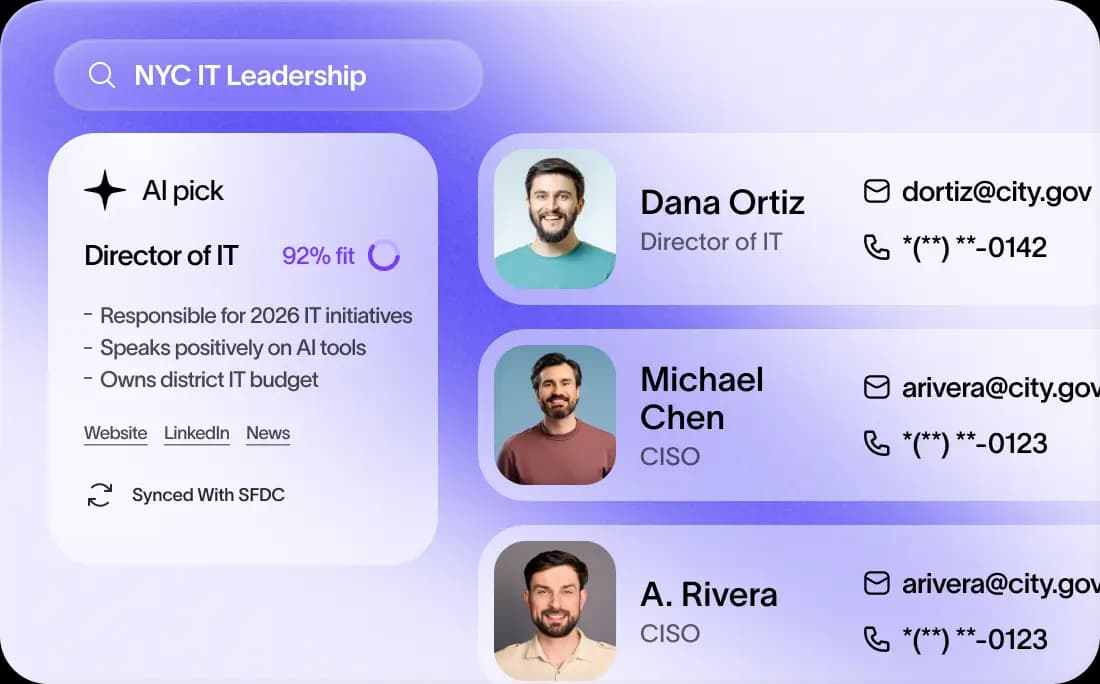
Within days of onboarding, Storage Scholars built a fully enriched TAM database and identified over 300 opportunities that their previous data provider had missed entirely.
Accurate data compounds over time. Reps stop wasting hours verifying contacts and start acting on them.
4. Track pre-RFP buying signals to time your outreach
In K-12 sales, timing is the difference between shaping a deal and chasing one.
Government and education buyers are rarely experts in the solutions they are evaluating. They consult vendors early to understand what is possible, what peer districts have done, and what questions to ask. By the time an RFP is published, the vendor who educated the buyer has already influenced the evaluation criteria. They helped frame the requirements. They built the relationship. The RFP was written with their solution in mind.
Responding to that RFP cold is an uphill battle at best.
The most valuable pre-RFP buying signals in K-12 include the following.
- Board meeting minutes discussing your product category or a related initiative
- Budget documents with new line items or increased allocations
- Strategic plans naming technology modernization, student safety, or digital learning
- Grant awards from federal or state programs tied to your solution area
- Leadership changes in superintendent, CTO, or curriculum leadership roles
- Job postings for roles that signal a new initiative (e.g., “Director of Digital Learning”)
- Contract expirations for incumbent vendors in your category
Monitoring these buying indicators manually across even a few hundred districts is unsustainable. Each district publishes information in different formats, on different schedules, across different websites.
Starbridge Buying Signal Monitor tracks these buying signals in real time across thousands of districts. It surfaces board discussions, budget changes, leadership transitions, grant awards, and contract expirations, with bids and RFPs included as well.
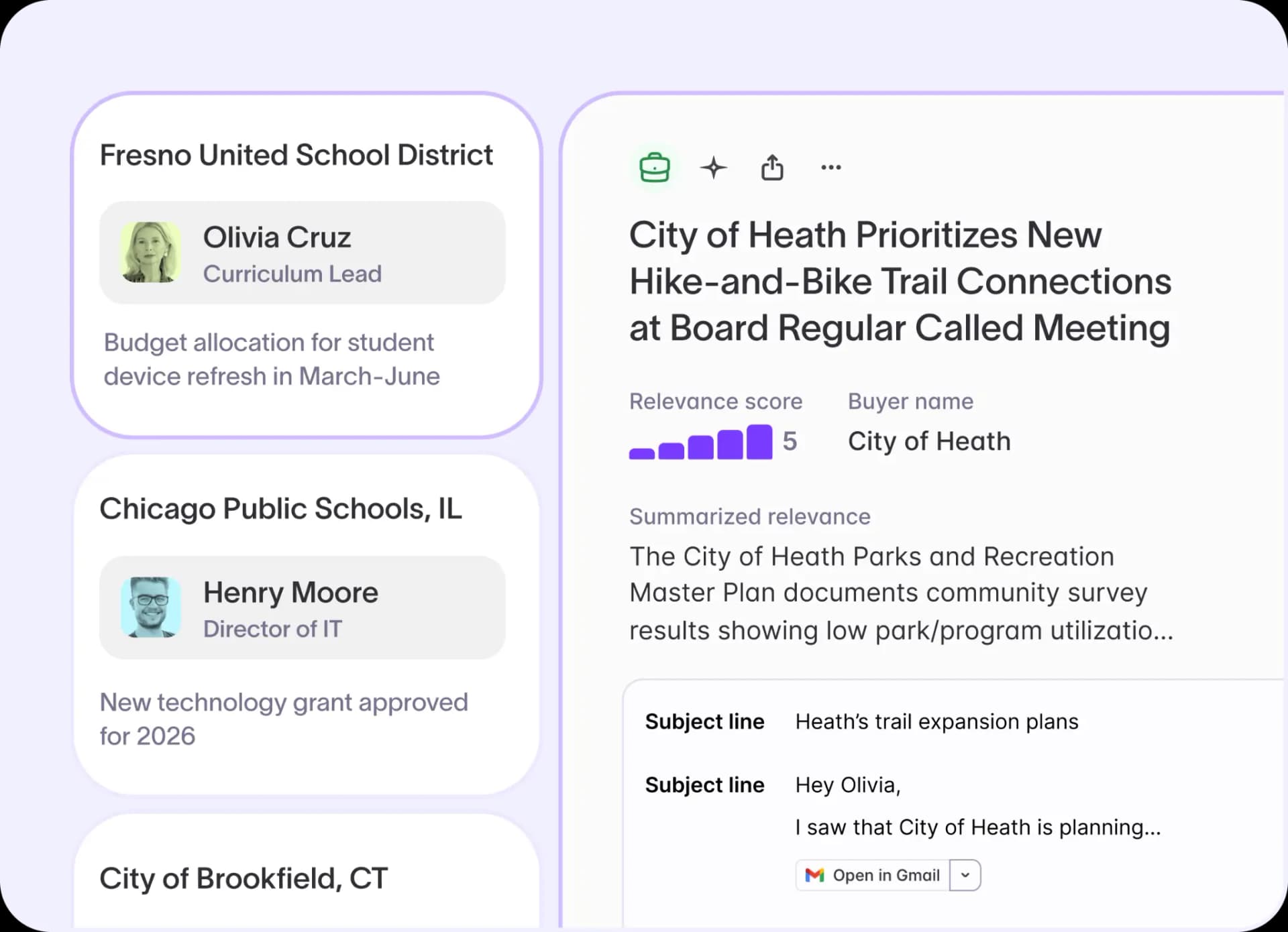
In their first week on the platform, GovWell booked 5 meetings. Hapara, meanwhile, saw 20% higher response rates by timing outreach to active buying indicators.
Each buying signal should map to a specific outreach action.
- Board discussion about your category? Send a relevant case study to the superintendent.
- Budget line item for your solution area? Reach out to the CFO with ROI data.
- Grant award? Connect your product to the grant’s stated objectives.
- Contract expiration? Lead with a competitive displacement message.
- Leadership change? Introduce yourself within the first 30 days.
Buying indicators only drive pipeline if they reach your reps where they already work. Starbridge bi-directional CRM integrations sync, clean, and enrich data directly in Salesforce and HubSpot. Buying signals surface inside the tools your team already uses every day.
When a new signal lands, reps can use Ask Starbridge Chat to pull account context, competitor history, and spending data without leaving the platform.
5. Build outreach that earns responses from school administrators
School administrators are busy, skeptical, and inundated with vendor pitches. A generic cold email that leads with your product’s feature list will get deleted. Earning a response requires showing that you understand their world and the outcomes they care about.
Frame every value proposition around educational outcomes, not software capabilities. District leaders think in terms of student achievement, teacher retention, and operational efficiency. If your product improves reading scores, say that. If it saves a technology director 10 hours per week on compliance reporting, lead with the time savings.
The product is the mechanism. The outcome is the message.
Outreach tactics that work in K-12 share a common thread. They demonstrate relevance and reduce perceived risk.
- Lead with a case study from a similar district (same size, same state, same challenge)
- Reference a specific initiative from the district’s own board minutes or strategic plan
- Share pilot results with measurable outcomes, not just testimonials
- Cite funding sources the district already has access to (Title I, IDEA, Title III, ESSER)
The most effective channel mix layers multiple approaches in a deliberate sequence.
Warm introductions convert at the highest rate. Government and education buyers are herd-driven. Close one district, and every similar nearby district becomes dramatically more likely to buy. After each win, build a list of the most similar accounts in the same region (same size, same segment, same challenge) and lead with the reference. “We just partnered with [District X]” lands harder with a neighboring superintendent than any feature pitch. Make this a repeatable motion, not a one-off.
Conferences work when you pick events where your actual economic buyers attend, not general industry conferences. For lean teams, skip the booth and suitcase it. Buy a ticket, work the floor, and walk up to buyers in hallways and at other booths. The highest-converting play is account-based personalized handouts. Enrich the conference attendee list in advance, then create one-pagers tailored to each account. Reference a nearby customer win, pull a line from the account’s strategic plan, and include their logo. Buyers immediately see you did the homework, and conversion rates on these are significantly higher than generic collateral.
Email and cold calls are the most scalable channel but convert at 0.5 to 1% book rates. Start with 100 manually personalized emails before automating. Personalization at this stage is about the district, not about you.
Cold RFPs are low priority early on. Responding to an RFP you did not help shape is expensive and rarely successful. Invest that time in pre-RFP relationship building instead.
Connect your product to government funding streams in every conversation. If a district received a Title I grant, show how your product supports the funded initiative. If IDEA funding is available, tie your solution to the special education outcomes it enables. Funding alignment removes the “we don’t have budget” objection before it surfaces.
Intelligence only drives pipeline when it translates into action inside the tools reps already use. Starbridge closes that gap by delivering prioritized accounts and buying indicators through daily email digests, so every rep starts the morning knowing exactly who to call and why.
For teams working conferences, Starbridge Conference Intelligence scores attendees by ICP fit and enriches lead lists with verified contact data. Every event is turned into a qualified pipeline rather than a stack of business cards.
For teams responding to RFPs, the Starbridge AI RFP Finder & Proposal Writer tracks best-fit opportunities by product and region, then auto-drafts proposals using account intelligence already in the platform.
HousingCloud found 30% more RFPs and saved 8 to 10 hours per RFP after using Starbridge to surface opportunities and generate proposal-ready intelligence.
6. Turn a pilot into a district-wide contract
Landing a pilot is just the starting line. Most vendors treat pilots as a free trial and hope usage speaks for itself. That approach fails the vast majority of the time because free pilots signal no commitment.
A pilot without clear success criteria, a financial commitment, and a defined timeline is just a demo that overstayed its welcome.
Structure every pilot for expansion from day one.
- Define measurable success criteria before the pilot begins (e.g., teacher adoption rate, reduction in administrative hours, student engagement metrics)
- Require a financial commitment, even a small one, to establish that the district sees value worth paying for
- Set a clear timeline with a decision date for expansion built into the agreement
- Identify which stakeholders need to see results and schedule check-ins accordingly
Price at market rate or slightly premium. Discounting to win a pilot trains the buyer to expect discounts at renewal. It also undermines your positioning when the expansion conversation starts.
Not every pilot is ready for a district-level conversation. Look for these indicators before pushing for expansion.
- The end user is actively using the product and can articulate specific outcomes
- The economic buyer has been briefed on results and has expressed interest in broader rollout
- IT has completed their evaluation and has no outstanding blockers
The expansion motion is a separate sale. It requires reaching new stakeholders, building a separate business case, and often navigating a different procurement path. The principal who championed your pilot is not the person who approves a district-wide purchase order. Map the new buying committee and treat expansion as its own deal cycle.
Cooperative contract vehicles can accelerate procurement. NASPO ValuePoint contracts let districts skip the RFP process entirely by purchasing through pre-negotiated terms. Resellers like Carahsoft, CDW, and Insight can facilitate the purchase, but they will not engage without a live deal in hand.
Post-sale support is the most underrated competitive differentiator in K-12. Districts talk to each other constantly. A vendor that provides excellent onboarding, responsive support, and proactive check-ins earns referrals that no marketing campaign can replicate. Every successful implementation becomes the warm introduction that opens the next district.
From first call to district-wide adoption
Most teams selling to schools lose deals before they even know the deal exists. They show up after the RFP is written, rely on contact data that bounces, and pitch features instead of outcomes.
The teams building a repeatable pipeline in government and education do the opposite. They act on buying signals early enough to shape the conversation, not just respond to it. That timing advantage compounds across every stage of the sale.
Book a demo with Starbridge to see how teams prioritize the right accounts, engage the right contacts, and act on early buying intent to win more contracts when selling to schools.
After the economic buyer agrees to move forward, the procurement process typically takes 2 to 18 months depending on deal size, procurement path, and district policies. Smaller purchases below sole-source thresholds can close in weeks, while large district-wide contracts involving formal RFPs take significantly longer.
Districts fund technology purchases through a mix of local operating budgets, federal programs (Title I, IDEA, Title III), state grants, bond measures, and competitive grant awards. Aligning your product to a specific funding source removes the “no budget” objection and gives your champion internal justification for the purchase.
Three buyer roles drive most K-12 decisions. End users (principals, curriculum directors) evaluate workflow fit. Economic buyers (CFOs, deputy superintendents, board members) control budget. IT buyers (CTOs, IT directors) evaluate security, data privacy, and integration requirements. In many districts, IT holds decision-making authority, not just an advisory role.
Generic B2B enrichment tools produce bounce rates of 15 to 25% in K-12 because they rely on LinkedIn data that barely covers education. Accurate contact data comes from official district websites, staff directories, and state education agency databases. Starbridge Contacts & Company Data validates contacts through continuous bounce-checking and delivers 98% email accuracy.
A buying indicator is an early sign that a school district is planning to spend. Examples include a new grant award, a budget line item for your category, a contract about to expire with a competitor, or board meeting minutes discussing a related initiative. These buying indicators surface weeks or months before an RFP ever appears, giving early-moving sellers a timing advantage.
Structure the pilot with clear success criteria, a financial commitment, and a defined decision timeline from day one. Free pilots fail most of the time because they signal no commitment. When results are strong, treat the expansion as a separate sale with its own buying committee, business case, and procurement path.
Build a scoring model around 5 to 7 attributes that answer two questions. Is there a use case for your product? And is there a budget? Score districts based on board meeting discussions, budget documents, grant awards, contract expirations, and competitor presence. Starbridge Public Spend Intelligence and its dynamic account scoring automate this process across your entire addressable market.
Frequently asked questions
After the economic buyer agrees to move forward, the procurement process typically takes 2 to 18 months depending on deal size, procurement path, and district policies. Smaller purchases below sole-source thresholds can close in weeks, while large district-wide contracts involving formal RFPs take significantly longer.
Districts fund technology purchases through a mix of local operating budgets, federal programs (Title I, IDEA, Title III), state grants, bond measures, and competitive grant awards. Aligning your product to a specific funding source removes the “no budget” objection and gives your champion internal justification for the purchase.
Three buyer roles drive most K-12 decisions. End users (principals, curriculum directors) evaluate workflow fit. Economic buyers (CFOs, deputy superintendents, board members) control budget. IT buyers (CTOs, IT directors) evaluate security, data privacy, and integration requirements. In many districts, IT holds decision-making authority, not just an advisory role.
Generic B2B enrichment tools produce bounce rates of 15 to 25% in K-12 because they rely on LinkedIn data that barely covers education. Accurate contact data comes from official district websites, staff directories, and state education agency databases. Starbridge Contacts & Company Data validates contacts through continuous bounce-checking and delivers 98% email accuracy.
A buying indicator is an early sign that a school district is planning to spend. Examples include a new grant award, a budget line item for your category, a contract about to expire with a competitor, or board meeting minutes discussing a related initiative. These buying indicators surface weeks or months before an RFP ever appears, giving early-moving sellers a timing advantage.
Structure the pilot with clear success criteria, a financial commitment, and a defined decision timeline from day one. Free pilots fail most of the time because they signal no commitment. When results are strong, treat the expansion as a separate sale with its own buying committee, business case, and procurement path.
Build a scoring model around 5 to 7 attributes that answer two questions. Is there a use case for your product? And is there a budget? Score districts based on board meeting discussions, budget documents, grant awards, contract expirations, and competitor presence. Starbridge Public Spend Intelligence and its dynamic account scoring automate this process across your entire addressable market.
Explore our use case library
 Automate account research with AI agentsStop manually researching accounts. Starbridge AI agents automate account research by monitoring buying signals 24/7 and surfacing the right contacts.
 Identify competitor contract expiration datesThe RFP is usually a formality. Starbridge surfaces competitor contract expiration dates so your reps reach accounts before the renewal cycle closes.
 Create a conference campaignTurn conference badge scans into pipeline. Import your contact list, surface buying signals across every account you met, and follow up with context.