
Strategic guide to government buying signals
Government buyers signal their intent months before an RFP drops. Learn to find those signals, score them, and turn them into pipeline before your competitors.

Government and education procurement leaves a paper trail. Meeting minutes, budget documents, grant awards, strategic plans, and contract records are all public, searchable, and continuously updated. Most of it sits unread across thousands of fragmented sources. The teams that know what to look for and where to find it see demand that everyone else misses.
This guide breaks down the most important government buying signals, shows how to stack and score them into a prioritization framework, and explains how to turn them into pipeline.
Where government buying signals come from
A buying signal is any publicly observable event, document, or data point that indicates a government or education entity is moving toward a purchase decision. These signals range from early indicators like strategic plan references to late-stage actions like posting a formal solicitation.
Government buying signals surface before the RFP because of how public procurement works. Unlike private-sector buyers who can make purchasing decisions quickly and quietly, government and education entities operate under transparency requirements. Board meetings are recorded and published. Budgets are public documents. Strategic plans, grant awards, and hiring decisions are all part of the public record. This transparency creates a window of visibility that does not exist in commercial sales.
That window typically spans 6 to 18 months before an RFP is released. The timeline varies by entity type. Most state and local government entities operate on a July 1 fiscal year, which means budget planning and approval cycles run from January through June. K-12 districts align major purchases with the school year calendar, and universities vary widely.
The lead time is only an advantage if you can find the signals in the first place. There are more than 320,000 state and local government entities, school districts, and higher education institutions across the United States. Buying signals are scattered across thousands of websites, meeting portals, budget databases, and grant repositories. No sales team can manually monitor even a fraction of their total addressable market. But the signals are there for teams with a signal-driven strategy.
The most important government buying signals to monitor
Not all buying signals carry the same weight. Some appear 12 or more months before a purchase and indicate early-stage exploration. Others surface just weeks before an RFP and signal urgency. Each signal type has different timing implications and different value for sales teams planning their outreach.
Here are the most important government buying signals to track, ordered roughly from earliest to latest in the buying cycle.
Board meeting minutes and agendas
Board meeting minutes and agendas are among the earliest and highest-value buying signals available. A school board could add “Evaluate new student information systems” to a meeting agenda or a city council might discuss pain with a current vendor months before any procurement action.
These discussions often reveal a number of early insights, including:
- Which problems leadership cares about
- Which departments are driving the initiative
- Which vendors have already been consulted
- How much runway you have
The catch is that while board meeting minutes are public record, they’re wildly inconsistent. Some entities post recordings, others publish typed minutes weeks after the meeting, and many bury them on obscure pages of their websites. Tracking them manually across hundreds or thousands of entities is impractical.
Strategic plans and grant awards
Multi-year strategic plans signal future purchases. When a district names “implementing a new assessment platform” as a Year 2 priority, that is a clear signal with a defined timeline. Strategic plans tell you not just what an entity intends to buy but when they plan to buy it.
Grant awards create both budget and urgency, with earmarked money and a related spending deadline. Because of this, grant-funded purchases often move on compressed timelines.
The funding landscape differs by entity type. Cities and counties access different federal and state programs tied to infrastructure, public safety, and modernization. Understanding which grants fund your category helps you identify which awards are relevant buying signals.
Budget documents
A specific budget line item is the strongest buying signal in government sales. If a city budget shows $250,000 earmarked for “Enterprise Resource Planning System Upgrade,” money has been allocated and approved. That entity is going to buy. The question is from whom.
Growing budgets in a relevant department are a weaker but useful signal. An increase in the IT budget might suggest expanded capacity for new tech projects, even if no specific purchase is named yet. Budget freezes and across-the-board cuts are negative signals that tell you to deprioritize the account. Budget documents should be examined for the specifics, not just the totals.
Leadership changes
A new superintendent, CIO, or department head often triggers vendor reviews within the first year. New leaders bring new priorities and relationships from previous roles. They want to evaluate what is working, what is not, and what alternatives exist.
A leadership change in a department relevant to your product is a strong signal that a buying cycle is about to begin. This is especially true when the incoming leader has a track record of adopting modern solutions at a previous organization. Each of these transitions should be treated as a time-sensitive outreach opportunity.
Job postings and contract expirations
Job postings signal new initiatives and expanded teams. New hires are often tied to new programs that will require purchases. The key is connecting the job posting to your product category. A posting for a “Grants Manager” in a district that just received federal funding tells a different story than the same title in a district under budget constraints.
Contract expirations are another natural opening. Most government and education contracts run 3 to 5 years, and the renewal evaluation process begins 9 to 12 months before expiration. If you know a competitor’s contract expires in 10 months, you have a window to build a relationship and demonstrate value before the entity starts evaluating alternatives.
Bids and RFPs
Bids and RFPs are the most commonly tracked buying signal, but they carry the lowest strategic value. By the time an entity posts a formal solicitation, the requirements are set, the evaluation criteria are defined, and in many cases, an incumbent or early-engaged vendor has already influenced the process. Most cold RFPs are written with a specific vendor in mind. The best practice is to avoid generic RFPs and bid only on those that originated from your own conversations.
If you must join the conversation at an RFP, disqualify RFPs that feature competitor names or include highly specific technical requirements that favor a rival vendor. Those are clear signs that an RFP has been shaped for a competitor and will be more difficult to win.
How to turn government buying signals into pipeline
Detecting buying signals is only the first step. Opportunities arise when you engage at the right moment: before requirements are set and before competitors are in the room. This guide shows you how to get to the right buyers before anyone else does.
1. Stack buying signals to identify high-probability opportunities
Signal stacking means combining multiple buying signals for the same account to build a composite picture of buying readiness. A single signal (like a grant award) suggests potential interest. Multiple signals pointing in the same direction (a grant award plus an expiring competitor contract plus a board discussion about the same category) indicate an account that is actively moving toward a purchase.
This is the difference between buying intent and buying propensity. Buying intent asks “Is this entity interested in our category?” Buying propensity asks “How likely is this entity to make a purchase decision in the near term, and how strong is our competitive position?” Stacked signals help you answer the second question.
Tracking and stacking buying signals manually across thousands of entities is not sustainable. Starbridge’s Buying Signal Monitor solves this by tracking more than 320k+ public sector entities and surfacing stacked signals automatically.
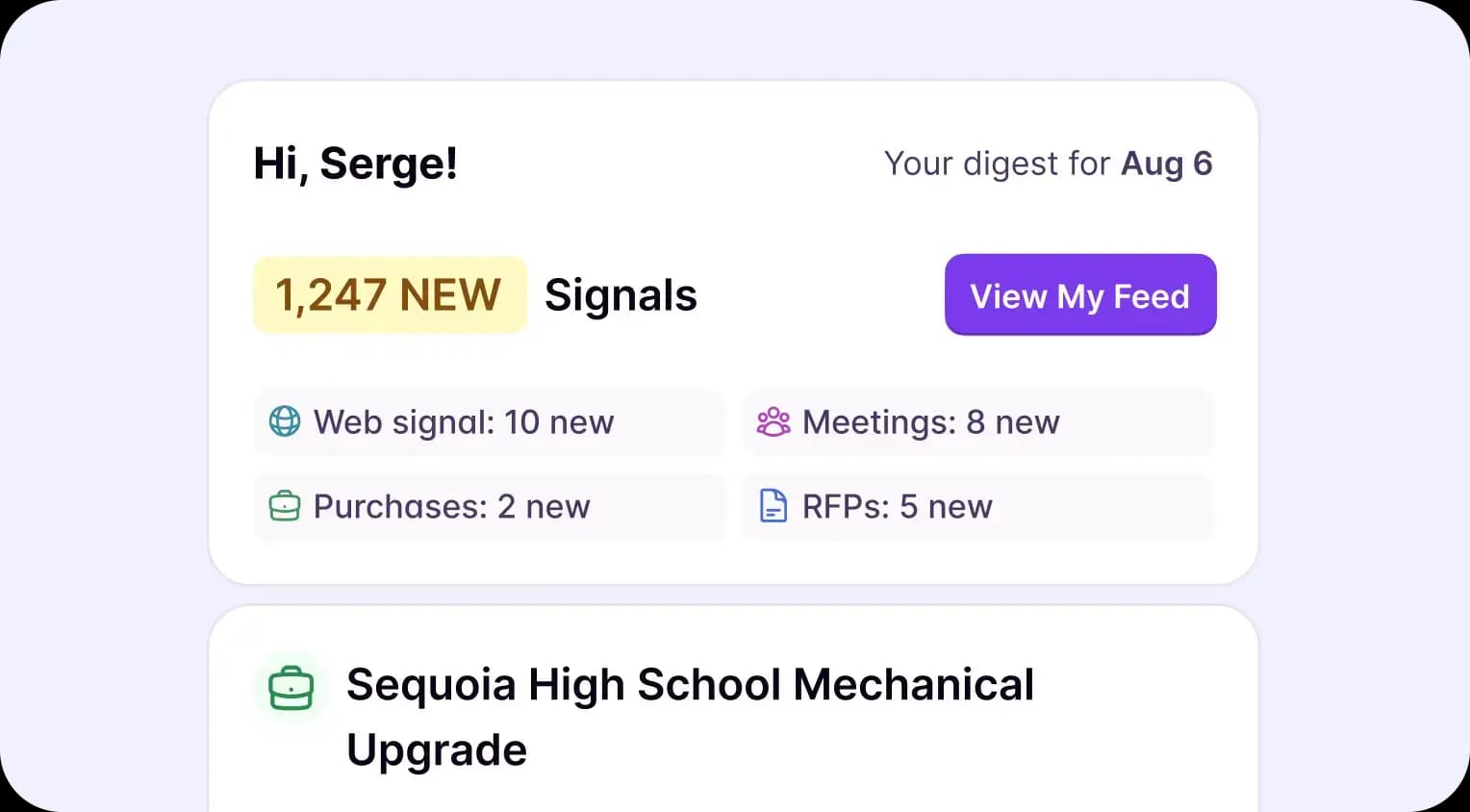
The platform monitors board meeting minutes, strategic plans, budget data, grants, job postings, contract expirations, and bids around the clock. When multiple signals converge on an account in a rep’s territory, Starbridge delivers a prioritized alert with context on why the timing is right.
Getting critical account context used to mean hours of manual research per account. Frontline Education cut research time by 90% after switching to Starbridge, and Zencity now sources 50% of its cold meetings from signals surfaced through the platform.
The more signals you can stack on a single account, the higher the confidence that a purchase is coming and the stronger your justification for prioritizing outreach.
2. Score accounts by buying propensity instead of firmographic size
Most sales teams in the B2G market default to prioritizing accounts by geography and size. They target the largest districts or the biggest cities in their territory. This approach misses ready-to-buy accounts that happen to be mid-size and wastes time on large accounts that have no near-term purchase plans.
A better approach is to score accounts using 5-7 attributes weighted by outcome predictors from your closed-won deals. Buying-readiness indicators should lead. Firmographic factors like size and geography should support but not drive prioritization.
| Priority level | Buying signal: use case and pain | Buying signal: budget and capacity | Competitive signal |
|---|---|---|---|
| High (9-10) | Strategic plan or meeting minutes explicitly name your category as top priority | Budget documents show a specific line item or hiring spree in the relevant department | Incumbent contract expiring in under 12 months, or documented public pain with current vendor |
| Medium (5-8) | High-level goals suggest a need but no specific project is named | Large operating budget or “open to spend” status, but no specific line item | Competitor present but contract not expiring soon |
| Low (1-4) | No evidence of your use case in recent public transcripts or strategic documents | Budget freezes, layoffs, or cost-cutting mandates in recent news | Competitor just signed a 5-year deal |
Use these scores to prioritize calls, pick which conferences to attend, and segment campaigns. Not all signals are created equal. Weight your scoring model based on what actually predicts outcomes in your closed-won deals, and refine it as you collect more data.
Starbridge’s Public Spend Intelligence adds competitive signal data to this framework. Teams can see which competitors hold contracts with specific entities, when those contracts expire, and how much the entity spent. This is the kind of data that typically requires FOIA requests and weeks of waiting, but Starbridge has 77% of purchase orders across all relevant State and local governments, K12 school districts and higher ed institutions. InquirED used this approach to drive $200,000 in new pipeline in its first quarter.
A strategic scoring model means every rep on the team can open their CRM and immediately see which accounts deserve attention this week, without relying on gut feel or geography.
3. Pair every buying signal with a verified contact and relevant outreach
A buying signal without a verified contact is just information. Contact accuracy matters enormously in B2G because government and education org charts don’t map cleanly onto commercial databases. Titles are inconsistent, turnover is high, directories are outdated, and generic databases don’t prioritize this market. This causes a serious bottleneck during research.
Sales teams need fewer, higher-quality signals pre-loaded with everything required to take action. Starbridge’s Contacts & Company Data is built on proprietary web-agent technology that delivers 98% email accuracy, validated across a 14,000-email test. That is a 2% bounce rate compared to 15-25% from generic databases. TAM to Target reports that Starbridge contact data is 3-4x more valid than what they used previously, and their clients now book 2.5x more meetings as a result.
Contact moves are buying signals too. When a champion leaves an existing customer account, that account is at risk of churn. When that same champion lands at a new organization, it becomes an expansion opportunity. Starbridge’s Champion Tracking monitors these job changes so teams can flag churn risk early and open doors at new accounts where they already have an advocate.
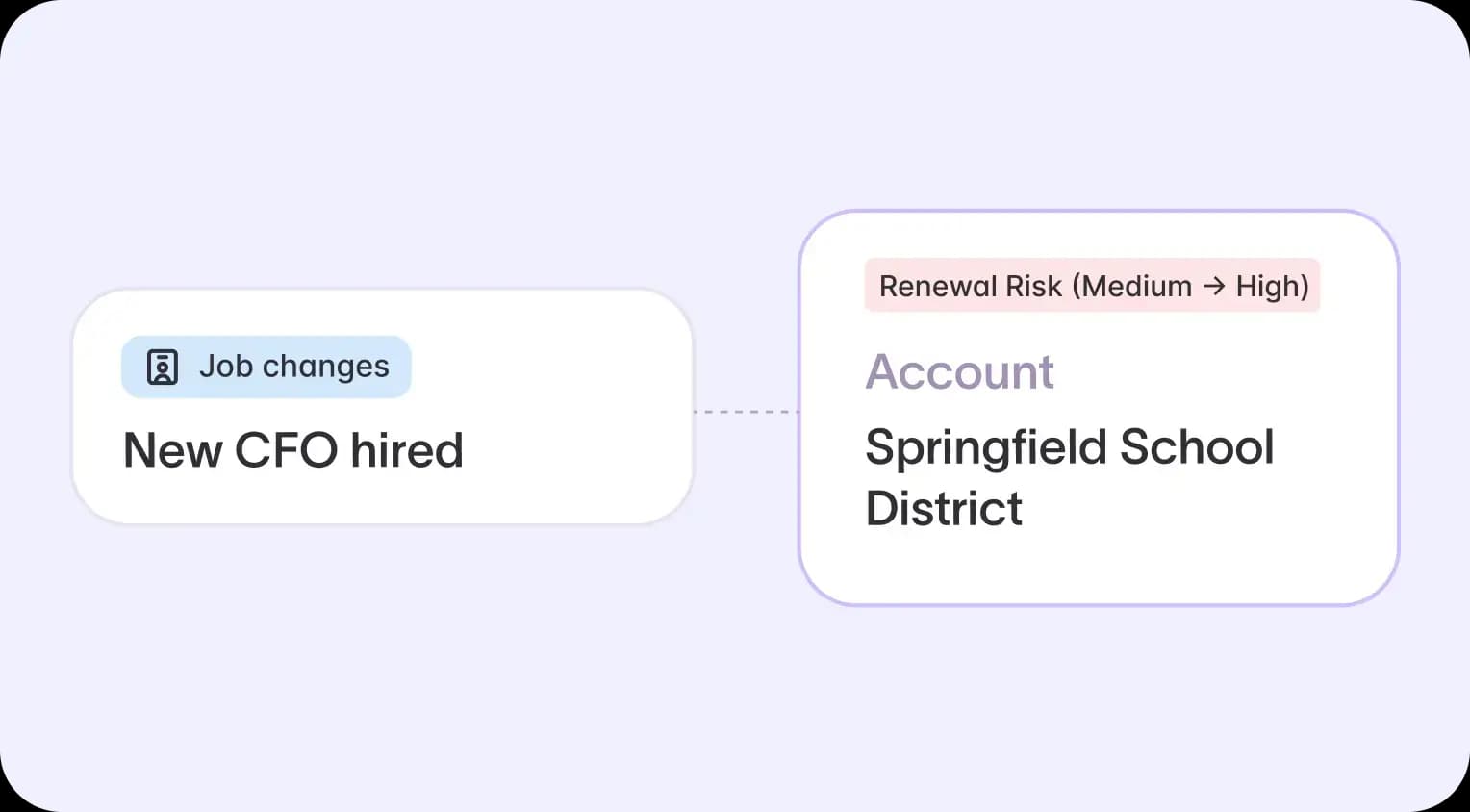
Starbridge closes the gap between signal detection and sales action. Every buying signal comes paired with a verified contact, the reason for outreach, and AI-generated messaging. Completed records push to your CRM through native bi-directional integrations that sync, clean, and enrich your data in Salesforce or HubSpot.
Storage Scholars used this workflow to identify more than 350 active school housing renovations and turn them into outreach-ready opportunities. When the signal, the contact, and the context all arrive together, the rep’s job shifts from research to conversation.
4. Craft outreach that references a specific buying indicator
The most effective outreach in B2G sales references something specific that the buyer’s organization did publicly. Generic emails about “improving efficiency” get ignored. An email that says “I noticed your board discussed upgrading your assessment platform at the March meeting” gets opened.
When a nearby district just discussed your solution, that proof point carries real weight. These buyers look to peers before making decisions, so referencing a local win can be the difference between a reply and silence.
Here is a simple framework for signal-based outreach:
- Lead with the specific signal. Name the board discussion, grant award, budget line item, or strategic plan reference.
- Connect it to a problem or opportunity. Show that you understand what that signal means for their organization.
- Offer a relevant CTA. Keep it simple. One clear next step, not a menu of options.
Keep emails short. A strong personalized hook, a brief customer reference, and a simple CTA outperform long capability overviews every time. Hapara drives 20% higher response rates using Starbridge’s meeting intelligence to personalize outreach, and Kaizen Labs saw a 10-20% lift in monthly quota attainment after adopting this signal-based approach.
“What’s most helpful is when the buying signal pulls specific pieces from board meetings or internal documents. That’s exactly what our reps reference when they call.”
The more specific your opening line, the more likely the buyer reads the rest. Signal-based outreach replaces volume with relevance.
From government buying signals to predictable pipeline
Teams that consistently win B2G deals detect government buying signals early and engage decision-makers while requirements are still forming. They score accounts by propensity instead of size, and they pair every signal with a verified contact and a reason to reach out.
If your team still relies on published RFPs and manual research to build pipeline, the gap between where you are and where signal-driven teams are operating will only widen. Book a demo to see how Starbridge surfaces the buying signals, contacts, and account context your team needs to engage buyers before the competition.
Frequently asked questions
A government buying signal is any publicly observable event, document, or data point that indicates a state and local government, K-12, or higher education entity is moving toward a purchase decision. Examples include board meeting discussions, budget allocations, grant awards, strategic plan references, job postings, and contract expirations. These signals typically surface weeks or months before a formal RFP is issued.
Government buying signals can appear 6 to 18 months before a formal RFP is released. The earliest signals include strategic plan references and board meeting discussions. Mid-cycle signals include budget allocations and grant awards. Late-cycle signals like job postings and contract expiration timelines appear 3 to 12 months out, while the RFP itself is the final and least strategically valuable signal.
Timing is the biggest difference in buying signals across government organizations. Most state and local entities follow a July 1 fiscal year, so budget-related signals cluster in the first half of the calendar year. K-12 districts align major purchases with the school year and rely heavily on Title funding programs. Higher education institutions vary widely, with some following state fiscal years and others operating on independent academic calendars with decentralized purchasing authority.
Buying intent indicates that an entity has expressed interest or need in a product category. Buying propensity measures how likely that entity is to make a purchase decision in the near term and how strong your competitive position is. A single buying signal (like a strategic plan mention) suggests intent. Multiple stacked signals (grant award plus expiring competitor contract plus board discussion) indicate high buying propensity.
Starbridge is the AI sales intelligence platform built on the most comprehensive dataset of government and education buyers and buying signals. It monitors more than 1 million state and local government, K-12, and higher education entities for buying signals in real time, stacks and scores them automatically, and pairs them with 98%-accurate contact data and AI-generated outreach. Completed records push to Salesforce or HubSpot through native bi-directional integrations that sync, clean, and enrich CRM data.
Explore our use case library
 Automate account research with AI agentsStop manually researching accounts. Starbridge AI agents automate account research by monitoring buying signals 24/7 and surfacing the right contacts.
 Identify competitor contract expiration datesThe RFP is usually a formality. Starbridge surfaces competitor contract expiration dates so your reps reach accounts before the renewal cycle closes.
 Create a conference campaignTurn conference badge scans into pipeline. Import your contact list, surface buying signals across every account you met, and follow up with context.