
4 DistrictIQ alternatives for government and education sales intelligence in 2026
Need more than district-level school data? Compare four DistrictIQ alternatives for government and education sales across the capabilities that build pipeline.

DistrictIQ gives edtech and govtech teams a starting point for K–12 prospecting. As teams expand into state and local government and higher education, or need capabilities like verified contacts and vendor spend intelligence, district-focused tools start to show their limits.
This article evaluates four DistrictIQ alternatives across five capability areas that determine whether your team engages early or reacts to opportunities after they’ve already taken shape. Each platform is compared on pre-RFP signal coverage, contact data quality, vendor spend visibility, RFP discovery and response, and contract vehicle access.
Here’s how they stack up at a glance:
| Platform | Identifying opportunities before RFPs | Contact and account data quality | Visibility into agency and institution spend | Finding and responding to RFPs | Contract vehicle access |
|---|---|---|---|---|---|
| Starbridge | Monitors 320k+ entities for board minutes, budgets, grants, leadership changes, contract expirations, and strategic plans | 98% email accuracy from .gov/.edu web crawls with continuous bounce-checking | FOIA automation for full competitor contracts with pricing, opt-out clauses, and expiration dates | AI-scored RFP feed with native proposal writer and compliance matrix | Shorten sales cycles by selling through TIPS, Sourcewell, and more with pre-approved access |
| GovSpend | Meeting transcripts and PO data plus newer Opportunities module with AI-ranked buying signals | Sourced through agency relationships and document requests on variable refresh cycles | Historical line-item PO data across thousands of agencies | Bid aggregation with proposal writing via third-party partner (Iris) | Contract vehicle access is not part of the offering as of July 2026. |
| GovWin | Analyst network tracking federal opportunities | Analyst-curated insights and government data sources with broad agency coverage | Strongest at the federal level with contract award tracking | Strong federal bid aggregation with state and local as a newer addition | Contract vehicle access is not part of the offering as of July 2026. |
| Burbio | Keyword-based tracking across school board meeting minutes, strategic plans, ESSER III spending data, and district budgets | School district contacts dataset with decision-maker names, titles, emails, and phone numbers | ESSER III spending plans, CapEx budgets, checkbook register keyword reports, and school bond data for K-12 districts | Keyword alerts may surface mentions of bids and contracts in board meeting documents | Contract vehicle access is not part of the offering as of July 2026. |
What to look for in a government and education sales intelligence tool
Winning government and education deals depends on five capabilities working together. Here’s what to evaluate when comparing platforms in this category:
- Identifying opportunities before they go to RFP. Board meetings, budget releases, grant awards, leadership changes, and contract expirations produce buying signals months before a formal solicitation appears. In government and education procurement, the agencies and districts that post RFPs have typically already consulted the vendors they trust to help define the requirements. Teams that monitor these early sources can engage during the requirements-gathering phase, shape the evaluation criteria, and position themselves as the frontrunner before competitors even know the opportunity exists.
- Contact and account data quality. The source of your contact data determines whether outreach finds the right person or bounces. Government and education decision-makers rarely maintain LinkedIn profiles, which means general-purpose B2B databases regularly deliver bounce rates of 15 to 25%. Every bad email wastes rep time, lowers deliverability scores, and reduces sequence performance for the rest of the campaign.
- Visibility into agency and institution spend. Knowing the incumbent vendor, contract value, and expiration date changes how a rep positions on a discovery call. Purchase orders show what an agency bought and at what price. Full contracts go deeper, revealing annual revenue, opt-out clauses, and renewal timelines that let reps build a displacement narrative before the first conversation.
- Finding and responding to RFPs efficiently. A centralized, scored RFP feed eliminates the hours teams spend hopping between individual bid portals. AI-assisted proposal drafting compresses response timelines from days to hours, so teams submit stronger proposals on more of the right opportunities.
- Contract vehicle access that removes procurement friction. Above a buyer’s sole-source threshold, a deal either routes through an existing cooperative contract or triggers a full competitive solicitation that can add months. Vendors who can transact through vehicles like TIPS, BuyBoard, Sourcewell, or NASPO ValuePoint give procurement offices a faster path to purchase. Teams without vehicle access watch won opportunities stall in procurement.
These five capabilities work together as a single pipeline-building motion. When one of them is missing, teams fill the gap manually, with spreadsheets, extra tools, and hours of research that could have gone toward selling.
The DistrictIQ alternatives in this article each cover a different slice of that motion. Where they differ is how much they connect into a single end-to-end workflow versus how much they leave teams to assemble on their own.
1. Starbridge
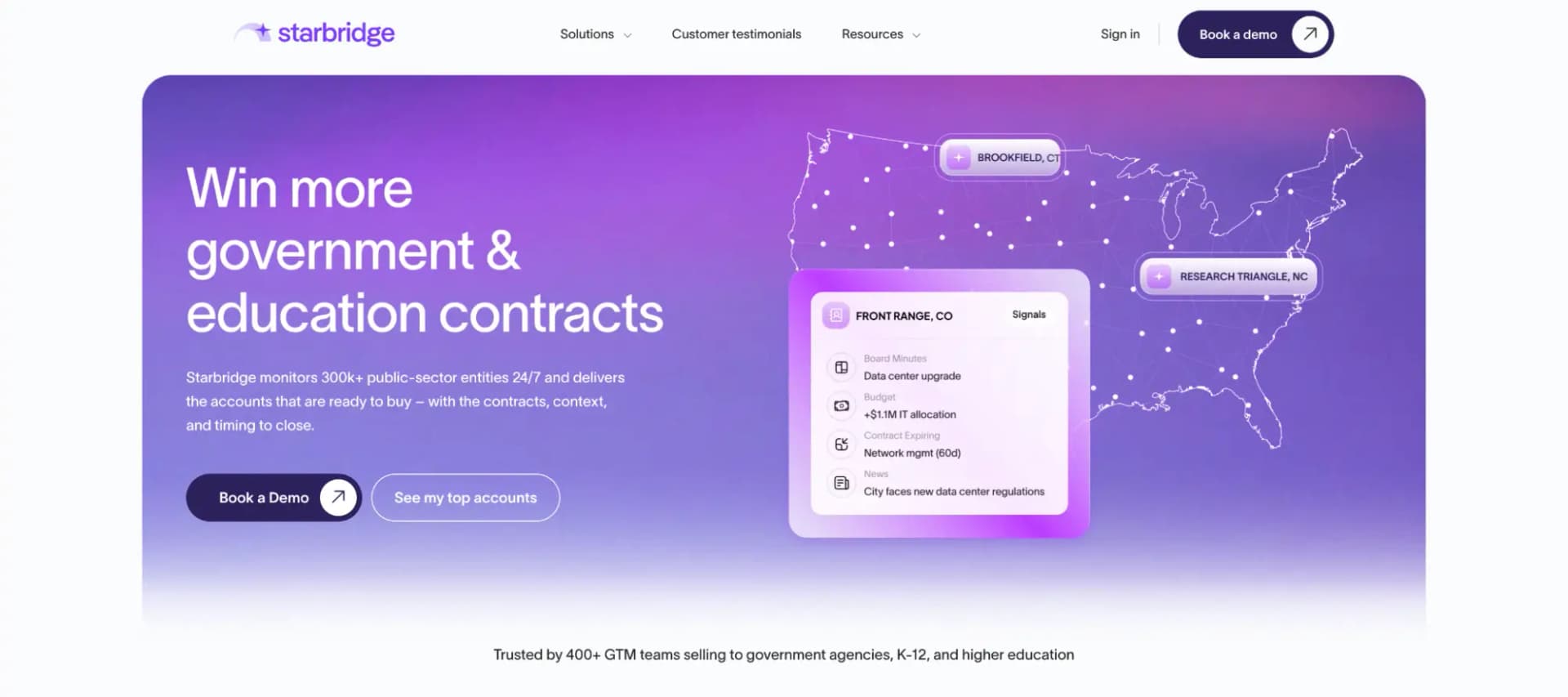
Starbridge is the AI sales intelligence platform built exclusively for companies selling to state and local government, K–12, and higher education. More than 600 GTM teams use Starbridge to surface buying intent before competitors know the opportunity exists, connect that intelligence to verified contacts, and push it directly into the tools reps already work in. One platform covers the full motion from buying signal to closed deal, with bi-directional CRM sync for Salesforce and HubSpot.
What Starbridge does well
Starbridge covers all five capability areas in a single workflow, each one designed to move a rep from buying signal to closed deal without switching tools.
Starbridge’s Buying Signal Monitor tracks 320k+ government and education entities around the clock, surfacing buying signals from board meeting minutes, budget data, grants, leadership changes, contract expirations, strategic plans, and bids. The platform uses an AI-native vector database that understands context rather than matching exact keywords, which means it surfaces relevant activity that keyword-based search tools miss entirely.
Every buying signal fires with a verified contact, a reason for outreach, and AI-generated personalized copy pushed directly into Salesforce, HubSpot, Apollo, and Outreach. InquirED drove $200K in new pipeline in their first quarter by replacing manual board-document research with signal-driven account scoring to identify which districts were actually ready to buy.
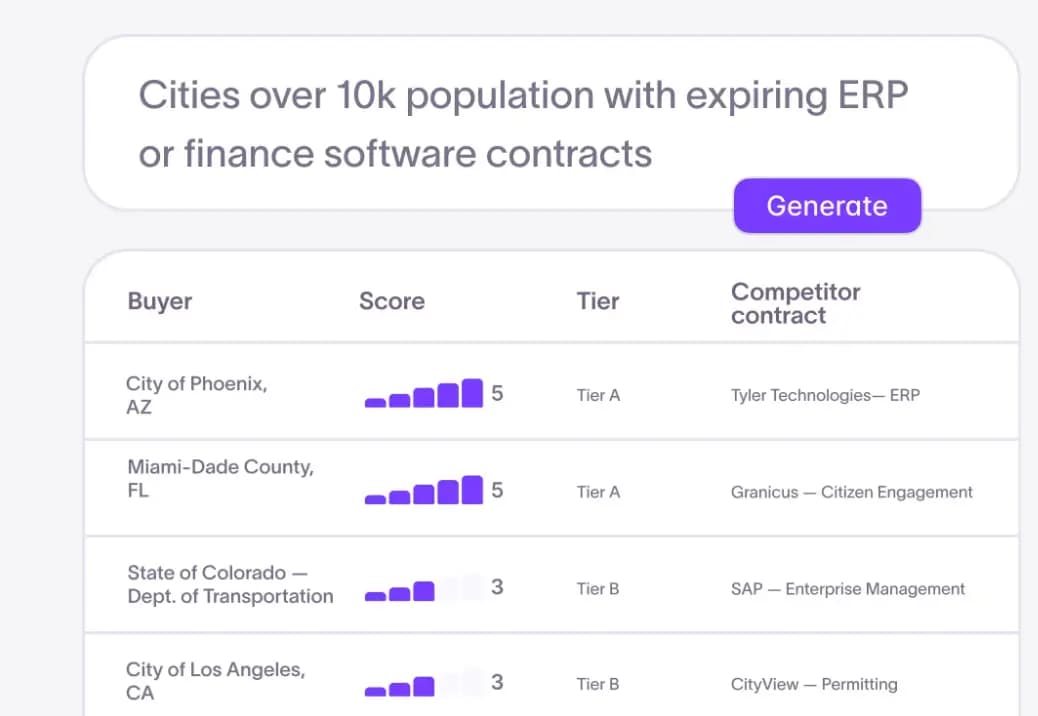
Surfacing the right account is only half the battle, because reps also need accurate contact data to act on it. Starbridge’s Contacts & Company Data uses proprietary web-agent technology to continuously crawl government department websites, school district portals, university staff directories, and board meeting records, delivering 98% email accuracy (validated across 14,000 emails) with a 2% bounce rate. Dynamic account scoring, AI-generated positioning briefs, and champion tracking via job changes give reps context before every call. Bi-directional CRM integrations with Salesforce and HubSpot sync, clean, and enrich records automatically.
With the right accounts identified and contacts verified, the next advantage is knowing what those accounts are already spending. Starbridge’s Public Spend Intelligence automates FOIA requests at scale, delivering full competitor contracts with annual revenue, vendor proposals, opt-out clauses, implementation fees, and expiration dates. Out of the box, Starbridge has the purchase order data for 77% of state and local government, K–12, and higher education institutions, and cross-references it against the platform’s full buying signal dataset so reps walk into discovery calls already knowing what a prospect pays a competitor. Frontline Education, for example, cut research time by 90% after deploying Public Spend Intelligence, with reps reclaiming hours every week that previously went to manual account research.
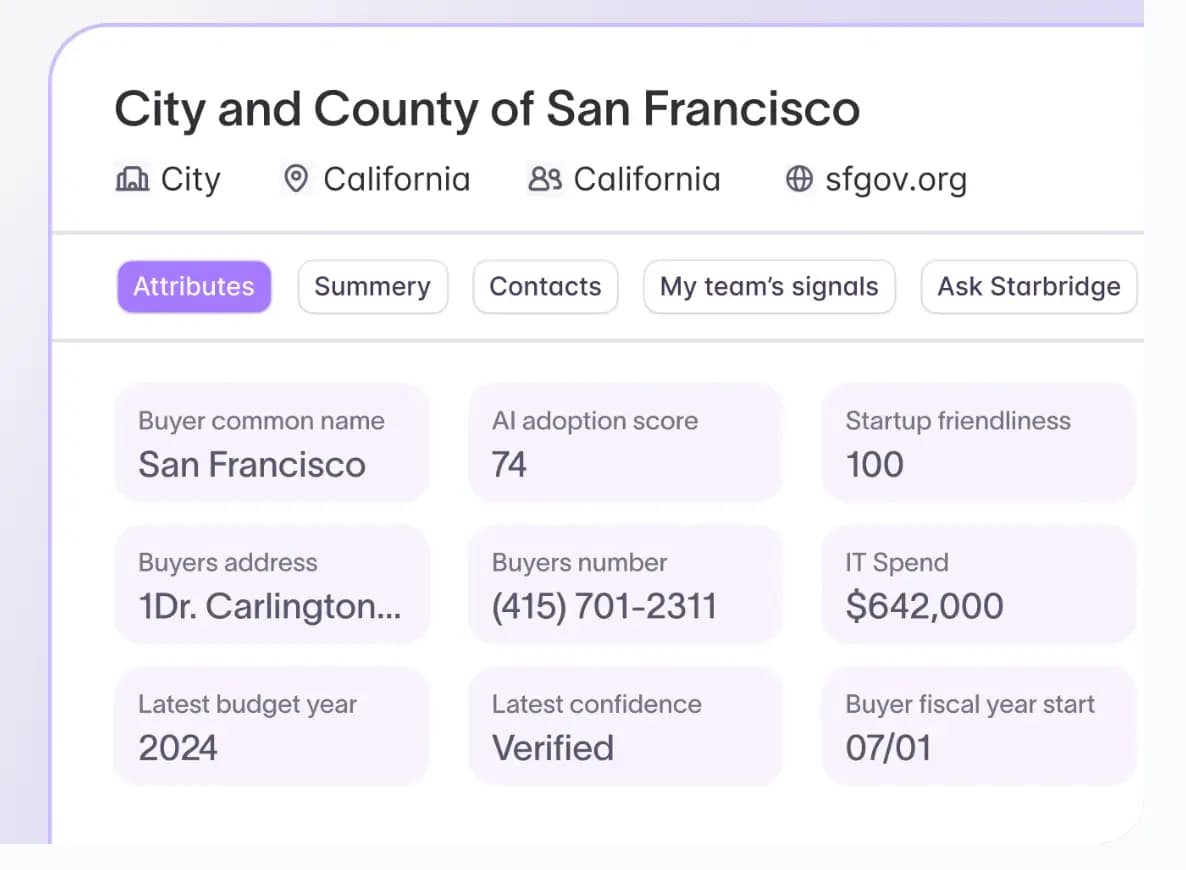
When opportunities reach the RFP stage, Starbridge’s AI RFP Finder & Proposal Writer centralizes thousands of state, local, education, and university bid portals into a single personalized feed. Every RFP is scored by product fit, region, and win likelihood. The platform automatically flags RFPs that mention a competitor by name, helping teams decide where to invest proposal effort. A native AI proposal writer drafts responses using the team’s product knowledge base, and a compliance matrix builder maps requirements to response sections for faster review.
Starbridge also gives teams a way through the procurement stage itself. The platform provides access to every major contract vehicle including TIPS, Sourcewell, NASPO ValuePoint, and GSA, and it handles the compliance, paperwork, and renewals. Because Starbridge already knows each buyer’s preferred purchasing channel, reps can route every opportunity down the fastest compliant path to a signed PO.
Where Starbridge falls short
Starbridge delivers stronger sales intelligence for state and local government and education than for federal. Companies with a primarily federal motion might find deeper coverage from platforms built around federal procurement databases.
The AI RFP Finder & Proposal Writer accelerates proposal drafting and handles repetitive sections well, but it’s lightweight and won’t replace a dedicated RFP hire. Teams responding to complex, high-stakes solicitations will still need experienced proposal writers to own the final submission. The tool saves hours per response, not headcount.
Starbridge is priced for enterprise sales teams with an established government and education pipeline, not for teams just starting out. The 98% email accuracy, FOIA automation, and continuous enrichment that distinguish the platform come at a higher price than simpler data sourcing methods reflect.
Best for
Revenue teams running outbound into state and local government, K–12, and higher education who need one platform from buying signal to closed deal. If your team is tired of stitching together separate tools for signal monitoring, contact enrichment, spend research, RFP response, and contract vehicle access, Starbridge consolidates that entire workflow into a single system connected to your CRM.
2. GovSpend
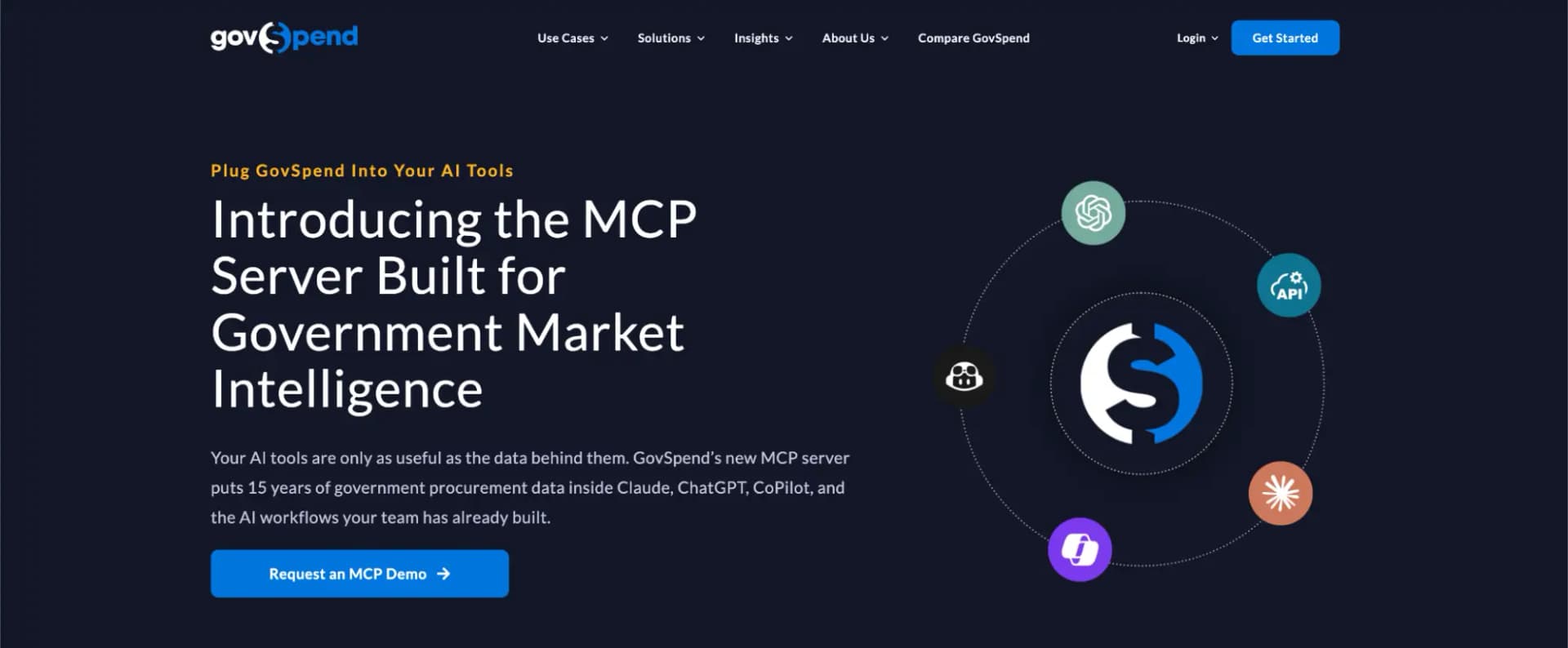
GovSpend is a procurement intelligence platform founded in 2011, now owned by Thompson Street Capital. It offers historical purchase order data, serving vendors, agencies, and consultants who need visibility into government purchasing activity.
What GovSpend does well
GovSpend’s core strength is historical line-item purchase order data across thousands of state and local agencies. For businesses focused on competitive displacement research and pricing benchmarking, this data shows what was purchased, from which vendor, and at what price.
GovSpend has added newer layers on top of that purchase order foundation, including an AI-ranked Opportunities module, AI Search, and AI Notebook, although all three still surface activity that has already entered the public record.
Searchable meeting transcripts allow teams to track agency discussions tied to budgets, technology priorities, and upcoming purchases. Bid alerts notify reps when new solicitations match their criteria, and a CRM integration is available for both Salesforce and HubSpot.
Where GovSpend falls short
Data freshness is a recurring theme in GovSpend’s user feedback. One G2 reviewer noted that “sometimes data is missing or not entered correctly or is out of date.” For teams relying on procurement data to time outreach around contract expirations or competitive displacement windows, stale records can lead to wasted effort and missed timing.
Keyword-based monitoring can surface high volumes of results that require manual filtering. Another G2 reviewer pointed out that monitoring for broadly relevant keywords “can result in false positive reports of potential response opportunities.” Companies running high-volume outbound need confidence that the opportunities surfaced are indeed relevant before investing research time.
Both issues trace back to the same constraint. GovSpend’s data, however deep, is a record of procurement activity that has already occurred. The platform surfaces an opportunity once it has entered the public domain, which is the same moment every other vendor monitoring that account finds out.
RFP proposal writing is handled through a third-party partnership. Teams that prefer an all-in-one workflow from bid discovery through submitted proposal may find that switching between tools for the response process adds friction to their pipeline.
The purchase itself also happens outside the platform. GovSpend surfaces cooperative contract data as part of its procurement research, but selling through a vehicle like TIPS, Sourcewell, or OMNIA Partners is not a stated capability as of July 2026.
Best for
Teams focused on procurement research, historical spend analysis, and bid monitoring in state and local government who want an established platform with purchase order data.
3. GovWin (Deltek)
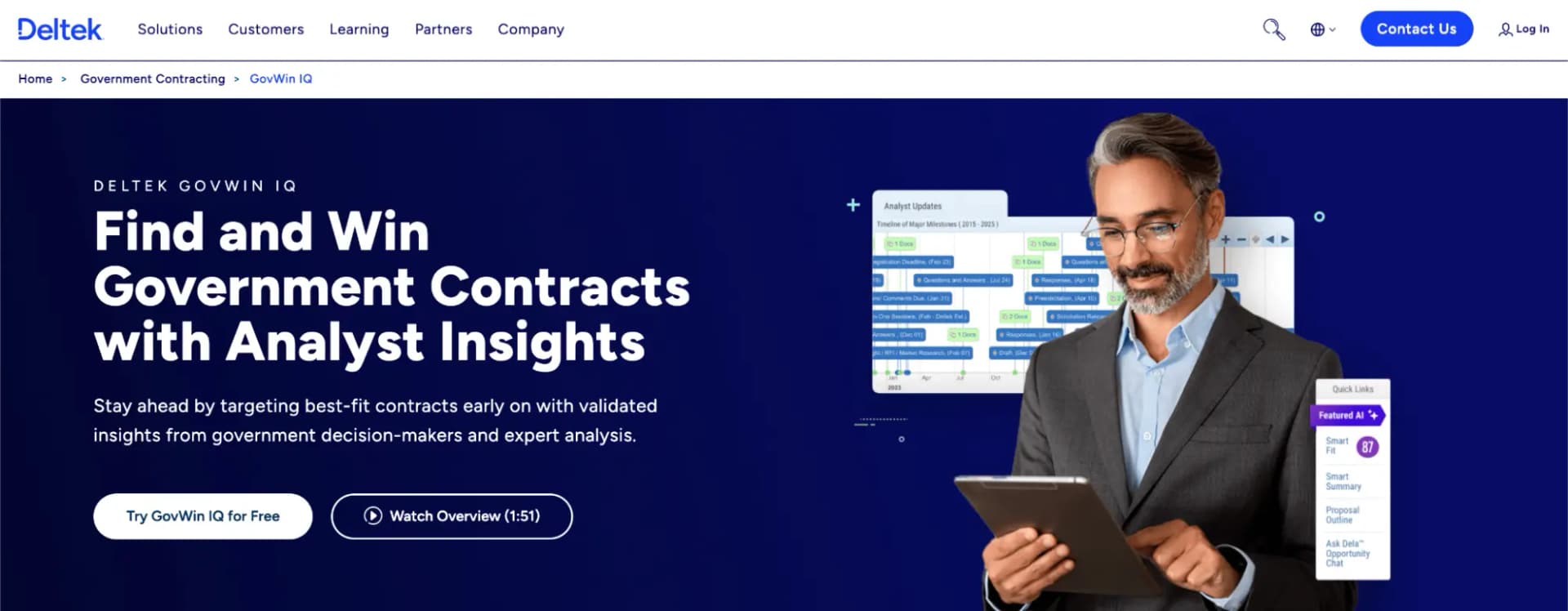
GovWin is a market intelligence platform owned by Deltek, traditionally recognized as the federal procurement incumbent. The platform is backed by an analyst network that sources insights directly from government decision-makers. GovWin has more recently expanded into state and local government and education markets, though federal remains its primary focus.
What GovWin does well
GovWin’s analyst network is its main differentiator for federal contractors. Analysts source leads, track recompetes, and deliver insights on federal opportunities before the RFP drops.
GovWin also operates one of the largest government bid aggregation databases available, with coverage across state and local agencies alongside its federal repository. The platform tracks contract awards, spending analysis, and agency org charts. For federal contractors specifically, GovWin provides labor rate analysis, competitor identification, and teaming partner recommendations that help teams price proposals competitively and identify capability gaps.
Ask Dela, a newer AI feature, summarizes lengthy procurement documents and supports research workflows. Published integrations include Deltek Costpoint and Deltek Vantagepoint CRM, making the platform a natural fit for teams already operating within the Deltek ecosystem.
Where GovWin falls short
State and local government, K–12, and higher education coverage is a more recent addition. GovWin’s depth in these markets has yet to match its federal strength. Teams whose primary market is state and local government or education may find that the platform’s strongest capabilities and most frequently updated data are oriented toward federal procurement.
Search and navigation friction is a common theme in user reviews. One G2 reviewer wrote that “searching outside of my saved searches is challenging. The filters are not user-friendly and can be difficult to find what I’m looking for. Lately postings have been missing attachments or have wrong dates.” When reps need to quickly identify opportunities that fall outside their standard search criteria, navigating the platform’s filters can introduce friction into daily prospecting routines.
GovWin’s contract vehicle coverage is analytical. The platform tracks and reports on vehicles like GWACs and IDIQs, but getting a vendor onto a vehicle and transacting through it is not a capability it offers as of July 2026.
Best for
Federal contractors needing analyst-backed opportunity intelligence, recompete tracking, and pricing analysis who also want visibility into state and local government solicitations from the same platform.
4. Burbio
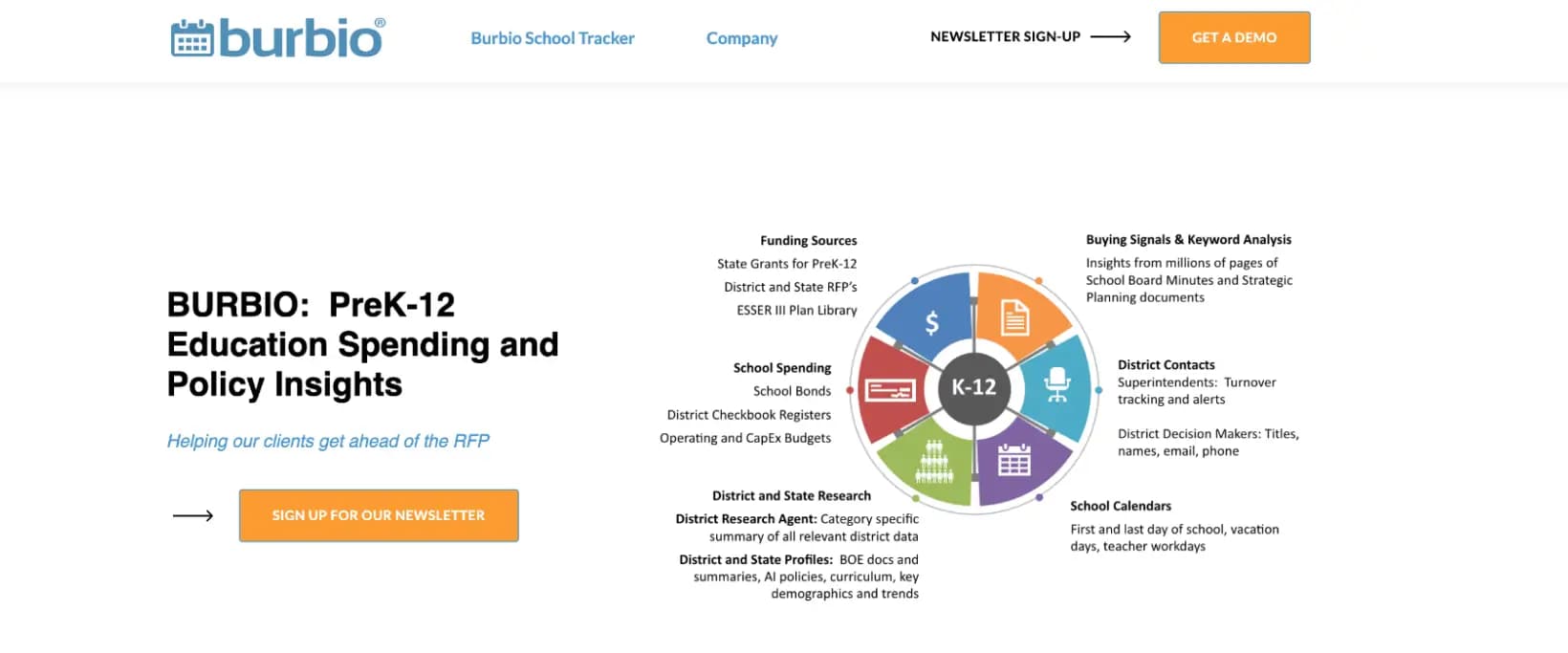
Burbio is a K-12 intelligence platform that monitors public school board meeting minutes, strategic plans, ESSER III spending data, and district budget documents. The platform offers keyword-based tracking of public district records.
What Burbio does well
Burbio’s K-12 document coverage is focused on teams selling to school districts. The platform pulls from school board meeting minutes, strategic plans, state grants, checkbook registers, ESSER III spending plans, CapEx budgets, and superintendent staffing data, giving edtech companies and education suppliers a granular look at what individual districts are discussing, planning, and spending.
Custom keyword searches run across all of Burbio’s document datasets. When a district mentions a relevant term in a board meeting or strategic plan, reps receive territory-filtered alerts so they can focus on important accounts. Dashboards organize matches by territory and keyword category, and CRM integration through API and quick links lets teams route relevant findings into the tools they already use.
Burbio also offers school district contacts database, covering decision-maker names, titles, emails, and phone numbers. A companion state funding sources database covers grants from all 50 states, with eligibility criteria, application details, and award information that education suppliers can use to track relevant funding opportunities.
Where Burbio falls short
Burbio’s coverage is focused on K-12 school districts. Companies that sell to cities, counties, state agencies, and higher education institutions would need a separate tool for those parts of their addressable market.
The platform surfaces what districts are discussing, but interpretation, prioritization, and next steps are left to the rep. When a keyword alert fires, the rep receives the matched document and determines which accounts to act on and how. For businesses running high-volume outbound, translating alerts into action manually can become a bottleneck.
Intelligence arrives as Excel and CSV exports, alongside a browser-based district profile tool. That model works well for individual account research or periodic market reviews. For revenue teams with multiple reps across different territories, translating file-based data into coordinated rep action typically requires building additional manual processes around it.
Knowing a district is budgeting for a purchase is also not the same as closing it. In K-12, that purchase often runs through a cooperative vehicle like TIPS, BuyBoard, or Sourcewell, which lets a ready buyer skip a full solicitation, and access to those vehicles is not part of Burbio’s offering as of July 2026.
Best for
Edtech sales teams focused on K-12 who need early visibility into what school boards are discussing and who primarily sell into district-level technology decisions funded through ESSER or capital budgets.
Which DistrictIQ alternative is right for you?
If your primary need is historical spend data and procurement research for state and local government accounts, GovSpend gives you PO data, meeting intelligence, and AI-powered research tools for that workflow.
If your team sells primarily to federal agencies and needs intelligence on recompetes, pricing, and teaming partners, GovWin delivers in the federal market, backed by an established analyst network. Teams on the Deltek stack also benefit from native integrations with Costpoint and Vantagepoint CRM.
If your team focuses strictly on K-12 edtech and needs early visibility into what districts are planning through board meeting documents and budget data, Burbio’s document intelligence and district contacts give you a useful starting point.
If your team sells technology or services to state and local government, K-12, and higher education, Starbridge is purpose-built for that motion end-to-end. The platform surfaces buying signals months before the RFP, delivers 98% accurate contacts, and provides full competitive contract context through FOIA automation. Starbridge scores and drafts RFP responses with AI. It also hands buyers a purchasing pathway they already trust, with pre-approved access to every major contract vehicle.
All five capabilities connect in one workflow, with bi-directional CRM sync that keeps Salesforce and HubSpot current without manual data entry.
Book a demo to see how Starbridge helps your team win more deals in government and education.
Frequently asked questions
The best DistrictIQ alternative depends on how much of the sales motion you need to cover, but for teams selling across state and local government, K–12, and higher education, Starbridge is the most complete choice. It connects pre-RFP buying indicators, verified contacts, spend intelligence, and RFP workflow in one system, so reps move from an early buying signal to a booked meeting and a faster close, without stitching tools together. GovSpend is best for teams that want historical line-item purchase order data for spend analysis and pricing benchmarks. GovWin is best for federal contractors who need analyst-backed recompete and pricing intelligence. Burbio is best for edtech teams that want granular K–12 document monitoring at the district level.
Yes. Starbridge is purpose-built for teams selling to state and local government, K–12, and higher education, and it is designed to turn early buying indicators into pipeline rather than leaving reps to interpret raw district data on their own. It monitors more than 320,000 government and education entities for board minutes, budgets, grants, leadership changes, and contract expirations, then delivers each buying signal with a verified contact, the reason the timing is right, and ready-to-send outreach. Kaizen Labs increased its reps’ quota attainment by 20% after replacing manual research with Starbridge’s scored, buying-indicator-driven outbound.
Starbridge extends beyond district-level K–12 data to cover the full government and education sales motion, from pre-RFP buying indicators through booked meetings. DistrictIQ centers on affordable, district-level school data, which gives K–12 teams a starting point. Starbridge monitors more than 320,000 entities across state and local government, K–12, and higher education, reading board minutes, budgets, grants, and contract expirations to surface buying intent months before a solicitation appears. Each buying signal arrives scored, with a verified contact, the reason the timing is right, and ready-to-send outreach pushed into Salesforce, HubSpot, Apollo, and Outreach. That is the difference between a data source and a pipeline engine built to help you close faster.
Yes. Starbridge is built to stay reliable as teams add reps and territories, which is where lightweight tools start to strain. Contact data holds at 98% email accuracy with a 2% bounce rate across a 14,000-email test, and proprietary web-agent technology continuously crawls .gov and .edu directories, board records, and district portals so records stay current instead of going stale. Native bi-directional sync with Salesforce and HubSpot cleans and enriches those records automatically across the whole team. Every customer also gets a dedicated solutions architect, and more than 600 GTM teams run on the platform, so multi-rep coverage is a proven motion rather than a manual workaround.
Starbridge covers the widest motion and engages the earliest. It surfaces pre-RFP buying indicators across more than 320,000 state and local government, K–12, and higher education entities, so reps engage months before a solicitation is published. DistrictIQ centers on affordable, district-level K–12 school data. GovSpend centers on historical purchase order data for spend analysis across state and local agencies. GovWin focuses on federal opportunity research backed by an analyst network, with state and local coverage newer. Burbio focuses on district-level K–12 monitoring of board documents, budgets, and strategic plans. Each covers one slice; Starbridge connects those pre-RFP indicators to verified contacts, spend intelligence, RFP workflow, and each buyer’s preferred contract vehicle in one system.
Starbridge is a premium platform priced for the depth of intelligence and workflow it delivers, and quotes are custom-scoped rather than pay-per-use, so it fits enterprise teams more than the smallest budgets. DistrictIQ centers on affordable, district-level school data, which can be a fine starting point for early K–12 prospecting. The value gap shows up in pipeline created and time returned. GovWell, for example, booked five meetings in its first week from buying indicators and now sources 15% of its total qualified pipeline through Starbridge. When one platform turns buying signals into booked meetings and closed deals across the full government and education motion, the higher price reflects the pipeline that depth creates.
Explore our use case library
 Automate account research with AI agentsStop manually researching accounts. Starbridge AI agents automate account research by monitoring buying signals 24/7 and surfacing the right contacts.
 Identify competitor contract expiration datesThe RFP is usually a formality. Starbridge surfaces competitor contract expiration dates so your reps reach accounts before the renewal cycle closes.
 Create a conference campaignTurn conference badge scans into pipeline. Import your contact list, surface buying signals across every account you met, and follow up with context.