
Starbridge vs. GovWin: Which platform builds pipeline in government and education sales?
Compare Starbridge vs. GovWin across key areas to see which platform is best for actually closing deals.

If your team sells technology or services to state and local government, K–12, and/or higher education, you might have narrowed your options to two tools with very different philosophies: Starbridge and GovWin.
GovWin, owned by Deltek, is a bid aggregation and opportunity tracking database known for its federal coverage, with more limited SLED (state, local government, and education) offerings. Starbridge is the AI sales intelligence platform built for companies selling to state and local government, K–12, and higher education, and it carries deals from the first buying signal to a signed contract.
This comparison breaks down the five areas vendors should evaluate when deciding between the two platforms. Here is a quick glance before we go deep.
| Capability | Starbridge | GovWin |
|---|---|---|
| Early buying signals from pre-RFP data sources | Monitors 320k+ entities 24/7 across board meetings, budgets, grants, leadership changes, bids, and custom web signals. | Bid/RFP alerts after solicitation is posted; strongest for federal opportunity tracking. |
| Contact and account enrichment | 98% contact data accuracy sourced in real-time from verified .gov domains and agency directories, proprietary web-agent technology, waterfall enrichment, continuous bounce-checking, and champion tracking via job changes. Offers contact data bakeoffs against any competitor. | Depends on industry. Stronger testimonials for federal market. Unclear if they offer contact data bakeoffs. Contact data sourced from procurement listings and agency org charts. |
| Vendor spend intelligence | Done-for-you, scaled competitor FOIA contract campaigns via FOIA automation service and PO contextualization across the full signal dataset. | Spend analysis and contract award tracking is strongest at the federal level. There are limited options for state and local offerings. |
| Contract vehicle access | Pre-approved access to every major contract vehicle, including NASPO ValuePoint, OMNIA Partners, Sourcewell, TIPS, and GSA, with compliance, paperwork, and renewals handled. Available as part of the platform with no minimum deal size. Free to start. | GovWin offers access to federal contract vehicles, but it doesn’t yet offer contract vehicles that help selling to state, local and education as of July 2026. |
| RFP discovery and response | AI-scored RFP feed & coverage for 320k state and local agencies, and an AI proposal writer that automates the proposal process. | Strong federal bid aggregation database. State and local offerings are a more recent addition to the platform. |
| Agentic workflows | The platform is built to automate outbound end-to-end with AI email templates, auto-scored leads, and search agents. | GovWin is primarily known as a data aggregator and research resource. |
| CRM Integrations and MCP/APIs | Native bi-directional Salesforce and HubSpot sync with automatic enrichment that keeps records current. Contract data is also accessible via MCP for plain-English querying. | Integrates with Deltek Costpoint, Deltek Vantagepoint CRM, and a Web Services API. |
Spotting early buying opportunities from data sources
A buying signal is an early indicator that a school district, university, city, or county is planning to spend. Think of a new grant award, a budget line item for technology modernization, a contract nearing expiration, or a leadership change tied to purchasing authority.
These signals surface months before an RFP is ever published. The data sources a platform monitors determine whether your team engages during that early window or shows up after a competitor has already been in the room shaping requirements.
Starbridge surfaces buying indicators from board meetings, grants, leadership changes, and more
Starbridge built its Buying Signal Monitor to detect buying intent as it forms, not after it becomes public solicitation. The platform monitors 320k+ public sector entities around the clock, scanning board meeting minutes, strategic plans, budget releases, grants, leadership changes, news alerts, and bids.
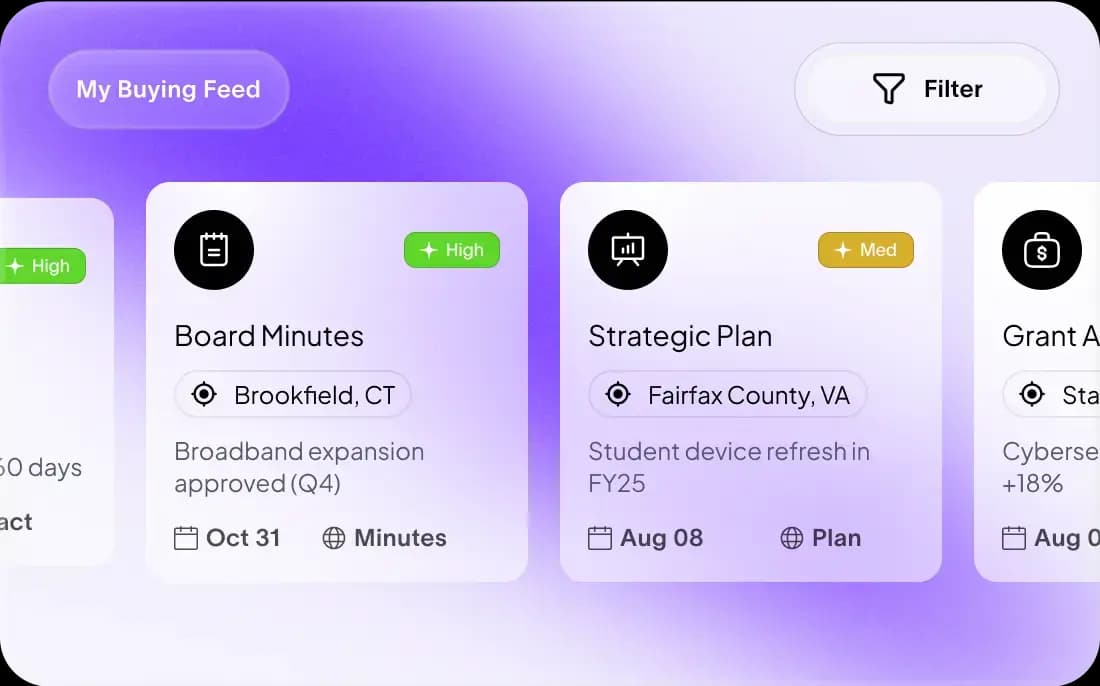
Launching a signal-driven sales strategy takes more than keyword-matching search. That’s why Starbridge runs on an AI-native vector database that understands context, not just keyword matches. When a school board discusses replacing its student information system, Starbridge recognizes the buying intent even if no one typed “RFP” or “solicitation.” Every buying signal fires with a verified contact, a reason for outreach, and AI-generated personalized copy. Signals push directly into Apollo, Outreach, Salesforce, and HubSpot.
The results show up fast. GovWell booked five meetings from Starbridge buying signals in its first week on the platform. Across the customer base, teams using Starbridge book more meetings on average than before.
GovWin is built around published solicitations and procurement tracking
GovWin’s core product is a federal bid database with an analyst-driven approach. They also appear to have a more limited state/local offering. For federal opportunity tracking, this is a genuine strength, and the platform tracks federal personnel changes and provides agency org charts.
For state and local government, K–12, and higher education, GovWin relies on keyword-based saved searches and email digests to surface opportunities, which means the team filters through high volumes of results manually. As one G2 reviewer noted, “while it is a helpful tool, often there are thousands of search results that generate.”
Starbridge takes a different approach by monitoring the data sources that produce buying intent before a solicitation exists, like board meeting minutes, strategic plans, grants, and district-level leadership changes. Where a bid-alert platform delivers a notification tied to a published opportunity, Starbridge delivers a warm lead with a verified contact, a reason for outreach, and AI-generated copy ready to send. Another G2 reviewer flagged “the delays in updates being posted to GovWin,” which compounds the timing gap for teams trying to engage early.
Bottom line
GovWin’s analyst network delivers real value for federal opportunity tracking, and that strength is worth acknowledging. For teams selling to state and local government, K–12, and higher education, Starbridge fills a fundamentally different gap. It monitors buying intent as it forms across board meetings, budgets, grants, and leadership changes, giving reps months of lead time that a bid-alert model cannot provide.
Contact and account enrichment that stays current
Contact data in state and local government, K–12, and higher education goes stale faster than most sales teams realize. Superintendents retire. City managers move between municipalities. IT directors rotate roles without updating LinkedIn.
Generic B2B databases scrape LinkedIn as their primary source, which barely covers government and education and deteriorates quickly. In a finite market where one poorly targeted email can damage a relationship your team needs for years, the enrichment system behind your contact data is not a nice-to-have.
Starbridge delivers 98% email accuracy through proprietary web-agent technology
Starbridge’s Contacts & Company Data is a contact database built specifically for government and education. Instead of scraping LinkedIn, Starbridge runs continuous web crawls powered by proprietary web-agent technology across government department sites, school district portals, university websites, and board minutes. The platform layers waterfall enrichment on top of those crawls and runs continuous bounce-checking to catch stale records before they reach a rep’s outbox.
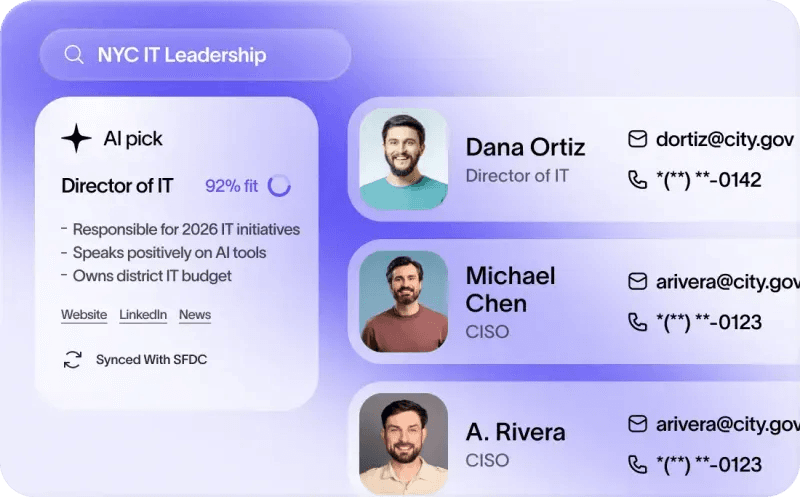
The accuracy numbers back this up. In a test of 14,000 emails, Starbridge achieved 98% accuracy with a 2% bounce rate. For comparison, generic B2B providers report user-observed bounce rates of 15 to 25%.
The platform goes beyond raw contact data.
- Dynamic account scoring weighs buying-readiness indicators like competitor usage, contract expirations, and budget trends before layering in firmographic data like enrollment and population
- AI-generated positioning briefs connect your product features to real buyer pain points at each account
- Bi-directional native integrations with Salesforce and HubSpot sync, clean, and enrich CRM data automatically
Within days of onboarding, Storage Scholars had fully automated contact enrichment that previously consumed thousands of SDR hours. The company also identified more than 350 active school housing renovations. At Mantra Health, the switch to Starbridge tripled data enrichment coverage.
GovWin sources contacts from procurement records and agency org charts
GovWin surfaces contact information through its bid and procurement tracking. Names and titles come from bid registration records, federal agency org charts, and procurement listings. This data is useful for tracking who is involved in a specific solicitation.
Starbridge takes a fundamentally different approach to contact data. Rather than sourcing contacts through procurement records, Starbridge runs continuous web crawls across government and education sources, layers waterfall enrichment from multiple providers, and bounce-checks every record before it reaches a rep.
Today, GovWin integrates with Deltek Costpoint, Deltek Vantagepoint CRM, and a Web Services API. Starbridge offers bi-directional native integrations with Salesforce and HubSpot that sync, clean, and enrich CRM data automatically.
Bottom line
When reps cannot trust the contact record in front of them, outreach carries the risk of a bounce or a dead end. Starbridge delivers continuously verified, scored, and enriched contacts that push into CRM with positioning context. GovWin is known for its procurement intelligence. Starbridge is built to power the outbound motion that turns that intelligence into closed deals.
Understanding vendor spend across government and education
Knowing what a prospect is actually spending, on what, with which vendor, and when that contract expires changes every part of a sales conversation. It determines which accounts to prioritize and what to say in a discovery call.
Starbridge runs FOIA automation to surface full competitor contracts, not just line items
Starbridge’s Public Spend Intelligence gives revenue teams a full view of what government and education accounts are spending and on what. The platform runs FOIA automation at scale to surface purchase data, full competitor contracts, and raw unredacted vendor proposals that would take an individual rep weeks to request and process.
The depth of contract detail matters here. Starbridge surfaces the full picture.
- Annual revenue by vendor
- Full sales proposals (unredacted)
- Opt-out clauses and termination terms
- Implementation fees and service charges
- Contract expiration dates
- Revenue breakdown by product line
This means a rep can walk into a discovery call already knowing what a prospect pays a competitor, when the contract expires, whether there is an opt-out window approaching, and how to position against specific weaknesses in the incumbent’s proposal. That is the difference between research and revenue.
After adopting Public Spend Intelligence, Frontline Education cut research time by 90%, with reps now walking into meetings knowing account priorities, competitive context, and spend history. The time savings are consistent across customers: Abnormal AI reclaims more than 10 hours per rep per week on research and account preparation alone.
GovWin provides agency spend data and contract award tracking
GovWin offers government spending analysis, contract award tracking, and agency profiles. For federal market sizing and recompete identification, this is useful.
Starbridge goes deeper by running FOIA automation at scale to surface the full competitive picture, including unredacted vendor proposals, pricing details, opt-out clauses, and implementation fees.
GovWin does offer a FOIA request service, but users have reported mixed results. One G2 reviewer noted “the delays in updates being posted to GovWin,” and the same reviewer flagged that “some of the data is outdated and competitive landscapes don’t update when an organization is acquired by another one.”
GovWin’s spend coverage is strongest at the federal level; the depth of contract-level detail available for K–12 districts, cities, and counties is less clear.
Bottom line
Knowing that a contract exists is table stakes. Knowing what the prospect pays, when the contract expires, and what the opt-out terms are is what wins deals. Starbridge closes that gap with full competitive context sourced through automated FOIA at scale.
Closing deals through contract vehicles
Above a buyer's sole-source threshold, a purchase normally triggers a full competitive solicitation that can add months to the sales cycle. A contract vehicle is how a vendor skips that process. The buyer purchases off a cooperative contract that has already been competitively bid, with no new solicitation required.
Starbridge offers access to major contract vehicles
Starbridge doesn't stop at sourcing and scoring the opportunity. When the buyer is ready to purchase, Starbridge offers pre-approved access to every major contract vehicle, including NASPO ValuePoint, OMNIA Partners, Sourcewell, TIPS, and GSA. Starbridge handles the compliance, paperwork, and renewals, and a single onboarding covers the major vehicles.
Getting onto vehicles has traditionally run through resellers who earn a percentage of the contract, which means they often wait for six-figure deals before engaging. Starbridge makes contract vehicle access available as part of the platform, free to start with no minimum deal size. The platform also surfaces the exact vehicle each buyer already purchases through, so reps route every deal down the fastest compliant path.
GovWin covers contract vehicles on the federal side
GovWin offers access to federal contract vehicles, which fits its federal customer base. Contract vehicles that help selling to state, local, and education are not part of the offering as of July 2026. Starbridge covers that side of the market with cooperative vehicles like NASPO ValuePoint, OMNIA Partners, Sourcewell, and TIPS, so a SLED buyer who has already chosen your product can purchase without a new solicitation.
Bottom line
A contract vehicle lets a ready buyer skip the bid process entirely. Starbridge gives vendors that path across state, local, and education, with pre-approved contract vehicle access available as part of the platform, admin handled, and the buyer's preferred purchasing channel visible in every account.
Finding and responding to RFPs
RFP discovery and response is where many government and education sales teams spend the most time and where the gap between an automated workflow and a manual one shows up in hours lost per week. But there is a deeper issue.
In government and education procurement, buyers often consult vendors during the requirements-gathering phase, months before the RFP is published. The vendor who educates decision-makers during that window influences the evaluation criteria, the technical requirements, and sometimes the budget itself. Finding an RFP after it is published means a competitor was likely already in the room.
Starbridge scores RFPs for fit and drafts proposals with AI
Starbridge’s AI RFP Finder & Proposal Writer centralizes thousands of state, local, education, and university bid portals into a single personalized feed. Instead of logging into dozens of portals and running keyword searches, a rep sees every relevant RFP in one place, scored by product fit, region, and win likelihood.
The AI proposal writer drafts responses using your team’s product knowledge base, cutting response time significantly. A compliance matrix builder flags gaps in the response before submission. Collaboration mode lets team members comment, tag colleagues, and refine proposals in real time. The platform also flags RFPs that mention a competitor by name, so teams can prioritize displacement opportunities.
RFPs are the last buying signal in the cycle, not the first. Starbridge’s buying signal capabilities engage reps with accounts months before an RFP drops, so by the time the solicitation is live, the team already has a relationship and context. That is how GovWell booked five meetings in its first week on the platform and now sources 15% of total qualified pipeline from Starbridge. The RFP tool closes the loop rather than starting the conversation.
HousingCloud cut 8 to 10 hours per RFP and saw a 30% increase in RFP discovery rate after adopting the AI RFP Finder & Proposal Writer.
GovWin is known for its bid aggregation database
RFP and bid aggregation is GovWin’s genuine core strength. The platform is one of the largest federal and state/local bid databases available and is known for surfacing federal opportunities early.
GovWin is well regarded for opportunity discovery. Starbridge goes further by handling the entire post-discovery workflow natively. It scores each RFP by product fit and win likelihood, drafts proposals with AI, and builds a compliance matrix with real-time team collaboration. Starbridge also engages teams with accounts months before the RFP drops through its buying signal capabilities, so by the time a solicitation appears, the team already has a relationship and context that a cold bid response cannot replicate.
Bottom line
The time between RFP discovery and submission is often shorter than teams expect. Starbridge compresses that timeline by scoring fit automatically, drafting proposals with AI, and catching compliance gaps before submission. Where GovWin is known for its bid aggregation database, Starbridge is an AI-native sales intelligence platform that goes beyond discovery to help teams move from RFP to submitted proposal faster.
Which platform helps you close more deals?
For teams that need comprehensive federal bid aggregation backed by analyst-curated insights, it is one of the largest databases available. Tracking published solicitations and contract awards at the federal level is its core strength, and that strength has kept it relevant for decades.
For teams selling technology or services to state and local government, K-12, and higher education with an outbound motion, the comparison favors Starbridge across every dimension that matters for closing deals. Starbridge surfaces buying indicators months before an RFP appears and delivers 98% email accuracy through continuous enrichment. It gives reps full competitor contracts and pricing through FOIA automation, scores and drafts RFP responses with AI, and hands buyers a purchasing pathway they already trust with pre-approved access to every major contract vehicle.
Book a demo to see how Starbridge can get your team into accounts earlier, with better data, less manual work, and a clear path from buying signal to closed deal.
Frequently asked questions
Explore our use case library
 Automate account research with AI agentsStop manually researching accounts. Starbridge AI agents automate account research by monitoring buying signals 24/7 and surfacing the right contacts.
 Identify competitor contract expiration datesThe RFP is usually a formality. Starbridge surfaces competitor contract expiration dates so your reps reach accounts before the renewal cycle closes.
 Create a conference campaignTurn conference badge scans into pipeline. Import your contact list, surface buying signals across every account you met, and follow up with context.