
A step-by-step guide on how to sell to the government
Learn how to sell to the government with a step-by-step playbook covering procurement mechanics, buying signals, contact data, and how to engage accounts before RFPs drop.

State and local government, K-12, and higher education represent one of the largest and most underworked sales opportunities in the country. Most revenue teams stall before they ever build a real pipeline.
The buying cycles are long, procurement is formal and rule-bound, and the decision-makers are hard to find. The tools built for commercial B2B sales barely work here.
The teams that know how to sell to the government show up before the RFP, build relationships early, and treat every buying signal as a pipeline opportunity. The teams that wait for formal solicitations and react are already behind.
What follows is a step-by-step playbook that moves from foundational preparation and active selling into scaling a repeatable outbound motion for government and education accounts.
1. Learn how government and education procurement actually works
Government and education buyers follow structured procurement processes that differ from commercial B2B sales. Understanding these mechanics is the prerequisite to everything that follows.
State and local government, K-12, and higher education buyers generally purchase through three methods:
- Informal purchases that fall below a micro-purchase dollar threshold and move fast.
- Formal solicitations like RFPs, RFIs, and ITBs require evaluation criteria, scoring committees, and public timelines.
- Noncompetitive or sole-source purchases happen when only one vendor can meet the need or when the contract value falls below the sole-source threshold.
Many buyers also use cooperative purchasing agreements that let them skip the RFP entirely. Vehicles like NASPO ValuePoint, Texas DIR, and New York OGS allow agencies and districts to piggyback on competitively awarded master contracts. Once you have a reseller relationship and a cooperative vehicle in place, certain buyers can procure your product without running a new solicitation.
Every deal in this market involves three distinct buyer roles, and your messaging must land differently with each one.
| Buyer role | What they evaluate | What your value prop should emphasize |
|---|---|---|
| End user (practitioner) | Daily workflow and functionality fit. | How the product improves their day-to-day work. |
| Economic buyer (director, VP, executive) | Organizational ROI. | Better outcomes, time savings, or cost savings. |
| IT / CIO / CSO | Security, compliance, technical integration. | Security posture, data handling, and integration with existing systems. |
In many state and local government and K-12 deals, IT is not just an evaluator. IT is the actual decision-maker driving the purchase.
Compliance requirements like security questionnaires, SOC 2, FERPA, and StateRAMP certifications are table stakes. Prepare these documents before you need them. Small business certifications and set-aside programs like SBA, MWBE, and HUBZone can also open doors, particularly at the state and local level where set-aside requirements vary by jurisdiction.
2. Research your market before you make a single call
Government and education spending data is public. Sellers who research their market before prospecting will prioritize better accounts, craft sharper messaging, and avoid wasting cycles on accounts that are not buying.
Start with public spending data to understand what agencies and districts actually buy. Many state and local government procurement portals publish contract awards, vendor names, and expiration dates. Walking into a discovery call already knowing what a prospect pays a competitor changes the entire conversation.
Manually researching spend data, contracts, and competitive presence for every account in your territory takes hours per account. Reps waste time searching across disconnected tools just to answer basic questions about a single account.
Starbridge, an AI sales intelligence platform built on the most comprehensive dataset of government and education buyers and buying signals, eliminates that bottleneck. Starbridge’s Public Spend Intelligence gives teams a 360-degree view of what government and education accounts actually spend, including purchase orders, contracts, and raw unredacted vendor proposals surfaced through automated FOIA requests.
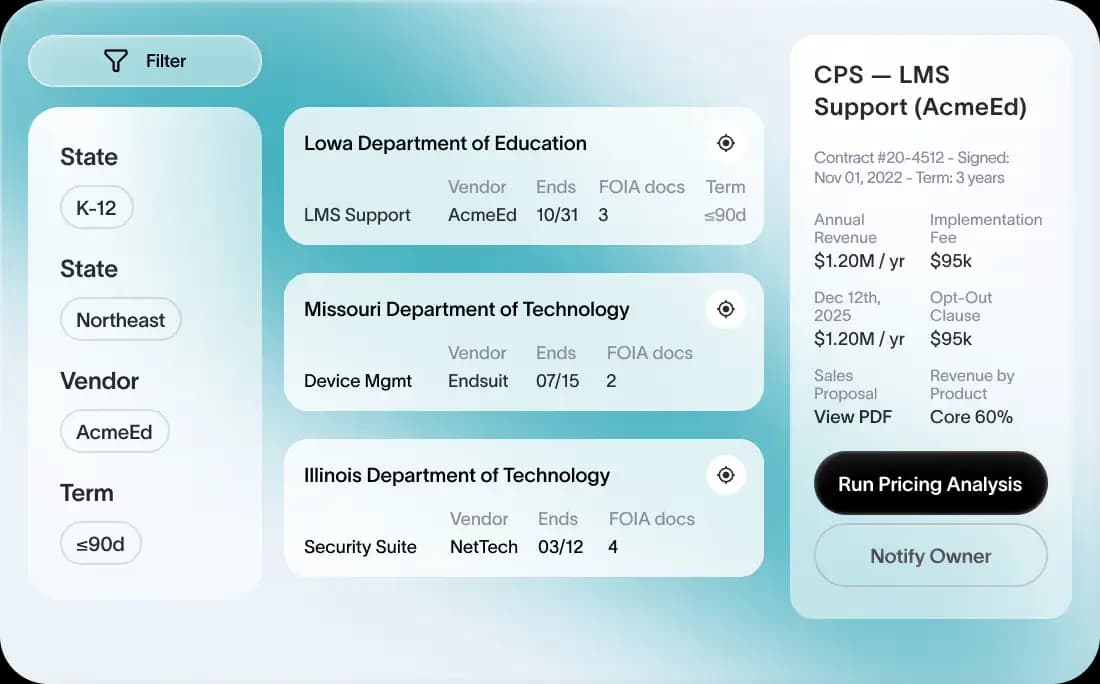
Mantra Health, for example, 3x’d their data enrichment coverage by connecting their Salesforce instance to Starbridge. Competitive intelligence became available to every rep on the team instead of just the ones who knew how to dig.
Reps can also pull account and competitive context instantly through Starbridge’s in-app AI chat, getting answers about any account or signal without switching tools. Responses are tailored to your business, products, and market, in the Chrome extension, or directly in Slack.
With thousands of school districts, cities, counties, and state agencies in your total addressable market, reps need a framework for ranking accounts. Build a simple scoring model with 5-7 attributes per account and rank every account from best to worst.
| Priority level | Use case and pain signals | Budget and capacity signals | Competitive signal |
|---|---|---|---|
| High (9–10) | Strategic plan or meeting minutes explicitly name your category as a top priority. | Budget documents show a specific line item or a hiring spree in the relevant department. | Incumbent contract expiring in under 12 months or public dissatisfaction with the current vendor. |
| Medium (5–8) | High-level goals suggest a need but no specific project is named. | Large operating budget or recent “Open to Spend” status but no line item. | Competitor is present but contract is not expiring soon. |
| Low (1–4) | No evidence of your use case in recent public transcripts. | Budget freezes, layoffs, or cost-cutting mandates. | Competitor just signed a 5-year deal. |
Use those scores to drive call prioritization, conference selection, and email campaign segmentation.
3. Build a reliable contact database for government and education
The single biggest bottleneck in selling to state and local government, K-12, and higher education is finding the right people to contact. Generic sales databases were not built for this market, and the consequences of bad data are severe.
Tools like ZoomInfo and other generic B2B databases scrape LinkedIn, which barely covers government and education roles. Titles like superintendent, city manager, and procurement director are underrepresented or missing entirely. User-reported bounce rates for tools like ZoomInfo run 15-25% for government contacts. In a finite market where reputation travels fast, a single bounced email damages credibility.
A reliable government and education contact strategy looks different. Contacts should be sourced from official .gov and .edu websites, district staff directories, and agency organizational charts. Email addresses should be continuously bounce-checked so reps never send to dead inboxes.
Starbridge’s Contacts & Company Data solves this with proprietary web-agent technology that crawls government and school websites. It then waterfall-enriches and continuously bounce-checks every contact. The outcome is a 98% email accuracy rate validated across a 14,000-email test, compared to 60-70% from generic sources.
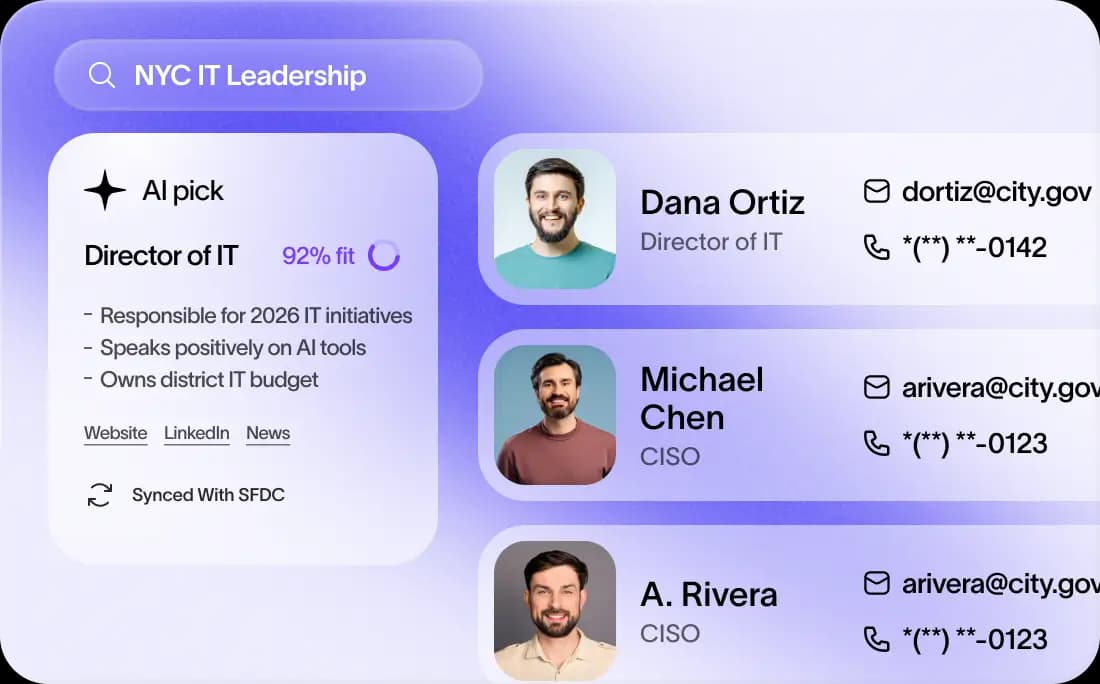
Starbridge’s bi-directional integration with Salesforce and HubSpot can sync, clean, and enrich verified contacts without manual data entry.
Within days of Starbridge setup, Storage Scholars had access to a fully enriched TAM database, fully automating contact enrichment and replacing thousands of hours of SDR time.
4. Identify buying signals before the RFP drops
The most valuable opportunities in government and education sales are found 6 to 18 months before a formal solicitation is published. Teams that wait for the RFP are already behind.
Buying signals in state and local government, K-12, and higher education are public, trackable indicators that an agency or district is moving toward a purchase. They surface well before any formal solicitation and tell you exactly when to engage. Here are the signals that matter:
- Board meeting discussions. When a school board or city council debates a new initiative, that conversation reveals both the pain and the urgency behind it.
- Contract expirations. An expiring vendor contract forces a re-evaluation and opens the door for a competitive conversation.
- Grant awards. A new federal or state grant unlocks a budget that did not exist last quarter.
- Budget line items. Planned spending on your category means the decision to buy has already been made internally.
- Leadership changes. A new superintendent, CIO, or city manager brings new priorities and a willingness to evaluate new vendors.
- Job postings. Hiring for roles aligned to your product category signals an expanding program.
- Published bids and RFPs. These come last because by the time a solicitation is posted, the winning vendor has typically been in the room for months and built the relationships that matter.
Responding cold to an RFP you did not know was coming rarely results in a win.
Government and education buyers are not procurement experts in every category they purchase. They rely on vendors to educate them on what’s possible, and the vendor who shows up early shapes the evaluation criteria, the requirements language, and the budget expectations. By the time the RFP is published, it often reflects the solution of whoever got there first.
Starbridge’s Buying Signal Monitor tracks over 320k government and education entities around the clock. It surfaces buying indicators from board minutes, strategic plans, budget documents, grants, contract expirations, and RFPs. Each signal arrives paired with a verified contact, a reason for outreach, and AI-generated messaging ready to send. Priority accounts are routed to the right reps with a clear explanation of why the timing is right.
In their first week using Starbridge buying signals, GovWell booked 5 meetings. Frontline Education cut research time by 90% after switching to signal-driven prospecting.
The goal is not just to find signals but to act on them immediately. Starbridge delivers territory-based alerts and daily digests so reps see the most relevant buying indicators each morning and can move within hours, not weeks.
5. Time your outreach to budget cycles and fiscal years
Government and education buying is cyclical. Aligning outreach to fiscal calendars determines whether a conversation leads to a purchase order this year or gets pushed to next fiscal year.
Sellers must track two primary fiscal year calendars. Most state and local government buyers operate on a July 1 to June 30 fiscal year. K-12 districts often align with the state fiscal year but plan purchases around the school calendar, with major buying decisions happening between January and May for the following school year.
The “use it or lose it” dynamic at the end of fiscal years creates concentrated windows of faster purchasing. Agencies and districts that have not spent their allocated budget risk losing it in the next cycle. For most state and local buyers, that window falls in April through June.
Buyers in this window are not likely to start a 90-day RFP process. They need a fast procurement path. If your product is available through a cooperative vehicle like Sourcewell, OMNIA, or NASPO ValuePoint, lead with that. If not, price below the sole-source threshold so the agency can issue a purchase order without a formal solicitation.
Build an outreach calendar that maps to these cycles. Initial relationship-building and product demonstrations should happen in Q1-Q2 of the fiscal year (July through December). When budget decisions finalize in Q3-Q4, your team is already positioned as a known solution rather than a cold vendor pitching at the last minute.
Timing intelligence is only useful if it is connected to specific accounts. Reps need to know not just that fiscal year-end is approaching, but which accounts in their territory have active budget, expiring contracts, or recent buying signals that make them likely to purchase in the current cycle.
The account scoring framework and the buying signal monitoring from previous steps combine here to tell reps exactly where to focus during each phase of the fiscal calendar.
6. Build relationships before procurement begins
Government and education buyers are not impulse purchasers. The teams that win consistently are the ones who invest in relationships months before a purchase decision is made.
Attend the conferences where your buyers gather. Offer to present at association meetings. Provide value through educational content that helps buyers do their jobs better. Government and education buyers respond to vendors who demonstrate understanding of their specific challenges, not vendors who lead with product features.
A high-converting conference play is account-based personalized outreach. Skip the booth early on and “suitcase it” instead. Walk the floor, meet your buyers face-to-face, and bring personalized one-pagers tailored to each account. Reference a nearby customer win, pull a line from the account’s strategic plan, and lead with their problem rather than your product.
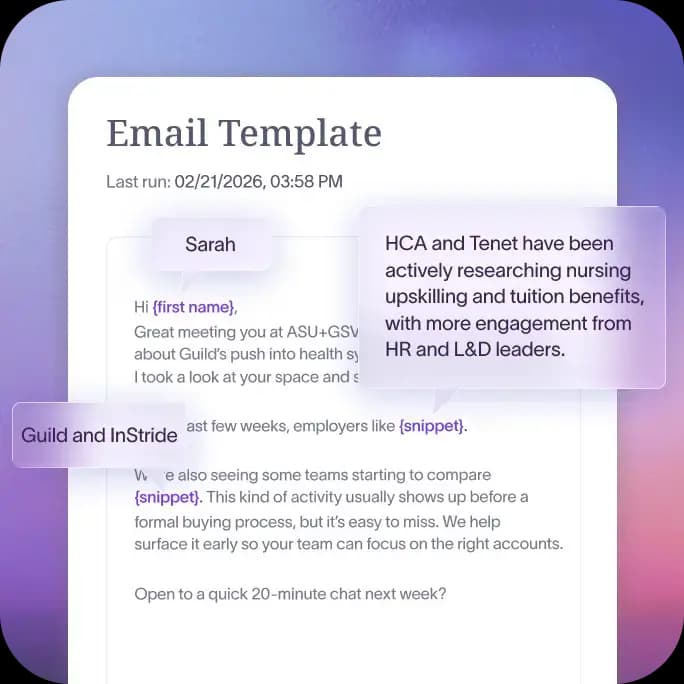
Starbridge’s Conference Intelligence makes this scalable. It scores conference attendees by ICP fit, enriches lead lists with verified contact data, and generates personalized follow-up outreach that syncs directly to CRM. Instead of leaving a conference with a stack of business cards and no follow-up plan, every lead is prioritized and routed into sequences the same day.
7. Turn intelligence into pipeline without adding headcount
The final step is operationalizing everything from the previous steps into a repeatable system. Buying signals, verified contacts, and account context need to flow directly into the tools reps already use. When intelligence becomes pipeline without extra manual work, you scale revenue without proportionally scaling headcount.
The last-mile problem in government and education sales is real. Even when teams have good data, it often sits in a spreadsheet or dashboard instead of flowing into CRM workflows where reps actually work. The gap between having intelligence and acting on it is where pipeline dies.
A connected sales intelligence stack for government and education looks like this:
- Every buying signal arrives paired with a contact, a reason for outreach, and suggested messaging.
- Account scores update dynamically as new signals emerge.
- Every insight pushes directly into Salesforce, HubSpot, or outreach sequences.
- Reps see their next action inside the tool they already have open.
Starbridge closes this gap by design. Its bi-directional CRM integration can sync, clean, and enrich contact and account data in Salesforce and HubSpot without manual entry. Every buying indicator surfaces with a verified contact, a reason for outreach, and AI-generated copy ready to send. Reps get prioritized pipeline views each morning that turn intelligence into action.
When opportunities your team helped create turn into formal solicitations, Starbridge’s AI RFP Finder & Proposal Writer tracks best-fit RFPs by product, region, and win likelihood, then auto-drafts proposals from your product knowledge base. HousingCloud used Starbridge’s proposal writer to cut 8-10 hours per RFP.
From research to revenue in government and education sales
Selling to government and education follows a predictable pattern. The teams that win consistently understand procurement mechanics, build reliable contact data, identify buying signals early, time outreach to budget cycles, and invest in relationships before the RFP.
If your team sells to state and local government, K-12, and higher education and you want to prioritize the right accounts, engage the right people earlier, and identify high-intent opportunities before the competition, book a demo with Starbridge to see how it works.
Frequently asked questions
For technology and SaaS companies, selling to the government means adapting your go-to-market motion to serve state and local government, K-12, and higher education buyers. These organizations follow formal procurement processes, require compliance documentation, and involve multiple stakeholders in every purchase decision. The opportunity is massive, but the sales motion is fundamentally different from commercial B2Bs.
B2G sales cycles typically range from 2 to 18 months after the economic buyer says yes, depending on deal size, procurement path, and the specific agency. Smaller deals below the sole-source threshold can close in weeks. Larger deals that require a formal RFP process can take a year or more. The best way to shorten the cycle is to engage before procurement begins and price below sole-source thresholds when possible.
Not always. RFPs are triggered when your price exceeds the agency’s sole-source threshold. Many deals close through informal purchases, sole-source justifications, or cooperative purchasing vehicles that bypass the formal solicitation process entirely. The highest-performing teams focus their energy on pre-RFP engagement and only bid on RFPs that originated from their own conversations.
Generic B2B databases were not built for government and education. The most reliable approach is sourcing contacts from official .gov and .edu websites, staff directories, and agency organizational charts. Starbridge automates this with proprietary web-agent technology that crawls government and school websites, then continuously verifies and bounce-checks every contact, delivering a 98% email accuracy rate compared to 60-70% from generic databases.
Buying signals are early indicators that a government or education buyer is moving toward a purchase. Examples include board meeting discussions about new initiatives, contract expirations, grant awards, budget line items, and leadership changes. These signals surface 6-18 months before an RFP, giving sellers a critical timing advantage. Teams that monitor and act on buying signals engage accounts before competitors even know the opportunity exists.
Explore our use case library
 Automate account research with AI agentsStop manually researching accounts. Starbridge AI agents automate account research by monitoring buying signals 24/7 and surfacing the right contacts.
 Identify competitor contract expiration datesThe RFP is usually a formality. Starbridge surfaces competitor contract expiration dates so your reps reach accounts before the renewal cycle closes.
 Create a conference campaignTurn conference badge scans into pipeline. Import your contact list, surface buying signals across every account you met, and follow up with context.