
SLED sales strategy: Build pipeline before the RFP
By the time a government RFP drops, the deal is already decided. Learn how to win more state, local, and education contracts by engaging buyers 6 to 18 months early.

By the time the RFP drops, the deal is already decided.
The vendor who secures a state or school district contract began building the relationship 12 to 18 months before the solicitation appeared. They participated in discovery conversations while the buyer was still defining the problem. They influenced the evaluation criteria. When the RFP was finally published, they were already the frontrunner. Every other vendor responding to it was filling out paperwork for someone else.
State and local governments, K-12 school districts, and higher education institutions collectively spend trillions of dollars each year across technology, professional services, construction, curriculum, and infrastructure, spanning more than 110,000 entities. Technology purchases alone account for $160.2 billion annually, and even within that category, the average deal takes 22 months to close — the longest buying cycle of any industry. The vendors who win consistently are not those with the best proposals; they are those who engaged earliest.
This guide covers the complete SLED sales playbook: how to prioritize your account list, identify buying indicators before budgets are allocated, engage buyers before procurement begins, use cooperative purchasing shortcuts to close deals faster, and consolidate the fragmented tool stack that is slowing your team down.
What Is SLED Sales?
SLED sales refers to selling products and services to state and local governments, K-12 school districts, and higher education institutions. The market includes over 110,000 entities purchasing everything from software and professional services to curriculum, construction, and infrastructure. Consistent success requires engaging buyers 6 to 18 months before an RFP and using cooperative purchasing vehicles to close deals without competitive bidding.
How SLED procurement differs from commercial B2B
SLED stands for State, Local, and Education. This category covers every government and education institution below the federal level: state agencies, city and county governments, public school districts, community colleges, and public universities.
Three structural differences set this market apart from commercial B2B.
Buyers operate on fixed fiscal calendars. Most state agencies and school districts run July 1 to June 30. Budget decisions are made in January and February. Purchases peak from January through May. A vendor whose first conversation occurs in March is already 10 months behind the budget cycle.
Decisions pass through evaluation committees with distinct veto conditions. The end user evaluates workflow fit. The economic buyer, typically a CFO, director, or deputy superintendent, evaluates ROI and total cost. The IT evaluator, often the actual decision-maker in K-12 and local government, evaluates security, compliance, and integration. A proposal that satisfies the end user but fails to meet IT requirements will not progress.
Procurement rules mandate competitive bidding above a certain threshold. The central question in every state and local government procurement is whether an RFP is required. Below the agency’s sole-source threshold, a buyer can purchase from a single vendor without a competitive solicitation. Most vendors never ask about the threshold. Those who do often avoid the RFP process entirely.
| SLED | Commercial B2B | Federal | |
|---|---|---|---|
| Sales cycle | 6–24 months | Weeks to months | 12–36 months |
| Procurement | Formal RFP/bid process, state/local rules | Flexible, relationship-driven | FAR/DFARS compliance |
| Decision drivers | Compliance, past performance, risk reduction | ROI, speed, innovation | Compliance, security, policy |
| Revenue profile | Multi-year contracts, low churn | Varies | Long-term, high compliance cost |
Who actually makes the buying decision
Research from Gartner found that only 41% of government C-level executives participate in technology buying decisions, compared to 55% in the private sector. Government leaders deliberately remain uninvolved to avoid any perception of political influence. Buying committees are weighted toward operational staff and department heads — the people most affected by the product — not those with the highest titles.
In K-12, the IT director or CTO often holds final veto authority over anything involving student data. Engaging them early as a strategic partner, rather than as a late-stage compliance checkpoint, is one of the most underused conversion levers in edtech sales.
How Long Do SLED Sales Cycles Take?
Why cycles average 6–24 months
Gartner’s 2022 survey of 1,120 technology executives found that government technology purchases take an average of 22 months — the longest of any industry surveyed. Nearly half of respondents (48%) reported six or more significant delays. Scope changes alone added an average of seven months. Additionally, 68% attributed delays to insufficient information from the technology provider.
That last figure is significant. Two-thirds of delayed deals stall because the vendor failed to provide the right information at the right stage. Engaging earlier is not just a relationship tactic; it is the primary lever for shortening the cycle. The complete guide to selling to state and local government explains how to structure those early conversations step by step.
The win rate data supports this. An analysis of 250,000 federal contract awards found that vendors who engaged 12 or more months before an RFP won at a rate of 34%. Those who first engaged at RFP release won at 18%. Reactive bidders won at 10 to 15%. The same dynamic applies to SLED: the earlier you engage, the better your odds. Contractors with structured pre-RFP capture management win 40 to 70% of the deals they pursue, compared to around 21% for those who respond cold.
The fiscal year calendar that controls everything
Most state agencies and school districts operate on a July 1 to June 30 fiscal year. Budget planning starts in January and February. Major purchases close January through May. The end-of-year surge runs from April through June, when departments must spend remaining allocations or see the money revert to the general fund.
Cities and counties on a calendar-year budget create a secondary surge from August through November. Understanding which fiscal calendar your target accounts follow is essential, as it determines whether your outreach lands during an active buying window or sits in a queue for 10 months.
The 75% rule and the free pilot trap
Once an economic buyer commits on pricing, close probability rises to approximately 75 to 80%. Once the deal reaches legal review, it reaches 90%. The process is slow, but the outcome becomes predictable once the right stakeholder is committed.
What prevents many deals from reaching that milestone is the free pilot. Free pilots fail most of the time. When a vendor offers something for free, agency and district leaders interpret it as a signal that the product is not confident enough to command market price. They invest minimal effort, the pilot produces limited results, and the engagement stalls. Price at market rate, define success criteria before the pilot begins, and build a contractual decision date into the agreement from the outset. — Justin Wenig, Founder & CEO, Starbridge
How Do You Prioritize Your SLED Account List?
Most vendors target the largest institutions first, assuming size implies budget. This is usually incorrect. Large cities and major school districts often have long-term contracts with established vendors and procurement teams skilled at slowing down new entrants. Mid-size accounts with expiring contracts, active strategic planning, and clear buying indicators are often much quicker to close.
The structural advantage in government and education selling is that the total addressable market is finite and knowable. There are 13,598 school districts in the United States, roughly 90,000 state and local government entities, and thousands of higher education institutions — more than 110,000 entities in total. Every account can be ranked from most to least likely to buy this quarter.
Scoring state and local government accounts
A practical scoring model for state and local government accounts uses five to seven attributes:
- Population or operating budget — larger entities have more procurement capacity but also more entrenched vendor relationships
- Competitor contract presence and expiration — which vendor is currently in place and when that agreement ends
- Funding environment — recent budget approvals, grant awards, or bond measures in your product category
- Relevant web indicators — board meeting minutes and strategic plan language explicitly naming your category as a priority
- Leadership changes — new superintendents, city managers, or department heads who typically reset vendor relationships within 12 months
Score every account in your TAM from best to worst. Use those scores to drive call prioritization, conference selection, and campaign segmentation. The full GTM playbook from founding CourseDog and Starbridge — including how to build this model from scratch — is covered in Justin Wenig’s govtech and edtech sales manifesto.
How scoring differs for Education
For K-12 accounts, enrollment size and year-over-year enrollment trends matter more than raw population. Federal funding sources become a scoring input — a district actively using Title I, IDEA, or ESSER funds for your product category has a funded path to purchase that other districts do not.
K-12 board approval is typically required above $10,000. That threshold shapes your pilot pricing and your expansion strategy from single-school to district-wide. Because districts communicate constantly with each other, a win in one region substantially raises the probability of closing similar nearby districts. After each win, identify the five most comparable districts in the same state and lead every outreach with that reference.
For higher education, the scoring model shifts toward department-level budget signals and campus-level technology priorities. Individual schools within a university system often buy independently, creating multiple entry points that centralized scoring alone will miss.
Finding and tracking these signals manually across more than 110,000 entities is not sustainable at scale.
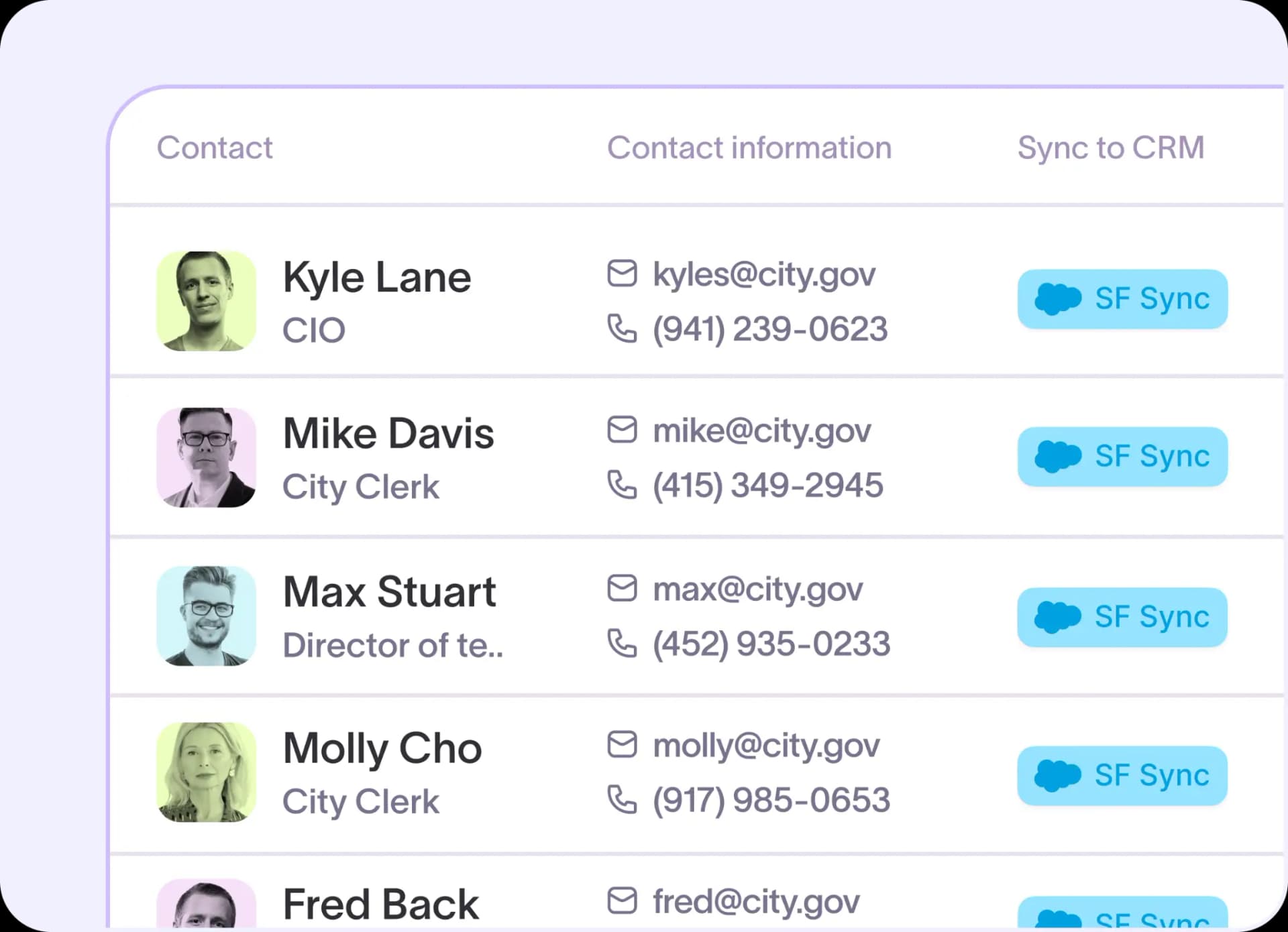
Starbridge, the AI sales intelligence platform built on the most comprehensive dataset of government and education buyers and buying signals, automates this process. Its Public Spend Intelligence functionality aggregates procurement and spend data across entities so teams can see which accounts are actively buying in their category. Teams define scoring criteria in plain language and scores update automatically as new buying indicators arrive.
InquirED generated $200,000 in new pipeline in their first quarter on Starbridge by replacing manual board-document research with a signal-driven scoring model that identified which districts were actually ready to buy.
Scored accounts drive every downstream decision. They determine your call list, your conference strategy, your outbound segmentation, and where you invest time building relationships.
How Do You Build Pipeline Before the RFP Drops?
Government and education buyers are rarely experts in the solutions they need to purchase. They consult vendors early to understand what is possible. The vendor who educates the buyer during this research phase builds trust and, in many cases, directly influences the evaluation criteria. The RFP is often written with their solution in mind.
Entering that conversation requires knowing which accounts are in the research phase before they announce it publicly. According to APMP and OST Global Solutions benchmarks, 80% of buying decisions are made before the proposal is even written.
The three-phase pre-RFP engagement window
Government and education procurement follows a predictable timeline with three distinct phases before the formal process begins.
During the Discovery phase, 12 to 18 months before an RFP, the buyer discusses the problem internally. Board minutes and strategic plans reference the issue, but no budget is allocated yet. The right approach is educational outreach: share thought leadership, peer case studies, and relevant policy analysis. The goal is to be a knowledgeable partner, not a vendor pitching features.
During the Planning phase, 6 to 12 months out, budget discussions begin. Line items appear in draft budgets. Job postings signal capacity building in the relevant department. This is the time to run discovery conversations, map the stakeholder structure, and introduce the product to the end user.
During the Procurement phase, 0 to 6 months out, requirements are being defined and solicitation documents drafted. If you are not part of this conversation, you are already behind. Lead with competitive proof points, references from similar entities, and a direct question about whether sole-source justification or a cooperative vehicle is available.
Eight buying indicators ranked by value
Not all buying indicators carry equal weight. Ranked from highest to lowest:
- Board meeting discussion naming your product category as a priority
- Budget line item approval or allocation in your category
- Grant award with spending tied to your category’s objectives
- Competitor contract expiration within 12 months
- Leadership change at the target account
- Strategic plan language naming your category explicitly
- Job posting signaling a new initiative or program build-out
- Published RFP — lowest value. By the time the solicitation is live, the preferred vendor relationship is usually already established.
What makes a qualified SLED lead
A buying indicator alone is not a qualified lead. A list of names is not a qualified lead. A qualified lead in government and education selling requires all three components working together.
An account-level buying indicator — something specific has changed at the account, signaling movement toward a purchase.
A verified contact in the right role — not a LinkedIn guess, but a specific person with a confirmed email sourced from official records.
Outreach context — a concrete, timely reason to reach out that connects your solution to the buyer’s current situation. A specific reference to the grant they just received, the board discussion they just had, or the nearby district that recently went live on your product.
Fifty signal-backed opportunities with verified contacts outperform 500 names from a purchased list every time.
Tracking buying indicators across more than 110,000 entities manually is not realistic for most sales teams.
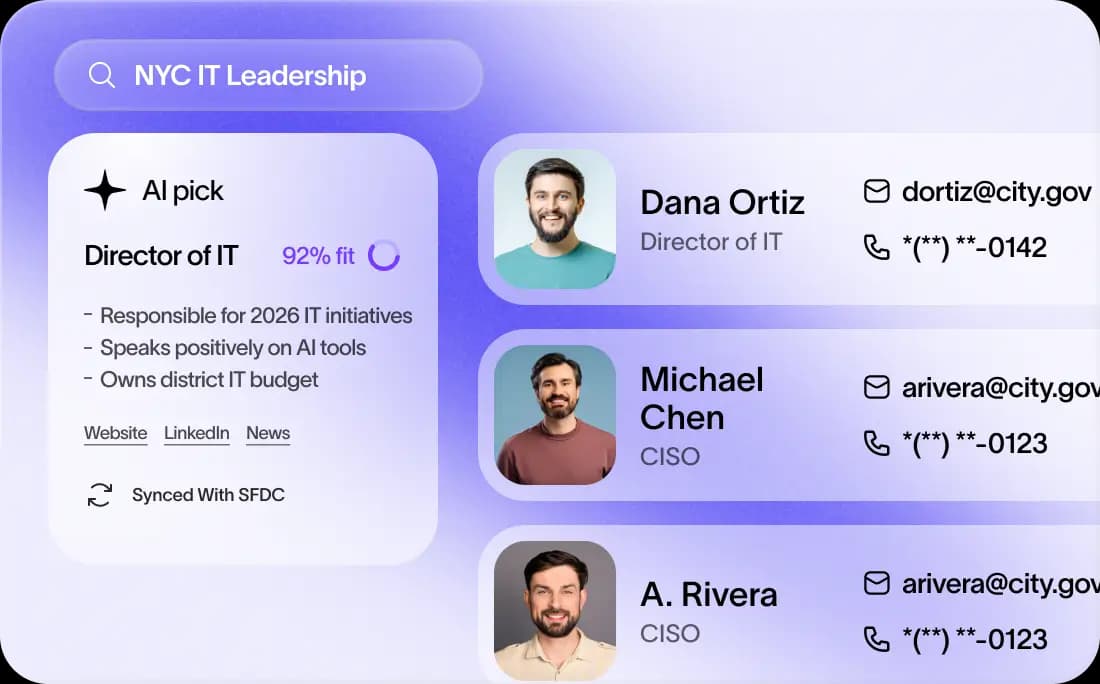
Starbridge’s Buying Signals Monitor tracks over 320k+ public sector entities continuously, surfacing board meeting discussions, budget approvals, grant awards, contract expirations, and leadership changes as soon as they appear — with a verified contact attached, so outreach can happen before competitors know the deal exists.
GovWell sources 15% of its total qualified pipeline from Starbridge buying indicators and booked five meetings in its first week on the platform.
The goal is not to respond to RFPs. It is to be the vendor who helped write the requirements.
Can You Skip the RFP Process Entirely?
For many vendors, the RFP seems unavoidable. It is not. Two reliable paths exist to close government and education deals without a competitive solicitation. The first is pricing below the sole-source threshold. The second is directing buyers to a cooperative contract they can purchase from directly.
Cooperative purchasing vehicles
Cooperative purchasing organizations run competitive solicitations, evaluate vendors, and award master contracts. Any eligible member agency can then purchase from those contracts without running their own RFP.
The major national vehicles:
- NASPO ValuePoint — the contracting arm of all 50 state chief procurement officers, plus Washington D.C. and U.S. territories. More than $24 billion in cooperative purchasing in 2024. Master agreements available to state agencies, higher education institutions, and political subdivisions.
- Sourcewell — $7.34 billion in contract sales in FY2024–25, up 14.7% year-over-year. Over 50,000 member government and education entities. Free membership, no purchase obligation.
- Omnia Partners — over $30 billion in annual managed spend across more than 90,000 member agencies.
- Texas DIR, New York OGS, ERIE BOCES — state-specific vehicles with broad reach in their jurisdictions.
Piggyback clauses extend this further. A city in Georgia can purchase from a contract competitively bid by a city in Florida without issuing any solicitation of its own. A single cooperative award creates purchase pathways across hundreds of eligible agencies.
Getting onto a cooperative contract typically requires a live deal in hand — ideally six figures or more — before a reseller or cooperative organization engages seriously. For teams also responding to active RFPs, Starbridge’s AI RFP Finder and Proposal Writer surfaces relevant bids and accelerates proposal development.
Sole-source thresholds by jurisdiction
Sole-source thresholds define the amount below which a buyer can purchase from a single vendor without competitive bidding.
Texas state agencies: approximately $50,000. California entities: approximately $100,000. K-12 school districts: often $10,000 before board approval is required. Universities: generally higher thresholds with more flexibility.
A vendor priced at $45,000 might close in 30 days in California but trigger a six-month RFP in a Texas school district. Ask about the threshold before building the proposal.
The April through June surge window
For state agencies and school districts on a July 1 to June 30 fiscal year, the final quarter creates a concentrated purchase window. Departments that have been conservative with budget all year face a hard deadline: spend remaining allocations or watch the money revert to the general fund.
These buyers are not starting a 90-day RFP process in April. They need a fast procurement path. Lead with cooperative vehicle availability first. If none applies, confirm whether pricing below the sole-source threshold allows the agency to issue a purchase order directly. Frame the conversation around their fiscal year deadline.
What Does a SLED Sales Tool Stack Actually Cost You?
Ask a government or education sales leader how many tools their team uses, and the answer is usually somewhere between “too many” and “I’m not sure anymore.” This is not a coincidence; it is a structural problem with how the SLED intelligence market has evolved. Each pain point attracted its own vendor. Each vendor became its own subscription, its own login, its own renewal conversation.
The average B2B sales team licenses 10 to 15 tools, but representatives actively use only 3 to 6 of them. Sellers who feel overwhelmed by their tech stack are 43% less likely to hit quota. 73% of sales teams waste $2,340 per rep per year on overlapping tools — and that is before accounting for time lost to context-switching, fragmented data, and extended ramp.
Legacy tools in Education
| Legacy Tool | Traditionally used for |
|---|---|
| Agile Education Marketing | K-12 contact intelligence |
| Burbio | Meeting and board intelligence |
| IPEDs (NCES) | Higher ed institutional data (manual research) |
| BidPrime, GovWin | RFP and bid tracking |
| GovSpend | Contract and spend intelligence |
| Outreach, Salesloft | Outreach and sequencing |
| Starbridge | All of the above — contacts, buying indicators, spend intelligence, account scoring, and CRM sync in one platform |
Legacy tools in Government
| Legacy Tool | Traditionally used for |
|---|---|
| GovNav, Power Almanac, ZoomInfo, Databees | Contact intelligence |
| BidPrime, GovWin | RFP and bid tracking |
| GovSpend | Contract and spend intelligence |
| Outreach, Salesloft | Outreach and sequencing |
| Starbridge | All of the above — contacts, buying indicators, spend intelligence, account scoring, and CRM sync in one platform |
The consolidation argument
Every tool above was built to solve a single problem. Contact tools were designed for finding who to reach. Bid trackers were created to surface active solicitations. Spend intelligence tools focused on historical purchasing data. Outreach tools enabled sequencing at scale. Each serves its purpose. The problem is the rep sitting in the middle, manually assembling a picture across six logins before every call and reconciling data that often conflicts between systems.
66% of sales reps report feeling overwhelmed by the number of tools they are expected to use. 90% of sales organizations plan to consolidate their tech stack. The cost of fragmentation — integration maintenance, context-switching, data silos, and extended ramp time — now exceeds the cost of the licenses themselves.
Starbridge, the AI sales intelligence platform built on the most comprehensive dataset of government and education buyers and buying signals, replaces all of these categories in one platform. Contacts, buying indicators, spend intelligence, account scoring, and CRM sync — without the tab-switching.
Mantra Health tripled their data enrichment coverage after switching to Starbridge. The team got a complete view of their addressable market for the first time.
Fewer tools. Better data. More time selling.
Does the Playbook Change by Segment?
State agencies, cities and counties, K-12 school districts, and higher education institutions are four distinct selling environments. The core strategy remains the same: engage early, score your TAM, and use procurement shortcuts. The specifics differ.
State government
State agencies generally have higher sole-source thresholds, longer formal procurement timelines, and statewide master agreements that standardize purchasing. GovRAMPcompliance is increasingly required for software products handling state agency data.
The economic buyer is typically an agency CFO, deputy director, or department head. IT evaluators carry significant influence and often collaborate with a statewide CISO. Budget planning runs from January through spring, with the strongest purchase window for new fiscal year initiatives from October through March.
Local government
Local government is the most fragmented segment. Small municipalities often have no formal procurement process for purchases below $25,000 (different by government) and can issue a purchase order with minimal friction.
Council and commission meeting minutes are the best pre-budget buying indicator. When a city council discusses a specific operational challenge — permitting modernization, public safety analytics, or revenue collection — that discussion typically precedes a formal procurement by 6 to 12 months.
The nearby-win strategy is especially effective here. Government and education buyers form a close-knit community. Close one mid-size city and immediately lead outreach to comparable nearby cities using that reference.
K-12 school districts
K-12 procurement is calendar-driven. Budget planning starts in January and February for the following school year. The main purchase window runs from January through June. The end-of-year surge peaks from April through June.
The IT director or CTO often holds final veto authority over anything involving student data. FERPA compliance documentation must be ready before any serious evaluation begins — not assembled afterwards. Engage the IT buyer early.
Connect your product to a specific federal funding source in every conversation. A district using Title I for academic support or IDEA for special education has a funded path to purchase that other districts may not. Addressing the budget source before it is raised removes one of the most common stall points. The complete guide to selling to K-12 schools covers how to map your product to each funding source.
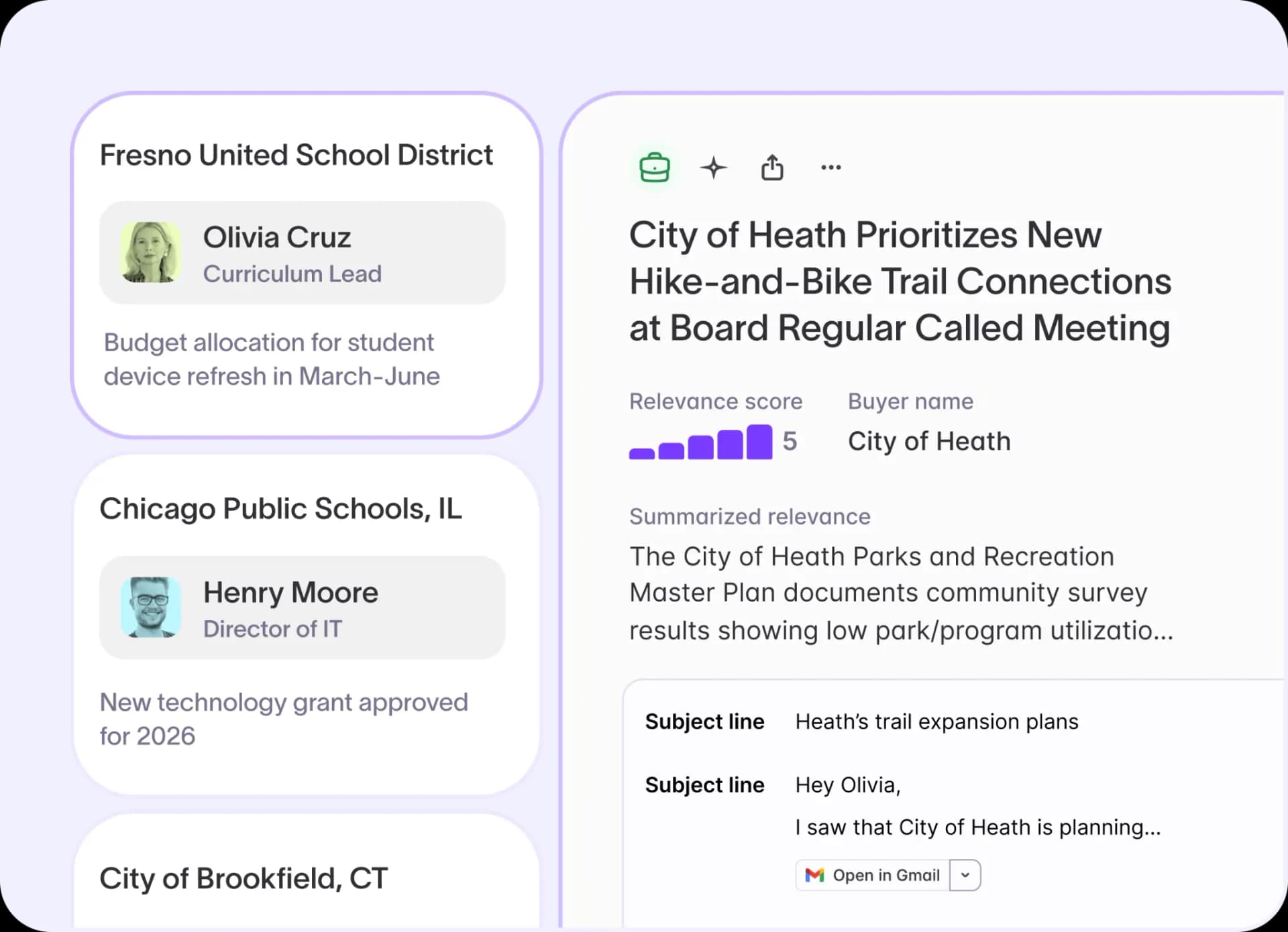
Hapara uses Starbridge to identify school districts actively discussing competitor solutions in board meetings in real time, replacing generic outbound with targeted campaigns based on actual buyer conversations. That approach has driven a 20% increase in response rates.
Higher education
Higher education generally offers faster procurement cycles and more flexibility than K-12 or state agencies. Individual department and campus-level budgets can move independently of central IT, creating multiple entry points within a single institution.
The challenge is knowing which contact to reach and what they are focused on before the first conversation. With multiple campuses making independent purchasing decisions, generic outreach misses most of the market.
Starbridge’s Ask Starbridge Chat surfaces campus-level spend data, competitive context, and account priorities in seconds. Representatives enter every discovery conversation already knowing what the buyer cares about, which competitors are present, and what the institution has been spending on in their category.
Frontline Education reduced account research time by 90% after deploying Starbridge. What previously required 20 to 30 minutes of manual research per account is now available instantly — reps walk into meetings already knowing account priorities, competitive context, and spend history.
Conclusion
Government and education selling rewards vendors who work backward from the RFP. Procurement is not where the pipeline begins; it is the finish line for a relationship that started 12 to 18 months earlier.
The playbook is consistent across segments. Score your total addressable market before you prospect. Identify buying indicators before budgets are allocated. Engage during the Discovery and Planning phases rather than waiting for a solicitation. Use cooperative vehicles and sole-source thresholds to reduce procurement friction. And consolidate the fragmented tool stack so your team is working on signals, not switching between tabs.
Every entity in this market can be scored, ranked, and engaged before the RFP. The question is whether your team is seeing the buying indicators early enough to act.
See how Starbridge helps government and education sales teams build pipeline before the RFP at the Buying Signals Monitor.
Frequently asked questions
SLED sales involves selling products and services to state and local governments, K-12 school districts, and higher education institutions — over 110,000 entities purchasing everything from software to curriculum, construction, and infrastructure. The market represents trillions in annual spending across all categories. Consistent success requires engaging buyers 6 to 18 months before an RFP.
SLED sales operates on fixed fiscal calendars, requires formal competitive bidding above sole-source thresholds, and involves evaluation committees where IT often holds veto authority. Sales cycles average 6 to 24 months, compared to weeks or months in commercial B2B. Revenue is more predictable, with multi-year contracts and low churn, but the path to close is more structured.
According to Gartner’s 2022 survey, government technology purchases take an average of 22 months, the longest buying cycle of any industry. Timelines range from 6 months for a sole-source deal below threshold to 24 months or more for a competitive RFP. Vendors who engage 12 to 18 months before the formal process consistently achieve the fastest closes.
Win SLED contracts by engaging buyers during the Discovery and Planning phases, 6 to 18 months before an RFP. Score your TAM to identify accounts with active buying indicators — expiring competitor contracts, budget approvals, board meeting discussions. Use cooperative purchasing vehicles to bypass competitive bidding. Price below sole-source thresholds where possible to avoid triggering an RFP.
Most state agencies and K-12 school districts operate on a July 1 to June 30 fiscal year. The primary purchase window runs from January through June. April through June creates an end-of-year surge as agencies must spend allocated budgets before they revert. Cities and counties on a calendar-year budget create a secondary surge from August through November.
Identify accounts in the Discovery phase — 12 to 18 months before procurement — by tracking board meeting discussions, budget approvals, grant awards, and leadership changes. Engage with educational outreach and peer case studies before any RFP is written. A qualified lead requires all three: an account-level buying indicator, a verified contact in the right role, and outreach context tied to their current situation.
Explore our use case library
 Automate account research with AI agentsStop manually researching accounts. Starbridge AI agents automate account research by monitoring buying signals 24/7 and surfacing the right contacts.
 Identify competitor contract expiration datesThe RFP is usually a formality. Starbridge surfaces competitor contract expiration dates so your reps reach accounts before the renewal cycle closes.
 Create a conference campaignTurn conference badge scans into pipeline. Import your contact list, surface buying signals across every account you met, and follow up with context.