
Starbridge vs. GovSpend: which platform actually closes deals?
GovSpend shows you what agencies bought and what they're bidding on. Starbridge shows you who's buying before the bid hits. See how the two platforms compare on signals, enrichment, and closed deals.

Starbridge and GovSpend take two fundamentally different approaches to government and education sales. GovSpend is a procurement intelligence database built with historical purchase orders and modules for bids, meeting transcripts, and contacts. Starbridge is an AI-native sales intelligence platform that surfaces buying intent before your competitors know the opportunity exists, then carries the deal all the way to a signed contract.
This comparison breaks down the five solution areas vendors should evaluate when deciding between the two platforms. Here is a quick glance before we go deep.
| Solution area | Starbridge | GovSpend |
|---|---|---|
| Early buying signals | Forward-looking from board minutes, grants, leadership changes, contract expirations, and more with real-time alerts, daily email digests, Slack notifications, all synced directly to your CRM. | Meeting transcripts, purchase orders, and a newer Opportunities module released in the last few months. |
| Contact enrichment | 98% contact data accuracy sourced in real time from verified .gov domains and agency directories, waterfall enrichment, and continuous bounce-checking. | Contact information sourced through agency relationships and document requests refreshed on variable cycles. |
| Vendor spend intelligence | Takes strong PO and contract award data and goes deeper with web analysis to surface competitor presence, expiration context, and account-level spend signals in one workflow. | Line-item PO data plus contract records with end dates and basic award details. |
| Contract vehicle access | Pre-approved access to every major contract vehicle, including NASPO ValuePoint, OMNIA Partners, Sourcewell, TIPS, and GSA, available as part of the platform. Starbridge handles compliance, paperwork, and renewals. | Contract vehicle sell-through is not a stated capability as of July 2026. |
| RFP discovery and response | AI-scored RFP feed & coverage for 320k+ state and local agencies, and an AI proposal writer that automates the proposal process. | RFP database; proposal writing via third-party partner (Iris). |
| Opportunity search | Natural-language Search Agents continuously scour the entire web for opportunities matching your buyer profile, signals, and scoring criteria. | Keyword-based search across platform modules as of July 2026; G2 reviewer notes users must know exact search terms to avoid wading through irrelevant results. |
| CRM Integrations and MCP/APIs | Bi-directional native Salesforce and HubSpot sync with multi-field account matching, territory sync from your CRM, and automatic enrichment that keeps records current. | Salesforce and HubSpot integration available. G2 reviewers flag account matching friction when CRM naming conventions differ from the platform’s records. |
Spotting early buying opportunities from data sources
In government and education sales, the data sources behind your buying signals determine whether your team engages early or shows up after a competitor is already in the room. A buying signal, such as a new grant award or a contract about to expire, tells reps when an account is ready to buy. The question is whether your platform surfaces those buying indicators before the opportunity goes public or after it is already underway.
Starbridge surfaces buying indicators from board meetings, grants, leadership changes, and more
Starbridge built its Buying Signal Monitor to solve this exact problem. The platform monitors 320k+ government and education entities around the clock, surfacing buying indicators from board meeting minutes, strategic plans, budget data, grants, job postings, contract expirations, news alerts, and bids and RFPs.
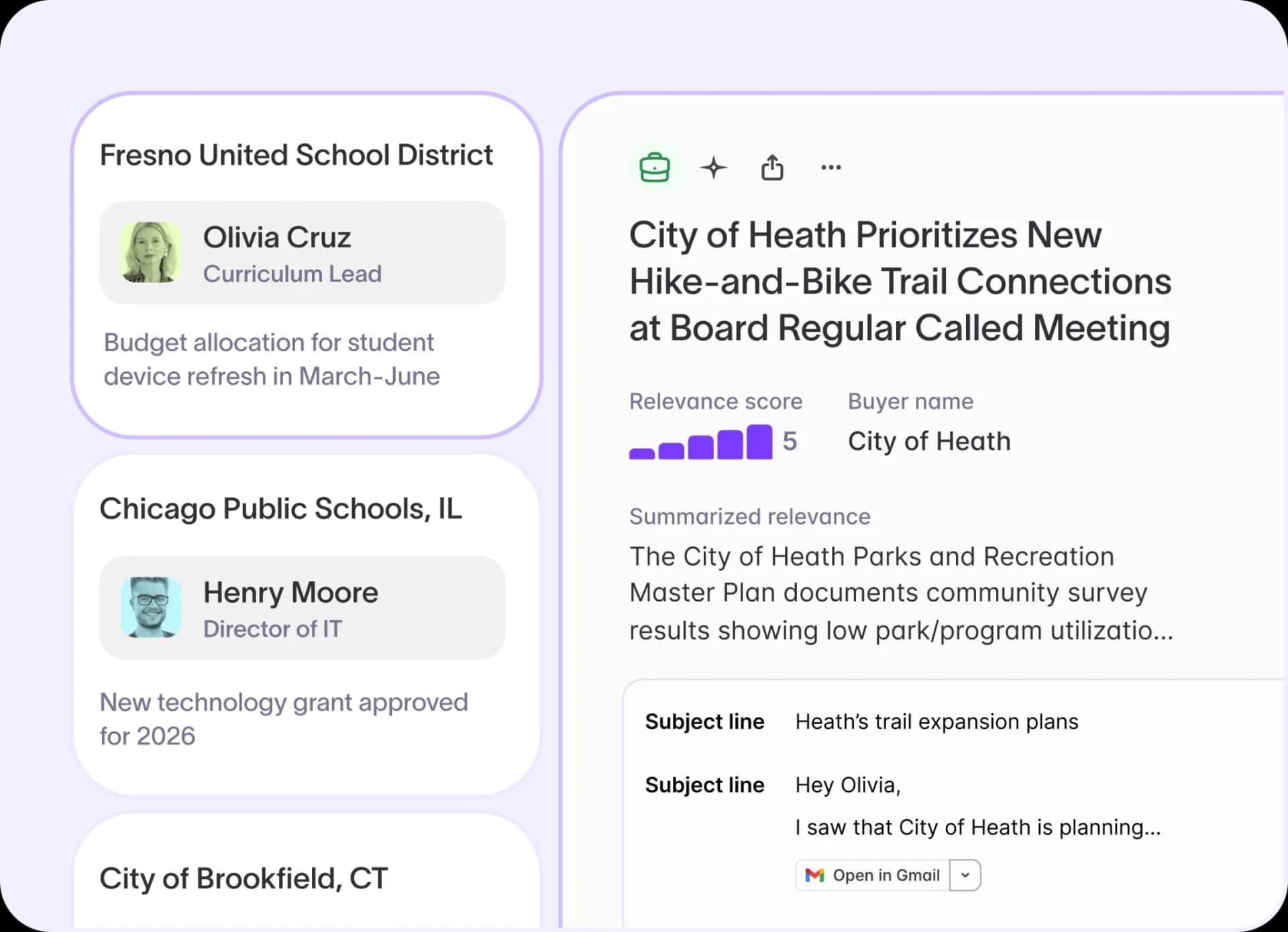
What makes meeting intelligence particularly powerful is that it captures stated buyer intent. When a school board discusses vendor pain points, budget priorities, or technology plans, reps hear how buyers describe their needs in their own words. That is a fundamentally stronger buying indicator than inferred data like grant funding alone, because it reflects what buyers are actively thinking and planning.
Every buying signal fires with a verified contact, a reason for outreach, and AI-generated personalized copy. Reps receive these through real-time alerts, personalized daily digests delivered to their inbox or Slack, and direct pushes into Apollo, Outreach, Salesforce, and HubSpot. The gap between signal and action shrinks to minutes, not days.
What makes this possible is Starbridge’s AI-native architecture. Built on a vector database from day one, the platform understands context rather than relying on exact keyword matches. If a school board discusses “budget shortfalls impacting technology spending,” Starbridge surfaces that buying indicator on semantic intent, even if those exact words never appear in your keyword list.
Today, 50% of Zencity’s cold meetings come from Starbridge, after their enterprise sales team replaced Google Alerts and manual research with signal-driven outbound powered by buying indicators.
GovSpend provides procurement data with AI tools layered on top
GovSpend’s Meeting Intelligence can surface planning discussions before procurement begins, and purchase order data provides a backward-looking view of what agencies have already bought.
GovSpend has also layered AI features onto its platform, including AI Search, AI Chat, AI Prompts, and a newer Opportunities module that uses a company profile to surface relevant activity.
As one G2 reviewer put it, “I’d like to be able to limit more results. It’s hard to get some of the things that are not pertinent to my business filtered out.”
Starbridge takes a workflow-focused approach to what happens after a buying indicator is detected. Every signal arrives paired with a verified contact, a reason for outreach, and AI-generated messaging pushed directly into sequencing tools. Where GovSpend is known for its procurement data platform, Starbridge is an AI-native sales intelligence tool that goes beyond data to help reps take action more easily, automatically turning buying indicators into closed deals.
The bottom line
GovSpend can surface buying activity at various stages. Starbridge surfaces intent before the opportunity goes public and routes it directly to the right rep with a verified contact, a reason for outreach, and ready-to-send messaging. Because government and education buyers often consult vendors early to learn what is possible, the vendor who engages first shapes how the buyer thinks about requirements. That is the advantage of a platform that connects detection to action in a single workflow.
Contact and account enrichment that stays current
Contact and account enrichment in government and education is a different challenge than in commercial B2B. Generic databases scrape LinkedIn, which barely covers this market. Government department heads, school district superintendents, and university procurement officers are not regularly updating LinkedIn profiles. The tools that win here are the ones that go directly to the source and keep data fresh.
Starbridge delivers 98% email accuracy through proprietary web-agent technology
Starbridge built Contacts & Company Data specifically for this market. Powered by proprietary web-agent technology, the platform runs continuous web crawls across verified government department sites, agency directories, school district portals, university websites, and board minutes. It then waterfall enriches every contact and continuously bounce-checks the results.
The numbers tell the story:
- 98% email accuracy validated across a 14,000-email test
- 2% bounce rate versus 15-25% for tools like ZoomInfo
Beyond raw contact data, Starbridge layers on dynamic account scoring that surfaces the warmest accounts with context. AI-generated positioning briefs connect your product features to real buyer pain so reps walk into conversations prepared.
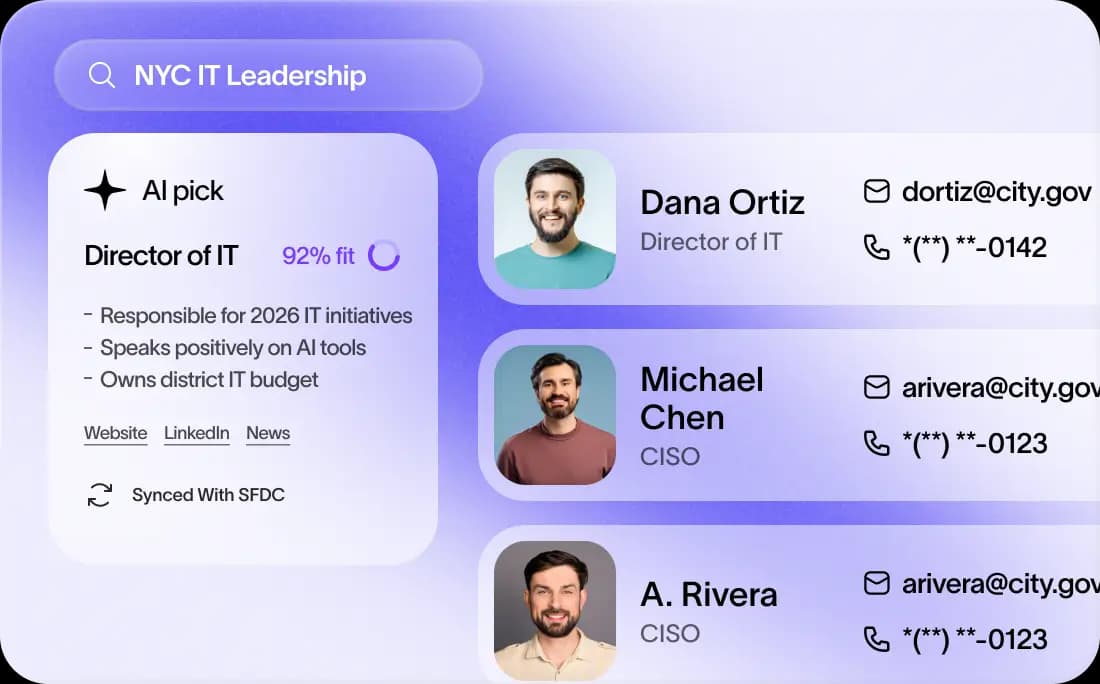
Starbridge also monitors job changes across your target accounts, turning personnel movement into actionable intelligence:
- Track champion departures from existing customer accounts to flag churn risk early
- Identify when champions move to new organizations as expansion opportunities
- Surface new-hire introductions to build relationships before competitors do
Bi-directional native integrations with Salesforce and HubSpot sync, clean, and enrich CRM data automatically. It eliminates manual imports and the stale records that quietly rot in most pipelines.
After switching to Starbridge, TAM to Target found that Starbridge contact data was 3-4x more valid than other vendors they had used. This gives their clients’ reps a database they could trust for outbound into government and education accounts.
GovSpend sources contacts through agency relationships and document requests
One of the ways GovSpend acquires contact data is through agency relationships and public record requests, which according to GovSpend can take weeks to return. The refresh cycle depends on each agency’s responsiveness. Starbridge sources contact data in real time using verified .gov and .edu domains, agency directories, and four levels of waterfall enrichment with continuous bounce-checking.
G2 reviewers have flagged data freshness on GovSpend repeatedly. One reviewer wrote that “Sometimes data seems outdated or requires additional verification.” Another suggested the platform “could improve by constantly refreshing and adding more data.” When reps cannot trust the contact record in front of them, outreach attempts carry the risk of a bounce or a dead end.
GovSpend offers CRM integration with Salesforce and HubSpot, but account matching is a friction point flagged in online reviews.
As one G2 reviewer described GovSpend:
“Sometimes it’s hard to search and unify the name that’s in our system, like our CRM versus GovSpend. We might call them slightly different, so there could be better search capabilities that allow you to 100% match up or search by other parameters. If anything is different in the name, sometimes the data just doesn’t show up, even though it’s there, and you’re just not finding it.”
Starbridge takes a different approach to CRM integration. Its matching engine resolves CRM accounts against Starbridge’s buyer database using multiple fields including name, state, city, domain, and unique identifiers like NCES and IPEDS IDs. Normalized name matching and AI inference handle the naming variations that exact-name lookups miss, and every match is reviewable before it goes live.
From there, Starbridge’s bi-directional sync keeps records enriched and current. Dynamic account scoring, AI-generated positioning briefs, and champion tracking connect every contact to a reason to call right now.
The bottom line
Starbridge gives reps a continuously verified, scored, and enriched database with champion tracking, positioning briefs, and bi-directional CRM sync that tells them exactly who to contact and why each account matters right now.
Understanding vendor spend across government and education
Visibility into what government and education accounts are actually spending matters for account prioritization, competitive displacement, and discovery call preparation. If your reps can see what a prospect is paying a competitor, when that contract expires, and what the opt-out clauses look like, they walk into every meeting with an unfair advantage.
Starbridge runs FOIA automation to surface full competitor contracts, not just line items
Starbridge built Public Spend Intelligence to give revenue teams that unfair advantage. The platform surfaces purchase data, full competitor contracts, and raw vendor proposals sourced through FOIA automation at scale.
The depth of contract detail is what sets this apart.
- Annual revenue per contract
- Full sales proposals
- Opt-out clauses
- Implementation fees
- Contract expiration dates
- Revenue breakdown by product
But Starbridge goes beyond surfacing raw spend records. Purchase orders on their own are narrow, typically just a line item and a price with no detail on what went into that pricing. Starbridge automatically cross-references PO data against its full signal dataset, layering in contract context, competitor presence, and account activity so reps do not have to piece together the story manually.
The use case is practical. Your reps walk into a discovery call already knowing what the prospect is paying a competitor, when that contract expires, and exactly how to position against it.
Research time dropped 90% for Frontline Education, for example, after deploying Public Spend Intelligence to replace manual FOIA requests. Across larger teams, the gains compound. With Starbridge replacing manual procurement research, Abnormal AI, for instance, now reclaims 10+ hours per rep per week and redirects that time into live conversations.
GovSpend is focused on historical purchase order data
GovSpend’s core strength is historical line-item purchase order data. This is a genuine strength for seeing what was purchased, from whom, and at what price.
But purchase order data alone has limits. A PO tells you what an agency bought last year, not what they are planning to buy next quarter.
Starbridge surfaces the deeper layer of competitive context through FOIA automation, including full pricing breakdowns, opt-out clauses, and implementation specifics that help reps position against incumbents with precision.
As one G2 reviewer noted for GovSpend, “Data cleanliness varies by state. Some agencies provide deep detail; others provide vague line descriptions.”
The bottom line
GovSpend tells reps what was purchased last year with varying levels of detail depending on the state. Starbridge tells them what the full contract says, when it expires, what the opt-out clauses look like, and exactly how to position against the incumbent. That depth of competitive context is what turns raw spend data into displacement campaigns your reps can actually execute.
Closing deals through contract vehicles
Winning the evaluation is not the same as getting paid. Above a buyer’s sole-source threshold, a purchase normally triggers a full competitive solicitation that can add months to the sales cycle. A contract vehicle is how a vendor skips that process. The buyer purchases off an already-competitively-bid cooperative contract, like NASPO ValuePoint, OMNIA Partners, or Sourcewell, and the deal closes without a new bid.
Starbridge provides pre-approved access to every major contract vehicle
Starbridge doesn’t stop once the opportunity is sourced. When a buyer is ready to move, Starbridge offers pre-approved access to every major contract vehicle, like NASPO ValuePoint, OMNIA Partners, Sourcewell, TIPS, GSA, and more. Deals close through a purchasing pathway the buyer already trusts. Starbridge manages the compliance, paperwork, and renewals, giving reps the shortest compliant route from first signal to signed contract.
One onboarding covers the major vehicles, with no per-vehicle applications. Contract vehicle access has also historically come with a catch. Traditional resellers typically focus on six-figure deals before they engage. Starbridge makes contract vehicle access available as part of the platform, with no minimum deal size.
Because the platform already knows each buyer’s preferred purchasing channel, reps can route every opportunity down the fastest compliant path to a signed PO. The same platform that surfaced the buying signal and the verified contact now closes the loop on the transaction itself.
GovSpend surfaces procurement intelligence data
GovSpend’s platform surfaces spending records, bids, meeting transcripts, and contacts. Contract vehicle sell-through is not a stated capability as of July 2026.
Starbridge covers sell-through. It gets your product transactable on vehicles like NASPO ValuePoint, OMNIA Partners, Sourcewell, and TIPS, so a ready buyer can skip the competitive bid process and sign without running a new solicitation.
The bottom line
A contract vehicle gives your buyer a way to skip the competitive bid process. Starbridge gets you selling through the major vehicles, with pre-approved access available as part of the platform, compliance and renewals handled, and each buyer’s preferred purchasing channel surfaced in the account. That is the difference between researching the procurement path and clearing it.
Finding and responding to RFPs
If your team only finds RFPs after they are published, you are already behind. Government and education buyers are rarely experts in the solution they need, so they consult vendors early to learn what is possible. The vendor who educates the buyer often influences the evaluation criteria, which means by the time the RFP is published, a competitor has likely already shaped it. When an RFP does land, however, speed and quality of response determine whether you win or waste weeks on a losing proposal.
Starbridge scores RFPs for fit and drafts proposals with AI
Starbridge built its AI RFP Finder & Proposal Writer to cover both finding and writing winning proposals. The platform centralizes thousands of bid portals into a single personalized feed. Every RFP is scored by product fit, region, and win likelihood. Your team knows which opportunities are worth pursuing before spending a single hour on a response.
Starbridge also automatically flags RFPs that already mention a specific vendor or competitor by name. If a competitor is baked into the requirements, that RFP is probably not worth your time. The platform does this across every RFP in your TAM, eliminating the manual work of digging through lengthy procurement documents to figure out whether a bid is truly open.
When it is time to respond, Starbridge’s AI proposal writer drafts responses using your product knowledge base. A compliance matrix builder ensures nothing gets missed. Collaboration mode lets team members comment, tag, and refine in real time.
Entire working days returned to pipeline work is what HousingCloud gained, for example, after switching to Starbridge. It managed to cut 8-10 hours per RFP by replacing manual drafting of responses with AI-generated proposals.
Here is the bigger picture. RFPs are the last buying signal in the cycle, not the first. Because Starbridge’s Buying Signal Monitor surfaces intent months earlier, your team is already in the account before the RFP drops. GovWell, for example, booked five meetings in their first week on Starbridge and now sources 15% of total qualified pipeline from the platform, built on outreach that starts before solicitations go public. That means when you do respond, you are responding from a position of strength, with context and relationships already in place.
GovSpend aggregates bids with AI-powered relevance ranking
GovSpend aggregates bids from public sources. GovSpend ranks opportunities by relevance based on a company profile. Starbridge scores each RFP by product fit, region alignment, and estimated win likelihood, including filtering out RFPs that already name a competitor.
Today, GovSpend partners with Iris for drafting RFP responses. Starbridge offers a native on-platform proposal writing experience, so reps do not need to switch to another tool.
Moving from a buying signal to outreach is easier with Starbridge’s end-to-end workflows. GovSpend offers modules for meetings, contracts, contacts, and CRM integration. Starbridge connects those stages into a single workflow that moves from signal detection to scored RFPs to AI-drafted proposals to CRM updates in one motion.
The bottom line
GovSpend’s AI tools can help assess individual bids, and today it partners with Iris for proposal drafting. Starbridge scores RFPs by fit and win likelihood, filters out competitor-locked bids, and drafts proposals natively using your product knowledge base. The difference is between a discovery tool paired with a partner response platform and an end-to-end proposal engine that saves your team entire working days per response.
Which platform actually closes deals?
GovSpend offers a broad procurement intelligence tool with strong historical spend data. For teams whose primary workflow is monitoring procurement activity, it is a capable and well-established tool.
Where the platforms diverge is in how intelligence becomes revenue. Moving from a buying signal to outreach to a signed contract is easier with Starbridge’s end-to-end workflows. Where GovSpend is known for its purchase order database and procurement modules, Starbridge is an AI-native sales intelligence platform that goes beyond data to help sales reps take action more easily, automatically turning buying indicators into closed deals.
Starbridge is built around that connection. Buying signals from board meetings, grants, and contract expirations feed into a single platform. That platform scores accounts by ICP fit, surfaces verified contacts, and generates outreach and proposals. Everything syncs to your CRM automatically. Starbridge also hands buyers a purchasing pathway they already trust, with pre-approved access to every major contract vehicle available as part of the platform. The result is teams that book more meetings, reclaim hours previously lost to manual research, and close deals before the competition knows the opportunity exists.
Both platforms serve public sector sales teams. The choice depends on whether your team needs a procurement intelligence database with deep data, or an end-to-end workflow engine that moves from signal to signed contract in one motion.
Book a demo to see how Starbridge helps your team close more deals in government and education.
Frequently asked questions
Explore our use case library
 Automate account research with AI agentsStop manually researching accounts. Starbridge AI agents automate account research by monitoring buying signals 24/7 and surfacing the right contacts.
 Identify competitor contract expiration datesThe RFP is usually a formality. Starbridge surfaces competitor contract expiration dates so your reps reach accounts before the renewal cycle closes.
 Create a conference campaignTurn conference badge scans into pipeline. Import your contact list, surface buying signals across every account you met, and follow up with context.