
Clay alternatives: 4 tools for government and education sales intelligence in 2026
Need more than purchase order data? Compare four Clay alternatives for government and education sales teams across the five capabilities that build consistent pipeline.

Revenue teams selling to state and local government, K–12, and higher education face a different set of challenges than commercial sellers. Decision-makers in these markets rarely maintain LinkedIn profiles, and buying cycles are shaped by board approvals, budget releases, and procurement rules that general-purpose enrichment tools were not built to track.
Clay can be pointed at this market. However, someone on your team still has to find the right government and education sources, scrape sites built to resist scraping, verify what comes back, and turn it into something a rep can act on. That’s an option if you have the headcount to own it. For most revenue teams, the build may end up costing far more in time and opportunity than it looks like from the outside.
This article evaluates four Clay alternatives across five capability areas that matter most for building pipeline in government and education sales. Each tool takes a different approach to the problem, and the right choice depends on where your team needs the most leverage.
The comparison table below provides a quick glance before we go deeper:
| Platform | Identifying opportunities before RFPs | Contact and account data quality | Visibility into agency spend | Finding and responding to RFPs | Contract vehicle access |
|---|---|---|---|---|---|
| Starbridge | Monitors 320k+ entities for board minutes, budgets, grants, leadership changes, contract expirations | 98% email accuracy from .gov/.edu web crawls with continuous bounce-checking | FOIA automation for full competitor contracts, pricing, and opt-out clauses; PO data for 77% of institutions | AI-scored RFP feed with native proposal writer and compliance matrix | Shorten sales cycles by selling through NASPO, OMNIA, Sourcewell and more with pre-approved access |
| GovSpend | Meeting transcripts and PO data plus newer Opportunities module | Sourced through agency relationships and document requests on variable refresh cycles | Deep historical line-item PO data across thousands of agencies | Bid aggregation with proposal writing via third-party partner (Iris) | Contract vehicle access is not part of the offering as of July 2026. |
| GovWin (Deltek) | Team of analysts tracking federal opportunities up to five years in advance | Sourced from procurement listings and agency org charts | Strongest at the federal level with contract award tracking | Strong federal bid aggregation with state and local as a newer addition | Contract vehicle access is not part of the offering as of July 2026. |
| Agile Education Marketing | Focused on contact data and marketing services | Millions of educator contacts with weekly refresh cycles across K-12 and higher education | Focused on education contact data and territory planning | Known for education data and marketing services | Contract vehicle access is not part of the offering as of July 2026. |
What to look for in a government and education sales intelligence tool
Vendors in this category all claim to help teams sell into government and education, but five specific capabilities are what truly separate a platform that builds pipeline from one that simply reports data back to you:
- Identifying opportunities before they reach RFP. Procurement in local government, K–12, and higher education is rarely a surprise. It’s preceded by buying indicators, such as board meetings, budget releases, grant awards, leadership changes, and contract expirations, that surface months before a formal solicitation is published. Because agencies often settle on a preferred vendor during requirements-gathering rather than during the bid itself, teams that monitor these early indicators can still influence evaluation criteria, while teams that wait for the RFP are usually responding to a decision that has already been made.
- Contact and account data quality. Most enrichment tools were built around LinkedIn, a platform local government, K–12, and higher education decision-makers rarely use. That gap is why LinkedIn-dependent tools post bounce rates of 15 to 25%, and why every one of those bounces quietly drags down sender reputation and sequence performance for the entire team, not just the rep who sent it.
- Visibility into what agencies and institutions are already buying. A rep who knows the incumbent vendor, the contract value, and the expiration date walks into a discovery call already ahead. A rep without that context spends the meeting asking questions the agency has already answered, just not to them. FOIA-sourced contracts close that gap by surfacing pricing breakdowns, opt-out clauses, and implementation terms before the first call happens.
- Finding and responding to RFPs efficiently. Because government and education procurement is split across thousands of separate portals at the state, county, city, district, and university level, manual searching alone caps how many opportunities a team can realistically track. A centralized, scored RFP feed removes that ceiling, AI-assisted drafting compresses response time from days to hours, and a compliance matrix builder protects teams from missing a requirement when deadlines are tight.
- Contract vehicle access that removes procurement friction. Above a buyer’s sole-source threshold, a deal either routes through an existing cooperative contract or triggers a full competitive solicitation that can add months. Vendors who can transact through vehicles like NASPO ValuePoint, OMNIA, Sourcewell, or TIPS give procurement offices a faster path to purchase. Teams without vehicle access watch won opportunities stall in procurement.
These five capabilities shouldn’t live in five separate tools. They function as a single pipeline-building motion. Weaken any one stage and the rest of the motion loses value.
The Clay alternatives compared in this article vary in how much of that motion they cover end-to-end versus how much they leave for teams to assemble manually. Some specialize deeply in one or two stages. Others are built to connect the full workflow, from the first buying indicator to a closed deal.
1. Starbridge
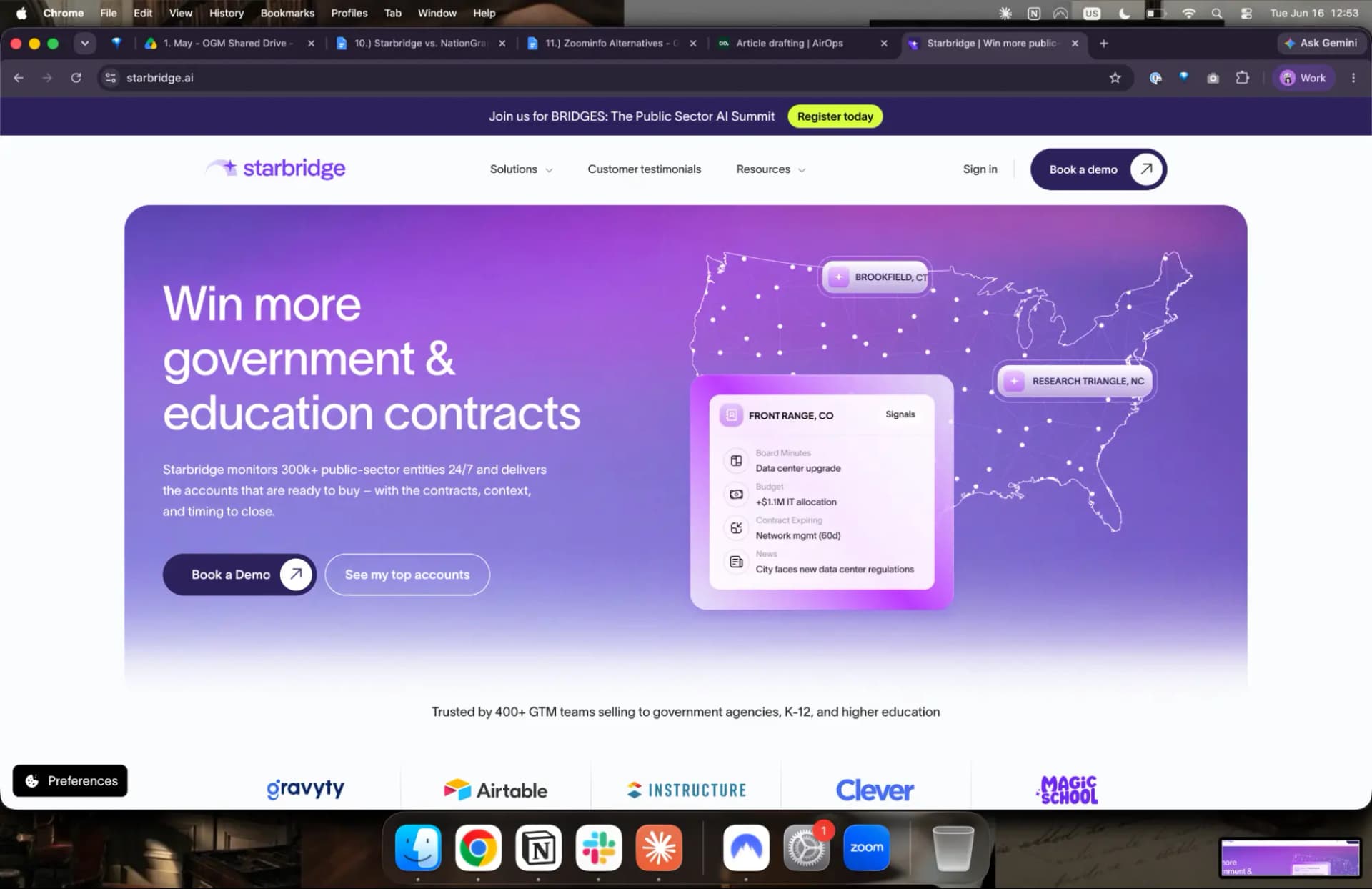
More than 600 GTM teams trust Starbridge to win business in local government, K–12, and higher education, because the platform was built only for this market. Starbridge surfaces buying intent before competitors even know an opportunity is available, links that intelligence to verified contacts, and pushes personalized outreach directly into CRM workflows, so reps act first instead of reacting late.
What Starbridge does well
Starbridge covers five capability areas, each designed to move a rep from signal to closed deal without switching tools.
Buying Signal Monitor tracks 320k+ government and education entities around the clock, surfacing buying indicators from board meeting minutes, strategic plans, budget data, grants, leadership changes, contract expirations, and bids. The underlying AI-native architecture understands context rather than matching exact keywords, so it can surface a buying indicator like “budget shortfalls” even if those exact words never appear in a document.
Every buying indicator fires with a verified contact, a reason for outreach, and AI-generated personalized copy pushed directly into sequencing tools. Zencity, an enterprise govtech company, now sources 50% of its cold meetings from Starbridge after replacing manual research with buying-indicator-driven outbound.
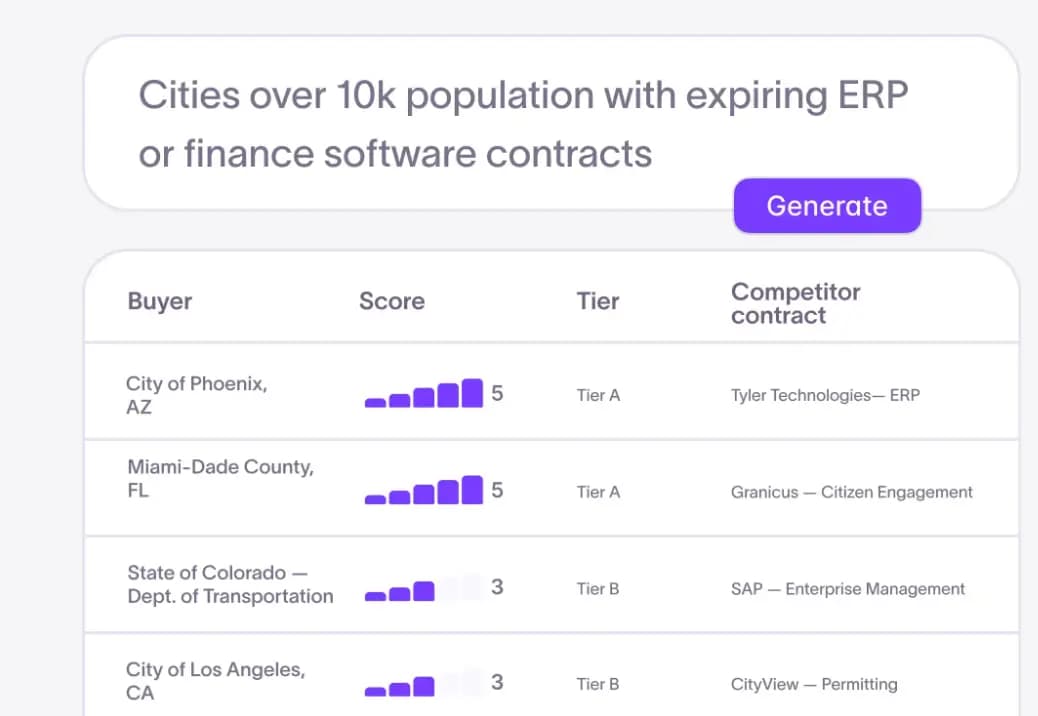
From there, Starbridge’s Contacts & Company Data ensures outreach actually reaches decision-makers. Proprietary web-agent technology continuously crawls verified .gov and .edu domains, agency directories, school district portals, and board meeting records. Waterfall enrichment and continuous bounce-checking deliver 98% email accuracy validated across 14,000 emails, with a 2% bounce rate compared to 15-25% from general-purpose B2B databases. The platform also includes dynamic account scoring, AI-generated positioning briefs, and champion tracking via job changes, all synced through bi-directional CRM integrations with Salesforce and HubSpot that sync, clean, and enrich your data.
Starbridge’s Public Spend Intelligence gives reps the competitive context they need before every conversation. FOIA automation at scale surfaces full competitor contracts, including unredacted vendor proposals, opt-out clauses, implementation fees, and contract expiration dates.
Out of the box, Starbridge has the purchase order data for 77% of state/local government, K-12, and higher education institutions, cross-referenced against the platform’s buying indicator dataset. Within weeks of deploying Public Spend Intelligence, Frontline Education saw a 90% reduction in research time, freeing reps to spend more time selling and less time searching through procurement portals.
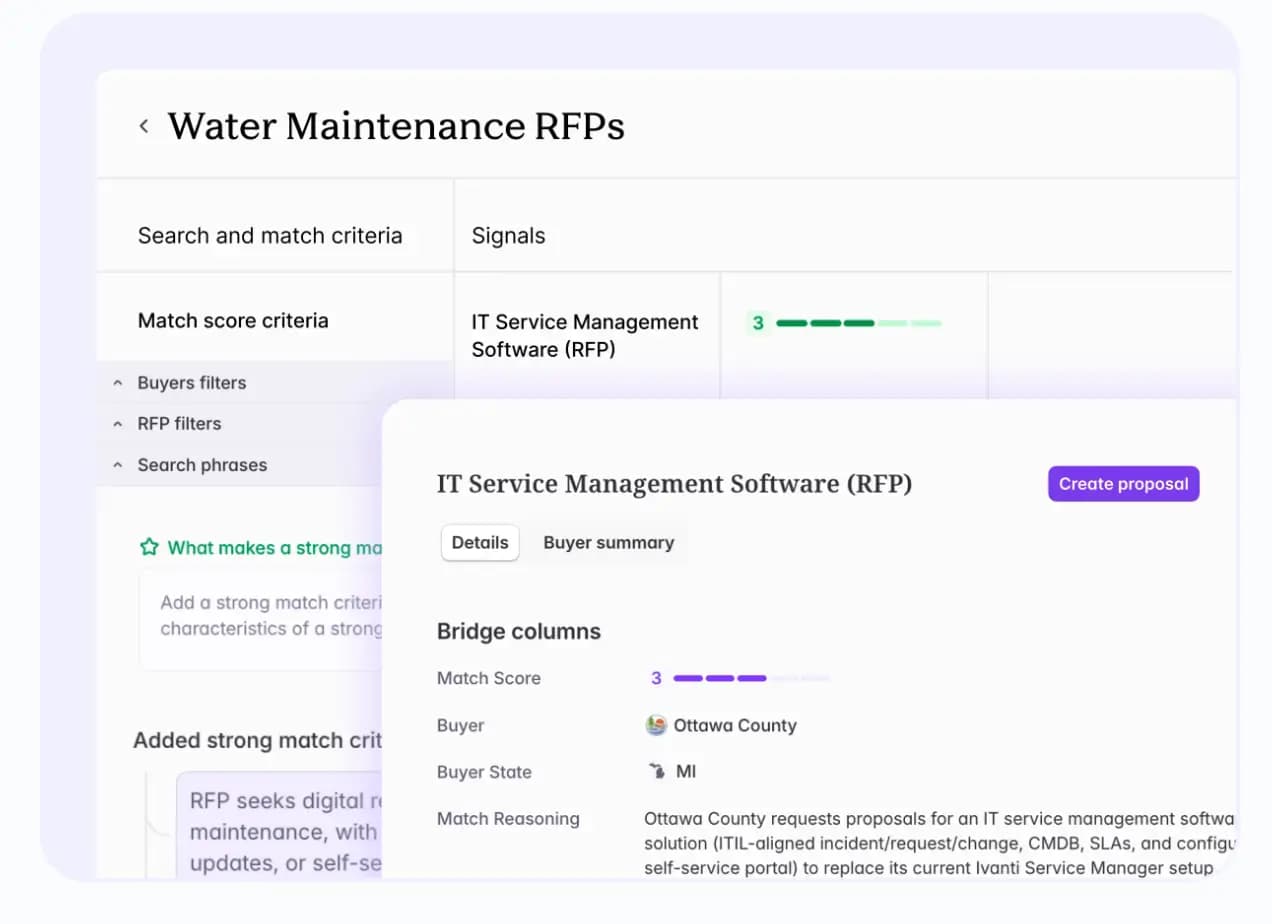
The AI RFP Finder & Proposal Writer centralizes thousands of state, local, education, and university bid portals into a single personalized feed. Every RFP is scored by product fit, region, and win likelihood, and the platform automatically flags RFPs that mention a competitor by name. A native AI proposal writer drafts responses using the team’s product knowledge base, with a compliance matrix builder and collaboration mode for real-time refinement.
Finally, Starbridge clears the procurement roadblock that stalls deals after a buyer says yes. The platform provides access to every major contract vehicle including NASPO ValuePoint, OMNIA Partners, Sourcewell, TIPS, and GSA, and Starbridge handles the compliance, paperwork, and renewals. Because the platform already knows each buyer’s preferred purchasing channel, reps can route every opportunity down the fastest compliant path to a signed PO.
Where Starbridge falls short
Stronger sales intelligence for state and local government and education versus federal. Teams with a primarily federal motion will find deeper coverage from platforms built around federal procurement databases and analyst networks.
The RFP writer is lightweight and won’t take the place of a dedicated RFP hire. Companies responding to complex, high-stakes solicitations will still need experienced proposal writers to own the final submission.
Overall, Starbridge is a stronger fit for enterprise sales teams than early-stage companies. Businesses with smaller budgets or those just beginning to build a government and education sales motion may find the investment difficult to justify until pipeline volume supports it. The 98% email accuracy, FOIA automation, and continuous enrichment that differentiate Starbridge come at a higher price point than tools that rely on less expensive data sourcing methods.
Best for
Revenue teams running outbound into state and local government, K-12, and higher education who need one platform from buying indicator to closed deal. Starbridge is built for teams that want verified contacts, competitive context, and CRM workflows in a single system rather than stitching together separate tools for research, enrichment, and outreach. If your company sells into both government and education and wants to consolidate the entire pipeline-building motion, Starbridge is the only platform in this list designed to do that end-to-end.
2. GovSpend
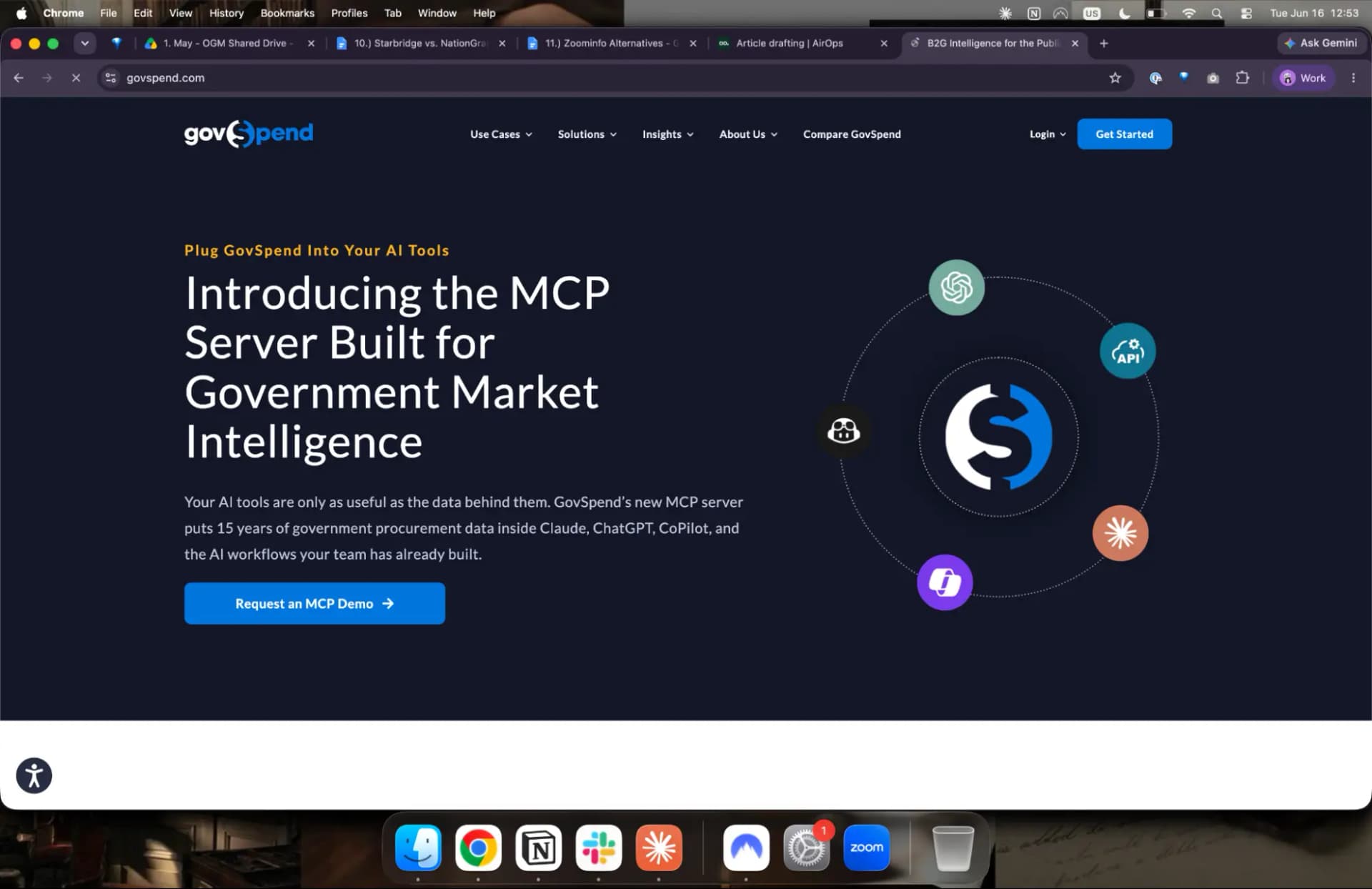
GovSpend is a procurement intelligence platform known for deep historical purchase order data covering both state and local government and federal markets. It serves vendors, agencies, and consultants who need visibility into government purchasing activity.
What GovSpend does well
GovSpend’s core strength is deep historical line-item purchase order data across thousands of state and local agencies. This level of PO coverage supports competitive displacement research, pricing benchmarking, and market sizing within specific product categories.
GovSpend has added newer layers on top of that purchase order foundation, including an AI-ranked Opportunities module and searchable meeting transcripts, although both still surface activity that has already entered the public record. CRM integration with Salesforce and HubSpot connects that data to existing sales workflows.
Where GovSpend falls short
Data freshness is a recurring theme in user feedback. One G2 reviewer noted that “sometimes data seems outdated or requires additional verification,” which can affect the timing of outreach around contract expirations and competitive displacement windows. Another reviewer echoed this, noting that “sometimes data is missing or not entered correctly or is out of date.”
Keyword-based searching can surface high volumes of results requiring manual filtering. One G2 reviewer pointed out that keyword search “can result in false positive reports of potential response opportunities,” making it harder for teams to quickly isolate the most relevant matches without significant manual review.
Both issues point back to the same root cause. GovSpend’s data, however complete, is a record of what’s already occurred in procurement. Freshness gaps and keyword noise are friction on top of that record. Even a perfectly clean, perfectly filtered version of GovSpend has the same ceiling. It can only show a rep an opportunity once that opportunity is already public. That’s the exact moment every other vendor chasing the same account finds out, too.
For proposal drafting, GovSpend partners with Iris, a separate platform, to handle the RFP response workflow. Teams that want their public sector workflows informed and streamlined on a single tool would need to look elsewhere.
The same boundary applies to contract vehicles. GovSpend surfaces vehicle and cooperative contract data as part of its procurement record, but selling through a vehicle like NASPO ValuePoint, OMNIA Partners, or Sourcewell is not a stated capability as of July 2026.
Best for
Teams focused on procurement research and historical spend analysis who value deep purchase order data for competitive positioning in the state and local government market. GovSpend is strongest when the primary use case is understanding what agencies have purchased in the past to inform competitive positioning and pricing strategy.
3. GovWin (Deltek)
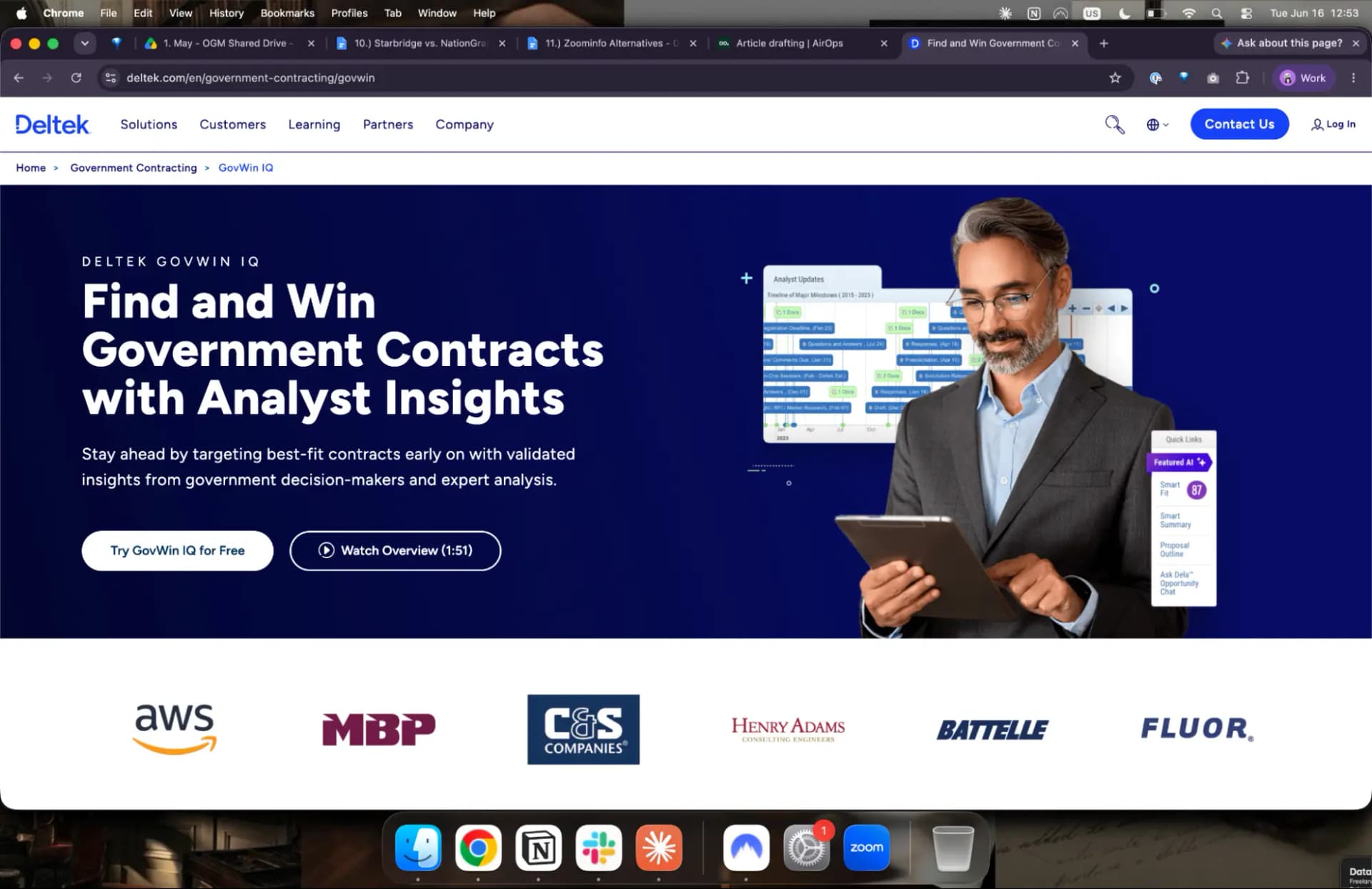
GovWin is a market intelligence platform owned by Deltek, traditionally for federal government contractors. The platform has expanded into state and local government and education, though federal remains its primary focus and deepest area of coverage.
What GovWin does well
GovWin’s network of market analysts is its most distinctive capability. Analysts conduct thousands of research requests annually, interviewing government decision-makers and producing forward-looking forecasts that automated tools cannot replicate. For teams that need to understand how agencies are thinking about technology investments years in advance, this analyst-curated intelligence provides valuable context.
The platform offers one of the largest government bid databases, covering thousands of agencies alongside deep federal coverage.
For federal contracting specifically, GovWin provides pricing and competitive intelligence that includes labor rate analysis, competitor identification, and teaming partner recommendations. The Ask Dela AI feature summarizes procurement documents and supports research workflows. Native integrations with Deltek Costpoint and Vantagepoint CRM serve teams already embedded in the Deltek ecosystem.
Where GovWin falls short
Search and filter friction is a common theme in GovWin user reviews. One G2 reviewer wrote that “the filters are not user-friendly and can be difficult to find what I’m looking for. Lately postings have been missing attachments or have wrong dates.” Another reviewer noted that searches “often there are thousands of search results that generate,” requiring significant manual filtering to find relevant opportunities.
State and local government, K-12, and higher education coverage is a more recent addition. The platform’s strongest capabilities and most frequently updated data are oriented toward federal procurement, and teams whose primary market is state and local government or education may find shallower depth in those segments.
GovWin provides macro trends for the market, while companies building pipeline at the account level in state and local government and education often need micro-level signals tied to individual contacts and specific buying indicators.
Contract vehicles follow the same pattern. GovWin tracks and reports on GWACs and IDIQs in depth, but getting a vendor onto a vehicle and transacting through it is not a capability the platform offers as of July 2026.
Best for
Federal contractors and teams with a primary federal motion who need analyst-backed research, long-range opportunity forecasting, and deep federal bid intelligence.
4. Agile Education Marketing
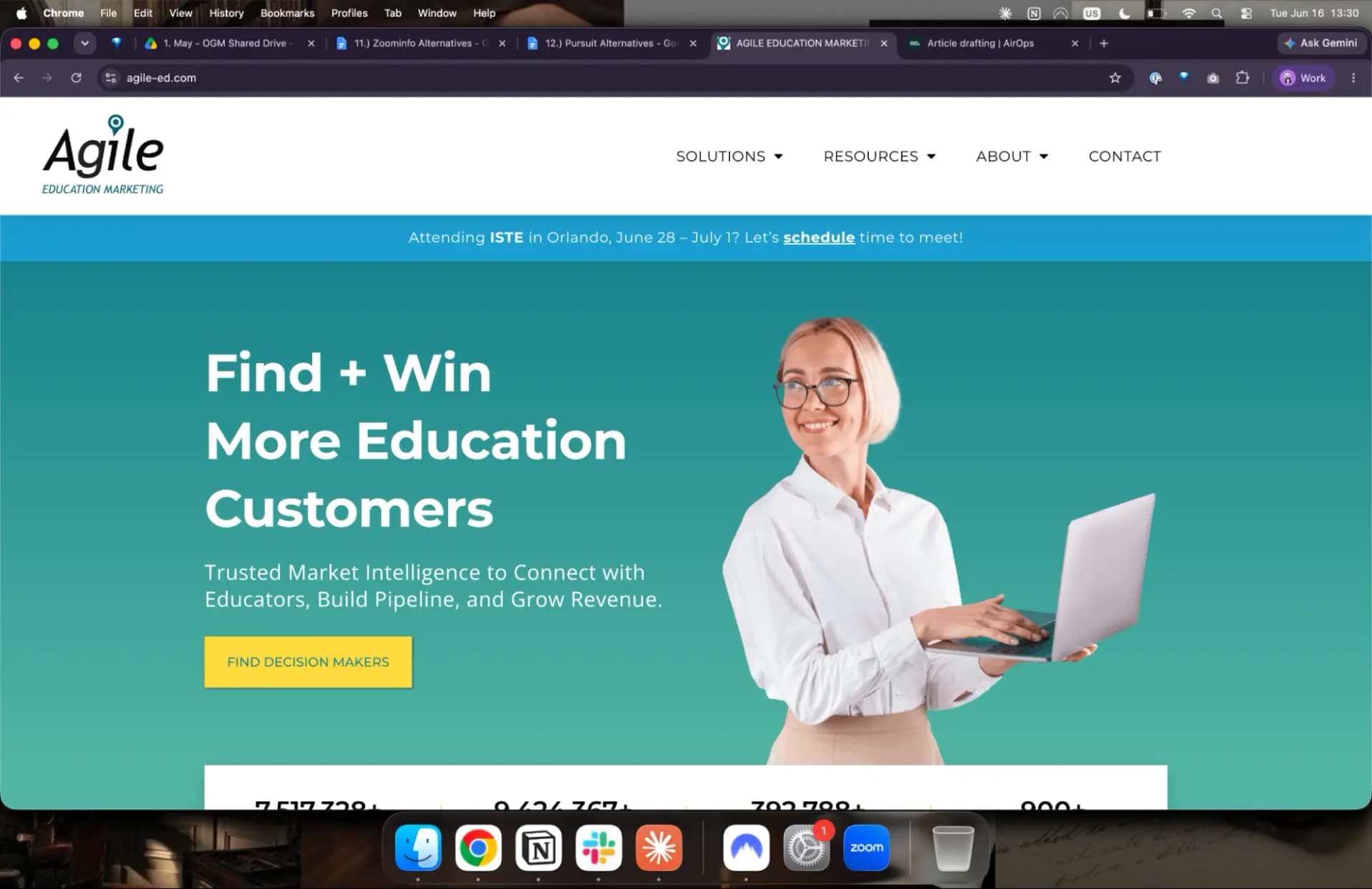
Agile Education Marketing is an education marketing data provider focused exclusively on K-12 and higher education contact data. The company also offers engagement services, including email campaigns, social media, paid ads, and strategic consulting.
What Agile Education Marketing does well
Agile Education Marketing’s deep educator contact database is its primary strength. The platform covers millions of educator contacts across K-12, higher education, early childhood, and public libraries, with hundreds of thousands of institutions covered. Weekly data updates and a year-round refresh methodology keep records current within the education vertical.
The platform offers flexible data products for different use cases. Self-serve Prospector handles on-demand list building, Data Explorer supports market analysis and segmentation, and Custom Data License provides full integration into internal systems. CRM integrations are available for Salesforce and HubSpot. The EdIntel tool captures state-specific programming and investment data at the district level, giving teams additional context for targeting.
Agile also provides education marketing services and campaign execution support. Omnichannel campaign services include email, social media, and paid advertising. Strategic consulting and dedicated account management are available for teams that want hands-on campaign support alongside their data.
Where Agile Education Marketing falls short
Agile Education Marketing’s coverage is limited to education. Teams selling across both government and education markets would need a separate tool for their non-education accounts, which means maintaining and paying for two separate platforms.
Agile’s tools are built around marketing list generation and campaign execution rather than buying-signal-driven outbound. Companies looking for a workflow that moves from buying indicator to closed deal would need to layer additional tools on top.
Contact data is licensed for defined terms. Buyers evaluating long-term data ownership versus subscription-based access should understand how each provider’s licensing model affects what stays in their CRM after a contract ends.
Closing is a separate job as well. In education, a ready buyer frequently purchases through a cooperative vehicle like TIPS, BuyBoard, or Sourcewell instead of running a full solicitation, and access to those vehicles is not part of Agile’s offering as of July 2026.
Best for
Marketing teams and SDRs at education-focused companies who need reliable educator contact lists and campaign execution support for K-12 and higher education outreach. Agile is strongest when the use case is marketing-led demand generation within education rather than sales-led outbound across both government and education.
Which Clay alternative is right for you?
If your primary need is historical procurement data for competitive spend analysis and pricing benchmarking, GovSpend has deep purchase order coverage across thousands of state and local agencies. The platform is strongest for teams whose primary motion is procurement research and competitive positioning.
If your team needs analyst-backed federal intelligence and long-range opportunity forecasting, GovWin is one of the most established platforms in the federal government contracting intelligence space. A team of analysts produces forward-looking research, and native Deltek integrations support teams already operating within that ecosystem.
If you need reliable educator contact lists for K-12 and higher education campaigns, Agile Education Marketing provides millions of educator contacts with weekly updates, flexible data products, and hands-on campaign execution support. The platform is a strong fit for education marketing teams that need volume and managed services.
If your team needs a single platform from buying indicator to closed deal with 98% email accuracy, purchase order data for 77% of institutions, FOIA automation, and an end-to-end workflow that connects directly to your CRM, Starbridge is the go-to option. The platform connects buying indicator monitoring, verified contact enrichment, vendor spend intelligence, AI-powered RFP discovery and response, and pre-approved contract vehicle access into one workflow that moves from signal to closed deal without tool-switching.
Book a demo to see how Starbridge helps your team win more deals in government and education.
Frequently asked questions
Explore our use case library
 Automate account research with AI agentsStop manually researching accounts. Starbridge AI agents automate account research by monitoring buying signals 24/7 and surfacing the right contacts.
 Identify competitor contract expiration datesThe RFP is usually a formality. Starbridge surfaces competitor contract expiration dates so your reps reach accounts before the renewal cycle closes.
 Create a conference campaignTurn conference badge scans into pipeline. Import your contact list, surface buying signals across every account you met, and follow up with context.