
Pursuit alternatives: 4 tools for government and education sales intelligence in 2026
Evaluating Pursuit alternatives for government and education sales? Compare four platforms on buying signals, contact accuracy, spend intelligence, RFPs, and contract vehicle access.

If your company sells to state and local government, K-12, or higher education, Pursuit may have crossed your radar as a way to find opportunities and get in front of decision-makers. This article breaks down four platforms across the five capability areas that drive pipeline in this market.
We’ll compare Starbridge, GovSpend, ZoomInfo, and Agile Education Marketing. Each platform approaches the government and education sales problem differently, from historical procurement data to horizontal B2B intelligence to education-specific contact lists. The comparison table below provides a quick glance view, and the sections that follow detail where each tool delivers and where it falls short.
| Platform | Identifying opportunities before RFPs | Contact and account data quality | Visibility into agency and institution spend | RFP discovery and response | Contract vehicle access |
|---|---|---|---|---|---|
| Starbridge | AI-monitored buying signals from board minutes, grants, leadership changes, contract expirations across 320k+ entities | 98% email accuracy from proprietary web-agent crawls of .gov and .edu sites with waterfall enrichment | FOIA-automated full contracts, vendor proposals, opt-out clauses, and expiration dates | AI-scored personalized RFP feed with native proposal writer and compliance matrix | Shorten sales cycles by selling through NASPO, OMNIA, Sourcewell and more with pre-approved access |
| GovSpend | Meeting Intelligence with keyword-based alerts and AI-surfaced Opportunities module | Contact data refreshed through agency relationships. | Deep historical PO data with line-item visibility across state and local agencies | Bids & RFPs module with proposal writing through Iris partnership | Contract vehicle access is not part of the offering as of July 2026. |
| ZoomInfo | Commercial intent signals from publisher-network content consumption and IP tracking | Large B2B database partly sourced from LinkedIn and contributed data | Firmographic and technographic company profiles | Focused on commercial B2B workflows | Contract vehicle access is not part of the offering as of July 2026. |
| Agile Education Marketing | Focused on contact data and marketing services | Human-verified education contacts with weekly refresh from federal and state files | Focused on education contact data and territory planning | Focused on education data and marketing services | Contract vehicle access is not part of the offering as of July 2026. |
How to evaluate a sales intelligence platform for government and education
Revenue teams selling into state and local government, K-12, and higher education need five capabilities working together to build pipeline consistently.
- Opportunity identification pre-RFP. Monitoring board meetings, budget releases, grants, leadership changes, and contract expirations surfaces buying intent before a formal solicitation posts. Teams that act on these buying signals (such as a new grant or a contract about to expire) engage while they can still shape requirements, rather than competing against incumbents on a pre-written spec.
- Contact and account data quality. The quality and accuracy of your data impact your outreach efforts. Platforms sourcing contacts from LinkedIn deliver bounce rates of 15 to 25% in government and education, where decision-makers rarely maintain active LinkedIn profiles. Accuracy compounds across every sequence, every cadence, and every quarter.
- Visibility into current public spending. Knowing the incumbent vendor, contract value, and expiration date changes how reps position themselves in discovery calls and which accounts they prioritize. Without spend visibility, teams pursue accounts unaware of the competitive dynamics that determine win probability.
- Swiftly finding and responding to RFPs. A centralized, scored RFP feed paired with AI-assisted proposal drafting means teams spend time on bids they can win, not chasing every posting. Government procurement timelines are tight, and the teams that respond fastest with the strongest proposals have an advantage.
- Contract vehicle access that removes procurement friction. Above a buyer’s sole-source threshold, a deal either routes through an existing cooperative contract or triggers a full competitive solicitation that can add months. Vendors who can transact through vehicles like NASPO ValuePoint, OMNIA, Sourcewell, or TIPS give procurement offices a faster path to purchase. Teams without vehicle access watch won opportunities stall in procurement.
These five capabilities aren’t independent checkboxes. They connect into a single pipeline-building motion where early buying signals inform account prioritization, verified contacts enable timely outreach, spend intelligence shapes positioning, RFP workflows accelerate response, and contract vehicle access clears the path to a signed PO.
The platforms evaluated in this article differ in how much of this motion they cover holistically.
1. Starbridge
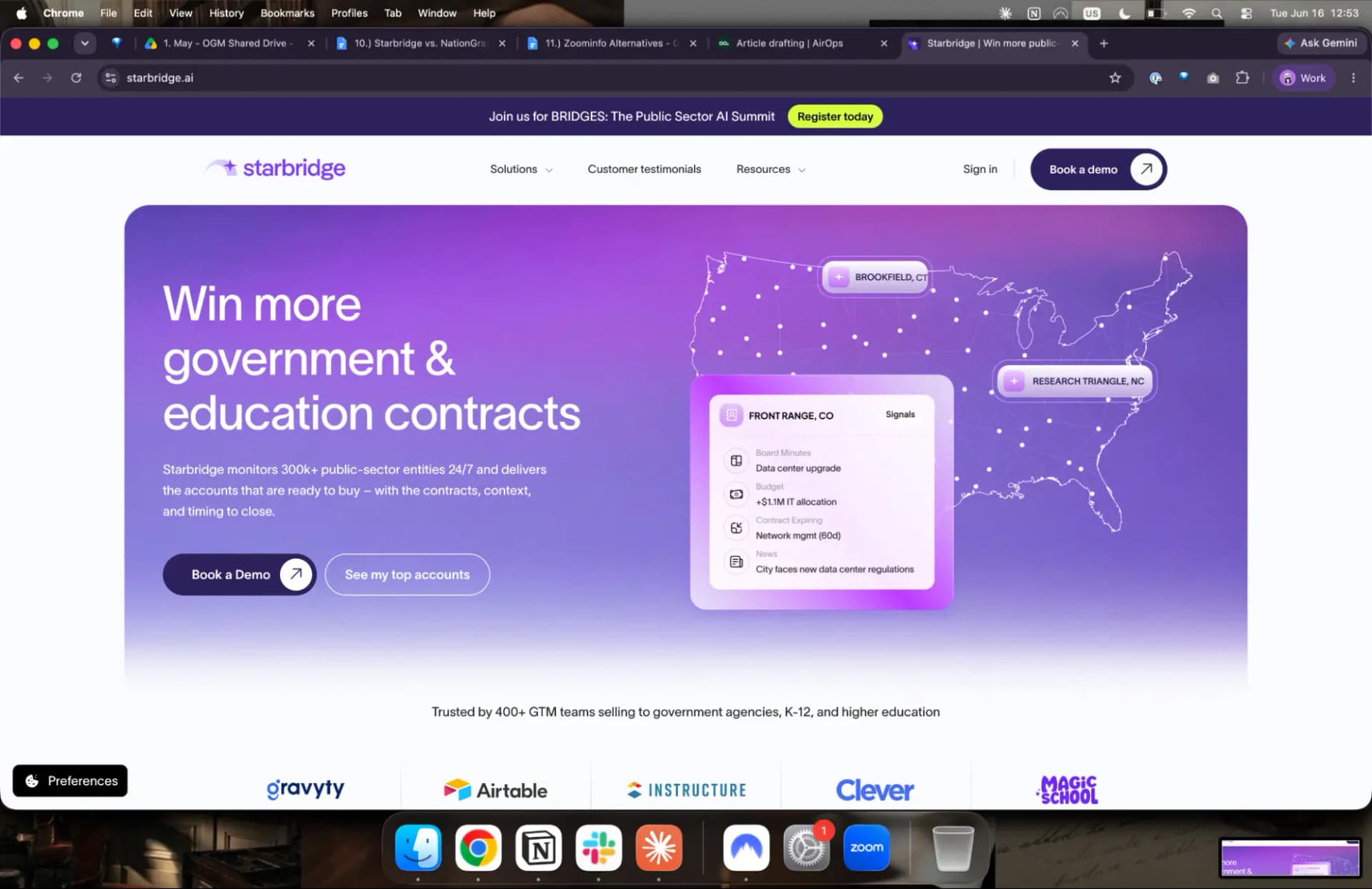
Starbridge is the AI sales intelligence platform purpose-built for businesses selling to state and local government, K-12, and higher education. Trusted by 600+ GTM teams, the platform reveals buying intent before competitors are aware of the opportunity, and turns that intelligence into pipeline through integrated workflows.
What Starbridge does well
The core bet Starbridge makes is that the teams winning in local government, K-12, and higher education are the ones engaging accounts before a formal opportunity ever gets posted. Every part of the platform is designed around that idea.
The Buying Signal Monitor is where that shows up most directly. Board minutes, leadership changes, grant awards, contract expirations, and bids from 320k+ entities are surfaced in a single feed. A vector database handles context, so relevant buying signals come up even when language varies across agencies and districts. The difference from a bid database is the timing, as these are pre-RFP indicators and not published solicitations. GovWell, for example, booked five meetings in its first week off buying signals alone, before any RFP dropped.
Signal quality only matters if you can reach the right person. Contacts & Company Data is built on proprietary web-agent technology that crawls official .gov and .edu sites, district portals, and board records instead of scraping LinkedIn profiles that government and education buyers rarely maintain.
Waterfall enrichment and continuous bounce checking produce 98% email accuracy validated across a 14,000-email test with a 2% bounce rate. TAM to Target found Starbridge’s data to be 3–4 times more valid than any other source, and clients using the platform now book up to 2.5 times more meetings. Account scoring, AI positioning briefs, and bidirectional integrations between Salesforce and HubSpot round it out.
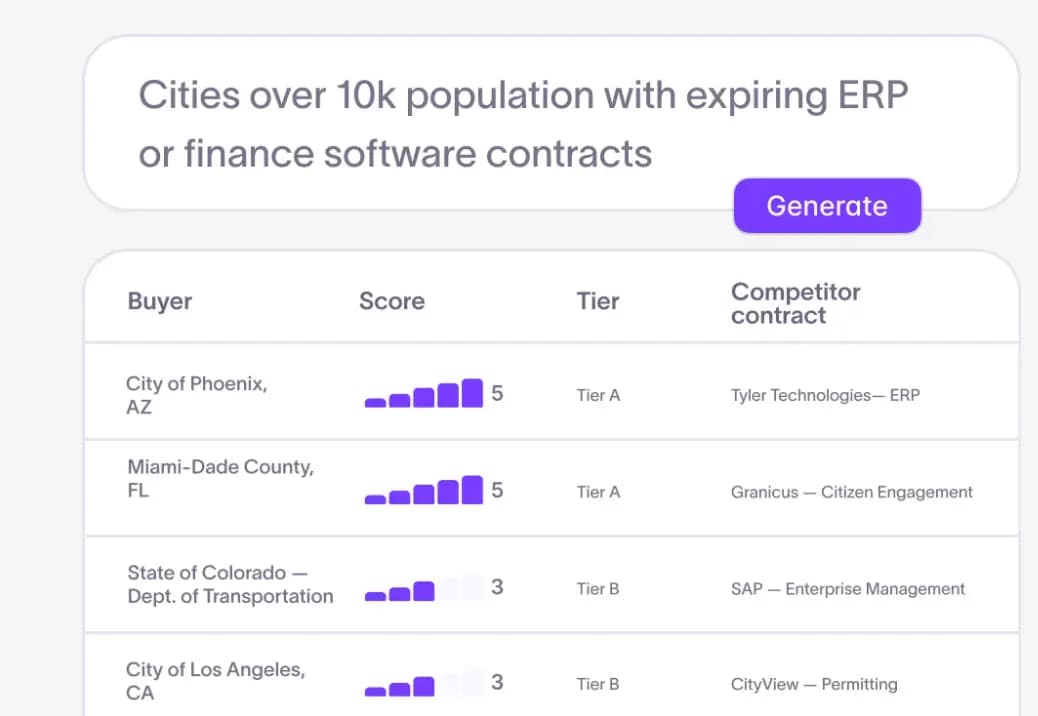
Before a discovery call, reps also need to know what a prospect is already spending and who they are spending it with. Public Spend Intelligence uses FOIA automation at scale to surface full competitor contracts, unredacted vendor proposals, opt-out clauses, implementation fees, and expiration dates. This covers purchase order data for 77% of local government, K-12, and higher education institutions out of the box. Frontline Education cut account research time by 90% after deploying it.
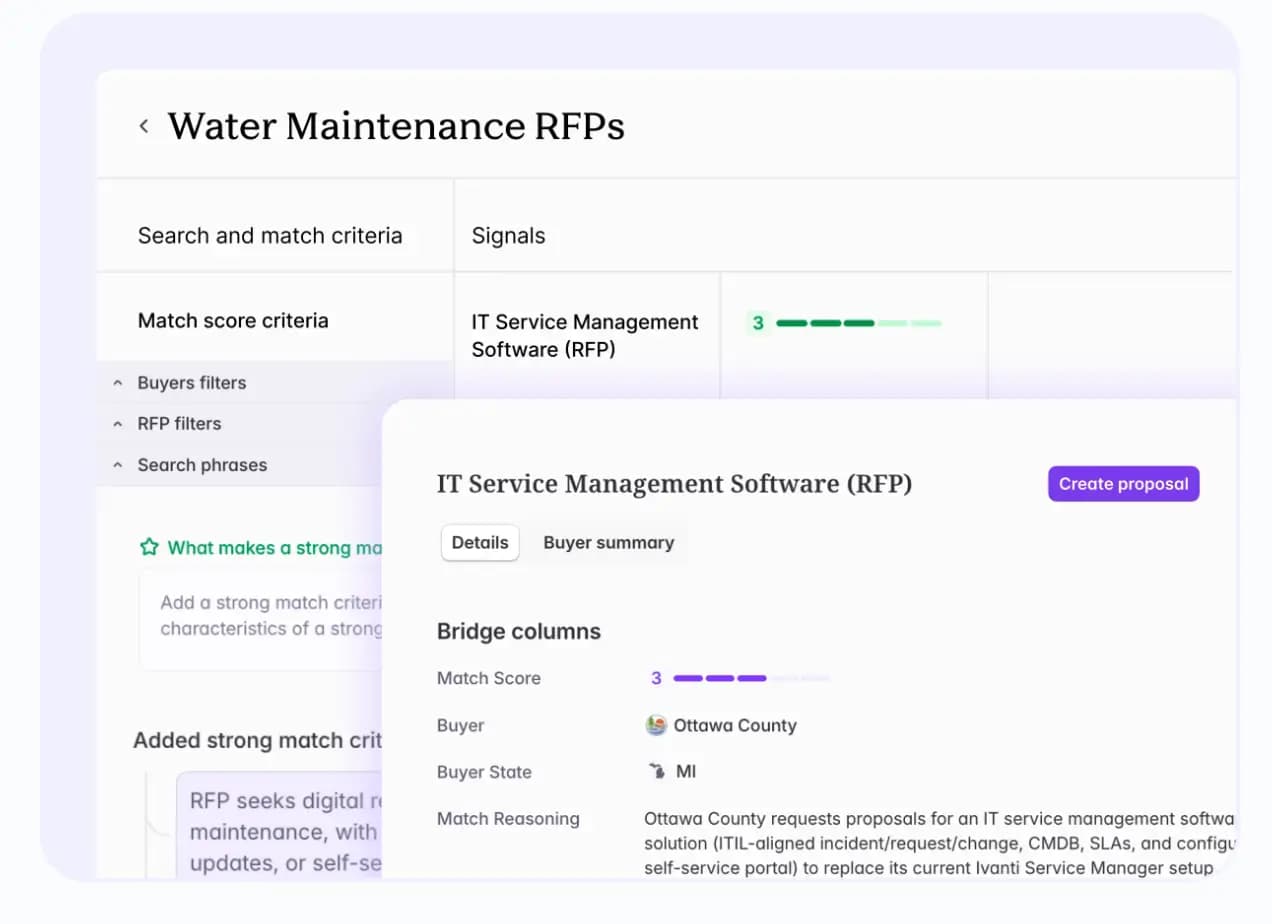
For teams that do respond to formal bids, AI RFP Finder & Proposal Writer pulls thousands of bid portals into a single scored feed, flags bids that already name a competitor, and auto-drafts responses using the team's own product knowledge base. The compliance matrix builder and real-time collaboration keep proposals moving without the usual scramble.
Contract vehicle access handles the last mile the same way. Starbridge provides access to every major contract vehicle including NASPO ValuePoint, OMNIA Partners, Sourcewell, TIPS, and GSA, and it handles the compliance, paperwork, and renewals. Because the platform already knows each buyer’s preferred purchasing channel, reps can route every opportunity down the fastest compliant path to a signed PO. Procurement moves from a roadblock at the end of the deal to a channel the team sells through.
Where Starbridge falls short
Starbridge delivers stronger sales intelligence for state and local government and education than for federal agencies. If your company has a significant federal pipeline, it would need a complementary tool for that segment.
The AI RFP Finder & Proposal Writer is a workflow accelerator, not a replacement for a dedicated RFP hire. It speeds up drafting, scoring, and compliance tracking, but complex proposals still require human expertise and final review.
As for company stage, Starbridge is better suited for enterprise sales teams than early-stage companies. The platform's pricing reflects the depth of intelligence and workflow capabilities it offers, so smaller teams with limited budgets may find it a significant investment.
Best for
Revenue teams running outbound into state and local government, K-12, and higher education who need a single platform that connects buying signals, verified contacts, spend intelligence, RFP workflows, and contract vehicle access into a single pipeline-building motion.
2. GovSpend
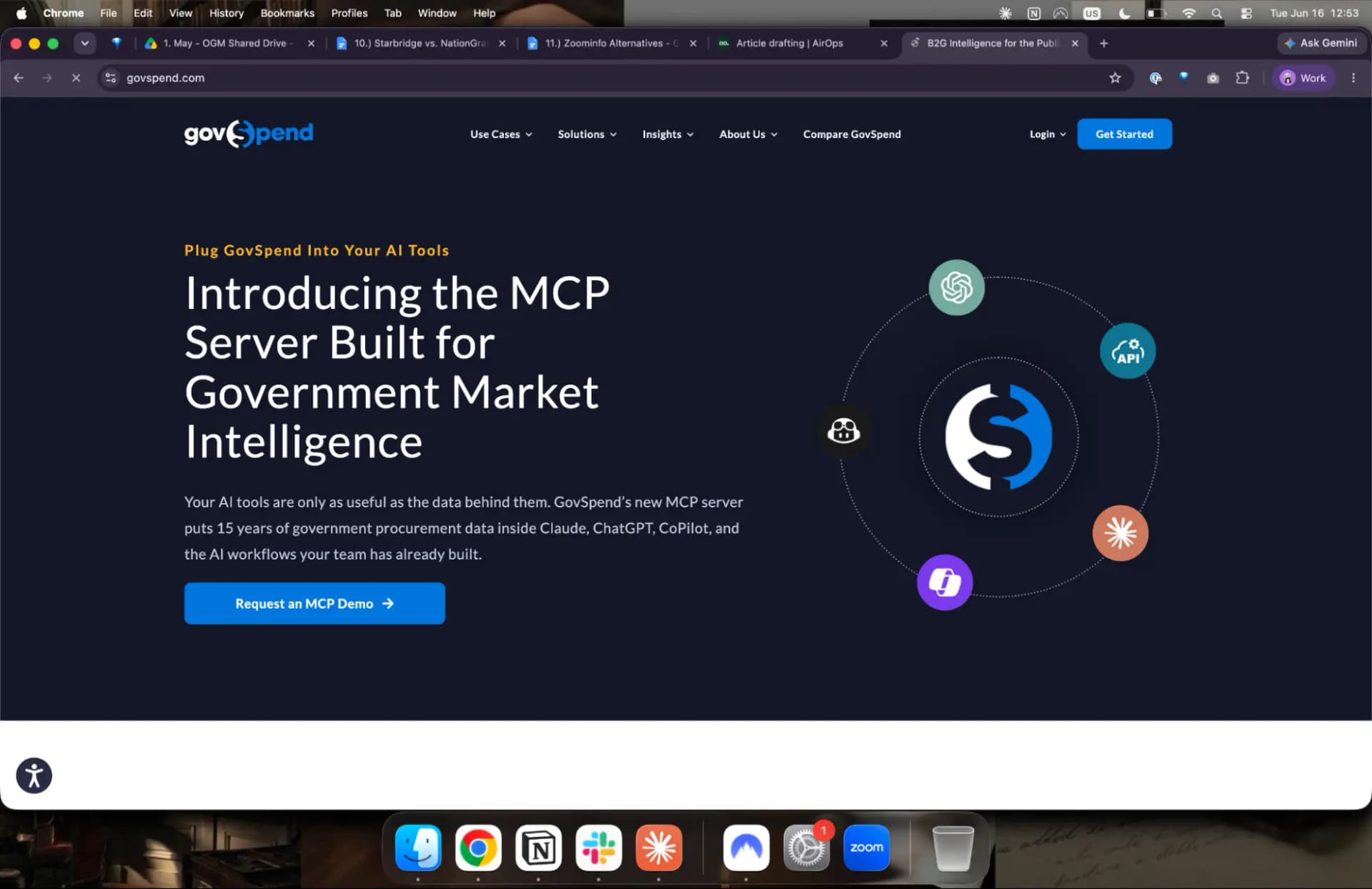
GovSpend is a procurement intelligence platform known for deep historical purchase order data, covering state and local government and federal markets. GovSpend serves vendors, agencies, and consultants who need visibility into government purchasing activity.
What GovSpend does well
GovSpend's granular historical PO data across state and local agencies provides line-item visibility into what was purchased, from whom, and at what price. Teams can leverage this capability for competitive landscape analysis, procurement pattern research, and identifying which agencies have a track record of buying in a given category.
Newer modules, including Meeting Intelligence and an AI-ranked Opportunities module, sit on top of that same purchase order foundation. Both depend on activity that has already entered the public record, whether a transcribed meeting or a published bid, so they extend the historical database rather than adding a forward-looking signal layer.
GovSpend also added AI Search, AI Chat, AI Notebook, and AI Prompts to help users navigate spending, bids, meetings, and contracts. CRM integration with Salesforce and HubSpot pushes records into pipeline, reducing manual data entry.
Where GovSpend falls short
GovSpend tells reps what already happened. Its data is comprehensive, but everything in it, purchase orders, meeting alerts, opportunity scores, describes activity that has entered the public record. One G2 reviewer captured the timing issues directly, noting that when an opportunity reaches GovSpend, “it’s already too late to get in on the specifications.” The platform surfaces opportunities at the moment they go public, which is also the moment the window to influence them is closing.
PO data can also be backward-looking, and depth varies by state and agency depending on what public records are available. A separate G2 reviewer noted that “sometimes data is missing or not entered correctly or is out of date.” If your team depends on this data for outbound, you may need to verify records before building outreach around them.
Today, GovSpend partners with Iris for proposal writing and RFP response automation. Businesses evaluating their RFP workflow should consider how this partnership fits into their existing process and whether moving between platforms introduces friction.
Contract vehicle sell-through sits outside the platform’s scope as well. GovSpend surfaces contract and vehicle data as part of its procurement intelligence, but getting a vendor onto a vehicle like NASPO ValuePoint, OMNIA Partners, or Sourcewell and transacting through it is not a stated capability as of July 2026.
Best for
Teams whose primary workflow centers on monitoring procurement activity and historical spend across state and local government, and who need deep line-item visibility into purchasing patterns.
3. ZoomInfo
ZoomInfo is a horizontal B2B intelligence platform for commercial sales teams. It maintains one of the largest contact databases in the market, partly sourced from LinkedIn profiles, contributed business card data, and commercial web sources. The platform offers intent signals based on content consumption across publisher networks and provides firmographic, technographic, and organizational data for commercial prospecting.
What ZoomInfo does well
ZoomInfo's B2B contact database offers strong commercial role coverage with firmographics, technographics, org charts, and advanced search filters. For those building targeted prospect lists in commercial markets, the breadth and depth of company and contact information are well-established. The platform is a proven starting point for outbound prospecting across multiple industries.
Intent data drawn from millions of IP-to-organization pairings and publisher networks identifies companies researching topics based on web browsing and content consumption. When digital research activity correlates with purchase intent, this signal layer gives sales teams a timing advantage in commercial deals.
ZoomInfo's integration ecosystem connects with Salesforce, HubSpot, and a wide range of sales engagement tools. Enterprise teams benefit from established workflows, robust support, and a single source of truth for commercial B2B prospecting across verticals.
Where ZoomInfo falls short
Commercial intent signals track publisher-network content consumption, which reflects how commercial buyers research solutions online. Government and education buying indicators live in a different layer entirely. Board discussions, budget line items, grant awards, and contract expirations are found in the public record, outside the commercial web networks that ZoomInfo monitors.
ZoomInfo is optimized for commercial B2B, where LinkedIn profiles and web browsing activity indicate interest. Government and education decision-makers rarely maintain LinkedIn profiles, which creates coverage gaps in this market, and platforms built on commercial data have a hard time keeping those contacts fresh. One G2 reviewer reported that “the contact data I use daily isn’t updated as often as we expected, so we still rely on other tools to fill in the gaps.” Another G2 reviewer observed that “occasionally inaccuracies or outdated information hinder sales effort,” which compounds when government and education contacts change roles on cycles tied to elections, budget years, and academic calendars rather than standard corporate turnover.
Teams selling into state and local government, K-12, and higher education may find that procurement spend analysis and RFP discovery and proposal writing require separate tools beyond what ZoomInfo covers. The same goes for the purchase itself: deals above a sole-source threshold often route through a cooperative vehicle like NASPO ValuePoint, OMNIA Partners, or Sourcewell, and contract vehicle access is not part of ZoomInfo’s offering as of July 2026.
Best for
Sales teams where government and education are a small part of a broader commercial motion and general B2B contact coverage across multiple verticals is the primary need.
4. Agile Education Marketing
Agile Education Marketing is an education-focused data and marketing services company with 50+ years of combined education market experience. The company provides human-verified contact databases covering K-12, higher education, early childhood, and public libraries.
What Agile Education Marketing does well
Agile's education contact data covers hundreds of thousands of institutions across K-12, higher education, early childhood, and public libraries. The year-round refresh cycle draws from hundreds of federal and state files, hours of web research, and hundreds of thousands of phone calls for verification.
CRM and marketing automation integrations with Salesforce, HubSpot, and Marketo allow teams to push licensed data into existing workflows. The self-serve Prospector tool enables on-demand list building, and inbound integration capabilities help reduce form abandonment for companies running inbound campaigns alongside outbound. These integrations make Agile a practical fit for teams already running marketing operations across multiple platforms.
Agile also provides full-service consulting and engagement capabilities, including email campaigns, digital advertising, and territory planning for education vendors. The company offers dedicated 1:1 account management, functioning as a strategic partner for marketing-led motions rather than a self-serve platform. Those who want hands-on support alongside their data get a more consultative experience.
Where Agile Education Marketing falls short
Agile is primarily a contact data and marketing services provider with coverage concentrated on K-12 and education roles. Teams selling to schools and also pursuing cities, counties, and state agencies may find they need a complementary source for that part of the business, which falls outside the education-focused dataset that Agile maintains.
Data is structured around licensed lists and subscriptions, refreshed on a weekly batch cycle rather than continuously. That gap matters most for roles with high mid-year turnover, where a record can sit several weeks past a staffing change before the next refresh catches it. The data tells teams who to contact, but not when or why those contacts are likely to buy.
Agile is optimized for marketing-led motions, including data delivery, campaigns, and territory planning. Companies that need account scoring, AI-generated outreach, RFP discovery, or proposal writing would build that layer separately. The same is true at the point of purchase: in education, a ready buyer often transacts through a cooperative vehicle like TIPS, BuyBoard, or Sourcewell, and access to those vehicles is not part of Agile’s offering as of July 2026.
Best for
Education-focused marketing teams that need accurate K-12 and higher education contact data for list-based outreach, territory planning, and marketing campaigns, particularly those that value hands-on account management and consulting support.
Which Pursuit alternative is right for you?
If your primary need is historical procurement data and spend visibility across state and local agencies, GovSpend's line-item PO database and Meeting Intelligence module provide a strong foundation for competitive landscape research and analysis of procurement patterns.
If your team sells across multiple verticals and government and education represent a secondary motion, ZoomInfo's broad commercial B2B contact coverage and intent signals serve the commercial side well.
If your focus is accurate K-12 and higher education contacts for marketing campaigns and list-based outreach, Agile Education Marketing's human-verified data and full-service consulting offer a hands-on approach to education market engagement.
If your team sells technology or services to local government, K-12, or higher education, Starbridge is made for the full motion. One platform surfaces buying indicators months before the RFP, delivers 98% accurate contacts, provides full competitive contract context through FOIA automation, and scores and drafts RFP responses with AI. It also hands buyers a purchasing pathway they already trust, with pre-approved access to every major contract vehicle.
Book a demo to see how Starbridge helps your team win more deals in government and education without adding headcount.
Frequently asked questions
Explore our use case library
 Automate account research with AI agentsStop manually researching accounts. Starbridge AI agents automate account research by monitoring buying signals 24/7 and surfacing the right contacts.
 Identify competitor contract expiration datesThe RFP is usually a formality. Starbridge surfaces competitor contract expiration dates so your reps reach accounts before the renewal cycle closes.
 Create a conference campaignTurn conference badge scans into pipeline. Import your contact list, surface buying signals across every account you met, and follow up with context.