
NationGraph alternatives: 4 tools for government and education sales intelligence in 2026
Looking for a NationGraph alternative built for government and education sales? Compare four platforms across the five capabilities that drive pipeline in this market.

If your team sells to state and local government, K-12, or higher education, you may already use NationGraph, one of the newer tools in the market, to prospect and build pipeline. Whether you’re looking for deeper buying intent coverage, more accurate contact data, or a platform that connects intelligence directly to rep workflows, evaluating alternatives is a reasonable next step.
This comparison evaluates four tools across five capability areas that determine whether a platform truly builds pipeline or just surfaces data. Each tool is positioned for a different slice of the government and education market, and the differences become clear when you look at what happens after a signal is identified.
Below is a quick look at how each NationGraph alternative stacks up:
| Platform | Identifying opportunities before RFPs | Contact and account data quality | Vendor spend visibility | RFP discovery and response | Contract vehicle access |
|---|---|---|---|---|---|
| Starbridge | Monitors 320k+ entities 24/7 across board meetings, budgets, grants, leadership changes, contract expirations, and bids with AI-generated outreach pushed to CRM | 98% email accuracy from proprietary web-agent technology crawling verified .gov and .edu domains with continuous bounce-checking | FOIA automation at scale surfacing full competitor contracts, pricing, opt-out clauses, and purchase order data for 77% of institutions | AI-scored RFP feed across thousands of bid portals with native proposal writer and compliance matrix builder | Shorten sales cycles by selling through NASPO, OMNIA, Sourcewell and more with pre-approved access |
| GovSpend | AI-powered Opportunities module ranking activity by company profile relevance across bids, contracts, meetings, and spending data | Contact database with alerts for new and updated contacts sourced through agency relationships and document requests | Line-item purchase order data going back 8+ years across state, local, and federal markets | Bid monitoring by agency, category, and due date; proposal writing via third-party partner Iris | Contract vehicle access is not part of the offering as of July 2026. |
| GovWin (Deltek) | Team of analysts surface federal leads with agency org charts and personnel change tracking | Contacts sourced from procurement listings, agency org charts, and bid registration records | Publicly reported government spending tracked with contract award history strongest at the federal level | Federal and state/local bid database covering thousands of entities with most notifications posted within 24 hours | Contract vehicle access is not part of the offering as of July 2026. |
| Burbio | Keyword-based tracking across school board meeting minutes, strategic plans, ESSER III spending data, and district budgets | School district contacts dataset with decision-maker names, titles, emails, and phone numbers | ESSER III spending plans, CapEx budgets, checkbook register keyword reports, and school bond data for K-12 districts | Keyword alerts may surface mentions of bids and contracts in board meeting documents | Contract vehicle access is not part of the offering as of July 2026. |
What to look for in a government and education sales intelligence tool
When evaluating tools for selling to state and local government, K-12, and higher education, five capabilities separate platforms that generate pipeline from those that cap at data delivery:
- Identifying opportunities before they go to RFP. Buying indicators from board meeting minutes, budget releases, grants, leadership changes, and contract expirations surface months before a formal solicitation. Platforms that monitor these sources give reps the lead time to engage decision-makers while requirements are still being shaped.
- Contact and account data quality. Government and education decision-makers rarely maintain LinkedIn profiles, which means generic B2B databases deliver 15-25% bounce rates in this market. The data source behind your contacts determines whether outreach lands or damages a relationship your team needs for years.
- Visibility into what agencies and institutions are already buying. Knowing the incumbent vendor, contract value, and expiration date changes every part of a discovery call. Teams that walk in with competitive context position against the status quo instead of pitching blind.
- Finding and responding to RFPs efficiently. A centralized, scored RFP feed eliminates the manual work of checking dozens of bid portals. AI-assisted proposal drafting compresses response timelines from days to hours so teams can pursue more of the right opportunities.
- Contract vehicle access that removes procurement friction. Above a buyer’s sole-source threshold, a deal either routes through an existing cooperative contract or triggers a full competitive solicitation that can add months. Vendors who can transact through vehicles like NASPO ValuePoint, OMNIA, Sourcewell, or TIPS give procurement offices a faster path to purchase. Teams without vehicle access watch won opportunities stall in procurement.
All of the above come together as a single pipeline-building motion. A platform that surfaces buying intent but delivers stale contacts leaves reps stuck in research mode. One that enriches contacts but misses early buying signals has reps showing up after a competitor already engaged the decision-maker.
While some NationGraph alternatives are strongest in a single capability area, others attempt, or succeed, to span the full workflow. The sections below break down where each platform delivers and where gaps remain.
1. Starbridge
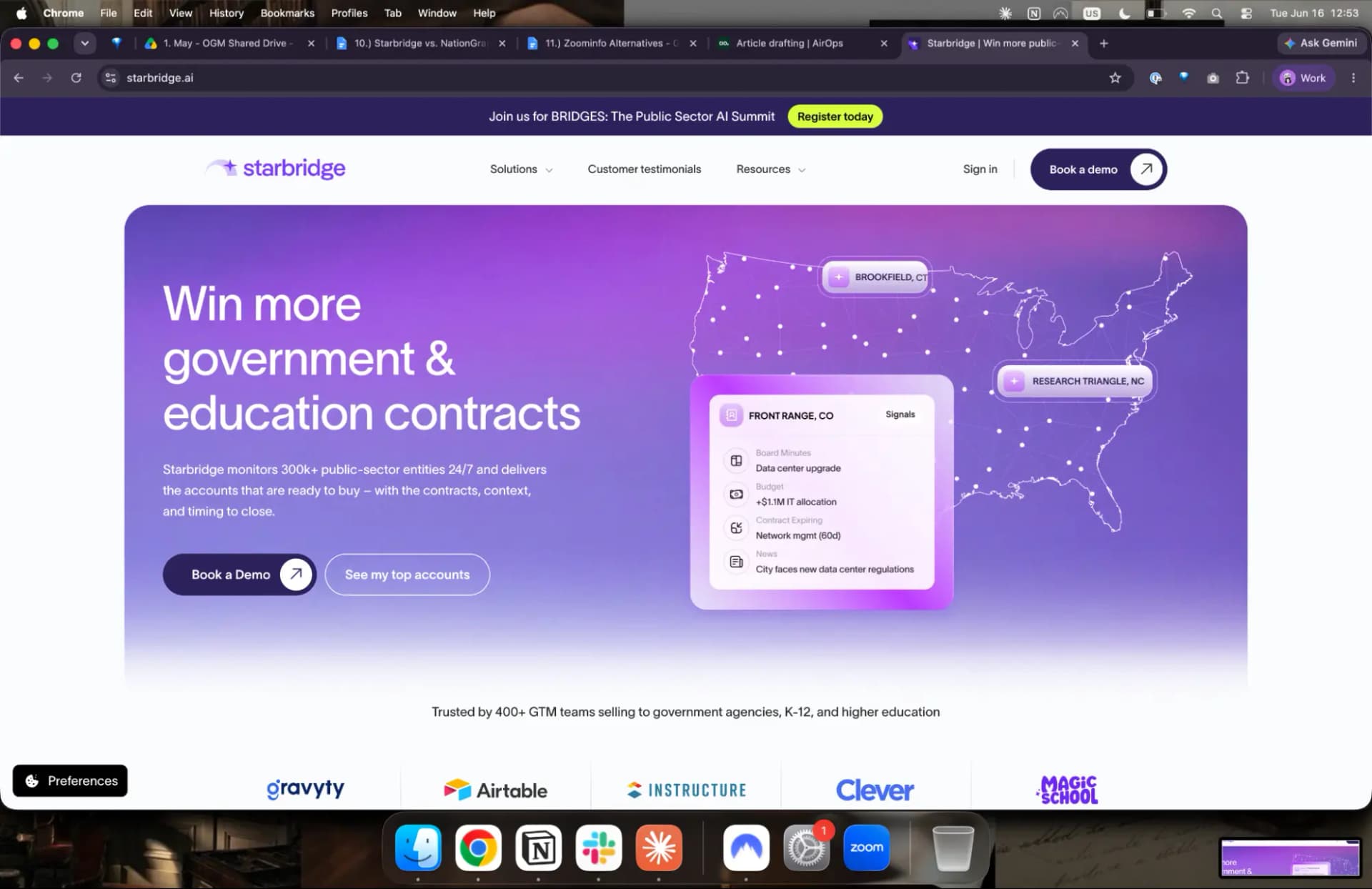
Starbridge is the signal intelligence platform purpose-built for companies selling to local government, K–12, and higher education. More than 600 GTM teams use it to identify buying intent ahead of the competition, connect that intelligence to verified contacts, and push personalized outreach directly into their CRM. Every part of it was built for this market specifically, not bent into shape from horizontal B2B software.
What Starbridge does well
Starbridge covers the full pipeline-building motion from early buying signal through booked meeting, and each capability reinforces the others rather than operating in isolation.
Starbridge’s Buying Signal Monitor tracks buying indicators across 320,000+ government and education entities around the clock. The underlying AI-native vector database understands context rather than relying on exact keyword matches, which means it can surface a signal like “budget shortfalls” even if those exact words never appear in a source document. Overall, the platform monitors board meeting minutes, strategic plans, budget data, grants, job postings, contract expirations, and bids.
Every signal fires with a verified contact, a reason for outreach, and AI-generated personalized copy pushed directly to Salesforce, HubSpot, Apollo, or Outreach. GovWell sourced 15% of its total qualified pipeline from Starbridge buying signals after deploying the platform across its sales team.
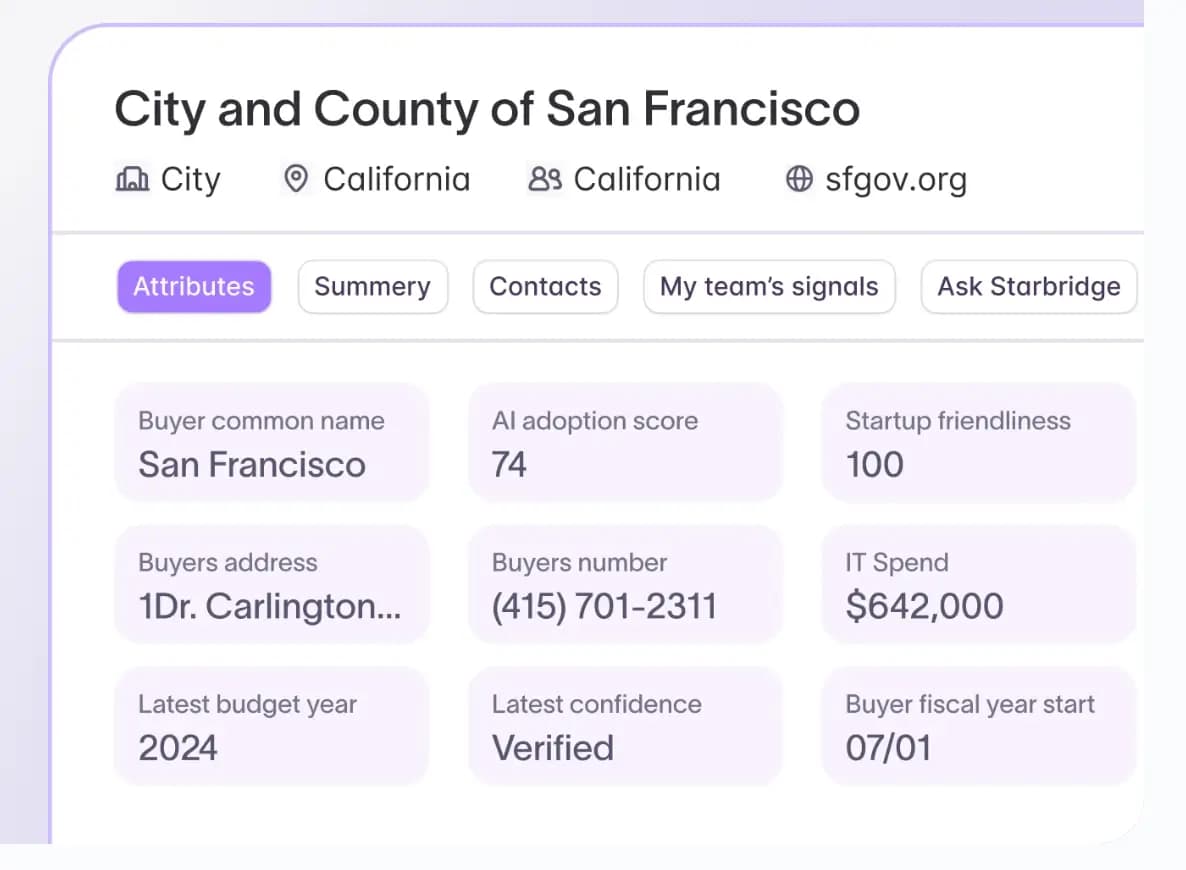
That signal intelligence becomes significantly more valuable when paired with accurate contact data. Starbridge’s Contacts & Company Data is a purpose-built contact database for government and education, powered by proprietary web-agent technology that runs continuous crawls across verified .gov domains, school district portals, university websites, and board minutes. Waterfall enrichment and continuous bounce-checking deliver 98% email accuracy, validated across a 14,000-email test, with a 2% bounce rate compared to 15-25% for generic providers.
Starbridge also tracks champion job changes so reps know when a known advocate moves to a new account. Bi-directional Salesforce and HubSpot integrations automatically sync, clean, and enrich contact records.
Accurate contacts and timely signals still leave reps at a disadvantage without competitive context. Starbridge’s Public Spend Intelligence gives revenue teams a full view of what government and education accounts are spending and on what. FOIA automation at scale surfaces purchase data, full competitor contracts, raw unredacted vendor proposals, opt-out clauses, implementation fees, and expiration dates. Out of the box, Starbridge has the purchase order data for 77% of state/local government, K-12, and higher education institutions.
The platform cross-references spend records against its full signal dataset, which means reps walk into every conversation knowing what a prospect pays a competitor, when the contract expires, and where the leverage sits. Frontline Education, for example, cut research time by 90% after deploying Public Spend Intelligence.
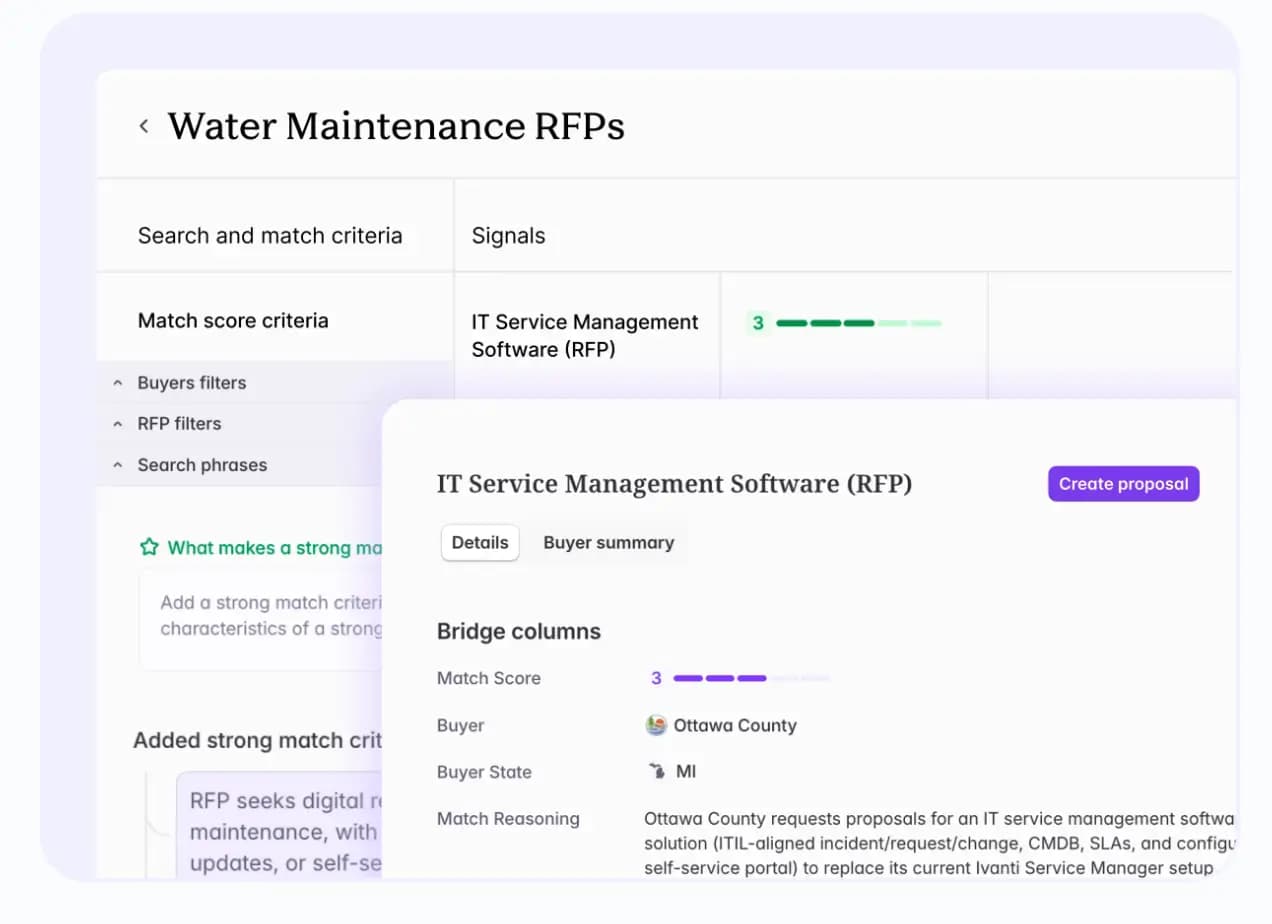
When an opportunity reaches the RFP stage, Starbridge’s AI RFP Finder & Proposal Writer centralizes thousands of bid portals into a single personalized feed. Each RFP is scored by product fit, region, and win likelihood, and the platform automatically flags solicitations that mention a competitor by name. The AI proposal writer drafts responses from the team’s product knowledge base, a compliance matrix builder maps requirements to response sections, and collaboration mode supports comments, tagging, and real-time refinement. Teams that have been engaging accounts through buying signals and competitive context are already positioned to win by the time the RFP drops.
Finally, Starbridge gives you a faster path to purchase by providing access to every major contract vehicle including NASPO ValuePoint, OMNIA Partners, Sourcewell, TIPS, and GSA. Starbridge is the only GTM platform that handles the compliance, paperwork, and renewals. Because the platform already knows each buyer’s preferred purchasing channel, reps can route every opportunity down the fastest compliant path to a signed PO.
Where Starbridge falls short
Starbridge delivers stronger sales intelligence for state and local government and education than it does for federal. Companies with a primary federal motion will find deeper analyst-curated intelligence and agency-level coverage from tools built specifically for that market. The platform’s strength is in surfacing micro-level buying signals across cities, counties, school districts, and universities rather than tracking macro federal procurement trends.
The RFP writer is lightweight and won’t replace a dedicated RFP hire for complex, high-stakes solicitations. It compresses response timelines and handles routine proposals effectively, but teams pursuing large federal contracts or multi-year agreements with dense compliance requirements will still need experienced proposal professionals on staff.
Starbridge is better suited for enterprise sales teams than early-stage companies. The platform is designed for revenue teams running a serious outbound motion into government and education, and the investment reflects the depth of intelligence and workflow automation it delivers. Teams with smaller deal sizes or a nascent government and education pipeline may find the price point difficult to justify until that motion scales.
Best for
GTM leaders and revenue teams at companies where selling to state and local government, K-12, or higher education is a core motion. Starbridge is meant for businesses that need one platform covering the full pipeline-building workflow, from early buying signal to verified contact to personalized outreach to closed deal, without adding headcount. It’s the strongest fit for organizations running enterprise-level outbound into this market that want buying intent, competitive context, and CRM automation in a single platform.
2. GovSpend
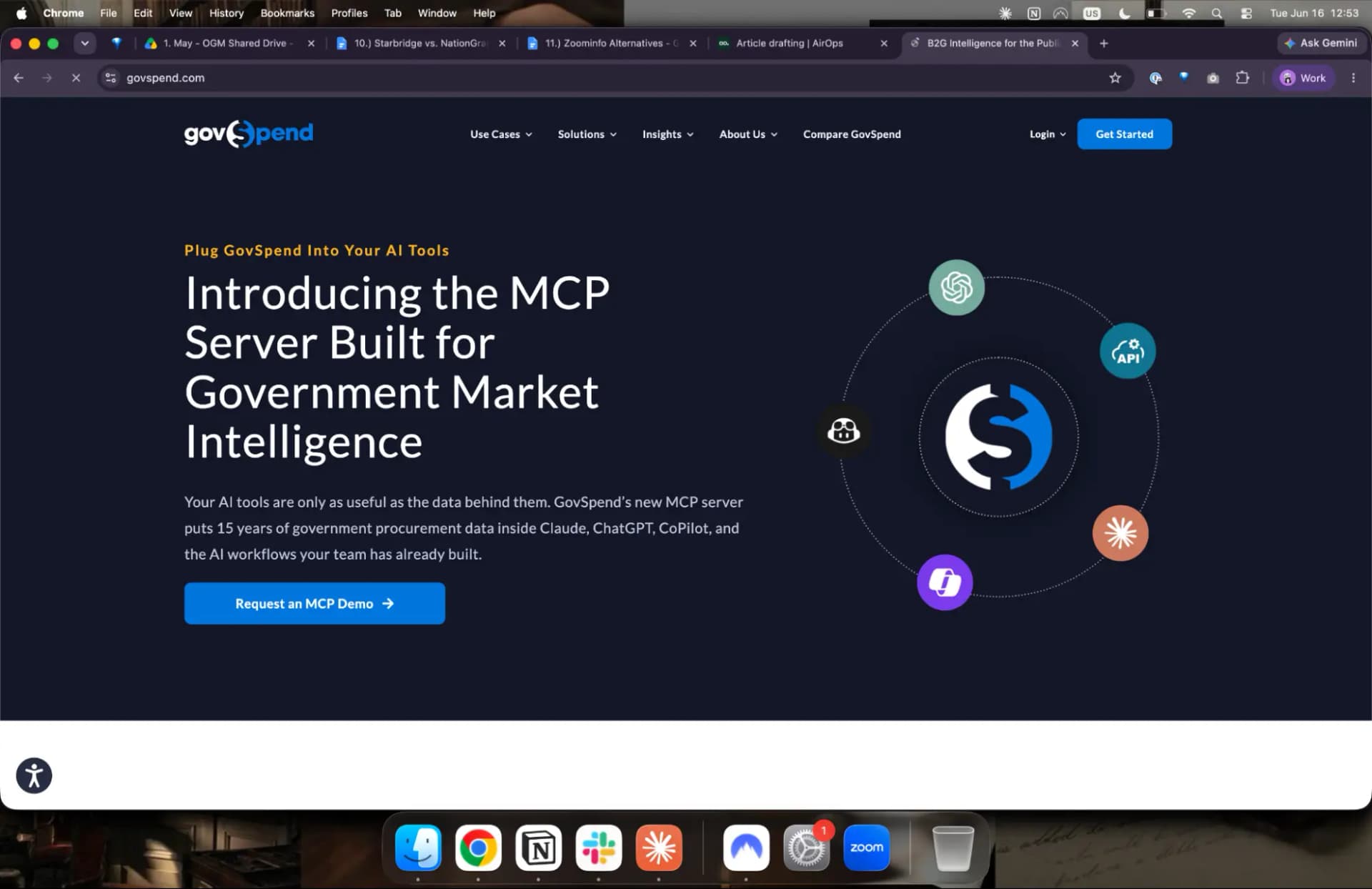
GovSpend is a procurement intelligence platform known for its historical purchase order data for state, local, and federal markets. Founded in 2011 and acquired by Thompson Street Capital Partners in 2020, GovSpend is one of the most established tools in the government sales intelligence space.
What GovSpend does well
GovSpend’s deepest strength is historical purchase order data. Line-item PO data going back eight or more years gives teams visibility into what was purchased, from whom, and at what price point. This data is useful for market sizing, identifying incumbent vendors, and preparing pricing conversations with agencies that have a documented purchasing history.
The platform’s AI Search feature supports keyword research across GovSpend’s data and the open web, and the Opportunities module ranks activity by company profile relevance.
GovSpend also includes modules for bids, contracts, meeting intelligence, spending data, and contacts, with CRM integration for Salesforce and HubSpot. A Slack integration supports real-time queries against the platform’s data, and opportunity alerts keep reps informed about new activity in their territories.
Where GovSpend falls short
GovSpend’s dataset describes activity that has already entered the public record. Purchase orders, meeting alerts, and Opportunities module scores all surface once an event has already occurred, which means a rep using GovSpend learns about an opportunity at the same moment everyone else watching that record does.
Search results can also be noisy and difficult to filter, particularly for teams monitoring broad product categories. One G2 reviewer wrote that “our industry can require that we monitor for key words that are widely ranging and can result in false positive reports of potential response opportunities.” For teams selling products that span multiple procurement categories, the time spent filtering irrelevant results can offset the value of the data underneath.
Data freshness varies by source and by state. Another G2 reviewer noted that “sometimes data is missing or not entered correctly or is out of date.” Because GovSpend aggregates procurement data from thousands of agencies with different reporting standards, the consistency of records depends on how each agency submits its data.
Today, GovSpend partners with Iris for drafting responses, so companies that prefer a single-tool workflow should take this into account during the evaluation process.
Seeing what agencies buy through contract vehicles and selling through one are two different things. GovSpend does the first, surfacing contract and vehicle data as part of its procurement intelligence. It does not do the second, so getting a vendor onto a vehicle like Sourcewell, OMNIA Partners, or TIPS is not a capability it offers as of July 2026.
Best for
Teams that need deep historical procurement data to size markets and understand agency spending patterns. GovSpend is a strong fit for organizations whose workflow centers on purchase order analysis, incumbent identification, and responding to published solicitations in federal markets.
3. GovWin (Deltek)
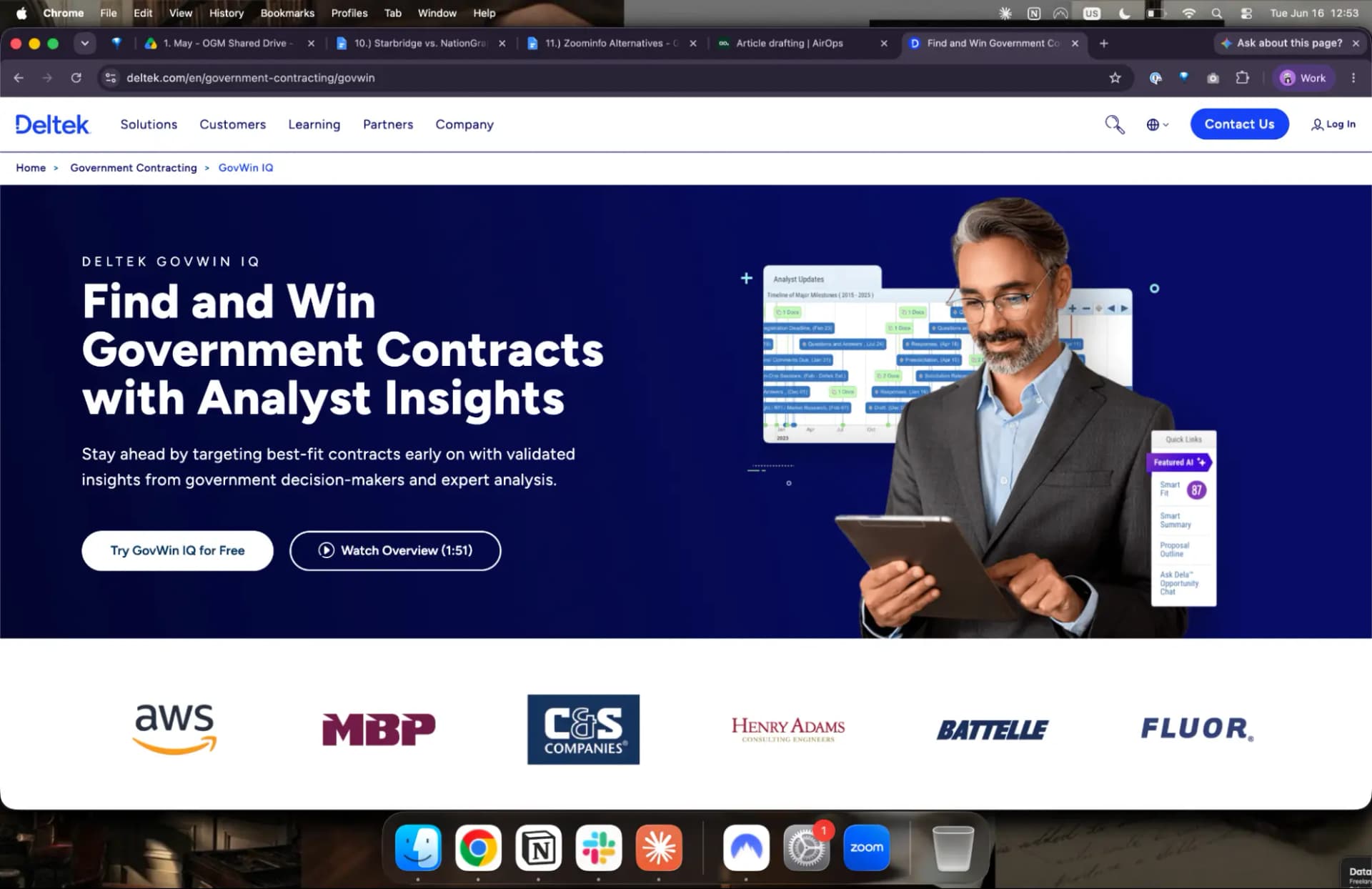
GovWin is a market intelligence platform owned by Deltek with a primary focus on federal procurement and a more recent expansion into state, local, and education coverage. The platform is traditionally for teams that need analyst-curated opportunity intelligence, teaming partner identification, and broad government spending forecasts.
What GovWin does well
GovWin’s analyst-backed federal opportunity intelligence is a well-established strength. A team of analysts track federal spending and source leads directly from government contacts, surfacing federal leads before they appear on SAM.gov. For federal contractors, this analyst network provides a high level of pre-solicitation insight.
The platform also offers broad bid aggregation across federal and state/local markets. GovWin centralizes bids from state and local entities alongside its federal coverage, and its Ask Dela AI feature helps reps summarize dense procurement documents.
GovWin provides relationship and teaming support designed for firms pursuing government contracts collaboratively. Agency org charts, federal personnel change tracking including RIFs, and teaming partner identification help teams understand competitive landscapes at the agency level. These tools are particularly valuable for federal contractors who need to build coalition bids and navigate complex procurement hierarchies.
Where GovWin falls short
Search usability challenges have been occasionally flagged by GovWin users. One G2 reviewer noted that “searching outside of my saved searches is challenging. The filters are not user-friendly and can be difficult to find what I’m looking for. Lately postings have been missing attachments or have wrong dates.” For teams that need to quickly surface specific opportunities outside their established search parameters, the platform’s filtering and navigation may slow down daily workflows.
GovWin’s analyst-curated intelligence is well-suited for market sizing and understanding the competitive landscape at a category level. Companies that need daily, account-specific triggers for outbound sequences, such as individual board meeting discussions, leadership changes, and grant awards, may find that the platform’s signal cadence is better suited to strategic planning than to powering a rep’s daily prospecting workflow. The gap between market-level forecasts and account-level action can be significant for users whose primary motion is outbound into state and local government, K-12, and higher education.
Knowing which contract vehicles exist and selling through one are two different jobs. GovWin does the first well, tracking and reporting on vehicles like GWACs and IDIQs. Getting a vendor onto a vehicle is not a capability it offers as of July 2026.
Best for
Federal contractors and teams with a primary federal motion that need analyst-curated opportunity intelligence, teaming partner identification, and broad government spending forecasts. GovWin is the strongest fit for organizations where federal procurement is the core revenue driver and where analyst-sourced pre-solicitation intelligence justifies the platform’s investment.
4. Burbio
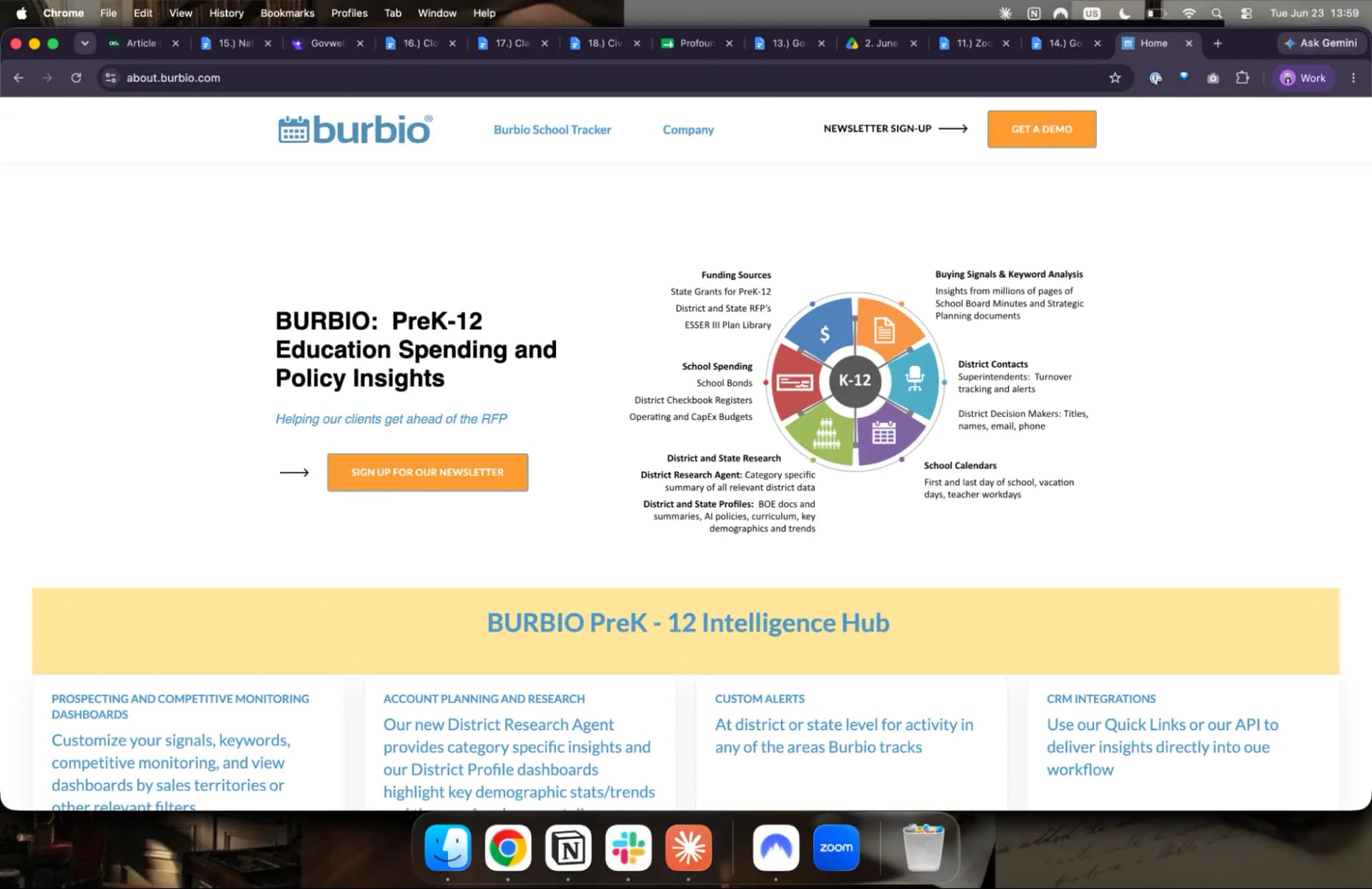
Burbio is a K-12 education data service that measures school district spending and policies. The company entered the K-12 market in 2020 with its COVID school opening tracker and has since expanded into business intelligence for education sales.
What Burbio does well
Burbio offers K-12 document coverage, useful for teams focused specifically on selling to school districts. The platform tracks school board meeting minutes, strategic plans, state grants, checkbook registers, ESSER III spending plans, CapEx budgets, and superintendent staffing data. This document-level intelligence gives edtech companies and education suppliers a detailed view of what individual districts are discussing, spending, and planning.
The platform’s keyword-based prospecting and competitive monitoring tools let teams define custom searches across Burbio’s document datasets. When a district mentions a relevant term in board meeting minutes or a strategic plan, reps receive alerts filtered by their sales territories. Dashboards organize this intelligence by territory and keyword category, and CRM integration via API and quick links helps teams push relevant findings into their existing workflows.
Burbio has also added a school district contacts dataset with decision-maker names, titles, emails, and phone numbers, along with a state funding sources database covering grants from all 50 states. The state funding sources database gives education suppliers a reference for grant eligibility, application details, and award information across the country.
Where Burbio falls short
Burbio’s coverage is focused on K-12 school districts. Companies that sell to cities, counties, state agencies, and higher education institutions need a separate tool for the rest of their addressable market.
The platform surfaces what districts are discussing, but interpretation, prioritization, and next-step action are left to the rep. When a keyword alert fires, the rep receives the matched document and decides which accounts to prioritize and how to act on the intelligence. For teams running high-volume outbound, the manual work of translating alerts into action can become a bottleneck.
Data is delivered through files, including Excel and CSV exports, and a browser-based district profile tool. This delivery model works well for individual account research or periodic market analysis. However, companies operating across multiple reps and territories may find that distributing, filtering, and acting on file-based intelligence requires additional manual effort to operationalize at scale.
Additionally, teams for whom conference intelligence is a big part of their GTM motion may want to consider alternatives that offer attendee tracking, ICP scoring for event lists, and pre-event outreach support.
Document intelligence tells you which districts are budgeting for a purchase. Closing that purchase is a separate job, and in K-12 it often runs through a cooperative purchasing vehicle like TIPS, BuyBoard, or Sourcewell that lets a ready buyer skip a full solicitation. Burbio does not offer access to those vehicles.
Best for
Edtech companies and education suppliers whose entire TAM is K-12 school districts. Burbio is the strongest fit for teams that need deep document-level intelligence on district spending plans, board discussions, strategic initiatives, and budget data, and whose sales motion doesn’t extend into cities, counties, state agencies, or higher education.
Which NationGraph alternative is right for you?
If your primary need is historical procurement data across state, local, and federal markets, GovSpend offers one of the deepest purchase order databases available, with line-item spending records going back eight or more years.
If your primary motion is federal and your team needs analyst-curated intelligence, teaming partner identification, and agency decision-maker access, GovWin brings decades of federal market coverage backed by a team of analysts.
If your TAM is exclusively K-12 school districts and you need document-level intelligence on spending, board meetings, and strategic initiatives, Burbio provides focused K-12 coverage with territory-based dashboards and keyword monitoring.
If your team sells technology or services to state and local government, K-12, and higher education, and needs one platform that covers the full motion from early buying signal to verified contact to outreach to closed deal, Starbridge is built for that workflow end-to-end. The platform surfaces buying intent months before RFPs drop, delivers 98% email accuracy across government and education contacts, provides full competitor contracts and pricing through FOIA automation, and scores and drafts RFP responses with AI. It also hands buyers a purchasing pathway they already trust, with pre-approved access to every major contract vehicle.
Book a demo to see how Starbridge gets your team into accounts earlier, with better data, and a clear path from buying signal to closed deal.
Frequently asked questions
Explore our use case library
 Automate account research with AI agentsStop manually researching accounts. Starbridge AI agents automate account research by monitoring buying signals 24/7 and surfacing the right contacts.
 Identify competitor contract expiration datesThe RFP is usually a formality. Starbridge surfaces competitor contract expiration dates so your reps reach accounts before the renewal cycle closes.
 Create a conference campaignTurn conference badge scans into pipeline. Import your contact list, surface buying signals across every account you met, and follow up with context.