
A guide to K-12 market signals
Discover the K-12 buying signals that reveal district intent months before an RFP, and how to turn them into pipeline.

Every school board meeting, budget approval, and grant award is part of the public record. K-12 districts are broadcasting exactly when they are ready to buy, but almost no sales team is listening.
K-12 districts generate a fully accessible trail of buying intent beacons months before any formal procurement begins. Revenue teams that learn to recognize these early indicators that a district is preparing to spend can engage the right accounts at the right time and build pipeline before the competition shows up.
This guide covers what K-12 market signals are, the eight signal types that predict purchasing, how budget cycles shape outreach timing, and how to turn buying signals into booked meetings.
What K-12 market signals are, and why they predict purchasing
A K-12 market signal is a public indicator that a school district is preparing to invest in a project and engage vendors. In practical terms, a buying signal is an early sign that a district is planning a purchase, such as a new grant award, a budget line item for a specific category, a contract about to expire, or a leadership change tied to purchasing authority. These buying indicators surface weeks or months before a request for proposal (RFP) ever appears.
K-12 generates more trackable buying signals than commercial business-to-business (B2B) organizations. The reason is structural: regulations require government and education buyers to deliberate in public. Board meetings are recorded and published, budgets are documented and available to the public, grants are disclosed, and contracts are filed as public records. This transparency creates a “signal-rich environment” that doesn’t exist in private-sector sales.
The pre-RFP window is where the real advantage lives. Government and education buyers are rarely experts in the solutions they evaluate. They consult vendors early in the process to understand what is possible, what peer districts have done, and what questions to ask. The vendor who educates the buyer ends up shaping the evaluation criteria.
By the time an RFP is published, the vendor who got there first has already built a strong relationship and framed the requirements. Responding to that RFP cold is an uphill battle.
Districts increasingly rely on evidence-based decision-making. Reviews, pilot data, and documented effectiveness influence purchasing committees. Vendors who understand this can position their outreach around outcomes and peer references rather than product features. A case study showing that a similar-sized district improved reading scores or saved 10 hours per week on compliance reporting carries more weight than a product feature list.
The eight K-12 buying signals that reveal district intent
Not all buying signals carry equal weight. The following taxonomy covers eight signal types ordered by how early they appear and how reliably they predict near-term purchasing.
1. Board meeting discussions and agendas
Board meeting discussions are the earliest and most valuable buying signal. When a school board discusses “modernizing student information systems” or “expanding cybersecurity coverage,” it signals active problem recognition months before procurement begins. A board agenda item naming your product category is a direct invitation to engage the superintendent or CTO with a relevant case study.
2. Budget approvals and new line items
A specific budget line item for your solution category means the district has already earmarked money. A dedicated line item is one of the strongest buying indicators available. Increased allocations in a category signal additional investment. Flat or shrinking budgets signal the opposite. Vendors can typically find budget documents publicly posted on district websites after board approval.
3. Grant awards and federal or state funding
Grants create both budget and urgency. A district that receives a School Safety Grant has the money and a mandate to spend it before the grant period expires. The major federal funding streams relevant to K-12 vendors include Title I (supplemental services for low-income schools), IDEA (special education technology and services), and Title III (English learner programs). ESSER funds have largely expired, shifting districts back to these core streams and local operating budgets.
4. Leadership changes
A new superintendent, CTO, or curriculum director brings new priorities and often triggers vendor re-evaluation. Leadership transitions are one of the strongest timing signals because new leaders often want to make an early mark. A leadership change in a department relevant to your product should be treated as a time-sensitive outreach opportunity.
5. Contract expirations
When an incumbent vendor’s contract is ending, the district is legally required to evaluate alternatives. A contract expiring sooner than 12 months is one of the strongest indicators of purchase readiness. This is a displacement opportunity: reach out to leads with competitive positioning that names a specific alternative and explains what makes your approach different.
6. Job postings that signal new initiatives
A “Director of Digital Learning” posting or a “fleet manager” listing that mentions electric vehicle (EV) experience reveals the direction a district is moving. Job postings signal a commitment of headcount and budget to a new initiative. The key is connecting the job posting to your product category and acting before the districting finalizes the hire and fully scopes the project.
7. Strategic plan updates
Districts publish multi-year strategic plans naming technology modernization, student safety, digital learning, or other priorities. When a district names “implementing a new assessment platform” as a Year 2 priority, that is a clear buying signal with a defined timeline. These plans signal future purchases one to three years before procurement.
8. Bids and RFPs
Bids and RFPs are the lowest-priority buying signal. By the time an RFP is published, a competitor has likely already been in the room with the district. Responding to an RFP you didn’t help shape is starting the race after another runner has already rounded the first turn.
How K-12 budget cycles and procurement shape your outreach timing
K-12 buying signals don’t exist in a vacuum. Each signal carries a different weight depending on where the district sits in its annual budget and procurement cycle. Timing your outreach based on their budget process requires understanding the rhythm of K-12 purchasing.
Most districts operate on a July-to-June fiscal year, with budget planning starting in January or February. The strongest window for engaging districts on new purchases is between January and April, when priorities are being set and budgets are being drafted. From May through June, districts shift into spending mode, racing to commit remaining budget before the fiscal year closes.
The major federal programs create additional timing windows:
- Title I funds supplemental services for low-income schools
- IDEA funds special education technology and services
- Title III supports English learner programs
- State grants and local bond measures create additional windows outside the federal calendar
As noted above, ESSER funds have largely expired, creating budget pressure for districts that relied on them for technology purchases. Districts that used ESSER for one-time technology investments now face renewal decisions with operating budget dollars. This creates a wave of contract re-evaluations as districts decide which ESSER-funded tools to keep and which to let go.
Policy and regulatory shifts also create market-level signals. School choice legislation, state adoption processes, and Department of Education policy changes inform which districts are expanding, consolidating, or shifting spending priorities. Declining enrollment trends affect district budgets, consolidation decisions, and technology investment. A district losing students is a different buying conversation than one adding portables to handle overflow.
From buying signal to booked meeting
Buying signals only drive pipeline if they reach reps where they already work and translate into specific outreach actions. The gap between “we have intelligence” and “we have pipeline” is where most teams stall.
Score accounts by buying readiness, not size
There are over 13,000 school districts in the United States. No team can research and keep tabs on them all. Most reps default to sorting by enrollment or geography, which means their lists likely include districts that may have no current budget or have had an incumbent vendor locked in for years.
Enrollment, population, and operating budget describe account size. They don’t predict purchase readiness. A large district might be in a spending freeze. A smaller district might have just received grant funding for exactly what you sell. Firmographic data provides useful context when combined with buying-readiness indicators, but it should not be the primary ranking factor.
The table below shows how to score K-12 accounts by buying readiness across three dimensions:
Score K-12 accounts by buying readiness
| Priority level | Use case and pain indicators | Budget and capacity indicators | Competitive indicators |
|---|---|---|---|
| High (9–10) | Board minutes or a strategic plan explicitly name your category as a priority | Budget documents show a specific line item or a hiring spree in the relevant department | Incumbent contract expiring in less than 12 months, or public pain with the current vendor |
| Medium (5–8) | High-level goals suggest a need, but no specific project is named | Large operating budget or recent spending activity, but no specific line item | Competitor present, but contract not expiring soon |
| Low (1–4) | No evidence of the use case in recent public transcripts or strategic documents | Budget freezes, layoffs, or cost-cutting mandates in recent news | Competitor just signed a multi-year deal |
For K-12 specifically, layer in enrollment, year-over-year enrollment trends, competitor usage, and per-pupil spending as supporting context on top of these buying-readiness indicators.
The key is scoring accounts with deep specificity and imagination, against the most reliable and up-to-date data. When you score accounts that way, time wasted goes down and time invested in meaningful outbound goes up.
Once you know which competitor each account uses, you can run targeted displacement campaigns with tailored differentiation messaging. However, surfacing competitive intelligence at scale across 13,000 districts isn’t something a rep can do manually.
Before a discovery call, a good rep wants to know what the prospect is spending today, who the incumbent vendor is, what the board has been discussing, and whether a contract is about to expire. That research can take hours per account.
Starbridge’s Public Spend Intelligence collapses that research into minutes. The platform runs custom FOIA requests at scale to surface competitor contract details, including expiration dates, annual revenue, and opt-out clauses.
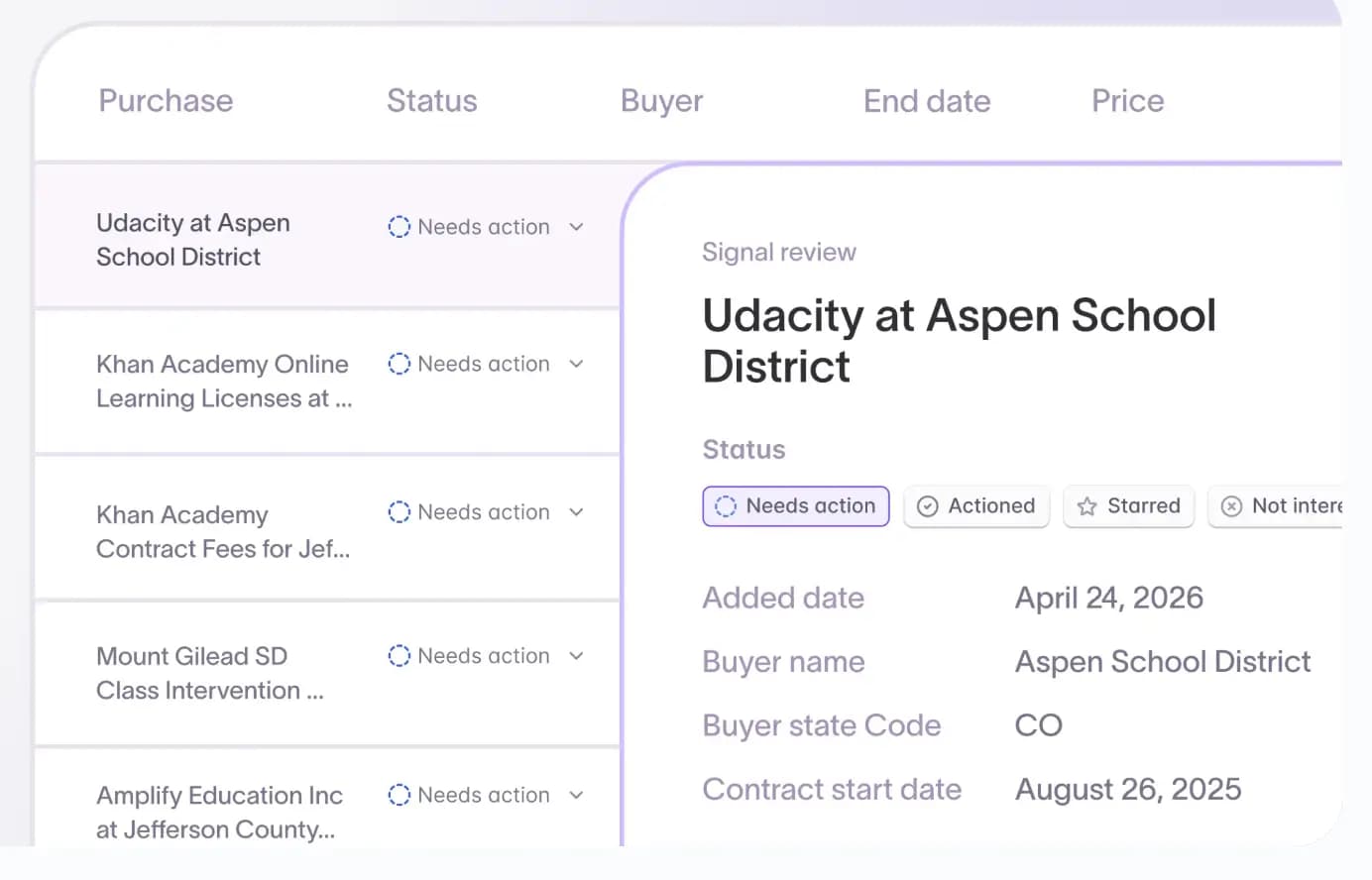
After adopting Starbridge, Frontline Education cut research time by 90%. Their reps now walk into meetings already knowing account priorities, competitive context, and spend history. With Ask Starbridge Chat, any rep can pull this context in seconds using natural language queries directly in Slack or the Starbridge platform.
In their first quarter with Starbridge, InquirED drove $200,000 in new pipeline by replacing manual board-document research with signal-driven account scoring to identify which districts were actually ready to buy.
Engage districts before the RFP
The pre-RFP engagement timeline spans from early board discussion (6 to 18 months before procurement) through budget allocation to vendor evaluation. Each stage calls for a different approach:
- Board discussion stage (6–18 months out). Send a relevant case study to the superintendent or CTO. Position yourself as a resource, not a seller.
- Budget allocation stage (3–6 months out). Reach out to the CFO with ROI data that maps to grant objectives or budget line items.
- Vendor evaluation stage (1–3 months out). Lead with competitive positioning, peer references, and pilot data.
The teams winning K-12 deals engage months before procurement begins, when they can still influence the conversation.
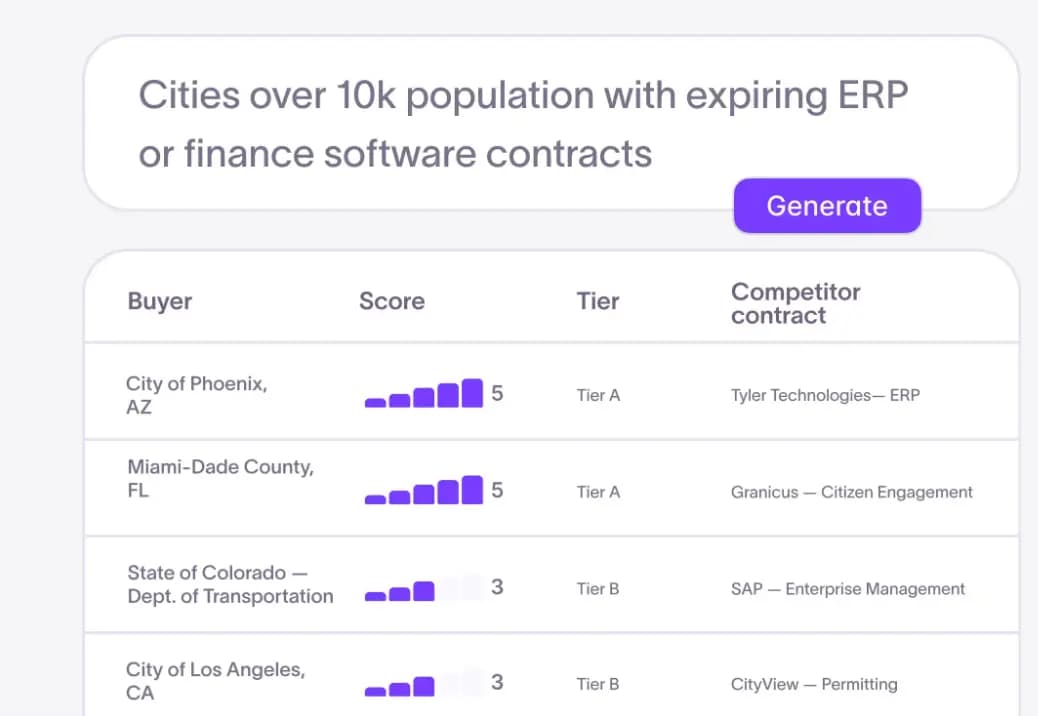
After switching to signal-timed outreach, Hapara saw 20% higher response rates by targeting school districts discussing competitor solutions in board meetings. Starbridge’s Buying Signal Monitor made this possible by surfacing specific board meeting discussions that indicated buying intent, so Hapara’s reps could act on that intelligence the same week. GovWell now sources 15% of its total qualified pipeline from Starbridge, making signal-timed engagement a consistent, repeatable channel rather than a one-time lift.
Turn signals into CRM workflows
Intelligence that stays in a dashboard still requires reps to figure out what to do next. The operational last mile is getting a buying signal to become a prioritized account, a verified contact, a reason for outreach, and a sequence inside the rep’s existing tools.
The contact data problem comes first. Generic B2B enrichment tools like ZoomInfo and Apollo scrape LinkedIn, which barely cover K-12 roles. Superintendents, curriculum directors, and district technology officers rarely maintain active LinkedIn profiles. The result is contact data with bounce rates of 15–25%. In a finite market where every interaction matters, a single email to someone who left two years ago wastes rep time, lowers deliverability scores, and reduces sequence performance.
Starbridge’s Contacts & Company Data takes a fundamentally different approach. Built on proprietary web-agent technology that crawls official school district websites, staff directories, and state education databases, the platform continuously bounce-checks results and delivers 98% email accuracy.
Contacts sync, clean, and enrich bi-directionally into Salesforce and HubSpot, so every buying signal surfaces inside the tools reps already use. Every buying indicator comes with a verified contact, a reason for outreach, and AI-generated copy ready to push directly into sequencers like Apollo and Outreach.
Within weeks of onboarding, TAM to Target found Starbridge contact data 3–4× more valid than other vendors they had used, eliminating the need to manually verify data before running campaigns. Their clients now book 2.5× more meetings thanks to outreach that actually gets to the right person.
When buying signals, verified contacts, and account context flow directly into the tools reps use every day, intelligence becomes pipeline without extra work. Kaizen Labs saw a 10–20% lift in monthly quota attainment after deploying Starbridge. Buying signals go directly to their team’s Slack channel, where reps immediately review ideal customer persona (ICP) fit, pull context from board meeting excerpts, and reference those details in outreach.
There’s also a compounding effect worth noting. When a district in one region adopts a product, nearby districts with similar profiles become stronger prospects. Signal-driven outreach to lookalike accounts after a win can compound the timing advantage. A closed deal in one Florida district makes every neighboring district with a similar enrollment profile and budget trajectory a higher-priority target.
Turning K-12 market intelligence into a repeatable pipeline
The difference between a reactive and proactive K-12 sales motion is the infrastructure behind it. Signal monitoring, contact verification, account scoring, and your CRM need to function as a single system, not four disconnected tools.
Starbridge is the AI sales intelligence platform built on the most comprehensive dataset of buyers and buying signals across state and local government, K-12, and higher education. It helps revenue teams prioritize the right accounts, engage the right contacts, and act on early buying intent, all from one platform that fits the tools your team already uses.
Book a demo to see how Starbridge helps your revenue team build pipeline before the competition.
Frequently asked questions
A K-12 market signal is a publicly visible indicator that a school district is preparing to spend. Common examples include:
- Board meeting discussions about a new initiative
- Budget line items for a specific product category
- Grant awards with spending deadlines
- Contract expirations that require vendor re-evaluation
Score accounts by buying readiness, not size. Lead with buying-readiness indicators like board meeting discussions, budget allocations, contract expirations, and grant awards. Layer in firmographic data like enrollment and per-pupil spending as supporting context. A smaller district with active buying signals is a better call than a large district in a spending freeze.
Generic databases like ZoomInfo and Apollo scrape LinkedIn, which barely covers K-12 decision-makers. Superintendents, curriculum directors, and district technology officers rarely maintain active LinkedIn profiles. The result is outdated contacts with bounce rates of 15–25%. Compare that to 2% bounce rates from platforms that crawl official district websites and continuously verify results.
The strongest teams engage six to 18 months before an RFP appears. Government and education buyers consult vendors early to understand what is possible and what peer districts have done. The vendor who educates the buyer during this window builds trust and influences the evaluation criteria. By the time the RFP is published, it often reflects what that vendor recommended.
Explore our use case library
 Automate account research with AI agentsStop manually researching accounts. Starbridge AI agents automate account research by monitoring buying signals 24/7 and surfacing the right contacts.
 Identify competitor contract expiration datesThe RFP is usually a formality. Starbridge surfaces competitor contract expiration dates so your reps reach accounts before the renewal cycle closes.
 Create a conference campaignTurn conference badge scans into pipeline. Import your contact list, surface buying signals across every account you met, and follow up with context.