
Best AI GTM platform for public sector sellers in 2026
Compare five AI GTM platforms for government and education sellers on pre-RFP signals, contact accuracy, spend data, RFP response, and contract vehicles.

Selling to state and local government, K–12, and higher education is a different sport than commercial B2B. Decision-makers rarely keep their LinkedIn profiles current, budgets move on fiscal cycles, and a won deal can sit in procurement for months after the buyer says yes. If you lead a revenue team or carry a quota in this market, the right AI GTM platform is what turns that fragmented, long-sales cycle complexity into a repeatable motion.
In this article, we evaluate five AI GTM platforms for public sector sellers against the most important capability areas, from identifying opportunities before RFPs all the way to contract vehicle access.
| Platform | Identifying opportunities before RFPs | Contact and account data quality | Vendor spend visibility | RFP discovery and response | Contract vehicle access |
|---|---|---|---|---|---|
| Starbridge | Monitors 320k+ entities for board minutes, budgets, grants, leadership changes, and more | 98% email accuracy from proprietary .gov and .edu web crawls with continuous bounce-checking | FOIA automation for full competitor contracts and pricing, plus purchase order data for 77% of institutions out of the box | AI-scored RFP feed across bid portals with a native proposal writer | Shorten sales cycles with contract vehicle access (NASPO, OMNIA, Sourcewell, and more - with compliance handled). Free to start. |
| Pursuit | Pre-RFP signals from public meetings, budgets, grants, and procurement records | Decision-maker mapping with contact confidence scoring and CRM sync | FOIA-sourced vendor contracts, pricing, and expirations | Surfaces RFPs and procurement records in the feed | Contract vehicle access is not part of the offering as of July 2026. |
| GovSpend | Meeting Intelligence and an AI Opportunities module ranking activity by profile fit | Contact data sourced through agency relationships and document requests | Historical line-item purchase order data with award details | Bid database with proposal drafting through a third-party partner | Contract vehicle access is not part of the offering as of July 2026. |
| NationGraph | Pre-RFP buying triggers from board meetings, budgets, and contracts across roughly 110,000 agencies | Role-matched decision-makers with verified emails and phone numbers, plus CRM sync | Automated FOIA returning incumbent, price, and renewal window | Buying triggers include contract and RFP timing via a daily feed | Contract vehicle access is not part of the offering as of July 2026. |
| Clay | Enrichment and AI research agents pointed at accounts you define | Waterfall enrichment across commercial data providers | General web research rather than procurement-specific spend data | Custom workflows rather than a purpose-built RFP feed | Contract vehicle access is not part of the offering as of July 2026. |
What to look for in an AI GTM platform
These five capabilities are the criteria that separate an AI GTM platform that builds pipeline and closes deals from one that only reports on activity after it is already public:
- Identifying opportunities before they go to RFP. The platform surfaces early buying signals, such as a new grant, a budget line item, or a contract about to expire, before a solicitation posts. This matters because buyers are not experts in the solution they need, so they consult vendors early to learn what is possible. The vendor who engages before the RFP helps shape the evaluation criteria and enters as the frontrunner.
- Contact and account data quality. It delivers verified names, emails, and phone numbers for the decision-makers inside agencies, districts, and institutions. Government and education leaders rarely maintain current LinkedIn profiles, and titles turn over with election cycles and budget years. Records built on commercial web data go stale fast and waste rep time.
- Visibility into what agencies and institutions are already buying. Insight into the incumbent vendor, contract value, and expiration date before a discovery call changes the entire conversation. Spend intelligence turns cold outreach into informed displacement plays and gives reps the context to position against a specific competitor.
- Finding and responding to RFPs efficiently. A centralized, scored RFP feed saves hours of portal-hopping across thousands of state, local, and education bid sites. AI-assisted proposal drafting compresses response time from days to hours, letting teams respond to more best-fit opportunities without burning headcount on manual drafting.
- Contract vehicle access that removes procurement friction. The platform gives a vendor a compliant path to sell through the cooperative and federal purchasing vehicles the buyer already uses. Even after a buyer says yes, a won deal can stall for months in a full RFP or legal negotiation. A pre-competed vehicle turns that stall into a signed purchase order in weeks.
These five capabilities work as one connected motion rather than five separate tools. A buying signal is only useful with a verified contact attached, context on what the account already spends, and a way to respond when the RFP appears. The motion runs from early buying signal through outreach and procurement to a signed contract.
No single capability outranks the others, because a gap anywhere breaks the chain. A great signal with stale contacts stalls, and a won deal with no contract vehicle access sits in procurement. The platforms in this article diverge in how much of that motion they cover compared to how much they leave teams to stitch together.
1. Starbridge
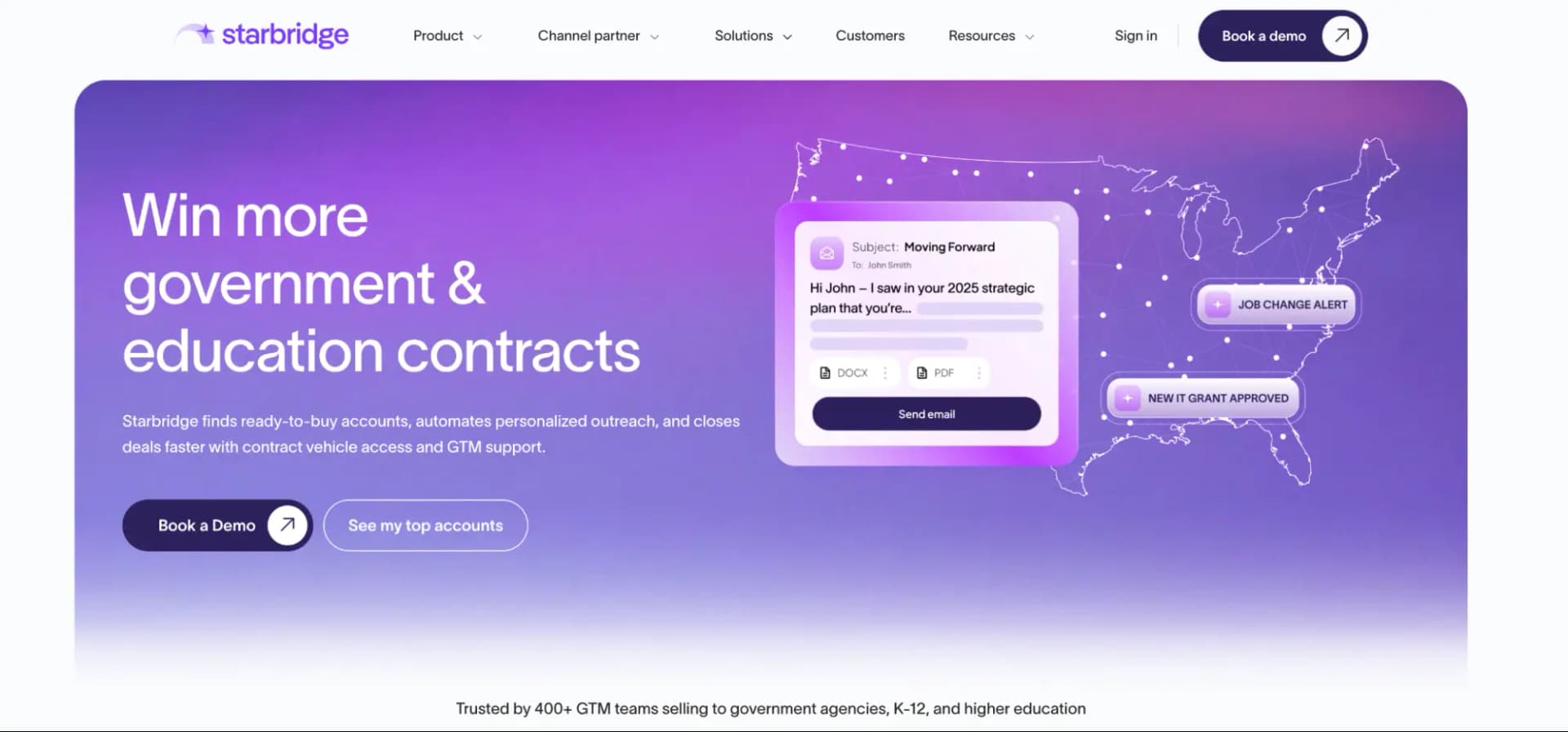
Starbridge is an AI GTM platform built for companies selling to state and local government, K–12, and higher education. It pairs the most comprehensive dataset of government and education buyers and buying signals with AI workflows that carry a deal from buying signal to closed deal. Trusted by more than 500 GTM teams, Starbridge fits revenue teams running an outbound motion into this market, from founder-led startups to enterprise sales organizations.
What Starbridge does well
Starbridge is built around five capabilities that cover the full government and education sales workflow.
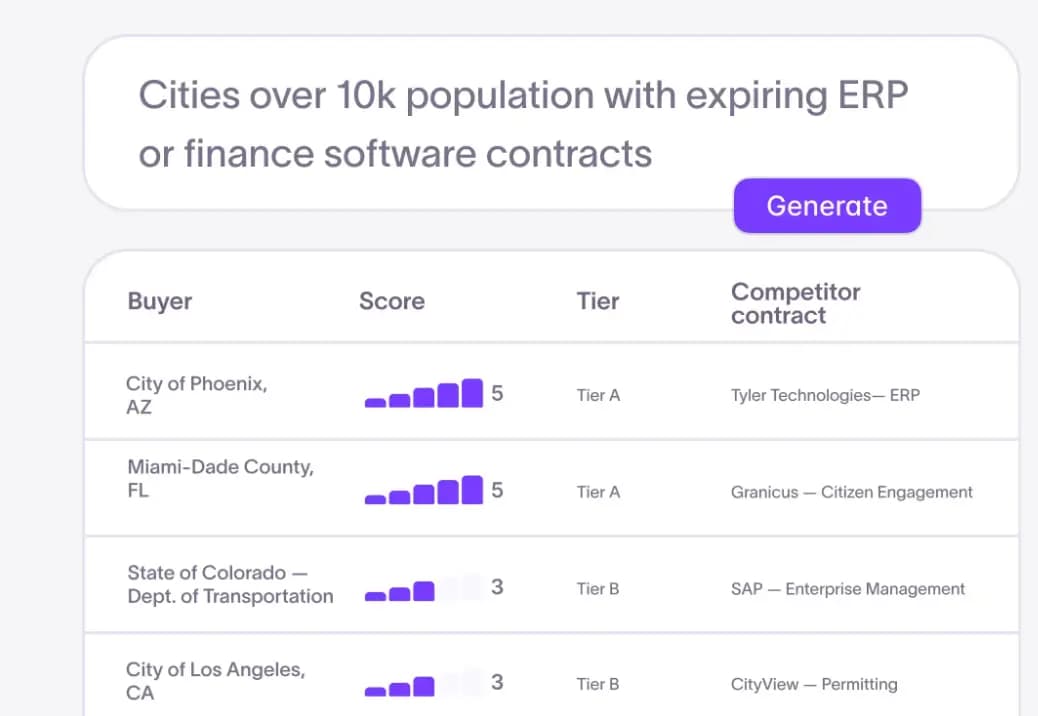
The first capability is the Buying Signal Monitor, and it means every warm lead arrives with the specific buying signal that triggered it, who to contact, and what to say. Starbridge monitors 320k+ government and education entities 24/7 across board minutes, budgets, and grants. It also tracks leadership changes, contract expirations, and bids, then scores and routes the highest-intent activity into the feed and CRM. InquirED generated $200K in new pipeline in its first quarter with Starbridge by replacing manual board-document research with account scoring that found the districts actually ready to buy.
Building on the signal, Contacts & Company Data makes sure the lead is someone a rep can actually reach. Starbridge delivers 98% email accuracy, validated across a 14,000-email test, with a 2% bounce rate against the 15 to 25% typical of databases that draw heavily from LinkedIn and commercial sources. Its proprietary web-agent technology continuously crawls government department sites, school district portals, and university directories, then waterfall enriches and bounce-checks every record. Teams can also run a free head-to-head contact data bakeoff to see the difference on their own territory.
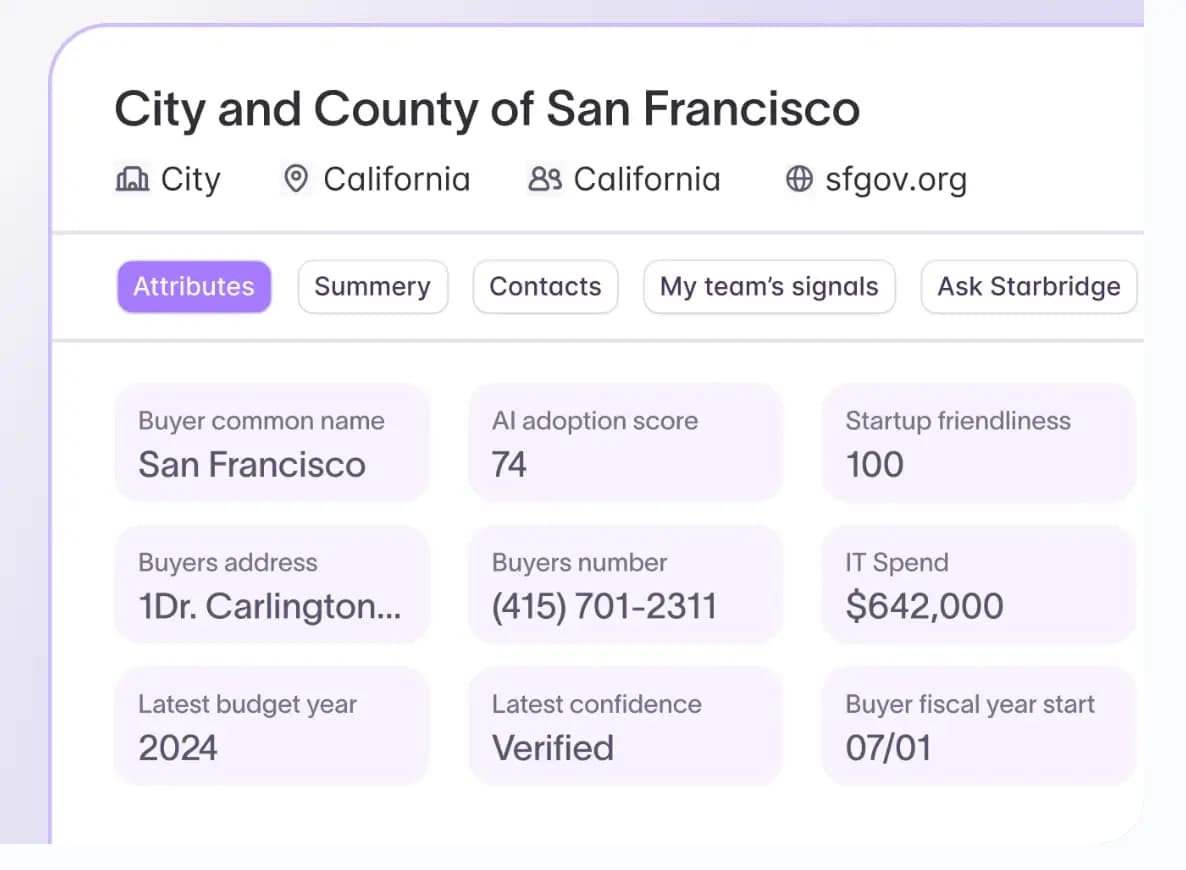
Where contact data gets a rep to the right person, Public Spend Intelligence tells them exactly how to position once they are in the room. Out of the box, Starbridge has purchase order data for 77% of state and local government, K–12, and higher education institutions, and FOIA automation returns full competitor contracts with pricing, opt-out clauses, and expiration dates. That means reps walk into a discovery call already knowing what a prospect pays a competitor and how to compete against it. Frontline Education cut account research time by 90%, from two hours to five minutes per account, using that context.
Once a solicitation appears, the AI RFP Finder & Proposal Writer keeps reps focused on the right opportunities. It centralizes thousands of state, local, university, and school district bid portals into one feed scored by product fit, region, and win likelihood, so reps chase the bids worth chasing. The AI proposal writer then drafts responses from the team’s product knowledge base, cutting response time by up to 50% and saving 8 to 10 hours per RFP.
Contract Vehicle & Reseller Access moves a won deal onto a vehicle the buyer already uses, so it reaches a signed purchase order in weeks instead of months, without triggering a full RFP. This access is available as part of the platform and provided directly by Starbridge, covering NASPO ValuePoint, OMNIA Partners, and Sourcewell. It also covers TIPS, and GSA. Teams onboard once, and Starbridge handles the compliance, paperwork, and renewals.
Where Starbridge falls short
Federal market coverage is thinner than Starbridge’s coverage of state and local government and education accounts. Teams whose primary motion is federal contracting will find the depth of signals and spend data weighted toward the state, local, and education side. Federal-first teams should weigh that during evaluation.
The AI proposal writer is lightweight by design and speeds up drafting rather than replacing a dedicated RFP function. Teams that respond to a high volume of complex solicitations will still want a dedicated RFP hire to own the process. Starbridge accelerates the work, but it doesn’t remove the need for that role.
Pricing is premium, as the platform is built for teams with a real government and education motion and the budget to match.
Best for
Starbridge is best for enterprise and established revenue teams whose primary market is state and local government, K–12, and higher education. These teams want buying signals, verified contacts, and spend intelligence connected in one system. That same system carries RFP discovery and response through to contract vehicle access. The payoff is a single motion that runs from early buying signal to a signed contract, without reps switching between four tools to complete it.
2. Pursuit
What Pursuit does well
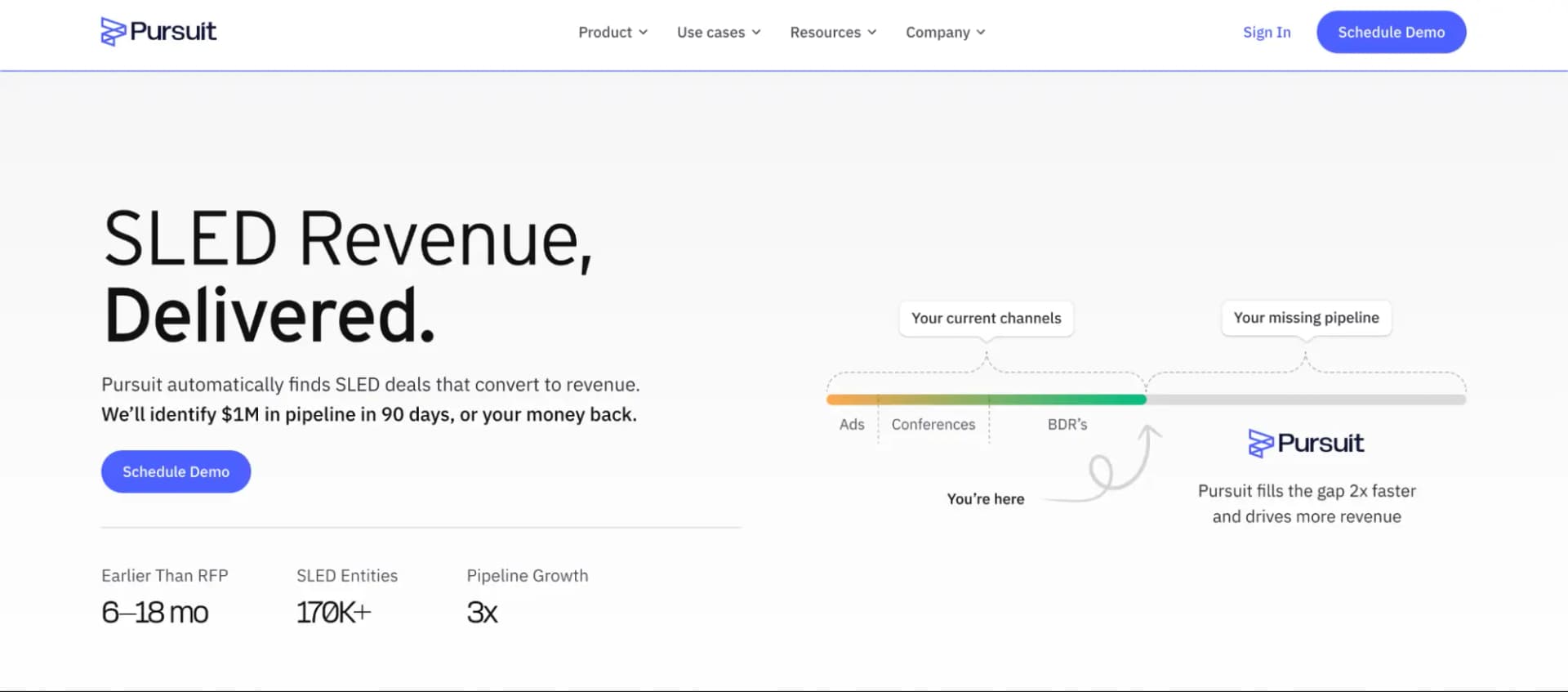
Pursuit scans public meetings, budgets, grants, and procurement records daily and delivers a ranked list of high-intent accounts. The aim is to help reps engage months before a solicitation posts.
Pursuit maps decision-makers across government and education entities and runs contact confidence scoring on those records. It offers bi-directional Salesforce and HubSpot sync, along with connections to Outreach and Slack, so enriched data flows into the tools reps already use.
Its FOIA intelligence files and analyzes public records requests to surface existing vendor contracts, pricing, and contract expirations.
Where Pursuit falls short
Contract vehicle access isn’t a stated capability as of July 2026. Pursuit surfaces procurement vehicles as intelligence on a buyer’s page, which helps reps understand how an agency buys. That is research context rather than a path to transact through a vehicle.
As of July 2026, proposal writing is not stated as a capability. Teams that want to move from finding a solicitation to drafting a response will need a separate tool for the drafting step.
Best for
Pursuit is best for teams selling to state and local government, K–12, and higher education that want a purpose-built pre-RFP signal and contact tool. Teams that value a daily ranked feed with CRM sync will find it a fit. It suits a motion focused on getting in front of decision-makers early.
3. GovSpend
GovSpend is a procurement intelligence platform centered on historical purchase order data, covering state and local government and federal markets. Founded in 2011 and privately held, it serves vendors, agencies, and consultants who need visibility into government purchasing activity.
What GovSpend does well
GovSpend’s foundation is a large historical line-item purchase order database showing what agencies bought, from which vendor, and at what price. Records include award details and end dates that support competitive research and recompete identification.
Its AI-assisted tooling adds an Opportunities module that ranks activity by daily fit from a company profile, an AI Search that runs across all modules and the open web, and an AI Notebook that creates a workspace for scoring and analyzing saved searches.
Meeting Intelligence gives teams a searchable database of public meeting transcripts, so they can track budget and technology discussions. Bid alerts flag matching solicitations, and CRM integration supports both Salesforce and HubSpot.
Where GovSpend falls short
One G2 reviewer noted that “sometimes data seems outdated or requires additional verification,” which undercuts timing-sensitive work like tracking contract expirations. When a record needs a second check before a rep can act, the timing advantage erodes. Freshness matters most in exactly the moments a rep is trying to move fast.
Another G2 reviewer found that monitoring broadly relevant keywords “can result in false positive reports of potential response opportunities.” Larger territories therefore carry more manual sorting before anything actionable surfaces. That sorting is time a rep is not spending in conversations.
Purchase records show which deals ran through cooperative vehicles. Selling through a vehicle like Sourcewell, OMNIA Partners, or TIPS isn’t a stated GovSpend capability as of July 2026, so teams manage that step separately.
Best for
GovSpend is best for teams whose primary workflow centers on procurement research, historical spend analysis, and bid monitoring in the state and local government market. It suits a research-led motion more than an automated outbound one.
4. NationGraph
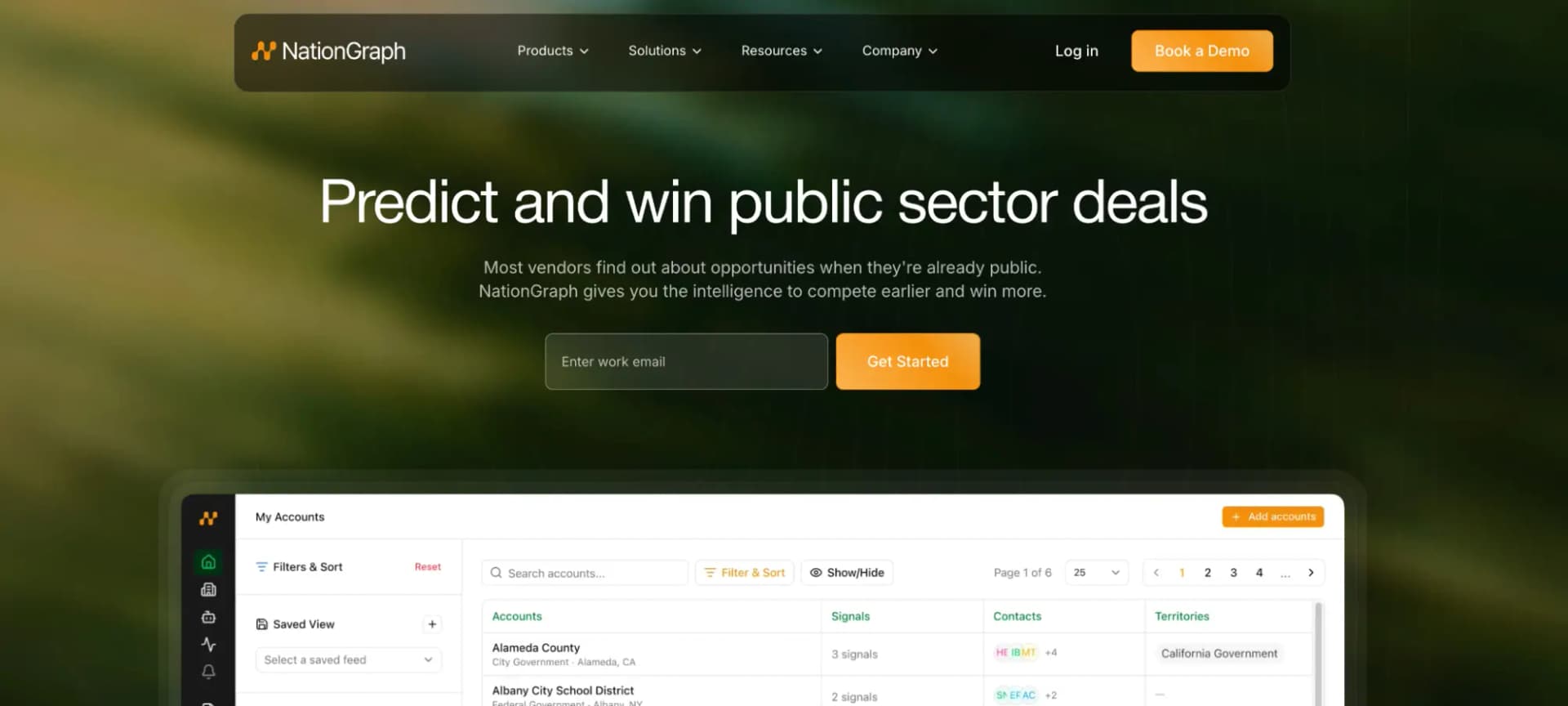
NationGraph is an AI-native intelligence platform for companies selling to state and local government, K–12, and higher education. It structures fragmented government and education data to predict purchasing before the RFP. The platform organizes board meetings, budgets, and contracts into buying triggers delivered through a daily feed.
What NationGraph does well
NationGraph structures board meetings, budgets, and contracts into buying triggers and contract expirations ahead of the RFP. Those triggers arrive through a daily feed and email digest. The goal is to put reps in the room while the opportunity is still forming.
It maps role-matched decision-makers with verified emails and direct phone numbers, and offers native Salesforce, HubSpot, and Zapier integration. Signals and contacts push into account records, so reps act inside the tools they already use.
Its Contract and FOIA Intelligence returns parsed contract data from automated FOIA requests. That surfaces the incumbent vendor, the contract price, and the renewal window as a foundation for competitive positioning. Reps use it to time displacement outreach.
Where NationGraph falls short
NationGraph doesn’t publicly list SOC 2 certification as of July 2026, which can be a hard procurement requirement for mid-market and enterprise buyers. Security reviews in these deals often gate a purchase on that attestation. Teams selling into larger organizations should confirm the platform’s current certification status during evaluation, as it’s a common blocker in government and education security reviews.
A buyer evaluating a newer entrant should ask for references and measurable outcomes in their own segment. Early-stage tools may also change quickly, so confirm that the capabilities shown in a demo are in general release.
NationGraph tracks which agencies purchase through cooperative vehicles like Sourcewell as intelligence. Selling through a contract vehicle isn’t a stated capability as of July 2026, so the path to transact is handled outside the platform.
Best for
NationGraph is best for teams working a defined or single-state territory that want pre-RFP buying signals and role-matched contacts in one workflow. Teams comfortable validating scale and certifications during evaluation will get value from its early-signal coverage. It suits a focused territory motion more than a broad multi-state rollout.
5. Clay
Clay is a horizontal data enrichment and workflow automation platform used across B2B SaaS. In government and education evaluations, it usually shows up as the build-your-own option, where a team points Clay’s enrichment waterfall and AI research agents at these accounts to assemble its own prospecting motion. Clay is SOC 2 Type II compliant and connects to most of the modern go-to-market stack.
What Clay does well
Clay’s waterfall enrichment pulls contact and company data from many providers in sequence, so if one provider misses an email, it tries the next. It can raise coverage well above what a single data source returns.
Its AI research agents and spreadsheet-style workflow give non-technical users a way to build enrichment and outreach without a data pipeline. Claygent visits websites to find specific news or signals, and the table interface lets a team assemble multi-step plays.
Deep flexibility is Clay’s signature strength. It connects to a large share of the modern toolstack and can automate multi-step enrichment and outreach in one place.
Where Clay falls short
One G2 reviewer described Clay’s learning curve as “quite steep, making it challenging to start using,” and added that “the initial setup process was extensive, feeling like it took an entire university.” Standing up and maintaining a program may call for a dedicated ops owner or a paid agency. Onboarding can stretch over months before the workflow is producing reliably.
As a horizontal platform, Clay draws largely on generic web scraping and commercial data providers. Legacy government portals, board meetings on Youtube, and purchase order records are poorly analyzed by generic scrapers. Coverage of pre-RFP buying signals and government spend data can therefore be difficult to build and maintain across the thousands of agencies in this market.
Contract vehicle access isn’t part of Clay’s offering as of July 2026. Teams that need a compliant path to transact through a cooperative or federal vehicle handle that step outside the platform.
Best for
Clay is best for commercial B2B teams that have a full-time hire to manage building an enrichment engine in-house. It can also work for teams selling to state and local government, K–12, and higher education that have a dedicated ops owner and the budget to build and maintain a custom workflow. The right fit is a team that wants to own the build rather than buy a purpose-built motion.
Which AI GTM platform is right for you?
GovSpend is worth a look if your workflow centers on historical purchase order data and procurement research for rip and replace campaigns, and to map who buys in your category. Its depth of spend data supports competitive positioning.
Pursuit and NationGraph are both worth evaluating if you want a purpose-built pre-RFP signal and contact tool for a defined government and education territory. Each delivers early buying triggers and role-matched contacts through a daily feed. A focused territory team can get moving quickly with either one.
Clay may be enough if you need a flexible, general-purpose enrichment and outbound engine for commercial markets and have the ops resources to build and maintain it. It rewards teams that want to own the build.
Starbridge is the clear choice if you want a single platform that carries the full motion for state and local government, K–12, and higher education. It connects all five capabilities, from early buying signals through to contract vehicle access. That’s the difference between a tool that surfaces data and a platform that closes the loop from buying signal to closed deal.
Book a demo to watch Starbridge put the full motion to work.
The best AI GTM platform for public sector sellers depends on how much of the sales motion you need in one system. Starbridge is the strongest fit for teams that want all five capabilities connected in one system, from buying signal to closed deal. Clay suits commercial or ops-led teams that want to build a custom enrichment workflow, while GovSpend fits teams focused on historical purchase order research. Pursuit and NationGraph work well for teams that want purpose-built pre-RFP signals and role-matched contacts across a defined government and education territory.
Look for five capabilities that work as one connected motion rather than five separate tools. The platform should surface pre-RFP buying signals, deliver accurate contact and account data, and show what agencies already spend. It should also handle RFP discovery and response and provide contract vehicle access that carries a won deal to a signed contract. A platform covering only one or two of these leaves your team stitching the rest together manually, procurement included.
Starbridge delivers the most accurate government and education contact data among the platforms here, at 98% email accuracy validated across a 14,000-email test. Its proprietary web-agent technology crawls verified .gov and .edu sites, then waterfall enriches and continuously bounce-checks every record, which holds its bounce rate at 2%. Databases that draw heavily from LinkedIn and commercial sources tend to go stale faster in this market, where titles turn over with budget years. Teams can run a free head-to-head contact data bakeoff to compare accuracy on their own territory before committing.
Starbridge closes government deals faster through contract vehicle access, which carries a won deal all the way to a signed contract. Even after a buyer says yes, a won deal can stall for months in a full RFP or legal negotiation, and a pre-approved path collapses that into a signed purchase order in weeks. Starbridge provides this access directly and handles the compliance, paperwork, and renewals, covering vehicles like NASPO ValuePoint, OMNIA Partners, and Sourcewell as part of the platform. Clay, Pursuit, GovSpend, and NationGraph don’t publicly state contract-vehicle sell-through as a capability as of July 2026.
Starbridge is priced as a premium platform built for teams with a real government and education sales motion, so the earliest-stage companies should size the investment carefully. A 10-person startup doing founder-led outbound can still get value, though teams with a very limited budget may feel the premium. For established revenue teams selling into this market, the connected motion typically offsets the cost by removing manual work across separate tools.
Frequently asked questions
Explore our use case library
 Automate account research with AI agentsStop manually researching accounts. Starbridge AI agents automate account research by monitoring buying signals 24/7 and surfacing the right contacts.
 Identify competitor contract expiration datesThe RFP is usually a formality. Starbridge surfaces competitor contract expiration dates so your reps reach accounts before the renewal cycle closes.
 Create a conference campaignTurn conference badge scans into pipeline. Import your contact list, surface buying signals across every account you met, and follow up with context.