
Government Contract Vehicles: What They Are, How to Get On
Contract vehicles decide who can sell to government buyers. Learn how GSA, NASPO, and Sourcewell contracts work and how vendors actually get on them.

Government contract vehicles are pre-competed contracts that let agencies buy from approved vendors without running a new solicitation for every purchase.
If you sell to government buyers, contract vehicles are one of the best ways to close deals in weeks rather than stall deals for months in competitive procurement.
This guide covers contract vehicles for the federal market, state and local governments, K12 school districts, and higher ed institutions. The vehicles that matter for each of these markets look slightly different. You’ll learn what contract vehicles are, the main federal and state types, how cooperative purchasing vehicles work, and whether you need one at all.
What Are Government Contract Vehicles?
A government contract vehicle is a pre-competed contract that lets government agencies buy products and services from awarded vendors without running a new competitive solicitation for each purchase. Federal examples include GSA Schedules, GWACs, and IDIQs. State and local buyers rely on state term contracts and cooperative purchasing vehicles like NASPO ValuePoint and Sourcewell.
Why agencies buy through vehicles instead of running solicitations
A full competitive solicitation is expensive for the buyer. Someone has to write the requirements, advertise the bid, empanel an evaluation committee, score proposals, handle protests, and push the winner through legal review. GSA’s own guidance tells agencies to meet their requirements through existing contract vehicles before looking anywhere else.
A vehicle removes most of that work. The competition has already taken place, the terms are already negotiated, and the pricing is already deemed fair and reasonable. The buyer issues an order instead of running a full procurement.
For vendors, the math is just as compelling. Orders placed against a vehicle are competed among a smaller pool, or not competed at all. You’re selling instead of bidding.
How a contract vehicle differs from a one-off contract
A standard contract covers one buyer, one scope, and one award. A contract vehicle is a standing agreement built for repeated orders, often from many different buyers, over a multi-year term.
That distinction matters for revenue planning. An award on a vehicle makes you eligible to sell. It doesn’t sell anything. Vendors who treat the award as the finish line hold a contract on paper while competitors on the same vehicle win the orders.
What Are the Main Types of Government Contract Vehicles?
The federal government, the states, and cooperative organizations each run their own vehicles. Here are the three types.
Government Contract Vehicles
Pre-competed contracts agencies buy through instead of running a new RFP
Cooperative Vehicles
Multi-state contracts other public agencies can use once awarded.
- NASPO ValuePoint
- Sourcewell
- OMNIA Partners
- TIPS
- BuyBoard
Federal Vehicles
Contracts federal agencies negotiate once for government-wide use.
- GSA Schedule (MAS)
- GWACs
- IDIQs
- BPAs
State Term Contracts
Contracts a single state negotiates for its own agencies.
- Texas DIR
- California CMAS
- New York OGS
How vendors get access
Path 1: Win the establishing solicitation
- Solicitation windows closed for 4+ year contract terms
- Commonly 6+ months from response to award
- National-scope proposal and pricing required
- Scored on past performance you may not have yet
Path 2: Traditional reseller (Carahsoft, CDW, Insight)
- Reseller earns a percentage of each contract
- Attention goes to deals that justify the overhead
- Typically requires a six-figure deal already in hand
Path 3: Starbridge Contract Vehicle Access
- No minimum deal size
- Available as part of the Starbridge platform
- Transact on NASPO ValuePoint, OMNIA, TIPS, Sourcewell, and GSA
- Compliance paperwork, renewals, and contract admin handled
1. Federal contract vehicles
Four vehicle types cover most of the federal market.
- GSA Multiple Award Schedule (MAS), commonly called the GSA Schedule. Long-term government-wide contracts with pre-negotiated pricing across millions of commercial products and services. The most accessible federal vehicle, and eligible state and local buyers can purchase through it too.
- GWACs (Governmentwide Acquisition Contracts). IT-focused vehicles managed by agencies like GSA, NASA, and NIH. More selective pools, larger engagements.
- IDIQs (Indefinite Delivery, Indefinite Quantity). Contracts with a fixed term but flexible quantities. Task orders are competed among the awarded vendors only.
- BPAs (Blanket Purchase Agreements). Simplified agreements for recurring needs, often established under a GSA Schedule.
One structural fact stands out for anyone weighing the federal market. Most task orders on these vehicles are competed only among vehicle holders. If you’re not on the vehicle, you can’t bid.
2. State term contracts
Each state runs its own version of the federal contract vehicle model through its central procurement office. Statewide term contracts pre-qualify vendors and pricing for state agencies, and in most states, cities, counties, and school districts can buy off them too. Texas DIR, California’s CMAS program, and New York’s OGS contracts are well-known examples.
3. Cooperative purchasing vehicles
For companies selling to state and local governments and schools, cooperative purchasing vehicles are the category that matters most. Cooperative vehicles are contracts competitively bid once by a lead state, a lead public agency, or a cooperative organization, then made available to member agencies nationwide. They get their own section below.
What Are Cooperative Purchasing Vehicles?
Cooperative purchasing vehicles allow government or education buyers to purchase off a contract that another entity has already competitively bid. One solicitation, thousands of eligible buyers. According to NIGP’s 2025 best-practice guidance, cooperative procurement now represents 11 to 19% of overall contract spend, and more than 85% of governments use it.
Why one contract reaches thousands of buyers
Behind every cooperative contract sits a single competitive RFP. A lead state or lead public agency runs the solicitation once and awards a master agreement to the winning vendors (OMNIA Partners follows this model, and Sourcewell runs its own national RFPs). Member agencies across the country then buy off that agreement without running their own procurement.
Two things follow from that design, and both matter to you. Win once and thousands of agencies can send you a purchase order. And because every listing traces back to a competitive award, there is no sign-up form. The co-ops fund themselves with a service fee paid by awarded vendors on each sale, while membership stays free for the agencies, which is why buyers join so readily.
Piggyback clauses extend the reach further
Many jurisdictions include piggyback language in their purchasing policies, which allows one government to buy off another government’s competitively bid contract, sometimes across state lines. A contract awarded by one Florida city can become the purchase path for a Georgia city that never saw the original bid. This is why a single cooperative award can reach buyers the awarding entity never anticipated.
The major cooperatives
The names that come up in state, local, and education deals.
- NASPO ValuePoint
- Sourcewell
- OMNIA Partners
- TIPS
- BuyBoard
Most states also have regional players, such as New York’s BOCES cooperatives in education.
Do You Need a Contract Vehicle to Sell to State and Local Governments?
Not always. Whether a vehicle matters depends almost entirely on your price point and your buyer’s thresholds.
When you don’t need one
Every jurisdiction has a sole-source or small-purchase threshold, the dollar amount below which a buyer can purchase directly without competitive bidding. Thresholds range from roughly $5,000 to $150,000 depending on the state, municipality, or district. Texas state agencies sit near $50,000. Many California entities can go to $100,000. K-12 districts often need board approval above $10,000.
Below the threshold, no vehicle is required. The buyer issues a purchase order and you close in weeks. A vendor who prices at $45,000 might close in 30 days in one jurisdiction and trigger a full RFP in another, so know the threshold before you price the proposal.
When a vehicle decides the deal
Above the threshold, the buyer has two options. Run a competitive solicitation, or buy through an existing vehicle. Procurement offices look for an existing vehicle first, because it saves them months of work.
Timing sharpens the choice. Most state, local, and K-12 fiscal years end June 30, and agencies with unspent budget hit April through June needing to spend it or lose it. A buyer in that window will not start a solicitation that takes most of a year. The vendor who can transact through a vehicle, or price under the threshold, is the vendor who can say “live before June 30.”
Researching how each account prefers to buy is its own workload. A rep covering a few hundred accounts would need to check purchasing policies, past contracts, and cooperative memberships one by one, and most teams simply skip it and find out during the deal.
Starbridge is the AI sales intelligence platform for companies selling to the government, K–12, and higher education, helping teams prioritize the right accounts, engage the right people earlier, and identify high-intent opportunities before the competition. Its Public Spend Intelligence surfaces an account’s past contracts, purchase orders, and vendor relationships, so reps can see how a buyer actually purchases before the first call.
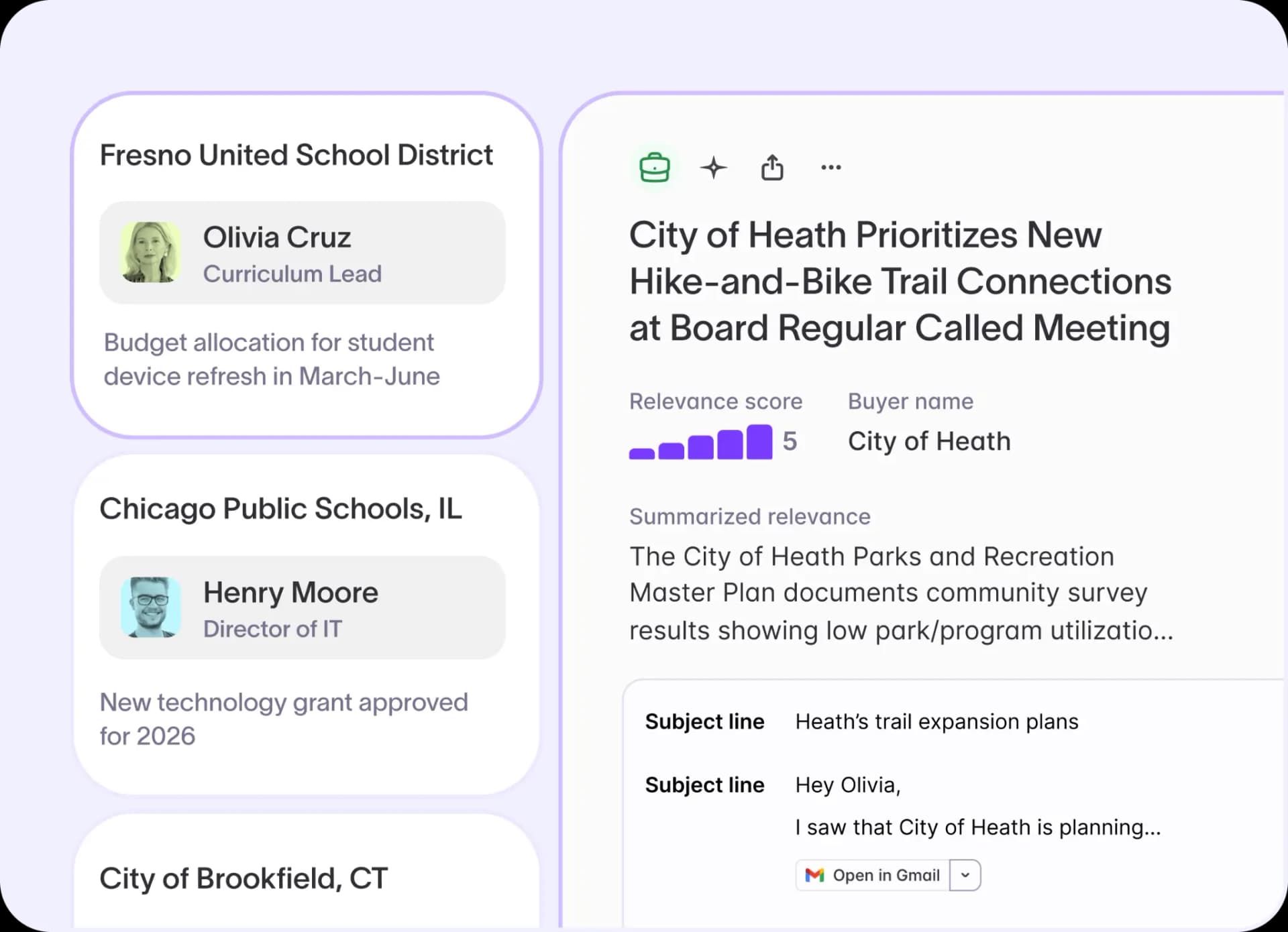
Zencity’s enterprise reps pull city priorities and procurement pathways from recent council meetings in seconds, and the team now sources 50% of its cold meetings from Starbridge.
Whether the answer turns out to be a direct purchase order, a cooperative contract, or a full solicitation, knowing the purchase path early changes how you price and when you push.
How Do You Get on a Government Contract Vehicle?
There are three real paths, and they differ enormously in speed and difficulty.
Path 1: Win the establishing solicitation (the hardest path)
Cooperatives and lead states award their contracts through public, competitive RFPs. NASPO ValuePoint posts open solicitations as lead states issue them. Sourcewell advertises each RFP nationally and gives proposers about seven weeks to respond. BuyBoard notifies registered vendors by email when a proposal invitation opens in their category.
Winning one of these is a serious undertaking. You’re proposing to serve thousands of agencies, so evaluators score national pricing, delivery and support capability, and references from multiple jurisdictions. It commonly takes six months or more from response to award.
Path 2: Win a state term contract (nearly as hard, state by state)
Register in each target state’s eProcurement system and respond to statewide term solicitations when they open. The reach is narrower than a national cooperative, but some categories are re-solicited more frequently, and registration is required infrastructure for selling to state agencies anyway.
The difficulty compounds state by state. Each state runs its own solicitation calendar, its own registration portal, and its own compliance requirements, so a vendor targeting ten states repeats the full process ten times. Term contract awards also run on multi-year cycles, and evaluations favor vendors with an in-state track record. Winning a first state term contract without existing government references is nearly as hard as winning a cooperative award.
Path 3: Partner with a reseller that holds the contract (the easiest, with a catch)
When the contract in your category is closed, NASPO ValuePoint’s own guidance points suppliers to the alternative. Partner with an awarded contractor, or sell through an awarded reseller’s dealer network.
A reseller in government purchasing is a company whose core business is winning and holding vehicle awards, then transacting other vendors’ products and services through those listings. National resellers like Carahsoft, CDW, and Insight hold positions across federal, state, and cooperative vehicles. Bring one a qualified deal and the reseller runs the transaction on its own contract, handles the procurement paperwork, and takes a percentage of the contract value. Your product reaches the buyer through paper you never had to win.
For most companies without an active listing, path 3 is the only one available this fiscal year. Which leads to the catch.
Why Is It Hard to Get on a Contract Vehicle Without a Big Deal in Hand?
Every path onto a vehicle, winning the establishing solicitation, winning a state term contract, or partnering with a reseller, has a gate. And every gate favors vendors who already have government revenue. The cost lands after you’ve already won. An agency can pick you as its vendor of choice and still have no fast way to buy from you.
The solicitation window is closed most of the time
Cooperative contracts are awarded for multi-year terms. Sourcewell awards run four years with up to three one-year extensions. NASPO ValuePoint states plainly that existing contracts are closed to new suppliers for the full term. If your category’s contract was awarded last year, the next open window could be half a decade away. You don’t apply on your schedule. You wait for the cycle.
The past-performance chicken-and-egg
When a window does open, the establishing solicitation scores track record. Cooperative RFPs want references from multiple jurisdictions and proof you can deliver nationally. On the federal side, flagship vehicles like OASIS+ require demonstrated federal past performance just to qualify. The vehicle that would win you government deals asks for the government deals you don’t yet have.
Resellers earn a percentage, so they chase big deals
The reseller path has its own barrier to entry. A reseller earns a percentage of each contract that moves through its listing, so its attention goes to the deals that justify the overhead. Bring a $400,000 opportunity and doors open. Bring a $40,000 pilot with a school district and you’re asking for the same paperwork for a tenth of the payout. For an early-stage company, the partner path exists in theory and stalls in practice.
The economics shape everything else about the experience. The big national resellers grew up serving federal mega-deals, so onboarding typically runs on manual paperwork and long timelines, and the fee conversation reopens with every sale. Vendors who do get in spend real energy renegotiating terms and competing for the reseller’s attention, deal by deal.
That catch-22 is why vehicle access has stayed an enterprise privilege, and it’s the gap Starbridge built contract vehicle access to close. Access comes as part of the platform, with no minimum deal size. One onboarding puts you in position to transact on vehicles including NASPO ValuePoint, OMNIA Partners, TIPS, Sourcewell, and GSA. Pricing is set once, every deal after that runs centrally, and Starbridge handles the compliance paperwork, renewals, and contract admin that come with each vehicle.
| Platform | Traditional resellers | Starbridge |
|---|---|---|
| Built for | Federal mega-deals and order taking | Companies selling to state and local government and education |
| Getting in | Typically requires a six-figure deal already in hand | No minimum deal size |
| Onboarding | Manual paperwork, vendor by vendor | Software-first, one onboarding across major vehicles |
| Fees | Re-quoted and renegotiated each sale | Set once, deals run centrally |
| Demand | You bring every deal | The platform also finds the demand |
One honest caveat. Each vehicle still lists, prices, and authorizes your product on its own review timeline, so access is easier and open at any size, not instant.
How Do Contract Vehicles Speed Up the Government Sales Cycle?
Vehicles are usually seen as compliance infrastructure. For sales teams, they are a weapon used to speed up sales cycles.
What a full RFP actually costs in time
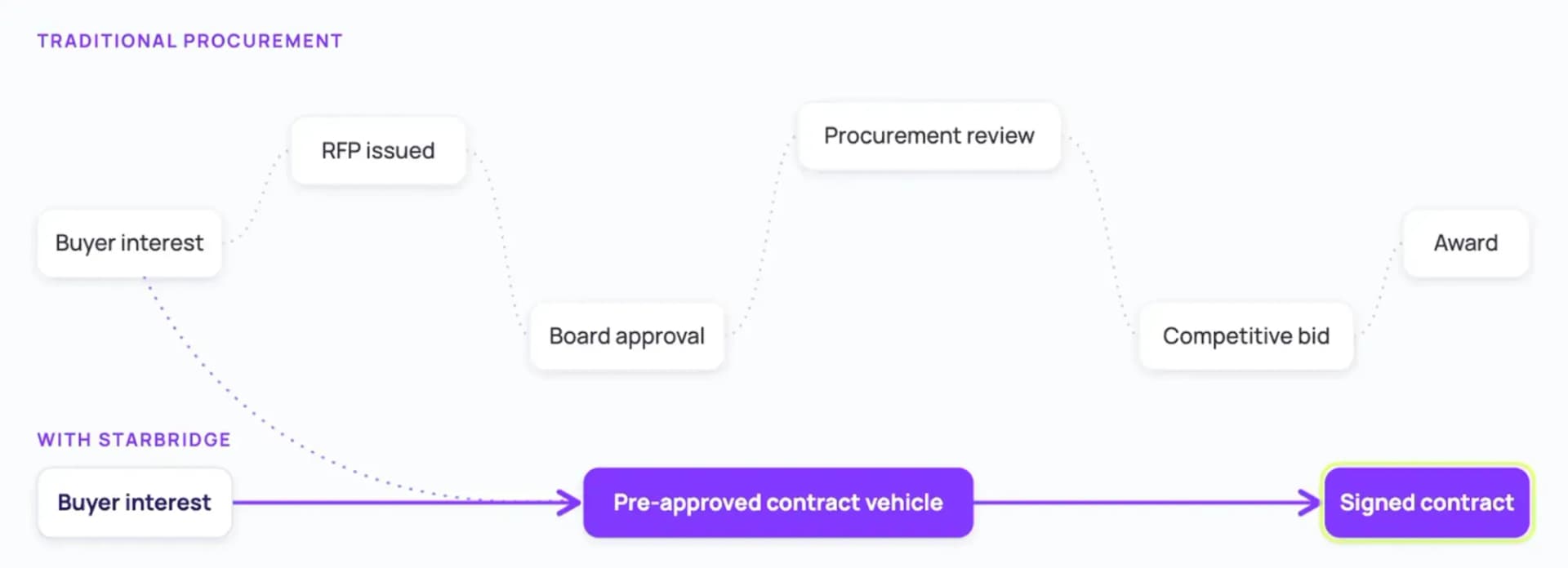
New York City’s Mayor’s Office of Contract Services measured its competitive RFP cycle times from pre-solicitation through contract registration. Across fiscal years 2022 to 2024, the end-to-end range was 354 to 621 days, and the city’s own recommended timeline still runs 325 to 510 days. New York is an extreme case, but the phases are universal. Requirements are drafted, the solicitation posts, an evaluation committee scores, an award survives review, and a contract is signed.
Triggering an RFP also means inviting competition. Once the solicitation is published, every competitor gets a shot at the deal you developed.
From buying signal to purchase order
Vendors who consistently win government and education deals engage 6 to 18 months before any solicitation exists, when the buyer is still discussing the problem in board meetings and budget sessions. By the time the RFP drops, the deal is already decided. The vendor who helped shape the requirements is the frontrunner, and everyone else is filling out paperwork for someone else.
Early engagement wins the relationship. The vehicle converts it. When a buyer you engaged early is ready to move, an existing contract vehicle, or a price under the sole-source threshold, turns their intent into a purchase order without waking up the full procurement process. That pairing, find the opportunity before the RFP, then close through the fastest available channel, is the entire playbook for compressing a cycle most vendors treat as fixed.
Finding buyers early enough for this to work is the hard part. Starbridge’s Buying Signals Monitor tracks board meeting minutes, budget documents, grant awards, and contract expirations across 320k+ government and education entities, and alerts reps the moment an account shows buying intent.
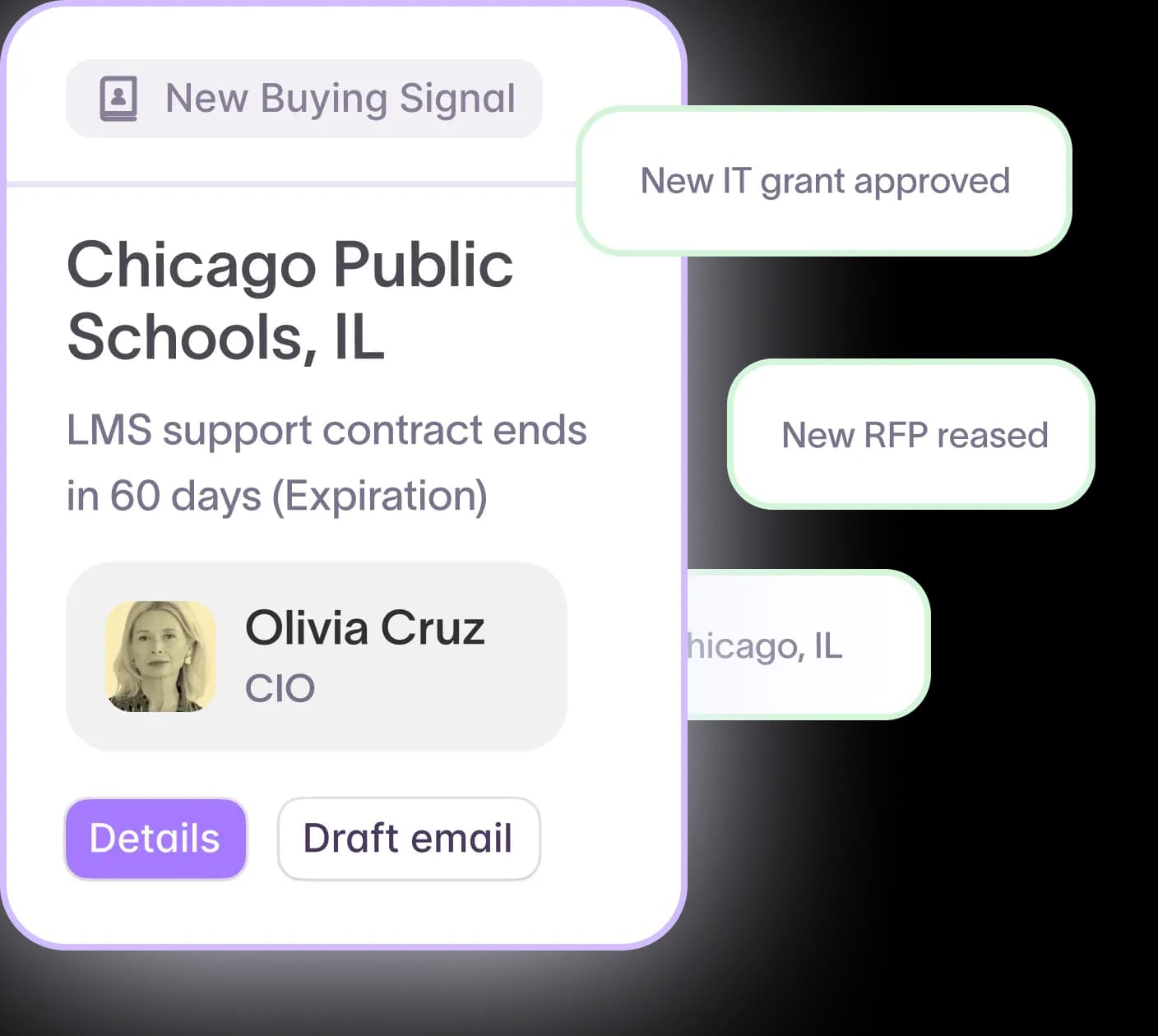
GovWell booked 5 meetings in its first week using those alerts, and now sources 15% of its qualified pipeline from Starbridge.
The buying signal finds the deal early. The vehicle closes it fast. Most of your competitors have neither.
Conclusion
Contract vehicles are how government buyers prefer to purchase, and the numbers show it. More than 85% of governments buy through cooperative contracts, and procurement offices look for an existing vehicle before issuing a solicitation. For companies selling to state and local governments, K-12 districts, and higher ed, the cooperative layer, NASPO ValuePoint, Sourcewell, OMNIA, TIPS, and BuyBoard, matters far more than the federal alphabet soup.
Getting listed directly is cyclical and gated by past performance, and traditional resellers reserve the shortcut for six-figure deals. Starbridge makes vehicle access available at any deal size as part of the platform, with the same platform finding the demand those vehicles then close.
If procurement is slowing down your pipeline, book a demo to see how Starbridge can help you find more deals and close faster.
Frequently asked questions
Government contract vehicles are pre-competed contracts that let agencies purchase from awarded vendors without running a new solicitation for each purchase. They include federal vehicles like GSA Schedules, GWACs, and IDIQs, state term contracts, and cooperative purchasing contracts from organizations like NASPO ValuePoint, Sourcewell, and OMNIA Partners.
Federal vehicles include the GSA Multiple Award Schedule, GWACs for IT, IDIQs, and blanket purchase agreements. States run statewide term contracts such as Texas DIR and California CMAS. Cooperative vehicles like NASPO ValuePoint, Sourcewell, OMNIA Partners, TIPS, and BuyBoard serve state and local agencies, school districts, and universities nationwide.
Cooperative purchasing vehicles are contracts competitively bid once by a lead state, lead agency, or cooperative organization, then made available to member governments, districts, and universities nationwide. Members buy directly from awarded vendors without running their own solicitation. Cooperative procurement represents 11 to 19% of public contract spend, and more than 85% of governments use it.
Three paths. Respond to the establishing solicitation when a cooperative or lead state opens one in your category, win a statewide term contract through a state procurement office, or partner with an existing contract holder, such as an awarded reseller, and transact through their listing while the direct window is closed.
Vehicle contracts are closed to new suppliers between solicitation cycles, which commonly run four years or longer. Establishing RFPs score past performance many newer vendors don’t have yet. And resellers who could transact your deal earn a percentage of contract value, so they prioritize vendors who bring six-figure opportunities.
No. Purchases below sole-source thresholds, typically $5,000 to $150,000 depending on the jurisdiction, can close on a direct purchase order. Above the threshold, a vehicle is often the difference between a purchase order in weeks and a competitive solicitation that takes most of a year.
A competitive RFP can take a year or more from planning to signed contract. New York City measured 354 to 621 days end-to-end. A vehicle replaces that process with a purchase order against pre-negotiated terms, so a buyer who already wants your solution can buy it in weeks.
Explore our use case library
 Automate account research with AI agentsStop manually researching accounts. Starbridge AI agents automate account research by monitoring buying signals 24/7 and surfacing the right contacts.
 Identify competitor contract expiration datesThe RFP is usually a formality. Starbridge surfaces competitor contract expiration dates so your reps reach accounts before the renewal cycle closes.
 Create a conference campaignTurn conference badge scans into pipeline. Import your contact list, surface buying signals across every account you met, and follow up with context.