
What Is SLED? A Guide to State, Local, and Education Sales
SLED stands for State, Local, and Education. See how big the market really is, how its 90,000+ buyers purchase, and what commercial sales teams must change.

SLED stands for State, Local, and Education, the non-federal public market of state agencies, local governments, and school systems. It behaves nothing like commercial B2B. Procurement is formal and public. Committees make the decisions. Budgets follow fiscal years rather than quarters. And the tools that power a commercial sales motion often underperform when pointed at school districts and county governments.
For a sales leader expanding out of the commercial market, the definition is the easy part. What matters is how differently this market buys. This guide sizes the market using primary sources, explains how its buyers purchase, shows where you can skip the RFP entirely, and covers what transfers from your commercial playbook and what needs to be rebuilt.
What Does SLED Stand For?
SLED stands for State, Local, and Education. It covers the more than 90,000 governments operating outside the federal system, all 50 states, counties, cities, townships, special districts, school districts, and public colleges and universities, which together spend more than $3 trillion a year. Their agencies, schools, and campuses push the count of buying entities into the hundreds of thousands.
The three segments of SLED
State covers the 50 state governments and their agencies. Departments of transportation, health services, revenue, public safety, and state IT offices all buy independently, though many purchase through centralized state procurement offices.
Local is the largest segment by entity count. The 2022 Census of Governments counts 90,837 local governments, including 3,031 counties, 19,491 municipalities, 16,214 townships, and 39,555 special districts that run utilities, transit systems, and water authorities.
Education is two markets inside one segment. K-12 covers the 12,546 independent school districts in that same Census count, where elected school boards approve major purchases and buying follows the school calendar. Higher ed covers public community colleges and universities, which answer to boards of regents or trustees, run their own procurement offices, and generally have more purchasing flexibility and higher spending thresholds than districts.
One nuance worth knowing. The Census counts governments, and a government is rarely one buyer. A state operates dozens of agencies that purchase independently, a district holds budget authority across its schools (98,577 public schools nationally), and a university system buys campus by campus. Count buying entities instead of governments and the market runs into the hundreds of thousands.
What SLED does not include
The federal government is not part of SLED. Federal agencies buy under a single procurement rulebook, register vendors through one portal, and reward a fundamentally different go-to-market motion. Many vendors build separate teams for federal and SLED for exactly this reason, and this guide covers only the non-federal side.
How Big Is the SLED Market?
Why every article cites a different number
Depending on the article, the SLED market is valued at $1.5 trillion, $2 trillion, or $2.3 trillion. These figures differ because they measure different things, and most articles never say which.
The Bureau of Economic Analysis puts state and local consumption expenditures and gross investment at $3.4 trillion as of early 2026. That figure represents state and local governments’ total final demand, the portion of GDP these entities purchase directly. The Census Bureau’s finance survey reports even higher spending, with total expenditures above $4 trillion once benefit payments and insurance trusts are included.
The smaller figures you see quoted, $1.5 to $2 trillion, are estimates of the vendor-addressable procurement slice, since a large share of government spending goes to employee compensation rather than purchased goods and services. Any of these numbers makes the same point. The SLED market is comparable in scale to the largest commercial verticals, and it does not contract when the economy does, because tax revenue and enrollment do not follow the business cycle.
Where the money is by segment
Education is the single largest spending category. State and local governments spent $1.1 trillion on education in a single year, more than a quarter of their total expenditures. Public K-12 schools alone spent $927 billion in 2020-21, an average of $18,614 per pupil, and about 11 percent of current K-12 spending goes to purchased services such as food contracts, transportation, and professional services. Public colleges and universities add another $450 billion in annual expenses on top of that.
The rest is spread across public welfare, utilities, public safety, transportation, and general government operations. Nearly every commercial product category has an equivalent SLED buyer.
How Is SLED Different from Federal Government Sales?
One rulebook versus fifty
Federal procurement is governed by the Federal Acquisition Regulation, which every agency follows. Vendors register once through SAM.gov and can then pursue opportunities across the entire federal government.
SLED has no equivalent. Each state writes its own procurement code, and counties, cities, and school districts add their own ordinances and policies on top. There is no single registration portal, no standard solicitation format, and no shared threshold for when competitive bidding begins.
What that means for a vendor
Federal sales reward compliance infrastructure, certifications, and patience with very long cycles. SLED sales reward references, regional momentum, and relationships built before a solicitation exists. Deal sizes are smaller on average, but there are tens of thousands of buyers, and a win with any one of them is the strongest possible asset for winning the next, because SLED buyers trust peer references more than any marketing claim.
How Is SLED Sales Different from Commercial B2B Sales?
For most sales leaders, the bigger adjustment is not federal versus SLED, but commercial versus SLED.
Procurement is formal, and committees decide
Above certain dollar thresholds, a SLED purchase must go through a formal, public solicitation. Proposals are scored by an evaluation committee, typically including an end user who judges workflow fit, an economic buyer who judges ROI, and an IT evaluator who judges security and integration. There is no single champion whose signature closes the deal, and consensus-building is the core selling skill.
References carry more weight than in any commercial evaluation. A committee member who can call a peer at a similar district or agency will do so, and what that peer says matters more than your deck.
Budgets follow fiscal years, not quarters
Forty-six states begin their fiscal year on July 1, and most local governments and school districts follow similar calendars. Budgets are proposed and approved months before the fiscal year starts, which means the window to influence next year’s budget closes long before next year begins. Miss it, and the realistic close date moves out a full year.
K-12 adds its own rhythm. Districts make major purchasing decisions in spring for fall implementation, so the school calendar compresses the selling season further.
Everything your buyer does is public record
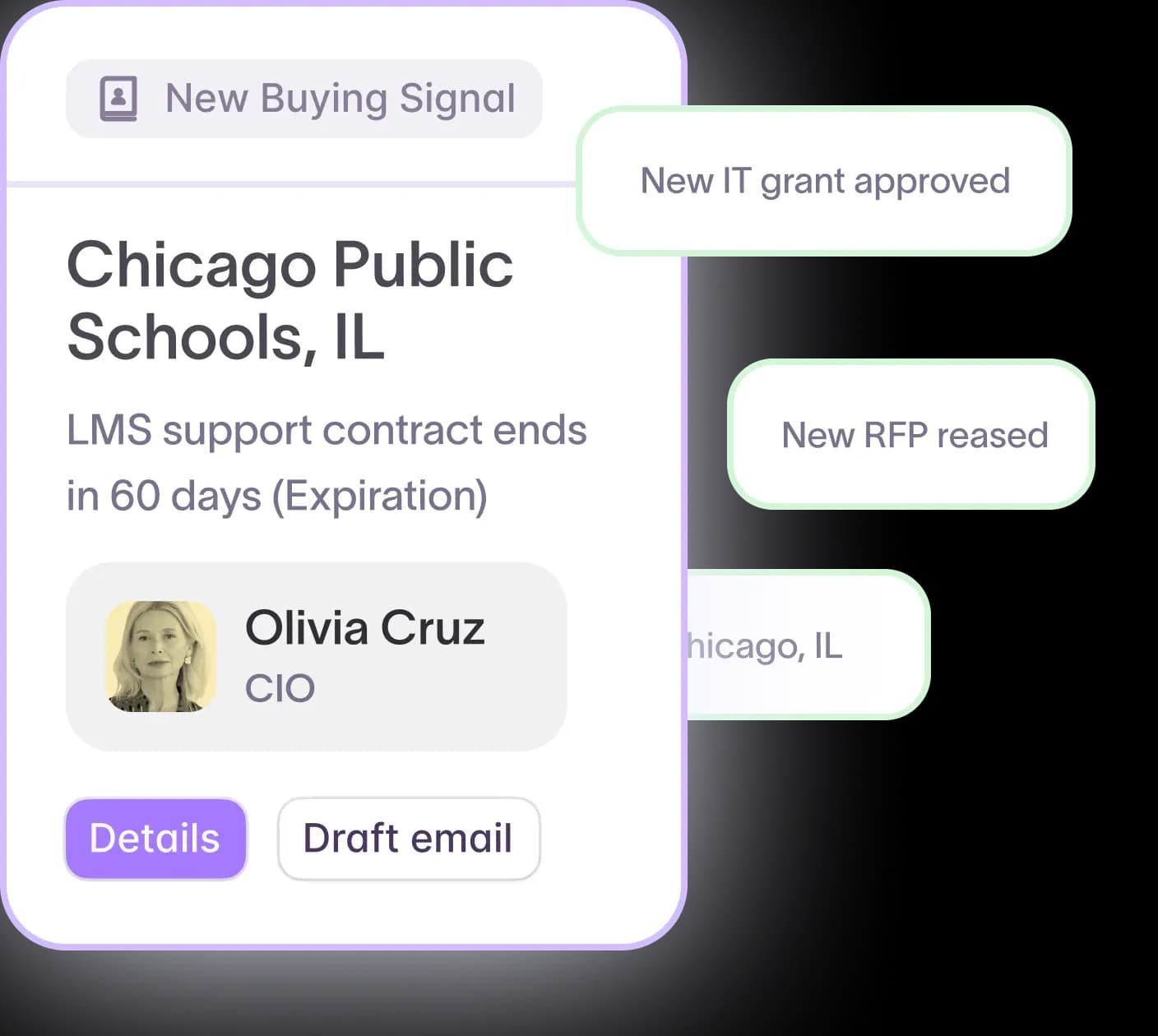
This is the difference commercial sales leaders least expect, and the one worth the most pipeline. SLED entities publish their board meeting minutes, budgets, strategic plans, contracts, and purchase orders as public record. In commercial sales, intent data is inferred and probabilistic. In this market, the buyer literally publishes what they plan to buy, what they currently pay a competitor, and when that contract expires.
Most teams entering the market ignore this and default to what they know, manually searching, building lists in spreadsheets, and running cold outreach. The vendors who win read the public record instead, because by the time the RFP drops, the deal is already decided. The vendor who engaged during the planning conversations helped shape the requirements. The RFP’s already out. The relationship’s already set. Our guide to government buying signals covers what these buying indicators look like in practice.
A county buyer who raises your product category in a board meeting has told you they are in market. The problem is scale. Reading board meeting minutes for 20 accounts takes an afternoon. Reading them for every county, city, and district in a national territory is a headcount problem.
Starbridge is the AI sales intelligence platform for companies selling to the government, K–12, and higher education, helping teams prioritize the right accounts, engage the right people earlier, and identify high-intent opportunities before the competition. Its Buying Signals Monitor tracks board meeting minutes, budget documents, and contract expirations across 320,000+ government and education entities, and every alert tells the rep which account to reach out to, why, and who the right person is to call.
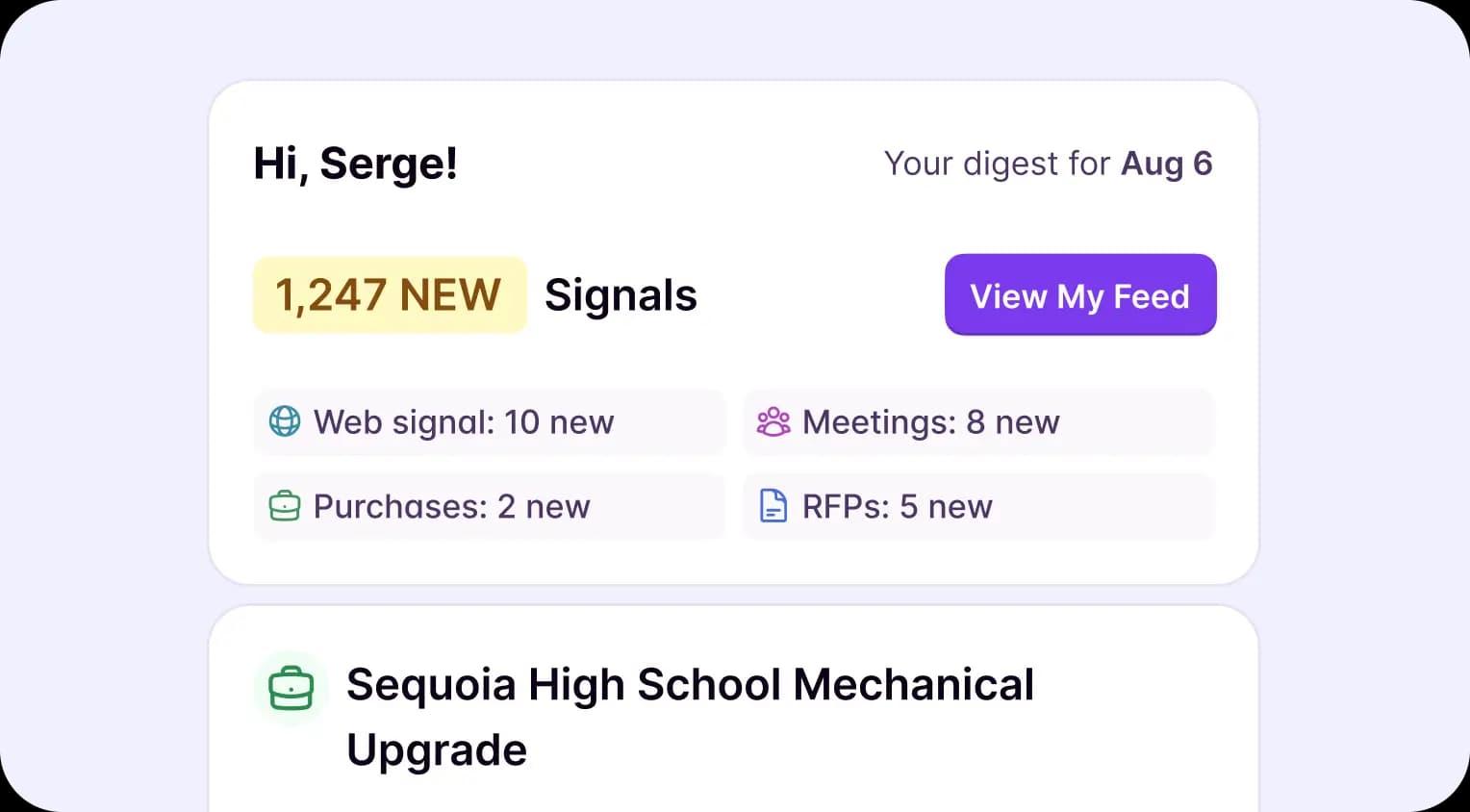
Zencity, for instance, sources 50% of its cold meetings from Starbridge. Reps pull city priorities from recent council meetings in seconds and walk into discovery calls already knowing procurement pathways and past contracts.
That is what public-record transparency is worth when a system reads it for you.
How Do SLED Agencies Buy?
The solicitation types
When a purchase exceeds an agency’s threshold for informal buying, it is issued as a formal solicitation. The three you will see most often are the RFP, used for complex purchases where evaluation goes beyond price; the RFQ, used when the buyer knows the specification and is comparing pricing; and the IFB, used for commodities where the lowest responsible bid wins. Technology and services purchases usually run through RFPs, which are the most time-consuming to respond to and the most heavily scored.
Below the threshold, agencies buy through informal quotes or purchasing cards, and those purchases move at commercial speed. Our complete guide to public sector procurement breaks down each solicitation type in detail.
Who scores your proposal
Evaluation committees score proposals against published criteria, typically technical fit, vendor experience, pricing, references, and implementation plan. The weighting is usually published in the solicitation itself, which means you can see exactly how you will be judged before you write a word. Vendors who mirror the solicitation’s language and structure consistently outscore vendors who submit their standard deck.
Can You Skip the RFP Process with Contract Vehicles?
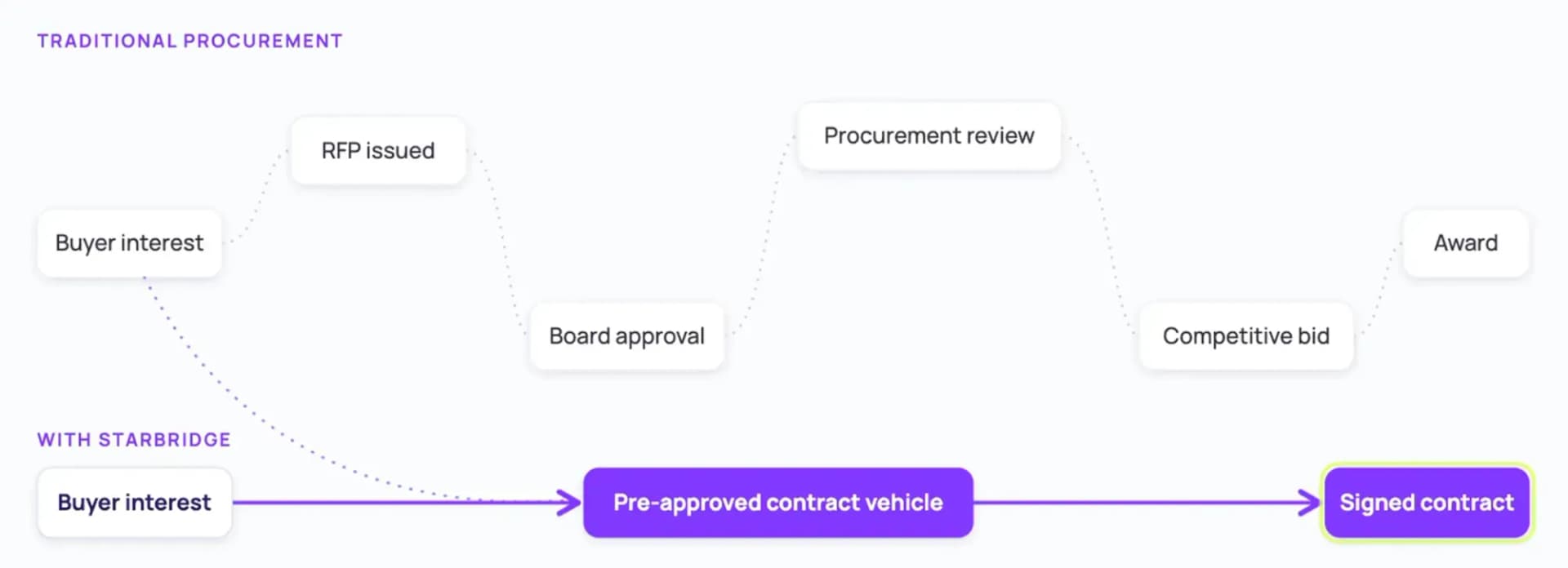
Often, yes. This is the most underused lever available to commercial teams entering the market, and it directly addresses the objection your CFO will raise about sales cycle length.
Cooperative purchasing agreements
A cooperative purchasing agreement allows an agency to buy from a contract that another jurisdiction has already competitively bid. Instead of running its own months-long solicitation, the buyer purchases directly from the existing contract. NASPO’s survey of state procurement practices found that every responding state uses cooperative contracts, and nearly 98 percent purchase from NASPO ValuePoint, alongside vehicles such as Sourcewell and OMNIA Partners.
Piggyback clauses extend the same idea across jurisdictions. If a Florida city awarded your contract through a competitive process, a Georgia city with a piggyback clause can buy from you without issuing its own solicitation. Our walkthrough on how to navigate procurement vehicles shows what this looks like inside a live deal.
Sole-source thresholds
Every jurisdiction sets a dollar amount below which it can buy from a single vendor without competitive bidding. Thresholds range from roughly $5,000 to $150,000, depending on the state, municipality, or district. Texas state agencies sit near $50,000, many California entities near $100,000, and K-12 districts often require board approval above $10,000.
The practical consequence is that pricing determines process. A $45,000 proposal might close in 30 days in one jurisdiction and trigger a full RFP in another, and triggering an RFP means months added to the sales cycle. Know the threshold before you price the deal.
Most commercial teams discover cooperative contracts late, usually after their first RFP response has dragged on for months. Knowing that vehicles exist is step one. Knowing which vehicle fits a specific buyer and a specific deal is the harder problem.
Starbridge recommends the right contract vehicle for each opportunity and provides cooperative vehicle access through its reseller partner Vertosoft, available as part of the platform. Deals that would otherwise trigger a solicitation can close on paper that was already competitively bid.
MGT, after deploying Starbridge, cut procurement research from 20 to 30 minutes down to 5 to 10 minutes per query, with results accurate enough that the team stopped double-checking them.
The fastest RFP to win is the one you never have to respond to.
Do Commercial Sales Tools Like ZoomInfo Work for SLED?
Your sequencer, your CRM, and your call-recording stack transfer fine. The data layer is what breaks.
Why commercial contact data goes stale in government and education
General B2B contact databases are built from commercial data flows, LinkedIn profiles, corporate email patterns, and job-change scraping. Those flows thinly cover the people who buy in this market. A district superintendent, a county IT director, or a university procurement officer often has no active LinkedIn presence, and their email addresses follow district-specific formats on .gov and .k12 domains that pattern inference gets wrong.
Churn makes it worse. MissionSquare Research Institute found 38 percent of retirement-eligible state and local employees accelerating their retirement plans, the highest rate since its survey began, and BLS data shows tens of thousands of state and local workers quitting every month. Records built on thin coverage decay fast, and reps feel it as contacts that just straight up bounce. Teams using general B2B databases on government and education lists typically see deliverability in the 60 to 70 percent range, and a one-in-five bounce rate is not a data inconvenience. It is a domain reputation risk for every campaign you send.
What purpose-built contact data looks like
ZoomInfo is traditionally used for commercial B2B prospecting, and in that market it is a category leader. The question is not whether the tool works. It is whether data built from commercial sources can cover buyers who barely appear in those sources. Our Starbridge vs. ZoomInfo comparison walks through the difference dimension by dimension.
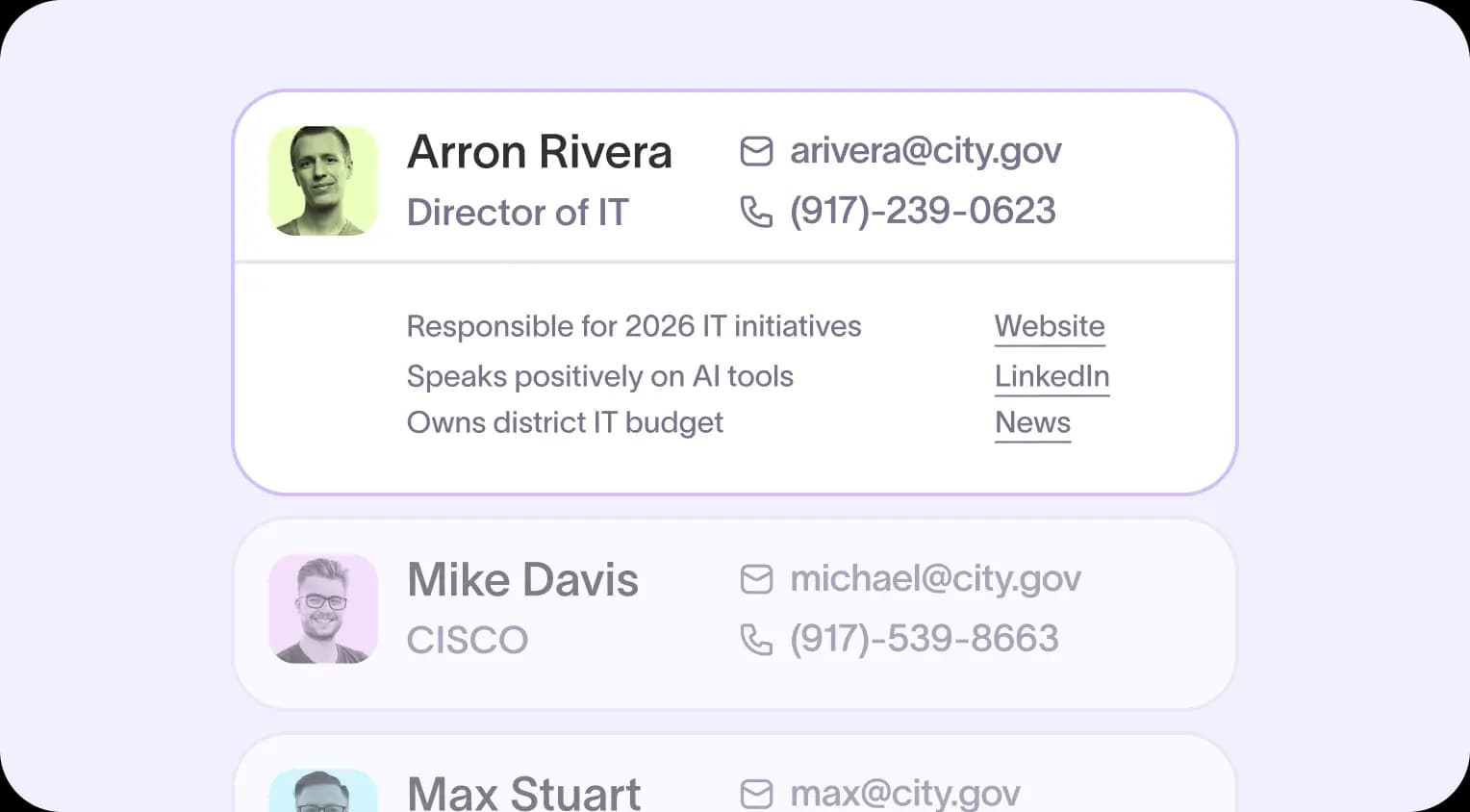
Purpose-built platforms source from the places these buyers actually appear, verified .gov domains, agency directories, board documents, and public records. That sourcing difference is why Starbridge reaches 98% email accuracy, measured across a 14,000-email test.
Starbridge’s Contacts & Company Data runs four levels of waterfall enrichment and bounce checking before a contact ever reaches your CRM, and keeps records current as people change roles.
TAM to Target describes Starbridge contact data as “literally 4 to 5 times more valid than any other source,” and their team stopped manually verifying records before running campaigns.
When the data layer matches the market, the rest of your commercial motion transfers better than you might expect.
Conclusion
SLED is not a niche. It is more than 90,000 governments, hundreds of thousands of buying entities, and more than $3 trillion a year in spending, all operating under procurement rules you can learn and fiscal calendars you can plan around. Three things separate the commercial teams that succeed here from the ones that stall. They engage accounts before the RFP, because by the time a solicitation is public, the relationship is usually set. They use contract vehicles to keep deals off the RFP path entirely. And they rebuild their data layer around sources that actually cover government and education buyers.
For the tactical playbook on running that motion, read our SLED sales strategy guide. If you want to see what your territory looks like through buying signals, contract data, and verified contacts, book a demo.
Frequently asked questions
SLED stands for State, Local, and Education. It refers to the more than 90,000 governments outside the federal system, including all 50 states, 3,031 counties, 19,491 municipalities, 16,214 townships, 39,555 special districts, 12,546 school districts, and public colleges and universities, plus their agencies, schools, and campuses, which push buying entities into the hundreds of thousands.
State and local governments account for about $3.4 trillion in annual final demand, according to the Bureau of Economic Analysis. Estimates of the vendor-addressable procurement market typically range from $1.5 to $2 trillion. Education is the largest spending category, with public K-12 schools alone spending $927 billion per year.
Federal buyers follow one procurement rulebook, the FAR, with centralized registration through SAM.gov. SLED buyers follow 50 different state procurement codes plus thousands of local ordinances, and each entity purchases independently. Federal sales reward compliance infrastructure. SLED sales reward references, regional momentum, and early relationships.
SLED purchases above certain dollar thresholds require formal, public solicitations scored by evaluation committees rather than a single decision-maker. Budgets follow fiscal years instead of quarters, so deal timing depends on the budget calendar. And buyer activity, including board minutes, budgets, and contracts, is public record.
Below dollar thresholds, agencies buy through informal quotes or purchasing cards. Above them, they issue formal solicitations, most commonly RFPs for complex purchases, RFQs for price comparisons, and IFBs for commodities. Many purchases also flow through cooperative contracts that were already competitively bid by another jurisdiction.
General B2B contact databases build from commercial data flows like LinkedIn profiles and corporate email patterns, which thinly cover government and education decision-makers, so teams typically see higher bounce rates on these buyers. Purpose-built platforms source from government records and agency directories, which is where the accuracy difference comes from.
Often, yes. Cooperative purchasing agreements like NASPO ValuePoint, Sourcewell, and OMNIA Partners let agencies buy from pre-competed contracts without issuing their own solicitation. Purchases below an agency’s sole-source threshold, which ranges from roughly $5,000 to $150,000 by jurisdiction, can also close without competitive bidding.
Explore our use case library
 Automate account research with AI agentsStop manually researching accounts. Starbridge AI agents automate account research by monitoring buying signals 24/7 and surfacing the right contacts.
 Identify competitor contract expiration datesThe RFP is usually a formality. Starbridge surfaces competitor contract expiration dates so your reps reach accounts before the renewal cycle closes.
 Create a conference campaignTurn conference badge scans into pipeline. Import your contact list, surface buying signals across every account you met, and follow up with context.