
Starbridge vs. NationGraph. Which platform builds more pipeline in government and education sales?
Starbridge vs. NationGraph: Which platform helps you close more government and education deals? Compare buying signals, contact data, RFP intelligence, and contract vehicle access.

If you sell to state and local government, K–12, and higher education, your shortlist for sales intelligence probably includes Starbridge and NationGraph. Both platforms promise pre-RFP buying signals, verified contacts, and faster paths to pipeline.
Starbridge and NationGraph take two different approaches to government and education sales. NationGraph structures fragmented public-sector data to surface buying signals ahead of the RFP. Starbridge is the AI sales intelligence platform that pairs buying signals with verified contact data, account scoring, and configurable outbound workflows, then carries the deal all the way to a signed contract.
This comparison breaks down the six areas vendors should evaluate when deciding between the two platforms. Here is a quick look before we go deep.
| Capability | Starbridge | NationGraph |
|---|---|---|
| Early buying signals | 320k+ entities monitored 24/7 across board meetings, budgets, grants, leadership changes, bids and more, routed to reps in a prioritized feed. Fully customizable signal scoring pushes the highest-intent buying signals automatically. | 110,000+ entities monitored. Includes buying signals sent via daily feed and email digest. |
| Contact and account enrichment | 98% accuracy of contact data gathered in real-time via proprietary web-agent technology. Starbridge offers free head-to-head contact data bakeoffs against NationGraph to prove data quality. Insights are easy to use: key contacts and insights are surfaced right where you browse with the Starbridge Chrome extension. | Best-fit, role-matched decision-makers, verified emails, and direct phone numbers mapped from 110,000 agencies. |
| Vendor spend intelligence | Get 77% of all purchase orders for state and local government, higher ed, and K-12 school districts out of the box. Starbridge also runs done-for-you FOIA campaigns that return full competitor contracts with annual revenue, sales proposals, opt-out clauses, and expiration dates. Starbridge offers free head-to-head PO data bakeoffs against NationGraph to prove data quality. | Managed FOIA requests within the platform that return parsed contract data. Additional FOIAs are done by request. |
| Contract vehicle access | Pre-approved access to every major contract vehicle, including NASPO ValuePoint, OMNIA Partners, Sourcewell, TIPS, and GSA, available as part of the platform. Starbridge handles compliance, paperwork, and renewals. | Contract vehicle access is not a stated capability as of July 2026. |
| Account scoring | Identify the accounts most likely to buy in a single prioritized view. Combine your CRM with real-time buying signals like competitor contract expirations, budget trends, leadership changes, and more. Custom Scoring allows you to define what matters to your business, and scores sync directly to CRM. | Ranked opportunity lists scored against requirements including signal strength, ICP fit, and budget-cycle timing. |
| RFP monitoring | Centralizes thousands of bid portals into a single AI-scored feed covering 320,000+ agencies. Every RFP is ranked by product fit, region, and win likelihood. Generate winning proposals with an AI-powered writer trained on your knowledge base. | Surfaces RFPs as part of its broader buying signal product, aggregating solicitations from state and local procurement portals. |
| CRM Integrations and MCP/APIs | Bi-directional sync with Salesforce and HubSpot for account matching and automatic CRM enrichment. Setup is fast, with a dedicated implementation team guiding every step. Enrichment data syncs automatically into the CRM records reps already work from. | CRM integration was recently launched. |
| Enterprise readiness and security | SOC 2 Type II certified, with a trust center for security and compliance documentation and usage dashboards that give managers visibility into rep adoption and coaching opportunities. | As of June 2026, NationGraph doesn’t currently publish or publicly advertise a SOC 2 Type II security certification. |
Spotting early buying opportunities from data sources
A government buying signal is an early indicator that an organization is planning to spend. If you can observe those buying signals, your team can engage months before the competition.
Starbridge monitors 320k+ buying signal sources
Starbridge’s Buying Signal Monitor tracks 320k+ government and education entities around the clock. It indexes data like:
- Board meeting minutes
- Contract expirations
- Grants
- Budget data
- Job postings
- News alerts
- Bids
Buying signal alerts all arrive with a verified contact and a reason for outreach. The underlying AI-native vector database understands context, not just keywords. It can surface, for example, a district discussing “budget shortfalls” even when those exact words never appear in the document.
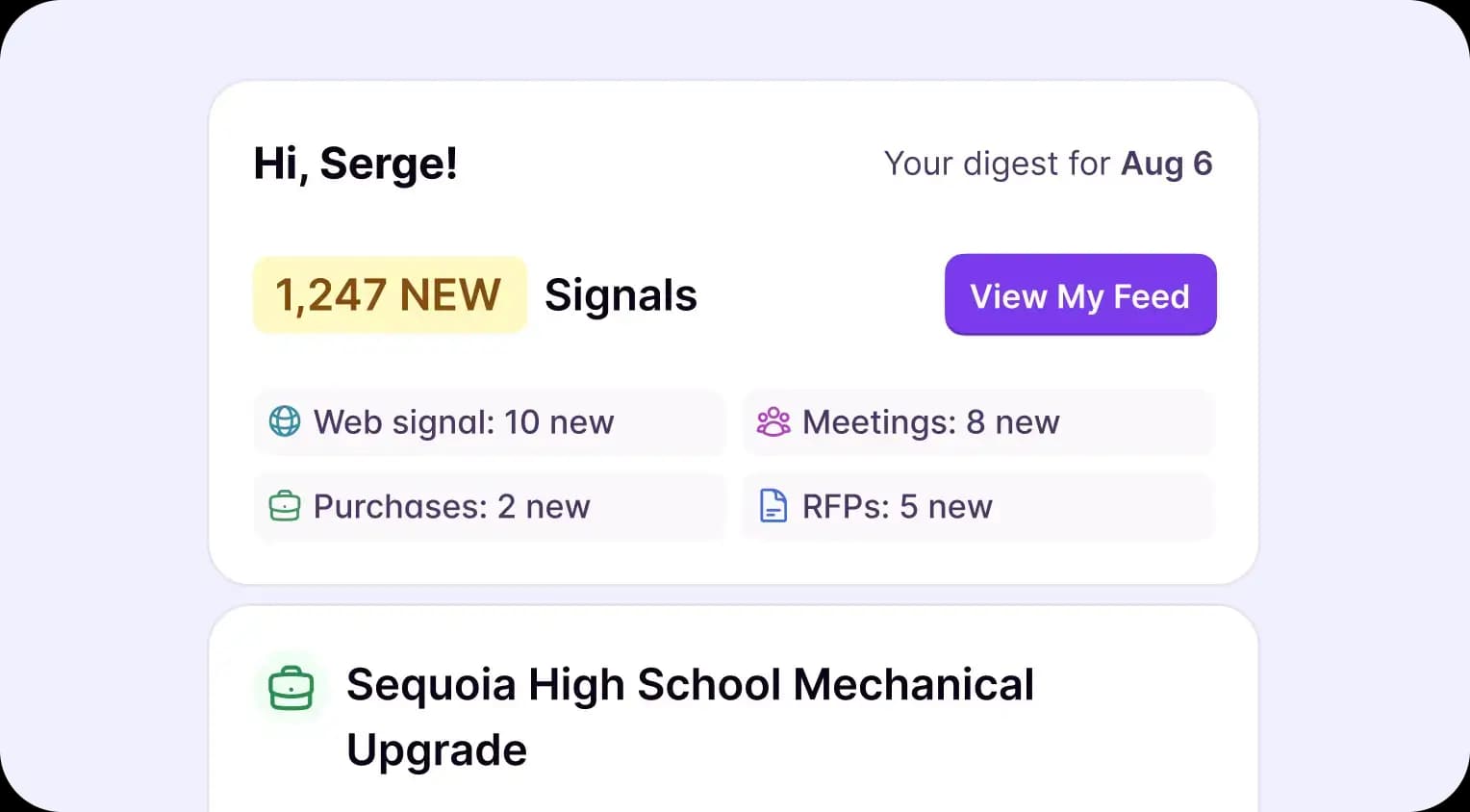
Early signal detection translates directly into closed deals. GovWell’s team booked five meetings from Starbridge buying signals in its first week, and today sources 15% of its total qualified pipeline from the platform. Overall, teams using Starbridge book more meetings compared to their prior outbound motion.
NationGraph surfaces buying signals from board meetings, budgets, and contracts
NationGraph monitors over 110,000 state and local government and education institutions. Their AI reads documents, meeting minutes, and contracts to surface buying signals, including:
- Budget approvals
- Board meeting discussions
- Grant awards
- Expiring contracts
- RFPs
Delivery follows a daily feed format with email digests and Slack integration. Ranked opportunity lists scored against custom requirements help teams prioritize which buying signals to act on first.
The bottom line
Both platforms surface pre-RFP buying signals from government data sources. Starbridge covers a significantly larger entity footprint, monitoring 320k+ entities to NationGraph’s 110k. This difference matters most for teams covering large or multi-state territories where comprehensive signal coverage directly affects how many deals your team can close.
Contact and account enrichment that stays current
Contact enrichment for B2G sales is fundamentally different from that in commercial B2B. Decision-makers rarely maintain active LinkedIn profiles, and titles turn over with election cycles, budget years, and school board appointments. In a finite market where reputation travels fast, a single outreach to a departed superintendent or a misidentified IT director damages credibility in a way that takes months to repair.
Starbridge delivers 98% email accuracy through proprietary web-agent technology and waterfall enrichment
Starbridge’s Contacts & Company Data sources contacts from official government and school websites, including department portals, staff directories, board minutes, and procurement filings. The platform uses proprietary web-agent technology to continuously crawl these sources rather than relying on LinkedIn scraping or third-party aggregators.
Every contact then passes through waterfall enrichment across multiple providers. Continuous bounce-checking flags and refreshes stale records before they ever reach a rep’s inbox. The result is 98% email accuracy validated across a 14,000-email test, with a 2% bounce rate compared to the 15 to 25% typical of general B2B databases.
Beyond raw contact data, the platform handles accuracy by tracking leadership changes and job moves as buying signals. A new key stakeholder hire can trigger an evaluation window, giving reps a head start on outreach while the new leader is still assessing their technology stack.
Once the right contacts are identified, dynamic account scoring layers contact quality with buying intent to prioritize where reps should focus. AI-generated positioning briefs connect product features to real buyer pain so reps walk into conversations with context, not just contact information. Bi-directional native integrations with Salesforce and HubSpot sync, clean, and enrich CRM data automatically, keeping the entire revenue team working from the same source of truth.
TAM to Target reports that Starbridge contact data is 3 to 4x more valid than any other provider they have worked with. Their clients consistently book more meetings after adopting the platform.
NationGraph offers contacts with role-matched decision-makers across 110,000 institutions
NationGraph provides access to over 2M contacts across 110,000 agencies, with role-matched decision-makers, verified emails, and direct phone numbers. Their marketing page describes a “zero bounce validation” process and highlights instant list creation, with the ability to generate 100+ contacts in under five seconds.
Contacts are re-verified on a rolling basis via large-scale web scraping and agentic web search, so that records update when roles change. The contact data integrates directly with their buying signal product so reps can move from a buying trigger to a contact list within the same workflow.
NationGraph’s approach appears well-suited for teams working a defined territory. Prospects evaluating both platforms may find that the accuracy gap becomes most apparent at scale, where web scraping can cause errors or gaps.
The bottom line
Both platforms invest in contact accuracy for a market where generic B2B databases consistently fall short. However, multiple teams that previously used NationGraph have cited the accuracy gap as their primary reason for switching to Starbridge. While NationGraph is known for structuring fragmented data, Starbridge pairs that data with effective GTM actionables, so enrichment feeds directly into rep action.
Understanding vendor spend across government and education
Knowing that a competitor has a contract with a school district is useful. Knowing the exact details allows reps to time outreach around renewal windows and walk into discovery calls with specific, relevant positioning. Vendor spend intelligence transforms account prioritization from guesswork into a data-driven motion.
Starbridge runs FOIA automation at scale with contextualized spend intelligence
Starbridge’s Public Spend Intelligence goes beyond surface-level purchase order data. The platform runs FOIA campaigns at scale on behalf of customers, surfacing full competitor contracts with:
- Annual revenue
- Complete sales proposals
- Opt-out clauses
- Implementation fees
- Expiration dates
- Revenue breakdown by product
This level of detail would otherwise take months of manual FOIA requests to assemble.
Contract intelligence also feeds directly into account scoring, so accounts with expiring competitor contracts are automatically prioritized alongside other buying signals.
After adopting Starbridge, the revenue intelligence team at Frontline Education reported a 90% reduction in research time. What previously took two hours per account now takes five minutes, and reps enter discovery calls already knowing what a prospect is paying a competitor and how to position against it.
NationGraph offers FOIA requests with parsed contract data
NationGraph includes FOIA capabilities within its platform, offering one-click FOIA requests that return parsed contract data pushed directly into sales systems. Their “Contract and FOIA Intelligence” automation tracks filings and surfaces purchase order data and historical spending patterns.
NationGraph also offers the ability to identify the incumbent vendor, the contract price, and the renewal window. For teams whose primary use case is understanding who holds the current contract, this level of visibility provides a workable foundation for competitive positioning.
The bottom line
FOIA-sourced competitive intelligence is available on both sides of this comparison, but the depth of contract detail may differ between platforms. Starbridge surfaces complete, unredacted vendor proposals and treats spend data as an input to the broader sales motion rather than a standalone research output, so reps move from insight to action without assembling the picture themselves.
Closing deals through contract vehicles
Surfacing the opportunity and winning the evaluation still leaves procurement between your team and revenue. Above a buyer's sole-source threshold, the purchase either rides an existing cooperative contract or triggers a full competitive solicitation, and a new solicitation can add months to the sales cycle. Vendors who can transact through vehicles like NASPO ValuePoint, OMNIA Partners, or Sourcewell give buyers a faster path to purchase.
Starbridge provides pre-approved access to every major contract vehicle
Starbridge doesn't stop once the opportunity is sourced. When a buyer is ready to move, Starbridge offers pre-approved access to every major contract vehicle, including NASPO ValuePoint, OMNIA Partners, Sourcewell, TIPS, and GSA. Deals close through a purchasing pathway the buyer already trusts, and Starbridge manages the compliance, paperwork, and renewals.
One onboarding covers the major vehicles, so there are no per-vehicle applications to manage. Traditional resellers often reserve their attention for six-figure deals before they engage; Starbridge makes contract vehicle access available as part of the platform, with no minimum deal size.
The platform also shows the exact contract vehicle each buyer uses to purchase, so reps can route every opportunity down the fastest compliant path from first signal to signed contract.
NationGraph focuses on the intelligence side of the deal
NationGraph's contract and FOIA intelligence can show which contracts an agency holds and when they expire, which is useful context for timing outreach. Surfacing that intelligence and giving the buyer a compliant way to purchase are two different jobs. As of July 2026, contract vehicle sell-through is not a stated capability on NationGraph's site.
Starbridge covers the transaction itself, getting your product transactable on vehicles like NASPO ValuePoint, OMNIA Partners, Sourcewell, and TIPS, so the buyer who already picked you doesn't have to run a solicitation to pay you.
The bottom line
NationGraph can tell you when a contract window opens. Starbridge opens the purchasing path itself, with pre-approved contract vehicle access available as part of the platform and each buyer's preferred purchasing channel surfaced in the account.
Finding RFPs before the field is set
If your team only finds RFPs after they are published, the deal may already be decided. In government and education procurement, the vendor who engaged the buying committee months before the solicitation went live helped shape the evaluation criteria and built the relationships that determine the shortlist. The sales intelligence platform you use should surface them early enough and score them well enough that your team pursues the right opportunities.
Starbridge provides an AI-scored RFP feed across 320,000+ agencies
Starbridge’s AI RFP Finder centralizes thousands of state, local, education, and university bid portals into a single personalized feed covering more than 320,000 agencies. Every RFP is scored by product fit, region, and win likelihood so reps focus their time on opportunities they can actually win rather than manually scanning dozens of portals.
The platform also flags RFPs that already name an incumbent competitor, giving reps critical context about the competitive landscape before they decide whether to pursue. Additionally, when a current customer posts an RFP in your product category, Starbridge flags it as a potential renewal risk, prompting a proactive retention conversation rather than a reactive scramble.
National Sign Plazas tripled its pipeline in six months with Starbridge, cutting account research from over an hour to five minutes per municipality. Their government sales rep now surfaces relevant opportunities directly from city council sessions and departmental meetings, reaching cities before the need ever becomes a formal bid.
NationGraph surfaces RFPs through buying signal monitoring and procurement aggregation
NationGraph surfaces RFPs as part of its broader buying signal product, aggregating solicitations from state and local procurement portals alongside other buying triggers. The platform tracks historical RFPs with AI categorization to match opportunities to a vendor’s solution area.
This discovery-focused approach serves teams that need a centralized feed of relevant solicitations without managing individual portal logins. NationGraph’s strength in this area is the integration between RFP discovery and their buying signal monitoring, so teams can see an RFP alongside the account context and contact data they have already gathered.
The bottom line
Both platforms centralize RFP discovery so teams aren’t logging into dozens of portals. The difference is in how each platform helps you decide which RFPs are worth pursuing. Starbridge covers a broader set of agencies, scores every opportunity by product fit and win likelihood, and flags incumbent competitors and renewal risks so reps have full competitive context before they commit resources to a response.
GTM workflows that turn intelligence into action
Surfacing buying signals and contacts is only half the problem. The other half is what happens next. Whether a rep needs to act on a buying signal, reach out to a new decision-maker, or respond to an RFP, the speed and quality of that action determines whether intelligence becomes closed deals or stays in a dashboard.
Starbridge connects signals to action with configurable workflows
Starbridge is built around configurable workflows that connect every buying signal, contact, and account score to a specific next step.
When an RFP is worth pursuing, Starbridge’s AI Proposal Writer generates tailored proposal drafts trained on your organization’s data, so responses reflect your actual capabilities and positioning rather than starting from a blank page. A compliance matrix automatically maps every RFP requirement, ensuring nothing gets missed. Teams can then comment, tag teammates, and refine proposals together in real time, cutting the cycle from discovery to submission significantly.
Thanks to the Proposal Writer, the HousingCloud team has gained 8-10 hours back per RFP.
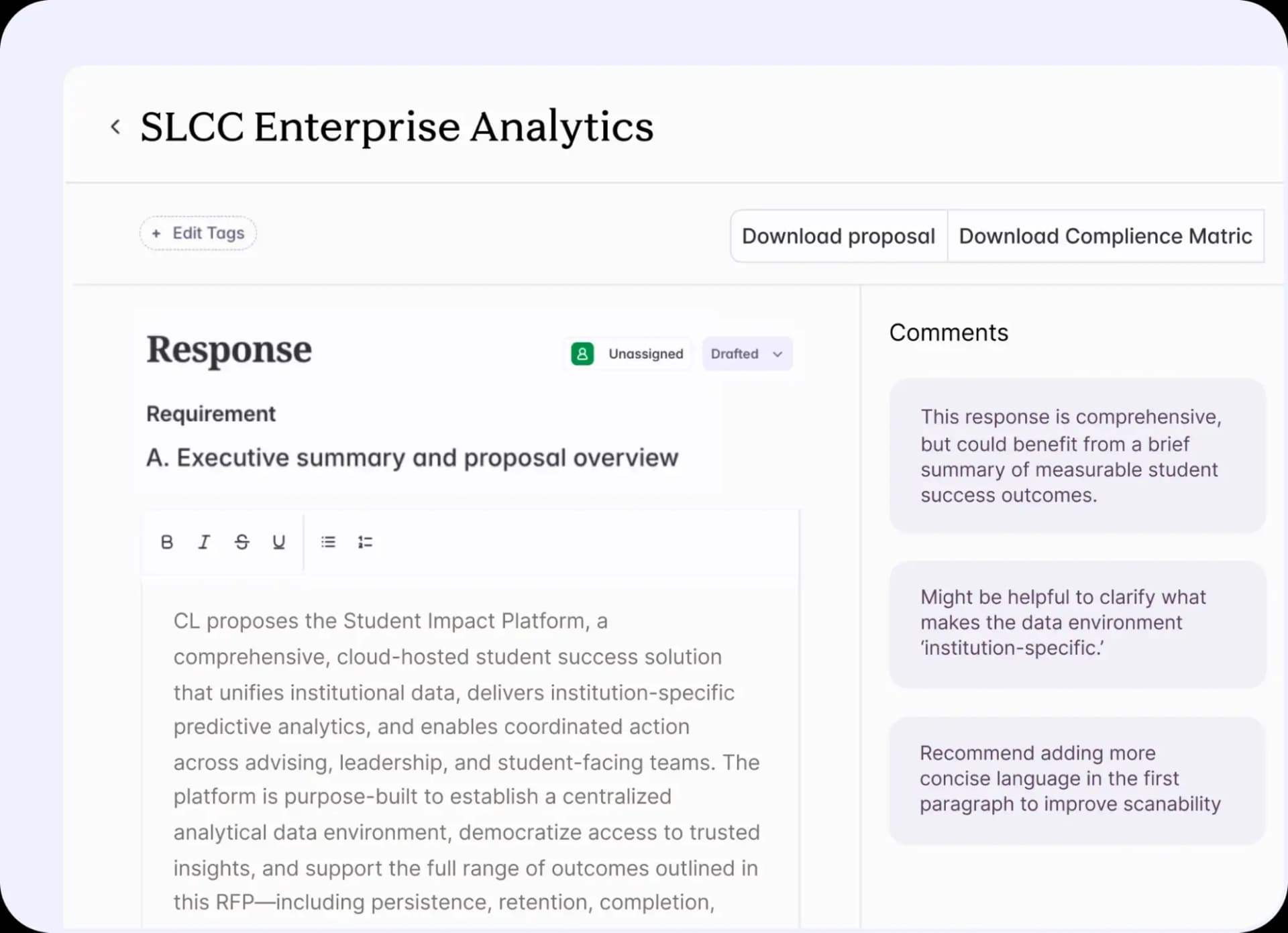
Signal-to-action logic extends across the rest of the outbound motion too. Starbridge’s Search Agents continuously scan the web for opportunities matching your buyer profile, and AI-generated outreach is personalized with account context, so every touch references what the buyer is actually planning rather than a generic template.
NationGraph provides suggested messaging and recently launched CRM integration
NationGraph pairs its buying signal product with an automation suite that generates suggested messaging tailored to buying signals, budget data, and competitive intelligence. Reps can create email and call scripts within the platform and export them into their outreach tools.
CRM integration with Salesforce and HubSpot is available, though it was formally launched recently and has limited production validation to date. NationGraph also delivers buying signals via Slack, email digests, and CSV/API export, giving teams multiple channels to receive alerts even if the CRM integration is still being adopted.
The bottom line
NationGraph structures fragmented public-sector data to surface buying signals, and it does help teams translate a buying signal into a relevant first touch. Starbridge connects intelligence to execution across the full GTM motion, from configurable signal-to-action workflows to native CRM sync that keeps every rep working from the same enriched dataset. With these workflows automated, sales teams can spend less time wrestling with outreach and more time closing deals.
Which platform helps you close more deals?
For GTM leaders who want end-to-end workflows in a single tool, this comparison points to Starbridge.
- Signals reach reps automatically through multiple unified channels, so no opportunity sits waiting to be found.
- Every signal is paired with 98% verified contact data through AI-powered web agents and continuous enrichment.
- Teams can find and score RFPs, draft proposals with a native AI writer, close deals through pre-approved contract vehicle access, and see full competitor contracts down to pricing and expiration dates.
- SOC 2 Type II certification, a trust center, and manager-level usage dashboards give IT, security, and GTM leaders what they need to clear review and keep reps accountable.
- All of it flows through bi-directional CRM integrations proven in production.
NationGraph delivers on its core promises, and customer testimonials on their website reflect real outcomes for teams that have adopted it. Their platform may be the right fit for teams with a focused territory, a straightforward outbound motion, and a smaller budget. It primarily serves SMBs today, which makes it a reasonable starting point for smaller startups testing a government and education motion.
Starbridge is built for teams at every stage of that journey, from early-stage startups to global enterprises like McGraw-Hill, ClearGov, and Airtable. The premium contact data quality comes at a higher price because it reflects the depth of infrastructure required to scale a government and education revenue motion.
Book a demo to see how over 600 GTM teams are running an intelligent, integrated government and education sales motion with Starbridge.
Frequently asked questions
Explore our use case library
 Automate account research with AI agentsStop manually researching accounts. Starbridge AI agents automate account research by monitoring buying signals 24/7 and surfacing the right contacts.
 Identify competitor contract expiration datesThe RFP is usually a formality. Starbridge surfaces competitor contract expiration dates so your reps reach accounts before the renewal cycle closes.
 Create a conference campaignTurn conference badge scans into pipeline. Import your contact list, surface buying signals across every account you met, and follow up with context.