
4 RFP SchoolWatch alternatives for government and education sales intelligence in 2026
Looking for RFP SchoolWatch alternatives built for government and education sales? Compare four platforms across buying signals, contact data, spend intelligence, and RFPs.

This guide compares four RFP SchoolWatch alternatives, Starbridge, GovSpend, ZoomInfo, and MDR, across the five capability areas that drive pipeline in government and education. The comparison table below shows how each one approaches these areas at a glance:
| Platform | Identifying opportunities before RFPs | Contact & account data quality | Vendor spend visibility | RFP discovery & response | Contract vehicle access |
|---|---|---|---|---|---|
| Starbridge | Monitors board minutes, budgets, grants, leadership changes, and more across 320k+ entities | Verified .gov and .edu contacts at 98% email accuracy and a 2% bounce rate | Full competitor contracts, pricing, and expiration dates through FOIA automation | Scored feed of thousands of bid portals with AI proposal drafting | Shorten sales cycles with contract vehicle access (i.e. NASPO, OMNIA, Sourcewell) with compliance handled. Free to start. |
| GovSpend | AI Opportunities module ranks bids, expiring contracts, and meeting signals | Contact data with native Salesforce and HubSpot sync | A comprehensive historical purchase order library | Bid alerts, with proposal drafting through a third-party provider | Contract vehicle access is not part of the offering as of July 2026. |
| ZoomInfo | Commercial buying-intent signals from web behavior | One of the largest B2B contact databases | Commercial firmographic and financial data | Sales engagement and enrichment workflows | Contract vehicle access is not part of the offering as of July 2026. |
| MDR | K–12 educator audience segments | Proprietary K–12 educator database, filterable by role and geography | Audience and campaign performance data | Multi-channel campaign execution | Contract vehicle access is not part of the offering as of July 2026. |
What to look for in a government and education sales intelligence tool
Five capabilities separate a tool that generates pipeline in this market from one that leaves reps doing manual work.
- Identifying opportunities before they go to RFP. Board minutes, budget releases, grants, leadership changes, and contract expirations produce buying signals months before a formal solicitation. Teams that monitor these sources engage while they still have time to shape requirements.
- Contact and account data quality. The underlying data source decides whether outreach reaches the right person. Decision-makers in state and local government, K–12, and higher education rarely maintain LinkedIn profiles, so platforms that draw heavily from LinkedIn and commercial sources have a hard time keeping these records fresh. Databases built on those sources typically deliver bounce rates of 15 to 25% on unfiltered exports.
- Visibility into what agencies and institutions are already buying. Knowing the incumbent vendor, the contract value, and the expiration date changes how a rep positions in a discovery call. Government buyers consult vendors early to learn what is possible, so a rep who walks in already understanding the current contract can shape the next one instead of reacting to it.
- Finding and responding to RFPs efficiently. A centralized, scored RFP feed saves hours of portal-hopping and keeps reps focused on winnable bids. AI-assisted proposal drafting compresses response time from days to hours.
- Contract vehicle access that removes procurement friction. A contract vehicle is a pre-negotiated purchasing agreement an agency can buy through without running a fresh solicitation. Access to the vehicle a buyer already uses lets a vendor skip a full RFP and move a won deal onto a signed purchase order.
These five capabilities work as one motion that carries a deal from an early buying signal through outreach and procurement to a signed contract. None of the capabilities outweighs the others, because a gap at any stage stalls the deal.
The platforms in this guide diverge in how much of that motion they cover in its totality. A tool that covers only one or two areas leaves reps to stitch the rest together manually across research, enrichment, outreach, and procurement.
1. Starbridge
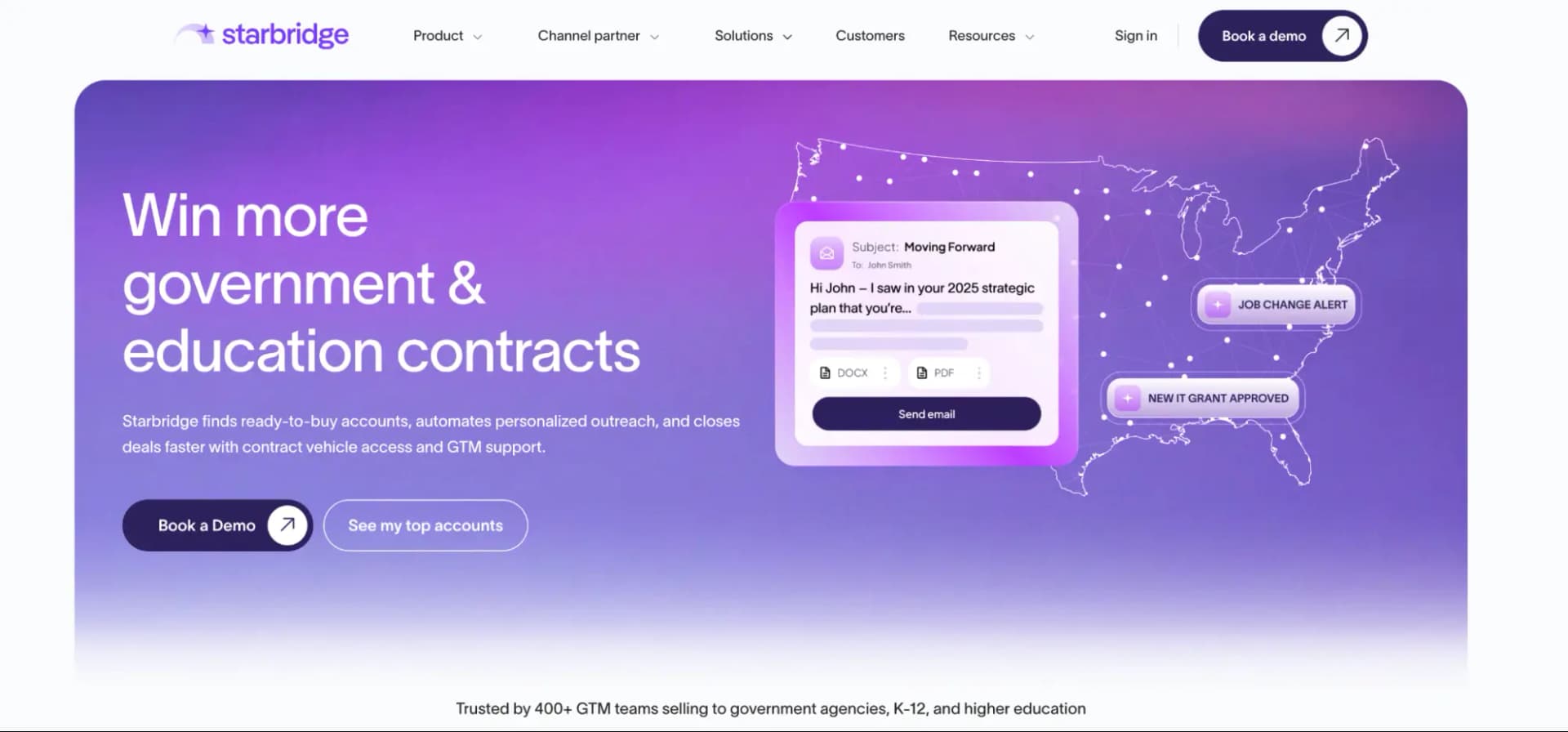
Starbridge is the AI sales intelligence platform built exclusively for companies selling to state and local government, K–12, and higher education, trusted by more than 500 GTM teams. Starbridge surfaces buying intent before competitors know an opportunity exists, then connects that intelligence directly to rep workflows in Salesforce, HubSpot, Apollo, and Outreach. That pairing of early signals and connected execution is why Starbridge leads this list.
What Starbridge does well
Starbridge is built around five capabilities that cover the full government and education sales workflow.
The first is the Buying Signal Monitor, which addresses the pre-RFP timing problem directly. It tracks board meeting minutes, budget releases, grants, leadership changes, and contract expirations across 320k+ entities, with bids surfaced last. Every signal arrives with a verified contact, the reason the timing is right, and AI-drafted outreach copy delivered into the tools reps already use. GovWellnow sources 15% of its total qualified pipeline from Starbridge buying signals, turning early intent into a repeatable channel.
Signals only convert when outreach reaches a real person, which is where Starbridge’s Contacts & Company Data comes in. Its proprietary web-agent technology crawls verified .gov and .edu domains, agency directories, and board minutes, then applies waterfall enrichment and continuous bounce-checking. The result is 98% email accuracy, validated across a 14,000-email test, with a 2% bounce rate. Bi-directional Salesforce and HubSpot integrations sync, clean, and enrich records automatically.
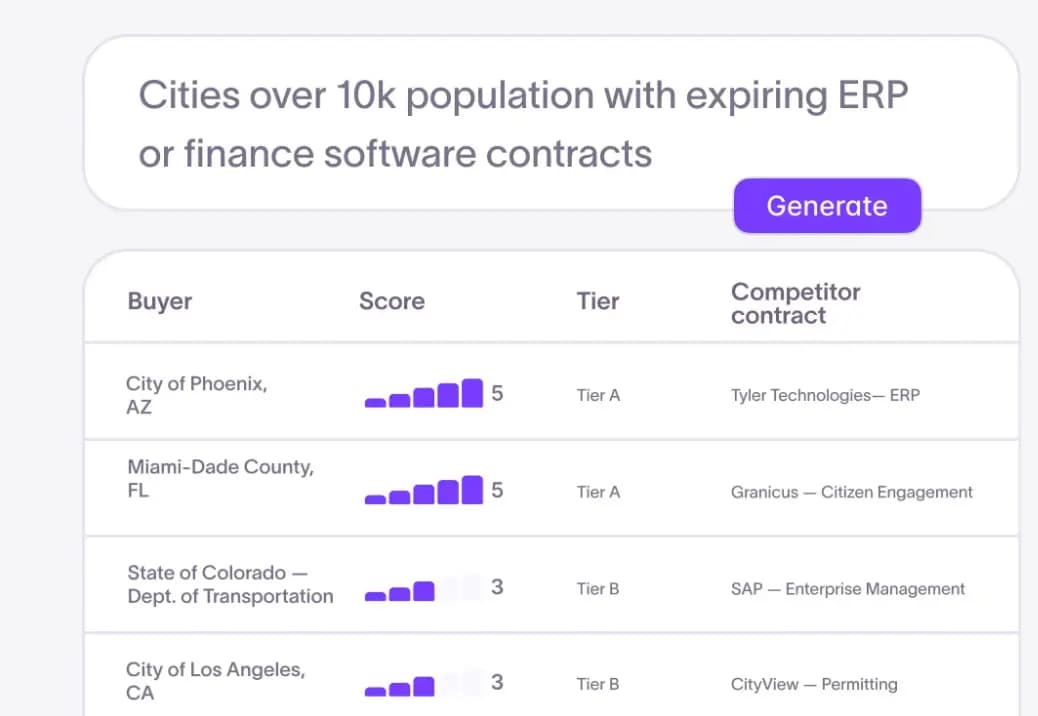
Verified contacts get more valuable when reps know what an account already buys, which is the job of Public Spend Intelligence. Starbridge uses FOIA automation at scale to surface full competitor contracts, including pricing, opt-out clauses, and expiration dates, rather than bare line items. Out of the box, Starbridge holds purchase order data for 77% of state and local government, K–12, and higher education institutions. Manual public records requests once consumed a rep’s week. After replacing them with this capability, Frontline Education cut research time by 90%, from about two hours per account to five minutes.
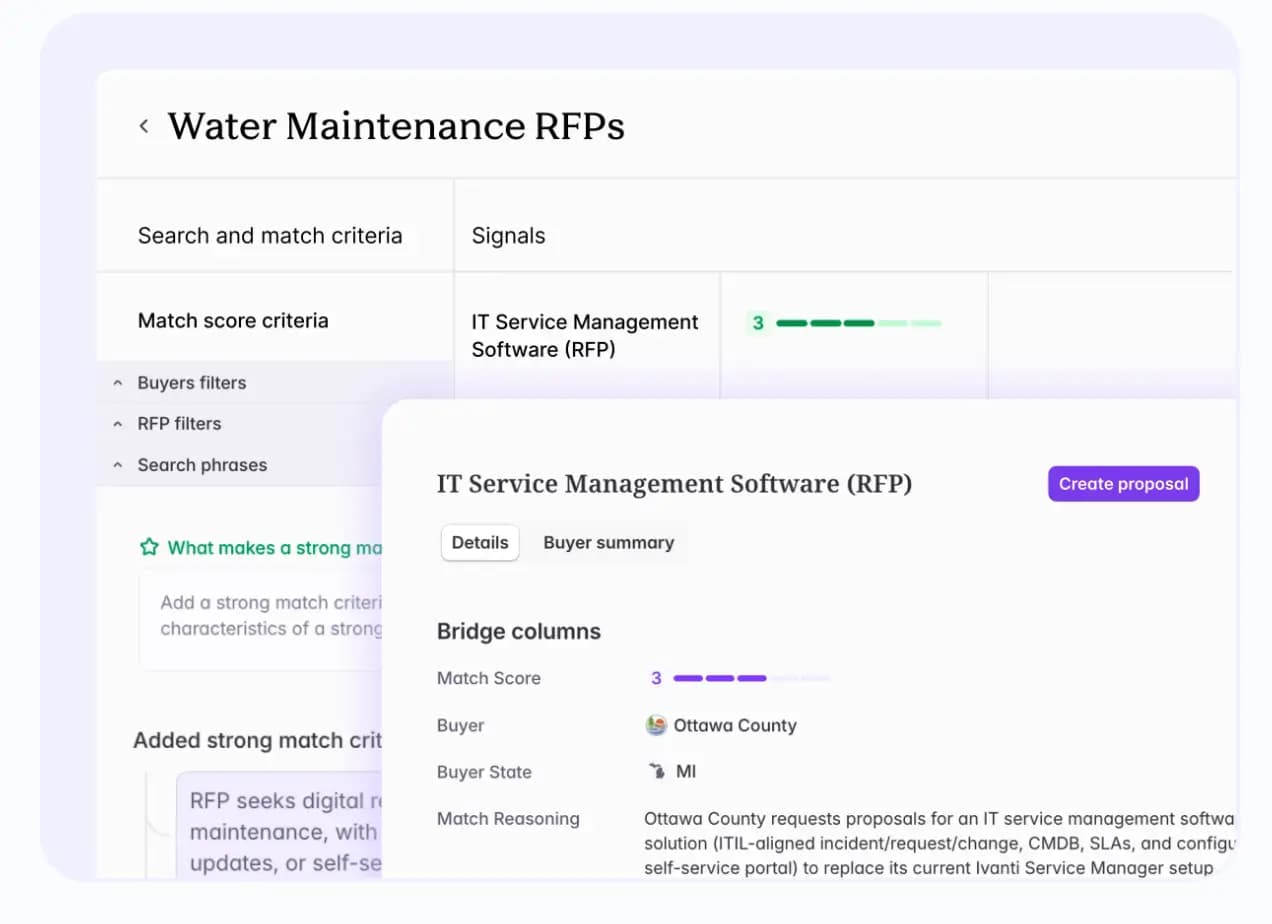
Once an opportunity reaches a formal solicitation, Starbridge’s AI RFP Finder & Proposal Writer centralizes thousands of bid portals into one personalized feed. Starbridge scores each RFP by product fit, region, and win likelihood, and flags any that name a competitor. The AI proposal writer then drafts responses from the team’s knowledge base, with a compliance matrix builder and collaboration mode for final refinement.
The fifth capability, Contract Vehicle & Reseller Access, is another Starbridge feature that carries a won deal across the finish line. Starbridge provides this access directly and handles the compliance, paperwork, and renewals. Teams onboard once across NASPO ValuePoint, OMNIA Partners, Sourcewell, TIPS, and others, then move a won opportunity to a signed purchase order without triggering a full RFP.
Where Starbridge falls short
Starbridge is strongest for state and local government and education, and its federal sales intelligence is comparatively limited. Teams whose pipeline is primarily federal will find less depth here than in the state, local, and education markets.
The RFP proposal writer is lightweight. It speeds up drafting, but it will not replace a dedicated RFP hire on a team that responds to complex solicitations at high volume.
Starbridge also comes with premium pricing, which makes it a better fit for enterprise sales teams than early-stage companies. Contact data accuracy and the breadth of buying signals come at a higher price point, so buyers are paying for the quality rather than the cheapest option in the market.
Best for
Starbridge fits enterprise revenue teams running outbound into state and local government, K-12, and higher education who want one platform that carries them from an early buying indicator to a booked meeting to a signed purchase order. It suits teams that treat this market as a core motion and need verified contacts, competitive spend context, and CRM workflows in a single system.
2. GovSpend
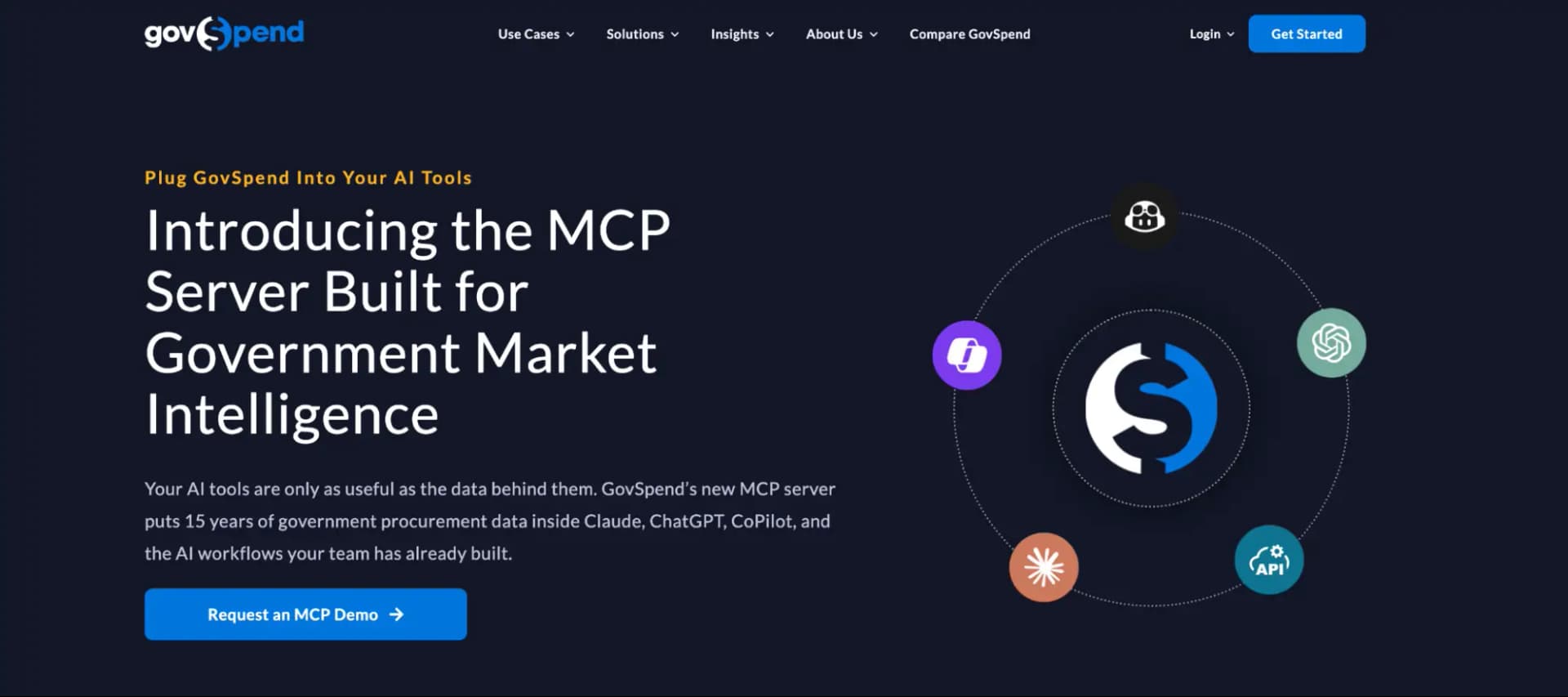
GovSpend is a procurement intelligence platform owned by Thompson Street Capital Partners. It runs on historical purchase order data spanning state and local government and federal markets, and it serves vendors, agencies, and consultants who need visibility into government purchasing.
What GovSpend does well
GovSpend’s core feature is its comprehensive library of line-item purchase order data. Companies can see what an agency bought, from which vendor, and at what price. Contract records that include end dates and award details support recompete identification and incumbent research.
The Opportunities module builds a profile of the user’s business and ranks bids, expiring contracts, competitor activity, and meeting signals drawn from GovSpend data and the public web. AI Search and AI Chat handle queries and generate opportunity briefs and lead lists across the platform’s modules.
Searchable meeting transcripts let teams track budget and technology discussions across agencies, while bid alerts notify teams when new or updated solicitations match their criteria. Combined with spend data, this gives vendors a multi-angle view of agency activity from early discussion through purchase.
Where GovSpend falls short
Some GovSpend users point to how late opportunities reach them. One G2 reviewer notedthat bids overlap with other services and that “it’s usually a delay in days that it has already been posted for that we will get the email about it.” A vendor who first learns about a solicitation after it publishes has less room to influence the requirements.
Other users point to data freshness. As one G2 reviewer put it, “sometimes data is missing or not entered correctly or is out of date.”
Broad keyword monitoring can also surface high volumes of results that need manual filtering. Another G2 reviewer noted that monitoring for widely relevant keywords “can result in false positive reports of potential response opportunities.”
The search quality and data freshness issues that current users surface both relate to the fact that Govspend’s value comes from a historical record of what agencies have already bought. Once an alert surfaces an opportunity, every competitor running that search sees it at the same time.
Knowing what an agency bought through a contract vehicle isn’t the same as being on one. GovSpend gives you the spend and contract records. Getting onboarded to a cooperative contract vehicle like Sourcewell, OMNIA Partners, or TIPS, which is what lets a ready buyer purchase without a full solicitation, happens somewhere else as of July 2026.
Best for
GovSpend is best for teams whose primary motion is procurement research, historical spend analysis, and bid monitoring in the state and local government market, and who want an established platform with deep purchase order data.
3. ZoomInfo
ZoomInfo is a horizontal B2B sales intelligence platform serving commercial revenue teams. It maintains one of the largest B2B contact databases available, layered with commercial intent data, conversation intelligence, and workflow automation. Many teams start with ZoomInfo and later look for deeper capabilities as government and education become a larger part of their pipeline.
What ZoomInfo does well
ZoomInfo offers broad coverage across commercial accounts, with firmographics and technographics that suit enterprise teams prospecting corporate accounts at volume.
Its commercial buying-intent signals draw on web behavior, and the platform pairs them with conversation intelligence, sales engagement, and data orchestration. Together, these support a full commercial go-to-market motion from first touch through closed business.
ZoomInfo also offers well-established CRM integrations and enrichment workflows that reps configure quickly. Intent and web insights feed directly into targeted outreach.
Where ZoomInfo falls short
As of July 2026, ZoomInfo models buying intent on commercial web behavior, such as content consumption and site visits. The signals that matter in government and education surface in board minutes, budgets, grants, and contract expirations, which sit outside commercial web activity.
Contact coverage for government and education roles is a different challenge than commercial coverage. Platforms that draw partly from LinkedIn and commercial sources have a hard time keeping these records fresh, because superintendents, procurement directors, and agency department heads rarely maintain a public profile. Contact databases built on those sources tend to accumulate stale records between refreshes. One G2 reviewer described “too many non working emails” and finding “contacts attached to the wrong company or duplicate companies.”
ZoomInfo also holds a GSA listing and FedRAMP authorization, which positions the company itself to be purchased by government buyers. That’s a different posture from handing a customer a pathway to sell into agencies through a contract vehicle, which, as of July 2026, ZoomInfo doesn’t.
Best for
ZoomInfo is best for teams whose pipeline is mostly commercial B2B, where its database breadth, intent data, and automation genuinely shine.
4. MDR Education
MDR is the K–12 education marketing division of Dun & Bradstreet, founded in 1969. It pairs a large proprietary educator database with full-service campaign execution through its ConnectED Cloud platform and the We Are Teachers media brand. MDR serves education marketers who license audience data and run campaigns to teachers, administrators, and district decision-makers.
What MDR does well
MDR maintains a large proprietary educator database spanning teachers, administrators, and district leaders across K–12 and higher education. Records are filterable by role, grade level, subject, and geography, and MDR updates them continuously through the school year.
As a full-service education marketing agency, MDR delivers strategy, audience building, and multi-channel campaign execution across email, display, social, and direct mail. Its staff brings education-market expertise and knowledge of the sector’s buying cycles.
The We Are Teachers media brand gives MDR a direct channel to educators through sponsored content and product-review programs, along with classroom-level reach that sales-focused databases rarely prioritize. Audience data can sync to CRM and marketing stacks such as Salesforce, HubSpot, and Marketo.
Where MDR falls short
MDR’s data and services partially focus on educator audience targeting and campaign execution rather than account-level buying indicators. Teams that need to know which districts are actively budgeting for a purchase rely on a separate source of buying intent.
Coverage centers on K–12 and, to a lesser extent, higher education. Cities, counties, and state agencies fall outside MDR’s primary coverage area.
MDR data is delivered as a licensed marketing audience with a batch refresh roughly every two weeks during the school year. An individual staffing change can therefore sit for up to about fifteen days before the next refresh, which matters most for districts with active hiring or turnover.
MDR handles the reach side of K–12 selling. The conversion side, where a signed purchase order usually moves through a cooperative contract vehicle such as Sourcewell or TIPS, is not something it covers as of July 2026. That closing step has to happen in another tool.
Best for
MDR is best for education marketers running broad awareness and demand campaigns to teachers and administrators who need a large, verified educator list paired with agency services.
Which RFP SchoolWatch alternative is right for you?
If your primary need is historical spend data and procurement research for state and local government accounts, GovSpend is worth a look. Its purchase order depth, meeting intelligence, and AI research tools support that workflow well.
If your pipeline is mostly commercial B2B with government and education as a smaller slice, ZoomInfo is worth evaluating. Its database breadth and commercial intent data give broad, high-volume coverage of corporate accounts.
If your motion is broad K–12 marketing campaigns to educators, MDR Education is worth considering. Its educator list and full-service agency support fit awareness and demand generation at scale.
If your team sells technology or services to state and local government, K–12, and higher education and needs a single motion from buying signal to closed deal, Starbridge is the clear choice. Starbridge surfaces buying signals months before an RFP, delivers verified contacts, and provides full competitive contract context. It then scores and drafts RFP responses, and opens contract vehicle access to close faster.
Book a demo to see how Starbridge helps your team win more deals in government and education.
Starbridge is the best RFP SchoolWatch alternative for teams selling primarily to state and local government, K–12, and higher education. Starbridge connects pre-RFP buying indicators with verified .gov and .edu contacts. Spend intelligence and a scored RFP feed keep each deal moving toward procurement. Contract vehicle access carries a ready buyer to a signed contract, so reps move from an early buying signal to a closed deal without stitching tools together. GovSpend is best for teams focused on historical purchase order research and spend analysis. ZoomInfo is best when government and education is one slice of a wider commercial B2B territory. MDR is best for education marketing teams building broad educator audiences for their campaigns.
Yes. Starbridge is purpose-built for enterprise revenue teams selling to state and local government, K–12, and higher education, and Starbridge turns early buying indicators into closed deals instead of stopping at a published bid. Starbridge monitors board minutes, budget releases, grants, leadership changes, and contract expirations across 320k+ entities. Each buying signal then arrives with a verified contact and ready-to-send outreach pushed into Salesforce, HubSpot, Apollo, and Outreach. Where RFP SchoolWatch emails a daily digest of already-public solicitations, Starbridge surfaces the opportunity months earlier. National Sign Plazas tripled its pipeline in six months with Starbridge, and the same motion carries each opportunity through procurement to a signed contract.
A daily bid alert confirms a solicitation exists, which helps teams catch published bids in one place. Starbridge goes further: each buying indicator includes a verified contact, the context behind the timing, and a view of what the account already buys. RFP SchoolWatch curates those email alerts across school districts, colleges, and state and local government. Starbridge scores each buying indicator by readiness factors like contract expirations, budget trends, and grant awards, then pushes an account feed with who to contact, why now, and what to say into Salesforce, HubSpot, Apollo, and Outreach. Reps open the day with prioritized accounts to work toward a close, not a list of bids to triage.
Teams engage buyers early by monitoring the upstream sources where intent shows up first: board meeting minutes, budget approvals, grant awards, leadership changes, and contract expirations. Starbridge reads those sources across 320k+ government and education entities and flags a buying indicator months before a solicitation, while a rep still has room to shape the specification and build the relationship that wins the deal. RFP SchoolWatch surfaces opportunities once they are formally published and keyword-matched, which is usually the point where requirements are already set. Because Starbridge uses semantic search that reads context rather than matching exact keywords, a facilities committee vote or a grant award surfaces on its own, with no RFP language required to catch it.
The fastest way to keep a committed district deal from stalling is to sell through a contract vehicle the buyer can already purchase against, and Starbridge provides that contract vehicle access directly. Starbridge onboards your team across TIPS, Sourcewell, OMNIA Partners, NASPO ValuePoint, and GSA, then handles the compliance, paperwork, and renewals so a ready buyer moves to a signed purchase order without a fresh solicitation. This access is available as part of the platform, not a separate service. Among these alternatives, contract vehicle access is not part of the GovSpend, ZoomInfo, or MDR offering as of July 2026, so that closing step lands elsewhere. Starbridge shortens the cycle by carrying a won opportunity to a signed contract.
Starbridge is a premium platform priced for enterprise revenue teams, with custom-scoped quotes rather than pay-per-use, so Starbridge is a heavier investment than a simple bid-alert subscription. The value is not another feed of published bids. Starbridge finds buying indicators months before a solicitation and verifies the .gov and .edu contact behind each one. Starbridge then adds what the account already buys and opens contract vehicle access to close the deal. A team paying only for alerts still sources contacts, builds account context, and clears procurement on its own. Every Starbridge customer also gets a dedicated solutions architect, and Abnormal AI reclaims more than 10 hours per rep each week with Starbridge.
Frequently asked questions
Explore our use case library
 Automate account research with AI agentsStop manually researching accounts. Starbridge AI agents automate account research by monitoring buying signals 24/7 and surfacing the right contacts.
 Identify competitor contract expiration datesThe RFP is usually a formality. Starbridge surfaces competitor contract expiration dates so your reps reach accounts before the renewal cycle closes.
 Create a conference campaignTurn conference badge scans into pipeline. Import your contact list, surface buying signals across every account you met, and follow up with context.