
4 Procurement Sciences alternatives for government and education sales intelligence in 2026
Evaluating Procurement Sciences alternatives for government and education sales? Compare four platforms across buying signals, contact accuracy, spend intelligence, and RFP.

Procurement Sciences helps government contractors automate their proposals and capture work. The platform offers bid/no-bid scoring, capture planning, and AI-drafted responses. Teams selling into state and local government, K–12, and higher education are usually solving a different problem though: the deals that go to the most prepared vendor rarely start with the RFP.
Deals start with a board meeting where a district discusses a technology need, a grant award that signals upcoming spending, or a contract approaching its expiration date. Teams that engage during those earlier moments tend to arrive as frontrunners rather than as one of seven responses in a vendor’s inbox.
This article evaluates four Procurement Sciences alternatives across the core capability areas that determine whether your team engages early or shows up after the window has already closed. Here is how they compare at a glance.
| Platform | Identifying opportunities before RFPs | Contact and account data quality | Visibility into agency spend | Finding and responding to RFPs | Contract vehicle access |
|---|---|---|---|---|---|
| Starbridge | Monitors 320k+ entities for board minutes, budgets, grants, leadership changes, contract expirations | 98% email accuracy from .gov/.edu web crawls with continuous bounce-checking | FOIA automation for full competitor contracts, pricing, and opt-out clauses; 77% PO data coverage out of the box | AI-scored RFP feed with native proposal writer, competitor flagging, and compliance matrix | Shorten sales cycles with contract vehicle access (i.e. NASPO, OMNIA, Sourcewell) with compliance handled. |
| GovSpend | Meeting intelligence and AI-powered Opportunities module surface relevant activity daily | Sourced through agency relationships and document requests on variable refresh cycles | Historical line-item PO data across state and local government | Bid alerts matched to criteria; proposal writing through a third-party partner | Contract vehicle access is not part of the offering as of July 2026. |
| ZoomInfo | Commercial intent signals from web browsing and publisher networks | Large B2B database partly sourced from LinkedIn and commercial web data | Focused on firmographics and technographics for commercial accounts | Focused on commercial B2B prospecting rather than public bid workflows | Contract vehicle access is not part of the offering as of July 2026. |
| RFP SchoolWatch | Surfaces opportunities after formal bid publication | Focused on bid matching rather than contact enrichment | Focused on bid discovery rather than historical spend analysis | Years of education and government bid aggregation with customized alerts | Contract vehicle access is not part of the offering as of July 2026. |
What to look for in a government and education sales intelligence tool
Five capabilities decide whether a platform builds pipeline in this category, or just hands you a bigger pile of data to sort through yourself:
- Identifying opportunities before they go to RFP. Buying signals from board meetings, budget releases, grant awards, and leadership changes surface months before any formal solicitation appears. By the time a government or education buyer issues an RFP, they have typically already consulted vendors and incorporated that input into the requirements. The team that was part of that conversation tends to walk into the evaluation as the frontrunner. Teams that wait for the bid portal miss the window where requirements can still be shaped.
- Contact and account data quality. Government and education decision-makers rarely maintain LinkedIn profiles, so platforms built on LinkedIn scraping routinely deliver bounce rates of 15 to 25% when targeting these markets. Every bounced email wastes a send, lowers deliverability scores across the entire sequence, and costs rep time that should have gone toward a qualified conversation. The source of the data matters as much as the volume of it.
- Visibility into what agencies and institutions are already buying. Knowing the incumbent vendor, contract value, and expiration date changes every aspect of a discovery call. Purchase order data tells part of the story, but full competitor contracts give reps the context to build a displacement narrative from the first conversation rather than discovering it two calls in.
- Finding and responding to RFPs efficiently. A centralized, scored RFP feed saves the hours teams spend combing through individual procurement portals looking for relevant opportunities. AI-assisted proposal drafting compresses response time from days to hours, and the ability to flag RFPs that already name a specific competitor helps teams focus effort on solicitations where they have a genuine shot at winning.
- Contract vehicle access that removes procurement friction. Above a buyer’s sole-source threshold, a deal either routes through an existing cooperative contract or triggers a full competitive solicitation that can add months. Vendors who can transact through vehicles like NASPO ValuePoint, OMNIA, Sourcewell, or TIPS give procurement offices a faster path to purchase. Teams without vehicle access watch won opportunities stall in procurement.
Most sales teams in this market already have some version of each capability. The problem is rarely that a single capability is missing. It’s that they sit in separate tools with no shared context, so a buying signal surfaces in one place, the contact lives in another, the spend history requires a separate pull, and the RFP shows up in a third inbox.
Once a rep assembles the full picture, the window to act early has already closed. The Procurement Sciences alternatives in this article each cover part of that picture. The differences come down to how much of the motion each one connects before the handoffs fall back on the team.
1. Starbridge
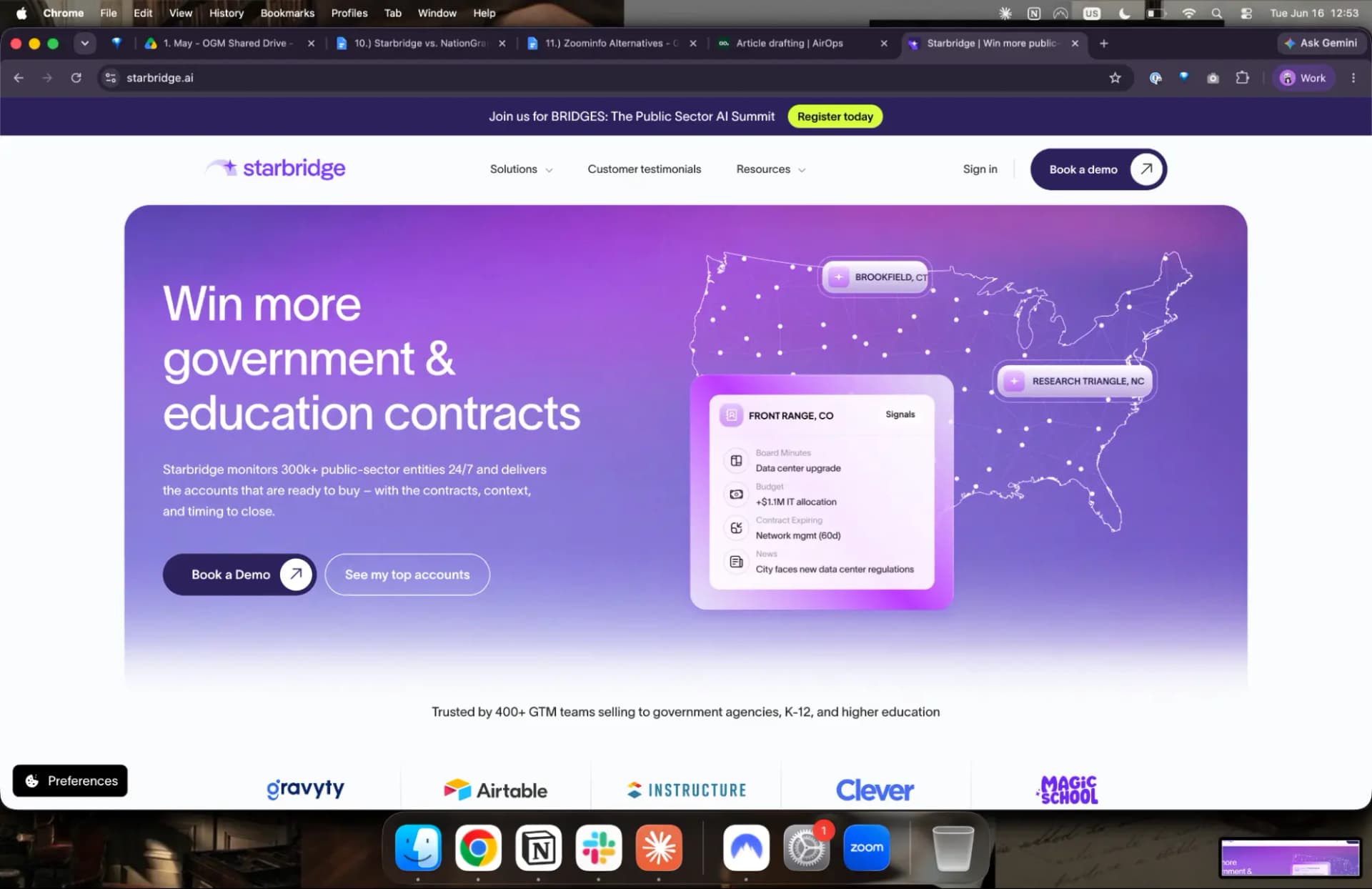
Starbridge is the AI sales intelligence platform built from the ground up for companies selling to state and local government, K-12, and higher education. More than 500 GTM teams use the platform to surface buying intent before competitors know the opportunity exists and connect that intelligence directly to rep workflows in Salesforce, HubSpot, Apollo, and Outreach.
What Starbridge does well
Starbridge covers the full government and education pipeline-building workflow across five integrated capabilities, each designed to connect to the next.
The Buying Signal Monitor tracks 320k+ government and education entities around the clock using an AI-native vector database that understands context rather than matching exact keywords. That includes content from YouTube recordings of public board meetings and hearings, formats that general-purpose AI tools typically cannot index. Every buying indicator fires with a verified contact, a reason for outreach, and AI-generated personalized copy pushed directly into sequencing tools. Zencity, a govtech company selling community analytics to local governments, sources 50% of its cold meetings from Starbridge buying signals.
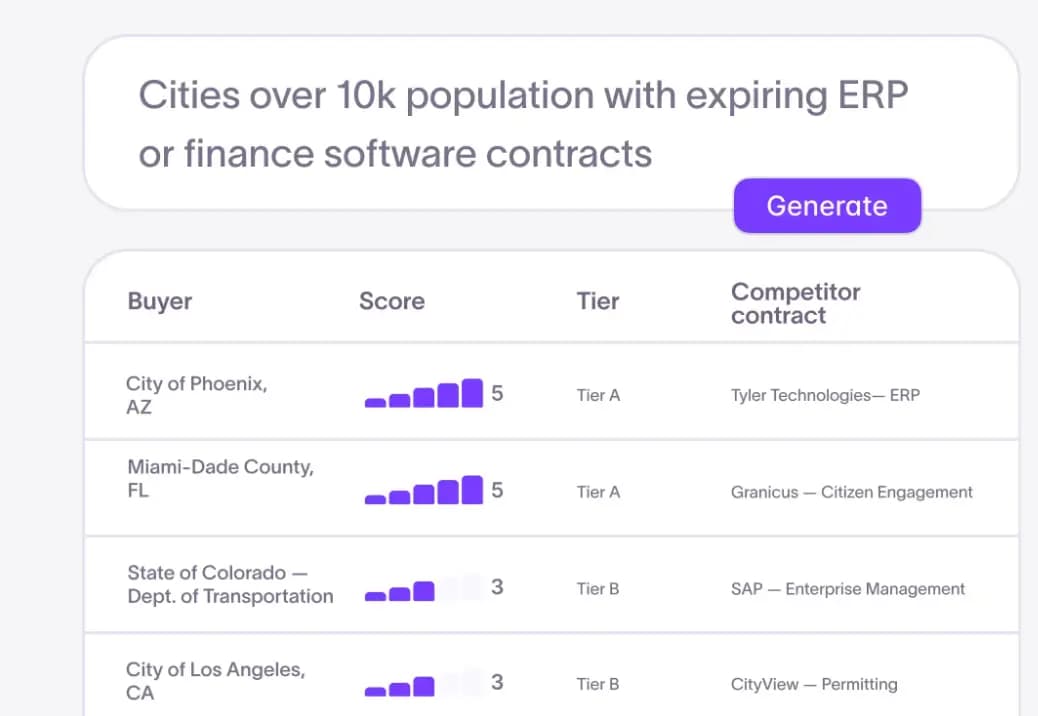
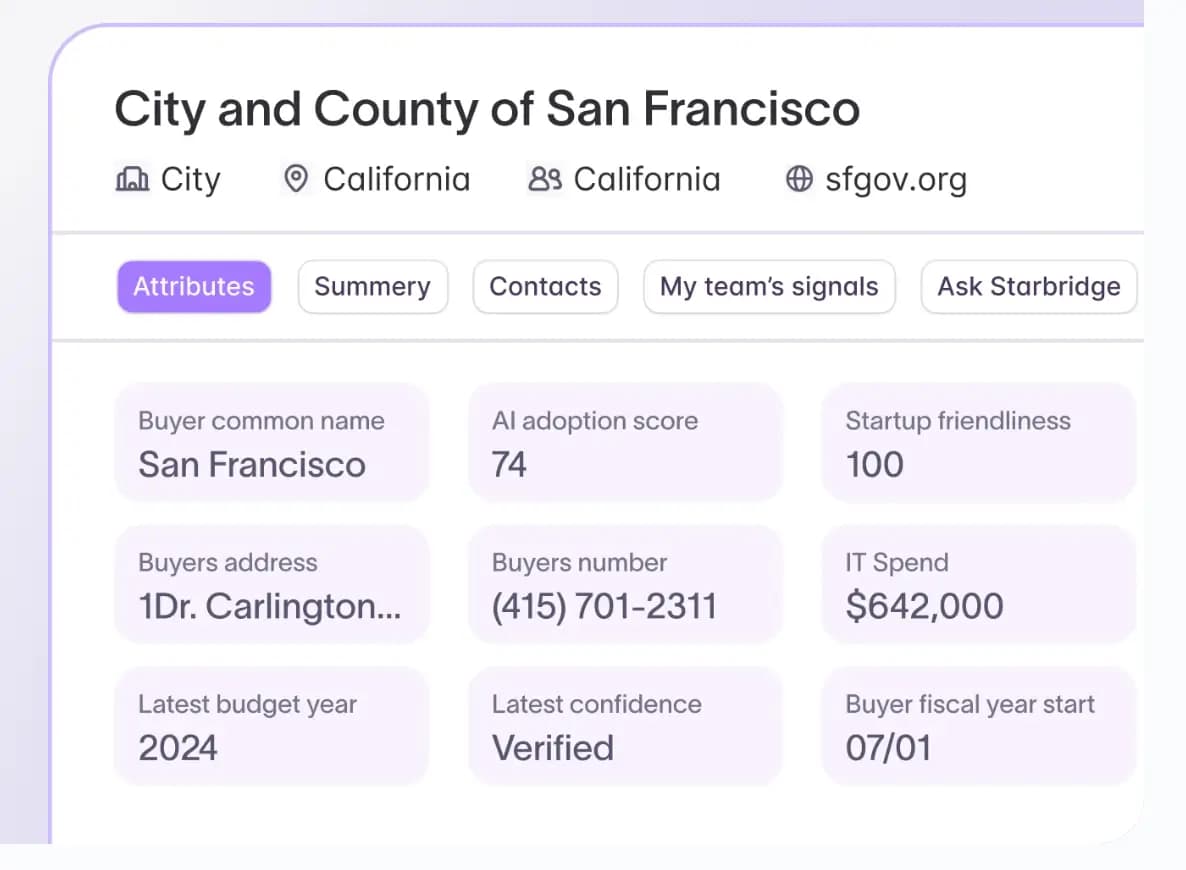
From that signal foundation, Contacts & Company Data uses proprietary web-agent technology to continuously crawl government department websites, school district portals, university staff directories, and board meeting records. Waterfall enrichment and continuous bounce-checking deliver 98% email accuracy with a 2% bounce rate, validated across 14,000 emails. Dynamic account scoring, AI-generated positioning briefs, and champion tracking via job changes give reps context before every call. Bi-directional CRM integrations with Salesforce and HubSpot sync, clean, and enrich records automatically. TAM to Target reports contact data 3 to 4x more valid than other vendors they have used, with clients booking 2 to 2.5x more meetings.
With accurate contacts in place, Public Spend Intelligence gives reps the competitive context they need before a discovery call. FOIA automation at scale surfaces full competitor contracts, cross-referenced against the platform’s full buying signal dataset. Out of the box, Starbridge has purchase order data for 77% of state and local government, K-12, and higher education institutions. Frontline Education cut research time by 90% after deploying Public Spend Intelligence, with reps entering every call already knowing what the buyer pays a competitor and when that contract is up.
When opportunities reach the RFP stage, AI RFP Finder & Proposal Writer centralizes thousands of bid portals into a single personalized feed. Every RFP is scored by product fit, region, and win likelihood, and the platform flags RFPs that already name a competitor. A native AI proposal writer drafts responses from the team’s product knowledge base, with a compliance matrix builder and collaboration mode for real-time refinement.
Because the purchase itself is often the hardest part, Starbridge helps buyers reach a signed contract faster. The platform provides access to every major contract vehicle, from Sourcewell and OMNIA Partners to NASPO ValuePoint, TIPS, and GSA. Starbridge absorbs the compliance work, paperwork, and renewals. Matched to each buyer’s preferred purchasing channel, this turns a qualified opportunity into a closed deal without the delay of standing up a fresh procurement.
Where Starbridge falls short
Starbridge’s signal sources, contacts, and workflows are built for state and local government, K-12, and higher education. Teams with significant federal pipeline will find that federal procurement follows a different structure and that purpose-built platforms for federal contracting offer deeper coverage in that market.
The AI RFP Finder & Proposal Writer accelerates proposal drafting and reduces time per response meaningfully, but it is designed to assist rather than replace a dedicated proposal team. Teams managing high volumes of complex solicitations will still need specialized proposal staff alongside the platform.
Starbridge is built for enterprise sales teams running a real outbound motion into government and education. The pricing reflects the depth of the data infrastructure behind it, including 98% email accuracy validated at scale, FOIA automation, and continuous enrichment cost more than generic data sourcing. Early-stage teams or those still building their first government and education pipeline may find it difficult to justify the investment before deal volume supports it.
Best for
Enterprise GTM teams running outbound into state and local government, K-12, and higher education who need one platform from buying indicator to closed deal. Starbridge fits best when the team has a CRM in place, an established government and education pipeline, and wants a purpose-built system that connects every stage of the motion without stitching together separate tools for research, contacts, spend intelligence, RFP response, and contract vehicle access.
2. GovSpend
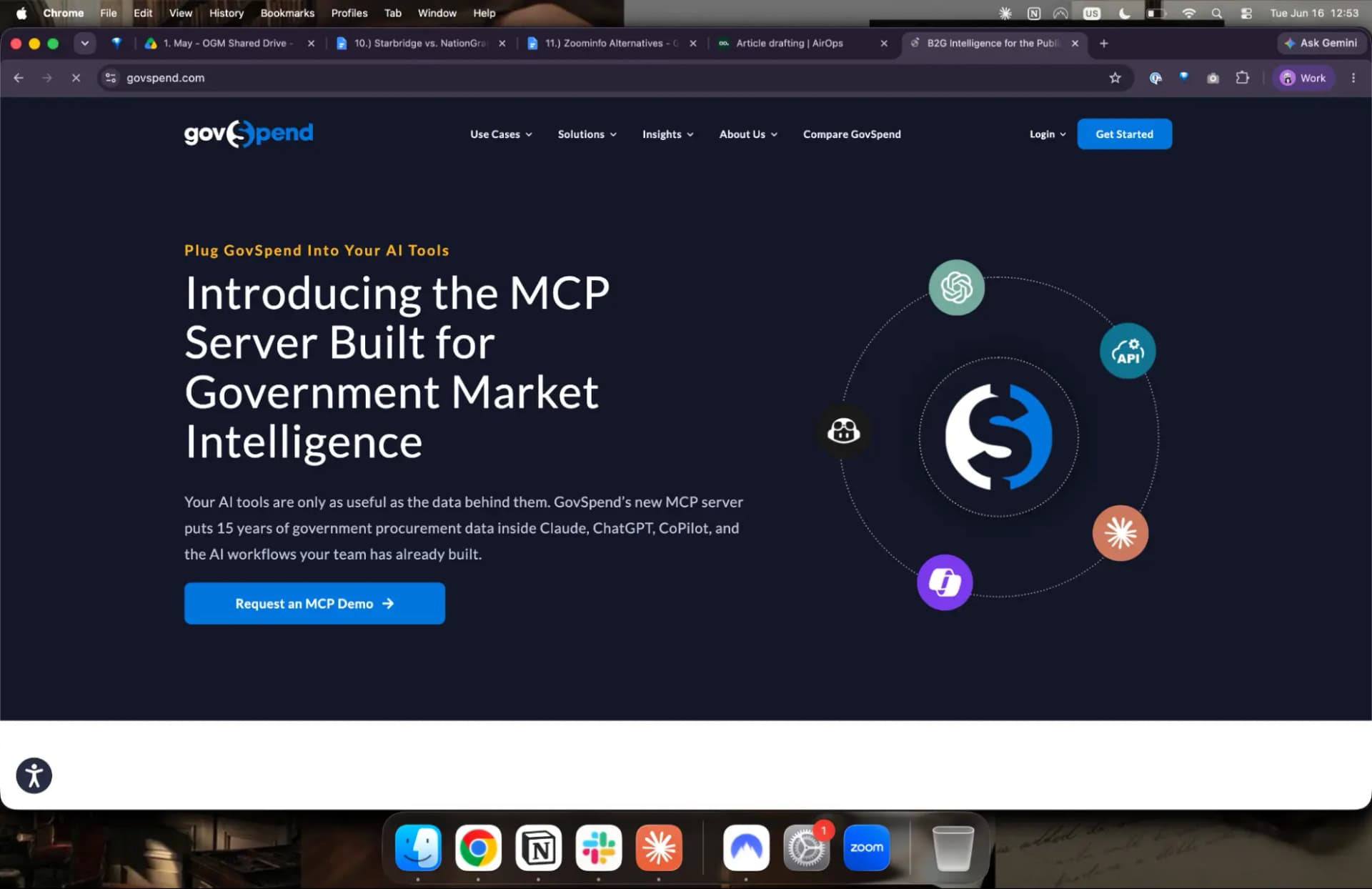
GovSpend is a procurement intelligence platform founded in 2011, that offers a library of historical purchase order data in the state and local government market. The platform serves vendors, agencies, and consultants who need visibility into what government buyers have purchased, from whom, and at what price.
What GovSpend does well
GovSpend’s value spans two distinct data layers. The historical purchase order database covers years of line-item government purchasing records across thousands of state and local agencies. Meeting Intelligence surfaces searchable public meeting transcripts, letting teams track budget discussions and technology conversations from board sessions and committee meetings.
The Opportunities module uses a company profile to surface relevant bid and contract activity each day, ranked by fit. AI Search lets reps run searches across all GovSpend data modules and the open web, while AI Notebook creates a personal workspace for scoring and analyzing saved searches. Each of these tools still surfaces activity that has already entered the public record. CRM integration is also available for both Salesforce and HubSpot.
Where GovSpend falls short
Records that arrive late undercut the timing-sensitive work procurement data is meant to support. One G2 reviewer found that “sometimes data is missing or not entered correctly or is out of date,” a problem that compounds when teams are trying to time outreach around a contract expiration or identify a displacement window before a competitor does.
Broad keyword searches may return more results than most teams can efficiently work through. Another reviewer found that monitoring for relevant terms “can result in false positive reports of potential response opportunities.” Sorting signal from noise takes time, and in a high-volume prospecting motion, that overhead adds up.
The core constraint sits beneath both issues. GovSpend fires the same alert on an opportunity to every other vendor tracking that market at the same moment it reaches you, so there’s no first-mover edge built into the notification itself.
For proposal drafting, GovSpend partners with Iris, a separate AI-powered platform. Teams that want a single path from bid discovery to submitted proposal will need to work across both tools to complete that workflow.
Cooperative contract visibility follows the same pattern. GovSpend can show what agencies bought through vehicles, but getting a vendor onto a vehicle like NASPO ValuePoint, Sourcewell, or TIPS is not a stated capability as of July 2026.
Best for
Teams whose primary workflow centers on procurement research, historical spend analysis, and bid monitoring in the state and local government market, and who want an established platform with a deep purchase order data foundation.
3. ZoomInfo
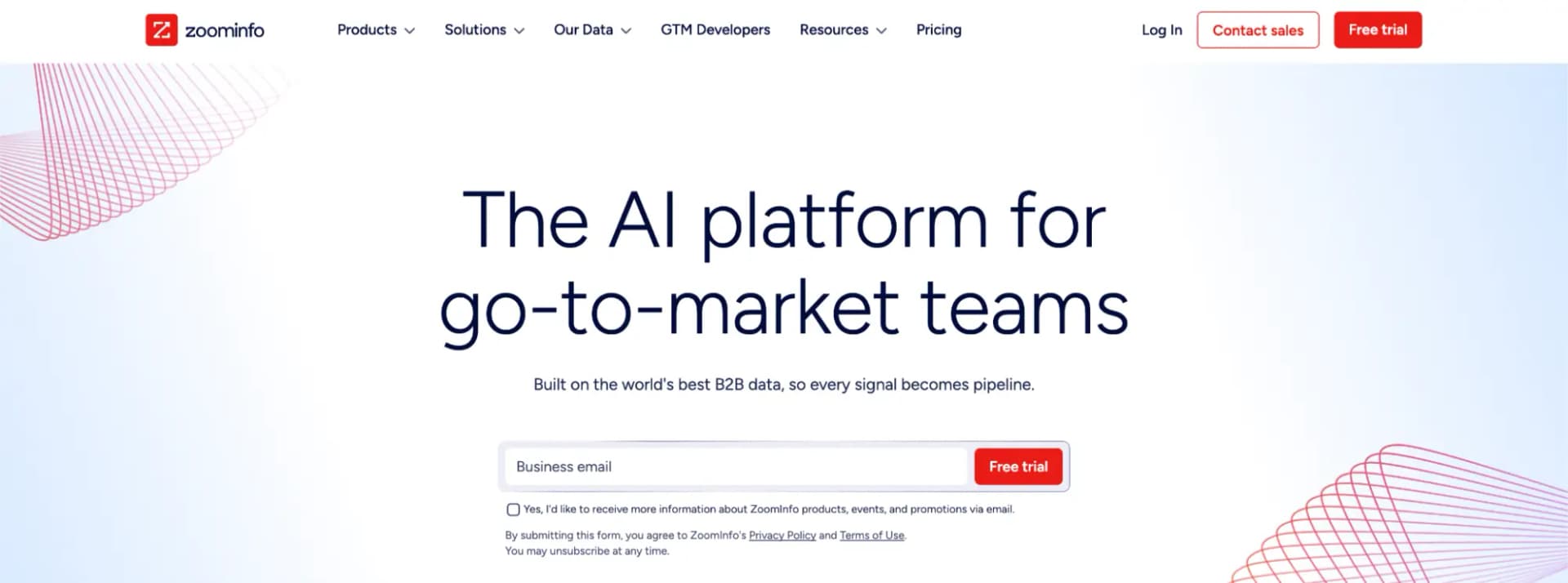
ZoomInfo is a horizontal B2B intelligence platform for commercial sales teams across industries. The platform offers a broad contact database, commercial intent data derived from web behavior and publisher networks, workflow automation, conversation intelligence, and deep CRM integrations.
What ZoomInfo does well
ZoomInfo competes on breadth. The contact database spans millions of B2B professionals across industries and geographies, with org charts, technographic data, firmographic filters, and direct dial coverage that make it a strong fit for commercial prospecting at volume.
The platform’s integration ecosystem is well developed in the B2B sales technology market, with connections to major CRMs, marketing automation platforms, and sales engagement tools. A large installed base, extensive documentation, and support infrastructure might make adoption straightforward for teams already operating in a standard B2B tech stack.
ZoomInfo’s intent data tracks web browsing and content consumption patterns across publisher networks, identifying accounts showing early research interest in relevant topics. For commercial B2B deals where buyers investigate solutions online before engaging vendors, this intent signal can surface accounts before they start fielding inbound inquiries.
Where ZoomInfo falls short
Government and education buying decisions don’t show up in web browsing patterns. They surface in board meeting minutes, budget releases, grant awards, and contract expirations. Teams selling into those markets typically pair ZoomInfo with a purpose-built platform to cover that signal layer, which means the single-vendor efficiency ZoomInfo offers in commercial selling doesn’t carry over cleanly to government and education territories.
Contact freshness follows the same structural line. ZoomInfo’s contact database partly draws from LinkedIn and commercial third-party sources. Government and education decision-makers rarely maintain LinkedIn profiles, which creates coverage gaps that become apparent when prospecting this market. Contact databases that rely on LinkedIn and third-party sources typically see bounce rates of 15 to 25% on unfiltered exports in general B2B use, and the gaps widen when prospecting markets where LinkedIn penetration is lowest. One G2 reviewer noted that “the contact data I use daily isn’t updated as often as we expected, so we still rely on other tools to fill in the gaps.”
Neither does the platform cover the purchase itself. Government and education deals above a sole-source threshold typically route through a cooperative vehicle like NASPO ValuePoint, OMNIA Partners, or Sourcewell, and contract vehicle access is not part of ZoomInfo’s offering as of July 2026.
Best for
Teams whose pipeline is primarily commercial B2B, where ZoomInfo’s breadth and automation deliver genuine value at scale. For organizations that sell across both commercial and government territories, ZoomInfo often serves the commercial side while a purpose-built platform handles the government and education motion.
4. RFP SchoolWatch
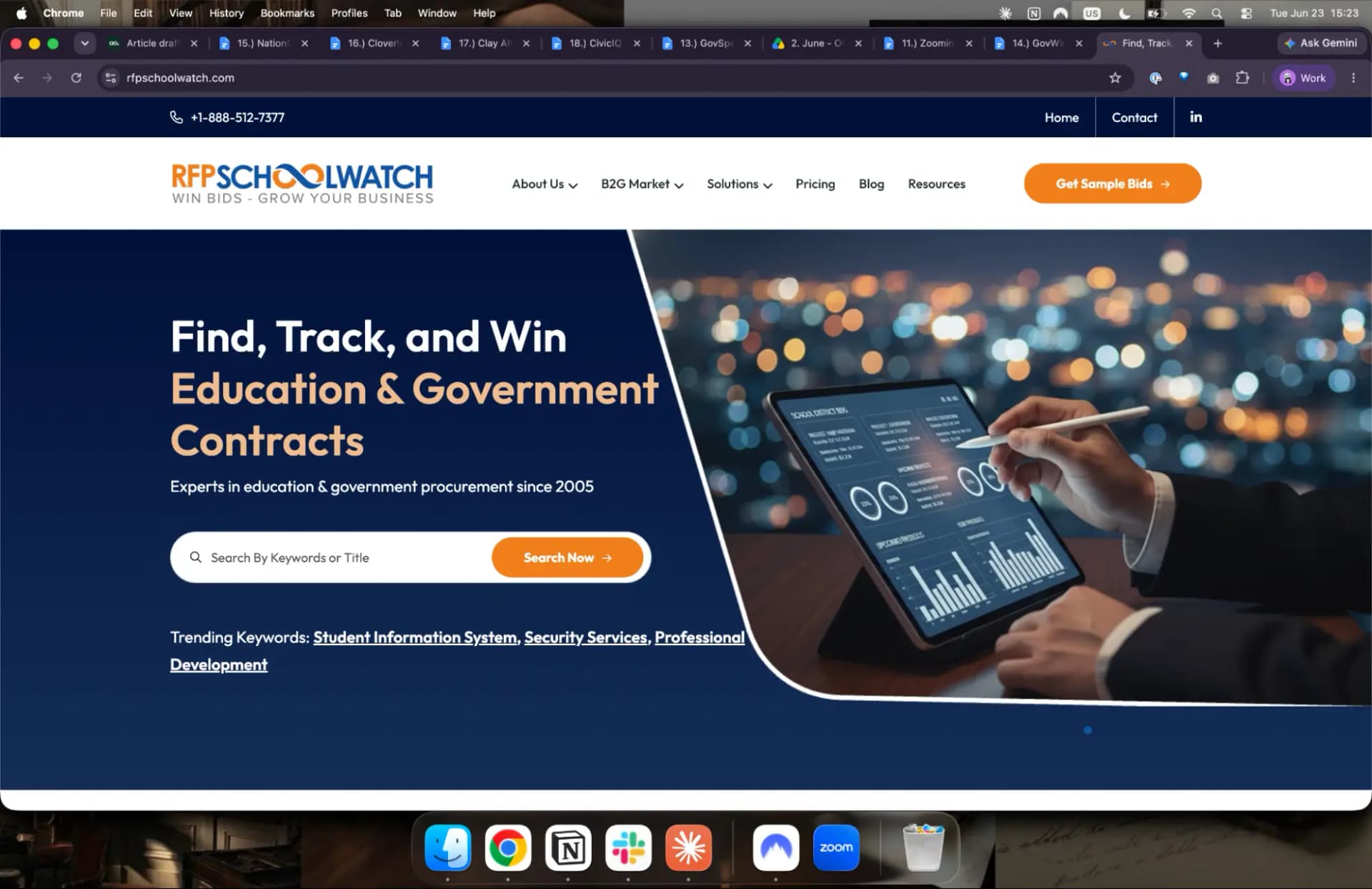
RFP SchoolWatch is an education and government bid tracking service founded in 2005 by Education Intelligence, Inc. The company has spent more than 20 years specializing in customized bid notifications for vendors selling into K-12, higher education, and state and local government across the United States and Canada.
What RFP SchoolWatch does well
RFP SchoolWatch’s bid notification model centers on personalization and direct support. Vendors receive daily email alerts matched by industry, geography, and unlimited keywords. A dedicated team handles keyword setup and works one-on-one with vendors to define the right search parameters.
The service is built for vendors whose primary motion is finding and responding to published solicitations, and it delivers on that use case without requiring complex platform adoption or technical onboarding.
Where RFP SchoolWatch falls short
RFP SchoolWatch centers on published solicitations. By the time a bid appears, government and education buyers have typically already consulted vendors, gathered requirements, and started shaping the evaluation criteria. Teams that engage only at the RFP stage may find themselves responding to specifications that another vendor helped write.
RFP SchoolWatch’s workflow is traditionally for bid delivery and notification. Companies that also need to run outbound campaigns will likely need to source those capabilities separately.
RFP SchoolWatch delivers bids through a daily email digest, which may suffice for teams whose workflow centers on reviewing and responding to published solicitations. Organizations that want buying indicators, contacts, and RFP tools connected in a single platform-based workflow may find that the email-based model doesn’t match how their reps operate.
Bids are also only one path to a contract. Many education and government buyers purchase through cooperative vehicles like TIPS, Sourcewell, or OMNIA when a vendor already holds a seat, skipping the solicitation entirely, and access to those vehicles is not part of RFP SchoolWatch’s offering as of July 2026.
Best for
Vendors who need reliable, affordable education and government bid alerts with hands-on support. RFP SchoolWatch fits teams whose primary motion is discovering and responding to published solicitations. It suits those who value personalized keyword setup, dedicated support, and deep specialization in education procurement.
Which Procurement Sciences alternative is right for your team?
If your primary need is historical spend data and procurement research for state and local government accounts, GovSpend delivers deep purchase order data, meeting intelligence, and AI-powered research tools built around that workflow.
If your team sells across both commercial and government territories and needs broad B2B contact coverage with mature workflow automation, ZoomInfo serves the commercial side of that motion well. Teams that also prospect into government and education may pair it with a purpose-built platform for that market.
If you need a straightforward, affordable way to receive matched education and government bid alerts without complex platform adoption, RFP SchoolWatch offers 20 years of specialization and a hands-on support model that helps vendors surface relevant solicitations quickly.
If your team sells technology or services to state and local government, K-12, and higher education, Starbridge is purpose-built for that motion end-to-end. The platform surfaces buying signals months before the RFP, delivers 98% accurate contacts, and provides full competitive contract context through FOIA automation. Starbridge scores and drafts RFP responses with trained AI, and shortens the sales cycle by giving buyers direct access to every major contract vehicle from one platform.
Book a demo to see how Starbridge helps your team win more deals in government and education.
Frequently asked questions
Explore our use case library
 Automate account research with AI agentsStop manually researching accounts. Starbridge AI agents automate account research by monitoring buying signals 24/7 and surfacing the right contacts.
 Identify competitor contract expiration datesThe RFP is usually a formality. Starbridge surfaces competitor contract expiration dates so your reps reach accounts before the renewal cycle closes.
 Create a conference campaignTurn conference badge scans into pipeline. Import your contact list, surface buying signals across every account you met, and follow up with context.