
A practitioner’s guide to getting state contracts
Learn how to get state and local government contracts, from vendor registration and account scoring through pre-RFP engagement and scaled outbound.

Many companies trying to win state and local government contracts stall before they ever build real pipeline. This market runs on procurement rules, budget cycles, and buyer relationships that commercial B2B playbooks were never designed to handle.
The companies that do win share a pattern. They show up early. They understand how procurement works before they respond to a single solicitation. They engage accounts months before the RFP drops and position their solution while the buyer is still defining their needs.
This playbook will help you secure state and local government contracts, covering everything from market research and vendor registration to pre-RFP engagement and a scaled outbound motion.
1. Research what state and local agencies buy before you register anywhere
The first mistake most companies make is jumping straight to vendor registration without validating whether a state or local agency actually buys what they sell.
There are thousands of procurement portals across the country, and registering on all of them is a full-time job that produces nothing if the agencies on the other side have no budget for your category. Spending some time on market research before registration prevents months of wasted effort.
Start by evaluating whether a given agency, district, or municipality is a realistic customer:
- Review publicly available purchase orders and contract awards to see what they have bought in the past.
- Check budget documents for line items related to your product category.
- Look at what incumbent vendors are currently under contract and when those contracts expire.
Public spend data is the fastest way to do this research at scale. It reveals which agencies are actively spending in your category, who the incumbent vendors are, what they’re paying, and when contracts come up for renewal. This intelligence should drive your target account list before you invest time in registration.
2. Register as a vendor and pursue relevant certifications
Vendor registration on state procurement portals is a prerequisite for pursuing contracts. Each state maintains its own system, and companies must register separately in every state where they plan to compete. For example, New Jersey uses NJSTART, California runs Cal eProcure, and Massachusetts operates COMMBUYS. The interfaces, requirements, and timelines vary, but the underlying process is similar.
Registration typically requires the following documentation:
- Employer Identification Number (EIN) or Tax Identification Number (TIN)
- UNSPSC or NIGP commodity codes that classify what you sell
- Proof of insurance
- W-9 forms
- Any state-specific business certifications
Small business certifications can meaningfully expand the pool of contracts available to you. Programs like Small Business Enterprise (SBE), Minority Business Enterprise (MBE), Women Business Enterprise (WBE), Veteran Business Enterprise (VBE), Disabled Veteran Business Enterprise (DVBE), and HUBZone set aside contract opportunities for qualified businesses.
Set-aside contracts face less competition and often move faster through procurement, so if your company’s profile qualifies for any of these designations, pursuing certification is worth the investment.
Registration is necessary but not sufficient. Completing the paperwork puts you in the system. It doesn’t create pipeline. The remaining steps are what separate companies that win contracts from companies that simply register.
3. Learn how state and local procurement actually works
State and local procurement isn’t a single process. It’s a set of methods that vary by purchase size, agency policy, and state law. Understanding which method applies to your deal determines your strategy, your timeline, and your likelihood of winning.
A deeper look at procurement mechanics can help you map these patterns to your specific market. The most common methods you’ll encounter are:
| Procurement method | How it works | What it means for sellers |
|---|---|---|
| Informal purchases | Fall below the agency’s micro-purchase threshold. Often sole-source eligible. | Ask about the threshold early. Price below it if possible to avoid a full RFP process. |
| Formal solicitations (RFP, RFI, ITB) | Triggered when the purchase exceeds the sole-source threshold. Requires evaluation criteria, scoring committees, and public timelines. | Plan 2 to 18 months from economic buyer approval to signed contract. Position your solution before the solicitation is written. |
| Noncompetitive / sole-source | Agency justifies buying from one vendor without competition. | Build the relationship and demonstrate unique value so the buyer can justify a sole-source award. |
Sole-source dollar thresholds are one of the most underused levers in government sales. Most state and local agencies and districts have a dollar amount below which they can purchase without a competitive process. Ask about this threshold early in every engagement. If your initial deal can be structured below that line, you bypass the RFP entirely and get to a signed contract in weeks instead of months.
Cooperative purchasing agreements offer another path around the RFP. Vehicles like NASPO ValuePoint, Texas DIR, and New York OGS allow state and local buyers to piggyback on pre-negotiated master contracts. Once a company has a reseller relationship and a cooperative vehicle in place, buyers can procure directly without running their own solicitation.
Every state and local deal involves three distinct buyer roles, and your messaging needs to land differently with each one:
| Buyer role | Title examples | What they evaluate |
|---|---|---|
| End user | Teacher, analyst, case worker | Daily workflow fit and ease of use |
| Economic buyer | Director, VP, superintendent | Organizational ROI and budget alignment |
| IT buyer | CIO, CSO, IT director | Security, compliance, and integration requirements |
Compliance requirements like SOC 2, FERPA, and StateRAMP are table stakes for the IT buyer specifically, so prepare that documentation before you need it.
4. Build your target account list and score it by buying readiness
After registration and procurement education, sellers face a critical question with no obvious answer. How do you decide which of thousands of state agencies, school districts, cities, counties, and universities to call first when every one of them could theoretically be a customer?
The default answer, picking accounts by geography or size, is how companies waste months calling into accounts with no budget, no timing, and no fit.
The most effective approach is building a scoring model with 5 to 7 attributes that ranks every account in your total addressable market (TAM) from best to worst. Lead with buying signals, which are early indicators that an agency is planning to spend, such as a new grant award, a contract about to expire, or a leadership change tied to purchasing authority.
Layer in indicators like competitor usage, budget trends, and procurement readiness. Use firmographic data such as enrollment, population, and operating budget as supporting context rather than as the primary ranking factor.
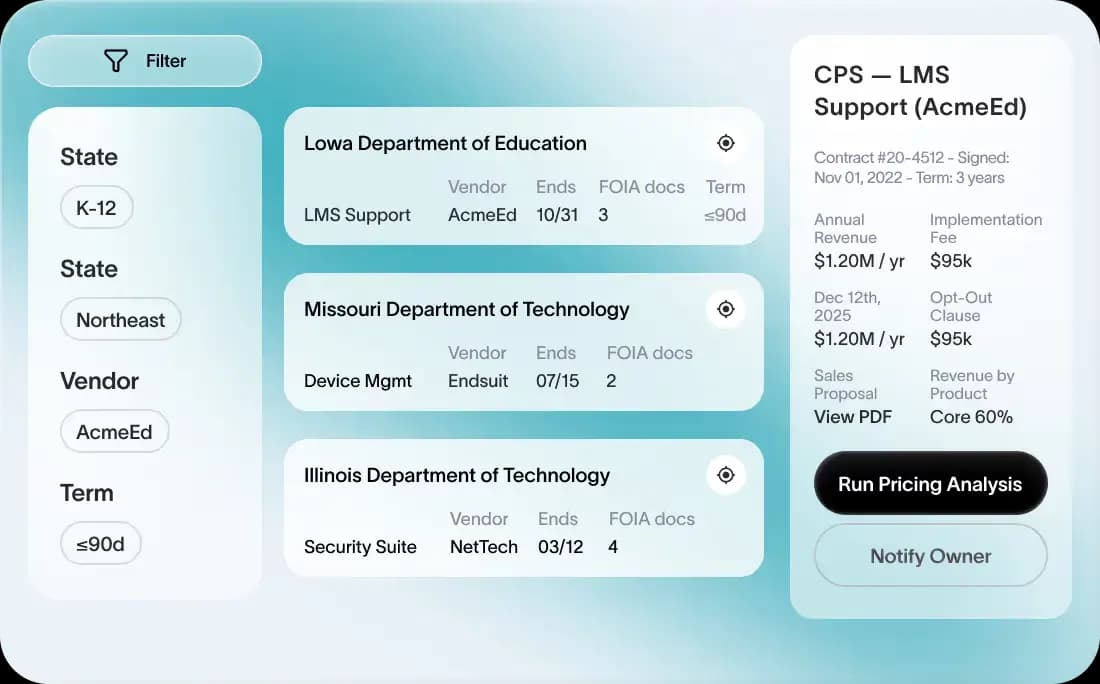
Doing this manually across a TAM of thousands isn’t feasible. Starbridge, an AI sales intelligence platform built exclusively for companies selling to state and local government, K–12, and higher education, solves the problem at scale.
Its Public Spend Intelligence feature surfaces 360-degree spend data, full competitor contracts, and procurement vehicle data across the market. You can rank your entire addressable market by buying readiness without spending hours digging through agency websites.
Within the first quarter with Starbridge, InquirED drove $200K in new pipeline by replacing manual board-document research with signal-driven account scoring to identify which districts were actually ready to buy.
5. Identify the right contacts and engage accounts before the RFP
Government and education buyers consult vendors early to learn what’s possible, and the vendor who provides that education builds trust and shapes the evaluation criteria. Winning starts months before the solicitation goes public.
A signal-driven strategy built around pre-RFP engagement gives sellers the timing advantage they need. Signals are early indicators that an agency is moving toward a purchase before any formal solicitation appears, such as:
- Board meeting discussions where a problem or initiative is raised
- Budget approvals and new line items for a relevant category
- Grant awards that create new funding with a spending deadline
- Strategic plan language naming a capability or initiative
- Leadership changes that shift spending priorities
- Job postings that signal a new program or initiative
- Contract expirations that legally require the agency to evaluate alternatives
Starbridge’s Buying Signal Monitor tracks these across the most comprehensive dataset of government and education buyers and buying signals, covering more than 320k public sector entities. Each buying signal is delivered with a verified contact and suggested outreach copy, meaning reps can act the same day instead of spending hours on research.
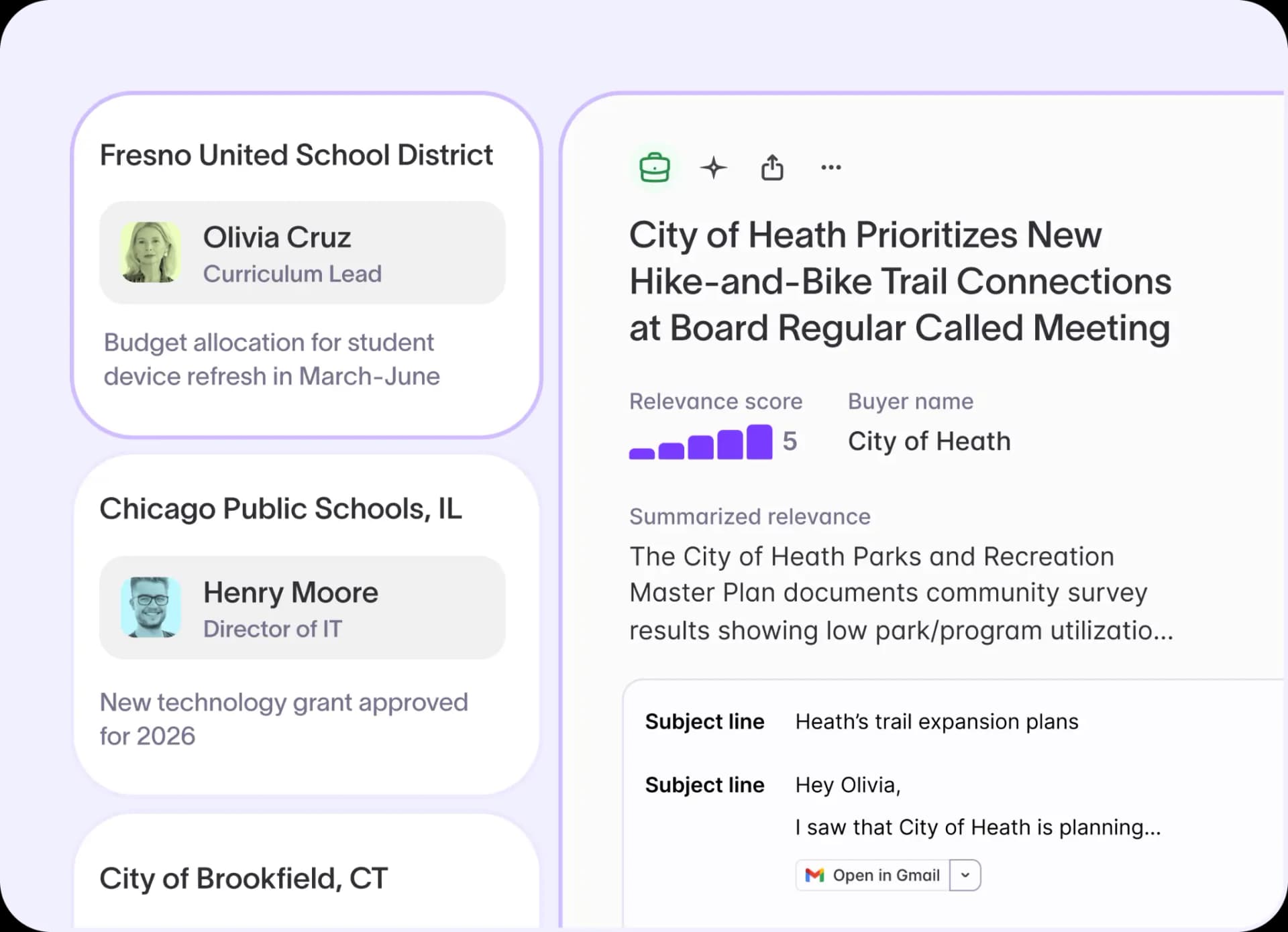
One week in with Starbridge, GovWell booked 5+ meetings sourced directly from pre-RFP buying signals. Hapara, another Starbridge customer, saw 20% higher response rates by timing outreach around board-level discussions rather than sending generic campaigns.
6. Find and reach the right decision-makers
Finding verified contacts in state and local government is a different problem than in commercial B2B. Generic databases scrape LinkedIn, which has almost no coverage of government and education decision-makers. Reps regularly reach out to people who left years ago or never held the role listed, burning hours on manual org chart research and tanking email deliverability scores in the process.
The most reliable contact data for this market comes from official sources: agency websites, staff directories, board meeting minutes, and state education portals. The problem is that crawling them manually across hundreds or thousands of accounts doesn’t scale.
Starbridge’s Contacts & Company Data solves this through continuous web crawls using proprietary web-agent technology, waterfall enrichment, and ongoing bounce checking. The result is a 2% bounce rate, compared with the 15 to 25% typical for generic providers.
Account context matters just as much as contact accuracy. A good rep wants to know what the prospect is spending today, who the incumbent vendor is, what the board has been discussing, and whether a contract is about to expire before making a single call.
Starbridge puts that information instantly at every rep’s fingertips, so the conversation starts with the problem, not the introduction. Frontline Education, for example, cut research time by 90% across its team after adopting the platform.
7. Scale your pipeline with layered channels and close contracts
Sustainable state and local government pipeline comes from layering multiple revenue channels rather than relying on a single motion. The channels, ranked by conversion rate, look like this:
- Warm introductions and lookalike outbound convert the highest because they carry built-in trust
- Conferences where economic buyers attend let you build relationships with decision-makers face-to-face
- Scaled email and cold calling produce 0.5 to 1% book rates and work best when layered on top of signal-driven targeting
- RFP responses should be reserved for solicitations where you have a realistic chance of winning, not used as a primary pipeline source
For warm introductions, after each win, identify similar accounts by size, geography, or competitor usage and lead outreach with the reference. Government buyers are heavily influenced by what nearby and similar entities are purchasing.
For conferences, skip the booth in the early days and focus on suitcasing . Build account-based handouts that reference the prospect’s strategic plan or board priorities and follow up within 24 to 48 hours. Starbridge’s Conference Intelligence discovers relevant events, scores attendees by ICP fit, and enriches lists with verified contact data, so every conversation has context.
As for outbound, start with 100 manually personalized emails before scaling with AI. Short emails with a personalized hook, a customer reference, and a simple CTA work best. Layer cold calls on top to achieve a 10% connect-to-book rate, versus 1 to 2% from email alone.
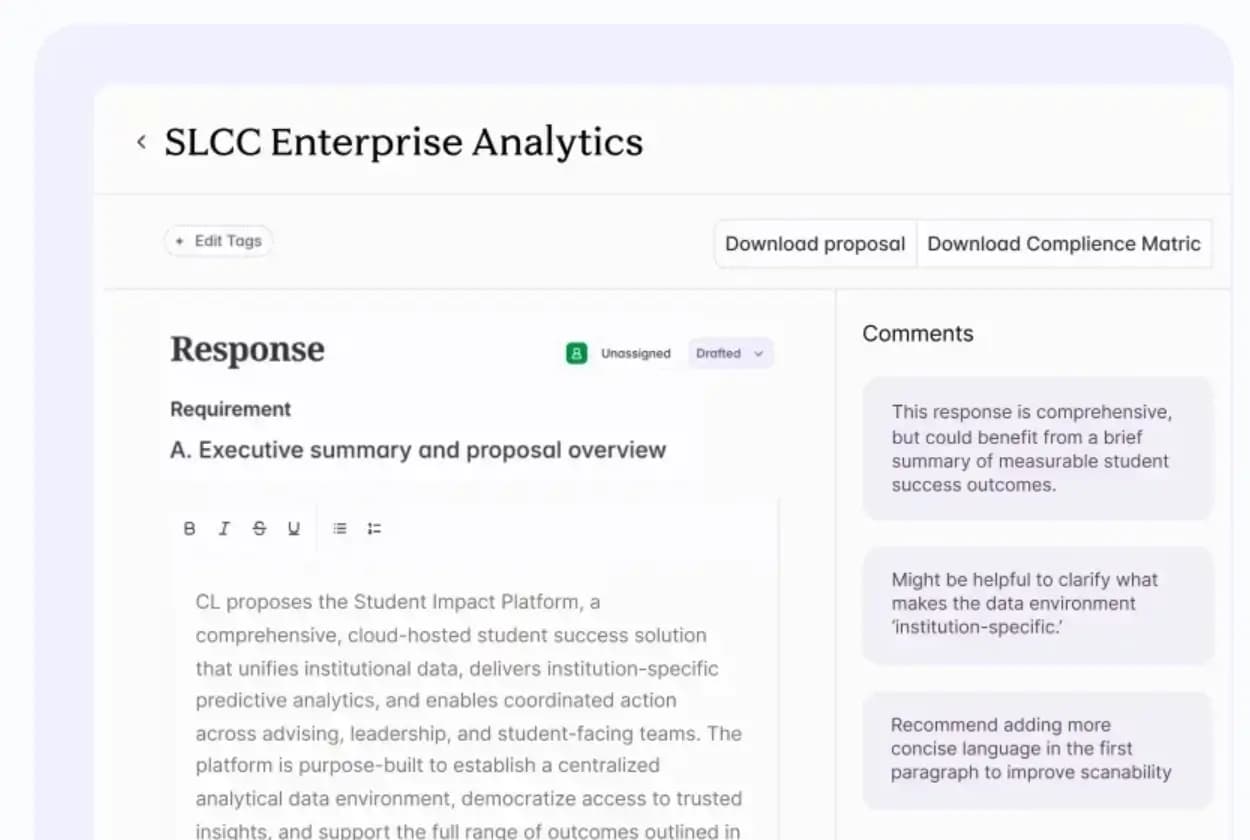
For RFPs, Starbridge’s AI RFP Finder & Proposal Writer centralizes thousands of state, local, and education bid portals into one personalized feed, scores RFPs by product fit and win likelihood, and drafts proposals from your product knowledge base. HousingCloud cut 8 to 10 hours per RFP after adopting Starbridge and saw a 30% increase in RFP discovery rate.
For companies without past performance, subcontracting under an established prime contractor is a viable entry path. APEX Accelerators and state-sponsored procurement workshops provide free training and matchmaking for new vendors. Once a deal is in motion, cooperative contract vehicles such as NASPO ValuePoint, Texas DIR, and New York OGS can reduce procurement friction by allowing buyers to skip a new solicitation entirely.
Getting state contracts is a process, not a lottery
The teams that win consistently in this market aren’t the ones responding to the most RFPs. They’re the ones showing up before the solicitation is written, engaging the right decision-makers with the right context, and treating government sales as a repeatable discipline rather than a numbers game. If your team is selling technology into state and local government, K–12, or higher education, that’s the motion worth building.
Book a demo with Starbridge to start prioritizing the right accounts, engaging verified contacts, and acting on early buying intent before the competition shows up.
Frequently asked questions
Timelines range from a few weeks to 18 months. Informal purchases below sole-source thresholds can close in weeks. Formal solicitations involving RFPs, evaluation committees, and board approvals typically take 2 to 18 months after the economic buyer signals intent.
RFPs are one path, but not the only one. Sole-source purchases below threshold amounts, cooperative purchasing agreements like NASPO ValuePoint and Texas DIR, and subcontracting under a prime contractor all bypass the traditional RFP process. The most effective government sales teams use RFPs as a supporting channel rather than the primary one, prioritizing pre-RFP engagement and warm introductions.
Small business certifications like SBE, MBE, WBE, VBE, DVBE, and HUBZone provide access to set-aside contracts with less competition. The specific certifications available depend on your company’s profile and the states where you compete. State-level procurement offices and APEX Accelerators can help identify which certifications are a good fit for your business.
State and local sales involve thousands of independent buying entities, each with its own procurement rules, budgets, and timelines. Federal contracting requires specific compliance investments, such as SAM registration, CAGE codes, and often security clearances, that are not needed for state and local work. State and local deals also tend to move faster, have lower dollar thresholds for sole-source purchasing, and rely more heavily on cooperative contract vehicles.
The most reliable approach is identifying contacts through official agency sources: staff directories, board meeting minutes, strategic plans, and public records. Look for three roles in every deal: the end user, the economic buyer, and the IT buyer. Starbridge’s Contacts & Company Data automates this by continuously crawling official sources and delivering verified contacts with 98% email accuracy.
Starbridge is the AI sales intelligence platform built exclusively for companies selling to state and local government, K-12, and higher education. It combines Public Spend Intelligence for account research and scoring, a Buying Signal Monitor that tracks intent across more than 1 million entities, verified Contacts & Company Data, Conference Intelligence for event-driven pipeline, and an AI RFP Finder & Proposal Writer that centralizes bid discovery and automates proposals.
Explore our use case library
 Automate account research with AI agentsStop manually researching accounts. Starbridge AI agents automate account research by monitoring buying signals 24/7 and surfacing the right contacts.
 Identify competitor contract expiration datesThe RFP is usually a formality. Starbridge surfaces competitor contract expiration dates so your reps reach accounts before the renewal cycle closes.
 Create a conference campaignTurn conference badge scans into pipeline. Import your contact list, surface buying signals across every account you met, and follow up with context.