
Starbridge vs. Pursuit: Which platform boosts sales to government and education
Compare Starbridge vs. Pursuit and the key features and differences that matter most for closing public sector deals.

Pursuit brands itself as AI-powered data infrastructure for government and education. Starbridge is the AI sales intelligence platform built to take deals beyond data, helping sales teams action and close more deals.
This comparison breaks down the five category areas that matter most to revenue teams in this market. Here is a quick glance before we go deep.
| Capability | Starbridge | Pursuit |
|---|---|---|
| Contract vehicle access | Pre-approved access to every major contract vehicle, including NASPO ValuePoint, OMNIA Partners, Sourcewell, TIPS, and GSA, with compliance, paperwork, and renewals handled. Available as part of the platform with no minimum deal size. Free to start. | Contract vehicle sell-through is not a stated capability as of July 2026. |
| Purchase data and contracts at scale. | All contract data - including annual price escalations, opt-out clauses, and implementation fees - is accessible natively inside the platform and via MCP, so reps and analysts can query it in plain English without leaving their workflow. Starbridge offers head-to-head data bakeoffs on PO coverage without having to wait weeks for additional PO data. | Depends on industry. FOIA-based contract retrieval is available on request. Unclear if the team offers direct bakeoffs and/or the volume of FOIA requests a month. |
| Contact enrichment | 98% contact data accuracy sourced in real-time from verified .edu and .gov domains via proprietary web-agent technology. Continuous bounce-checking, waterfall enrichment, and champion tracking via job changes data. Offers contact data bakeoffs to validate data quality and volume. | Offers contact enrichment services as well. Request a contact data bakeoff for the best validation method. |
| Signal discovery & noise filtering | Configurable scoring model lets you define what a strong match looks like and what is a red flag. You can penalize irrelevant signal types (e.g., lateral officer moves in a volume territory) and set scoring thresholds so reps only see signals above a relevance bar. Supports separate filter configurations for strategic vs. volume territories. | Pursuit has released updates to signal filtering, but teams managing multiple territory types may find that achieving a clean signal feed requires ongoing manual tuning. |
| RFP discovery and response | AI scoring by fit and win likelihood, competitor-mention filtering, and AI proposal writer built into the platform. | No native proposal writer. |
| Agentic capabilities | Platform is built to automate outbound end-to-end with AI email templates, auto-scored leads, and search agents. Plain-English search agents surface insights across the full data corpus - purchase records, board minutes, strategic plans - in Starbridge, Salesforce, HubSpot, Slack, or Claude. | As of June 2026, Pursuit’s website does not describe comparable agentic workflow capabilities. |
| CRM integrations | Native bi-directional Salesforce + HubSpot sync for any data field and/or object, including custom objects. Deploys quickly with dedicated implementation support. All enrichment data flows automatically into the rep’s existing CRM records. | Promotes CRM integrations, but lack of clarity on flexibility in what fields and/or objects can be configured. |
| Implementation & enablement | Dedicated Customer Solutions team owns onboarding end-to-end, including account scoring configuration, signal tuning, and rep enablement. Teams transitioning from other platforms typically report a significantly lower ongoing maintenance burden. | Teams coming from Pursuit have cited limited implementation support, high ongoing maintenance requirements — some reporting multiple days per week on configuration and prompt tuning — and weak rep adoption as friction points. |
Spotting early buying signals from data sources
Being early is everything in government and education sales. A buying signal is an early indicator that a school district, university, or state or local agency is planning to spend. That could be a new grant award, a contract about to expire, a budget line item, or a leadership change tied to purchasing authority.
These buying indicators surface months before an RFP ever appears. The data sources behind them, and how quickly a platform turns them into outreach-ready leads, determine whether your team engages early or shows up late. That is the foundation of a signal-driven sales strategy.
How Starbridge’s AI-native buying signal engine reads context, not just keywords
Starbridge’s Buying Signal Monitor is built on a vector database that understands context rather than relying on exact keyword matches. It monitors over 320k government and education entities around the clock, surfacing buying indicators from board meeting minutes, contract expirations, grants, budget data, strategic plans, leadership changes, job postings, news alerts, and bids and RFPs.
Every buying signal fires with three things attached: a verified contact, a reason for outreach, and AI-generated personalized outreach copy. Reps do not need to research the account, find the right person, or draft the message. The buying signal pushes directly into Apollo, Outreach, Salesforce, and HubSpot, so it lands in the workflow the rep already uses.
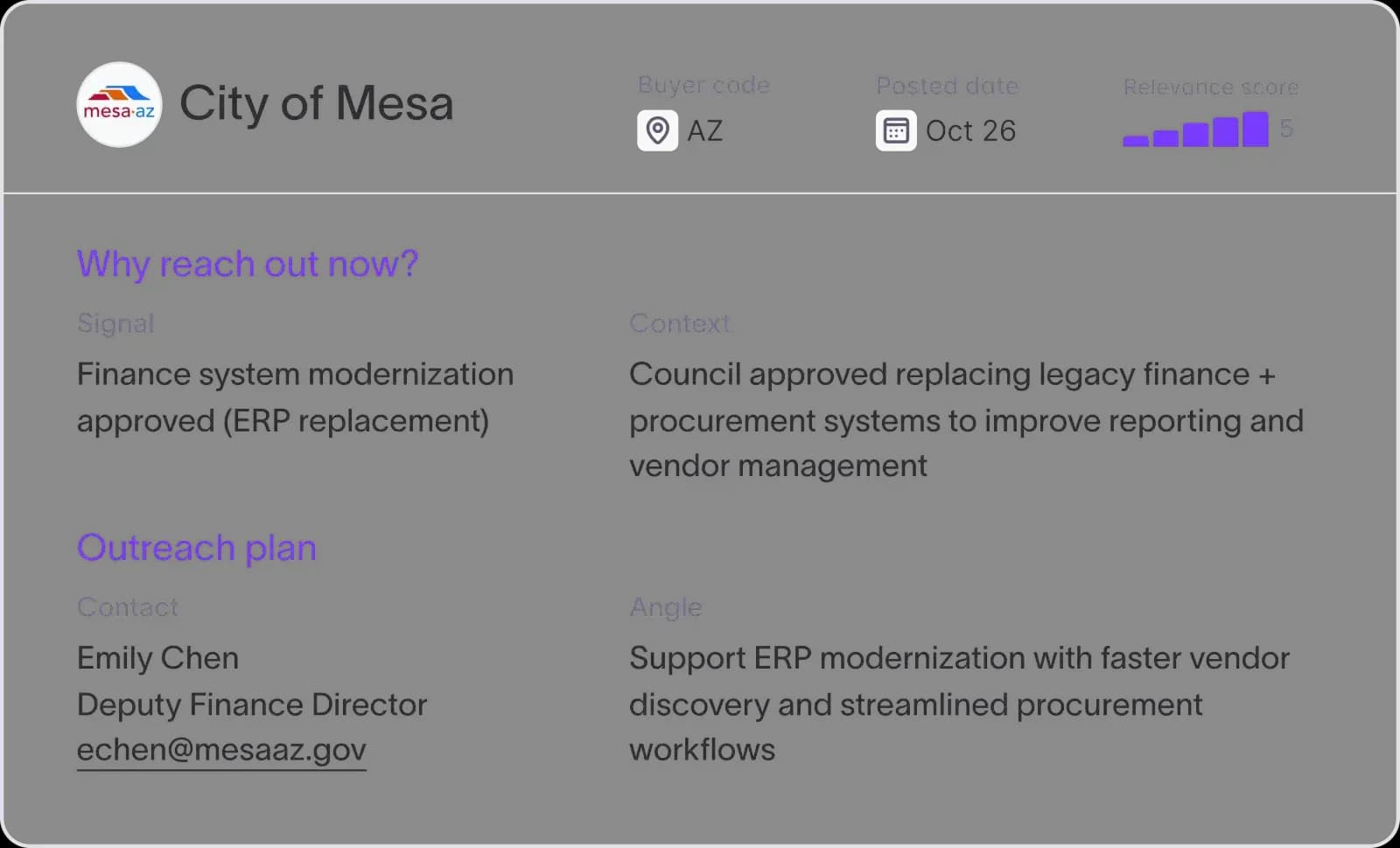
Prioritization is customized to your business. Starbridge ranks buying indicators by account score and the matching criteria configured with each customer, so reps see the highest-fit opportunities first instead of a raw feed.
Teams using Starbridge book more meetings on average. In its first week on the platform, GovWell booked 5 meetings sourced directly from Starbridge buying signals and now sources 15% of its total qualified pipeline from this platform.
Pursuit monitors similar sources with a different workflow
Pursuit’s Radar product monitors 160K+ entities. The buying indicator categories overlap with Starbridge on paper, covering council meetings, budgets, strategic plans, and public documents. Pursuit markets itself as surfacing opportunities "92 days ahead" and "6-18 months before RFPs drop."
Where Starbridge bundles a verified contact, outreach copy, and CRM push with every buying signal automatically, teams using Pursuit may find themselves spending more time evaluating and acting on each signal individually. For teams running outbound at scale across hundreds of accounts, that difference in workflow efficiency adds up.
The bottom line
Both platforms monitor government and education data sources for buying indicators. The difference is in what happens after a buying signal fires. Starbridge delivers a verified contact and ready-to-send outreach with every buying signal, pushed directly into the rep’s existing tools. Moving from a buying signal to outreach is faster with Starbridge’s end-to-end workflow, which moves every buying indicator down the path to a closed deal.
Contact and account enrichment that stays current
Selling to government and education means reaching decision-makers who rarely show up on LinkedIn. Superintendents, city managers, procurement officers, and IT directors at school districts and state agencies rotate roles on timelines that generic B2B databases cannot track. Outdated contacts waste rep time and erode credibility with accounts your team is trying to build trust with.
Starbridge delivers 98% email accuracy through proprietary web-agent technology
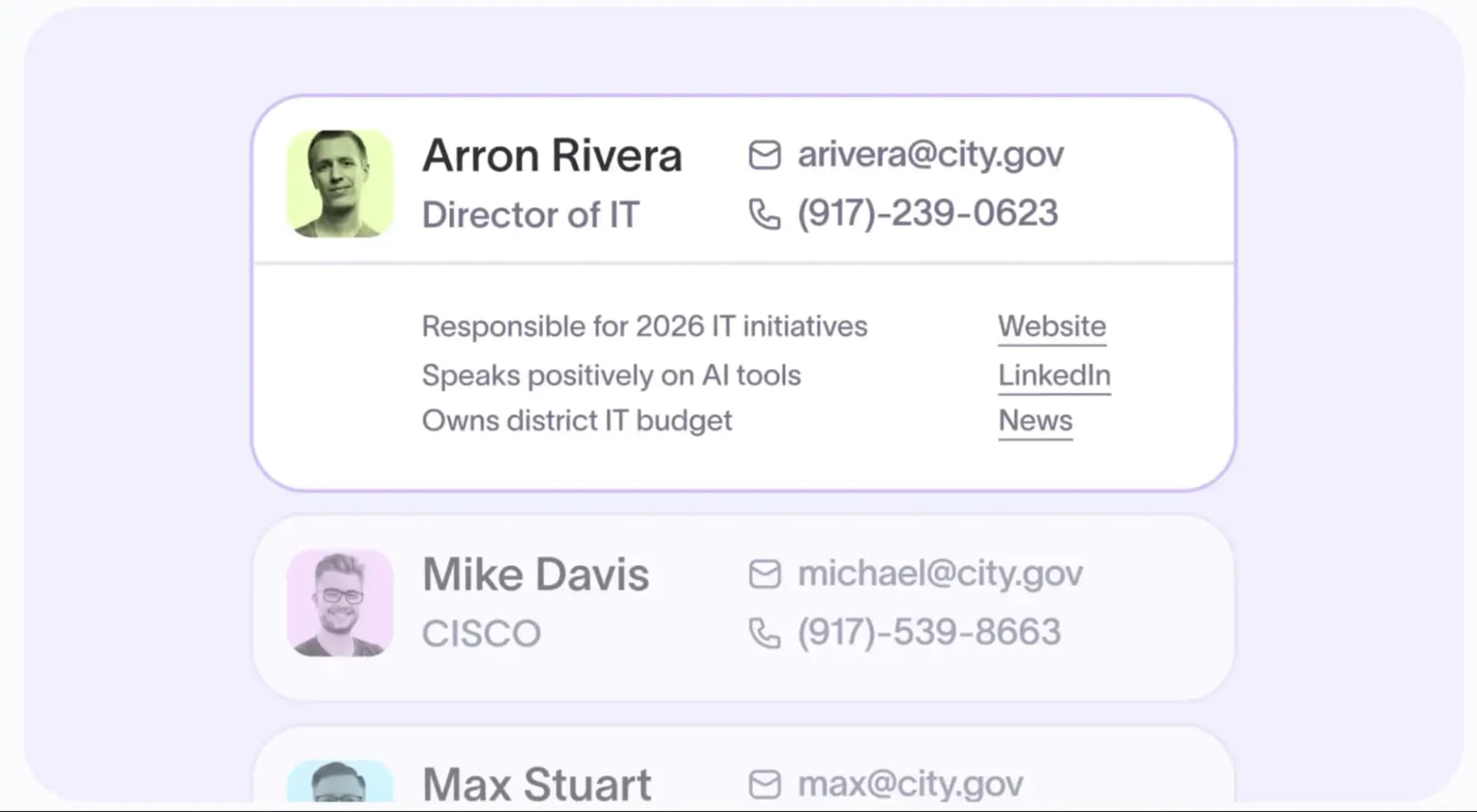
Starbridge’s Contacts & Company Data is built specifically for government and education. The platform runs continuous web crawls, powered by proprietary web-agent technology, across government department sites, school district portals, university websites, and board minutes.
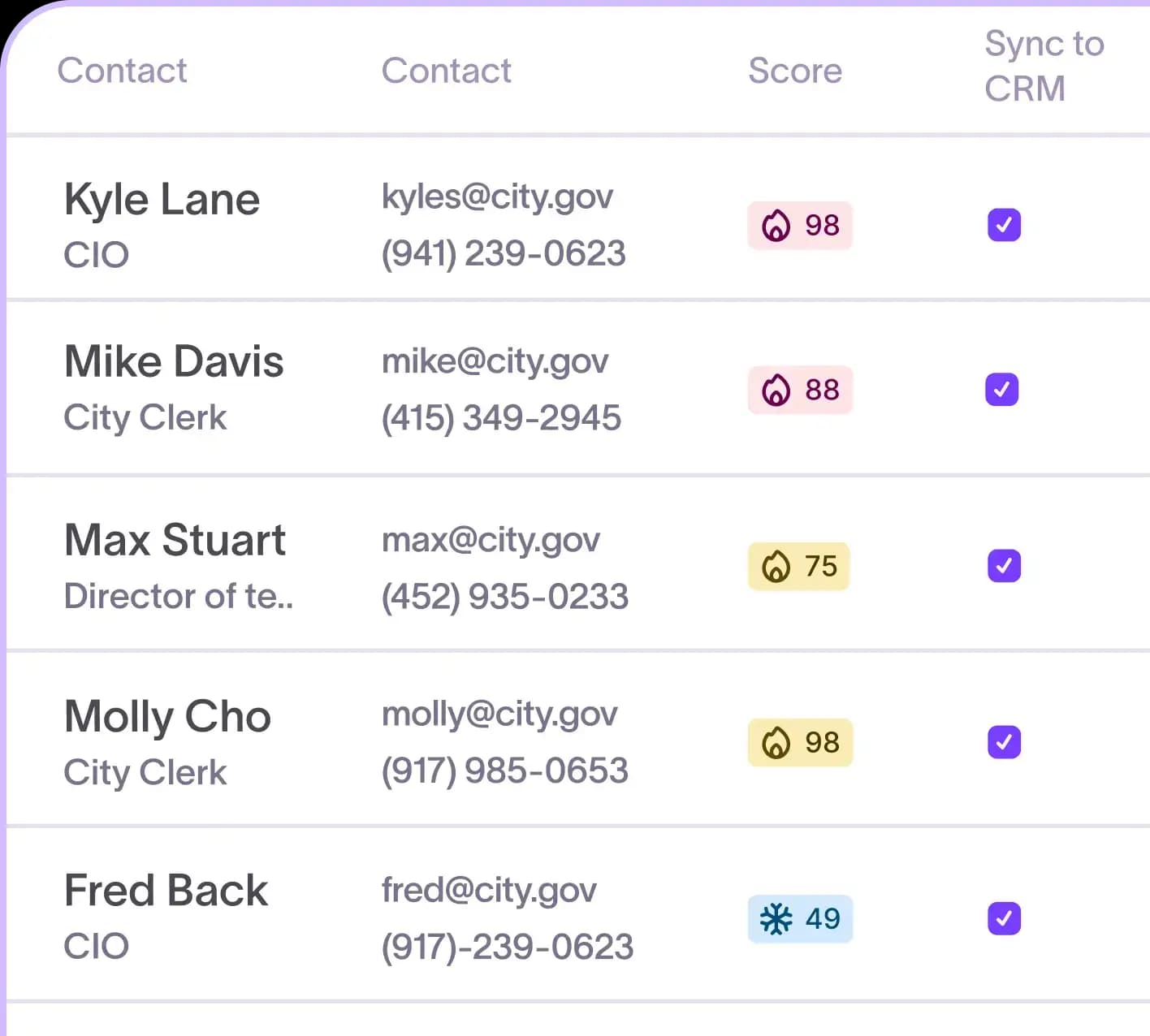
Waterfall enrichment and continuous bounce-checking throughout the year deliver results that stand up to scrutiny:
- 98% email accuracy validated across a 14,000-email test
- 2% bounce rate compared to the 15-25% industry standard from generic databases
- 3-4x data enrichment coverage compared to alternatives
The platform scores accounts dynamically using budget data, board discussions, ICP match, and buyer attributes, so reps focus effort where buying intent is highest. Bi-directional native integrations with Salesforce and HubSpot sync, clean, and enrich CRM data automatically.
After connecting Salesforce, Mantra Health saw 3x data enrichment coverage and gained granular visibility into each campus’s spending patterns. Meanwhile, Storage Scholars fully automated contact enrichment within days of setup, replacing thousands of hours of manual SDR research and identifying 350+ active school housing renovations worth reaching out to.
Pursuit advertises 94% data accuracy
Pursuit offers contact enrichment with AI verification, and its site advertises 94% data accuracy across its records as of August 2026. The figure is a general data-accuracy claim, with a confidence score carried on each record.
Starbridge validates accuracy at the individual contact level. The 98% email accuracy figure comes from a 14,000-email test with a 2% bounce rate, and every record is continuously bounce-checked between sends. At outbound volume, the gap between those numbers compounds across every sequence a rep sends.
The bottom line
Starbridge’s 98% tested email accuracy gives GTM teams contact data they can trust for outreach. Pursuit advertises 94% data accuracy across its records, and Starbridge’s higher verified accuracy, purpose-built crawling infrastructure, and native bi-directional CRM integration give it the edge for teams that need contact data to drive meetings, not just populate records.
Understanding vendor spend across government and education
Before a discovery call, a well-prepared rep wants to know what a prospect is paying their current vendor, when the contract expires, and how to position against the incumbent. In government and education, most of that information is technically accessible through public records, but obtaining it at scale requires navigating Freedom of Information Act (FOIA) requests across thousands of entities. The platform that automates this research gives reps a competitive advantage on every call.
Starbridge surfaces full competitor contracts with scaled FOIA automation
Out of the box, Starbridge has the purchase order data for 77% of state and local government, K12 and Higher Ed institutions. Starbridge can go even deeper for its customers with its Public Spend Intelligence, which uses FOIA automation at scale to surface data that is rarely available through standard procurement databases. Starbridge goes beyond publicly awarded contract notices and purchase order summaries, obtaining full competitor contracts with a level of detail that changes how reps prepare for meetings:
- Annual revenue figures
- Full sales proposals (unredacted)
- Opt-out clauses and renewal terms
- Implementation fees
- Contract expiration dates
- Revenue breakdown by product line
Reps walk into discovery calls already knowing what a prospect is paying a competitor, when the contract expires, and exactly how to position against it.
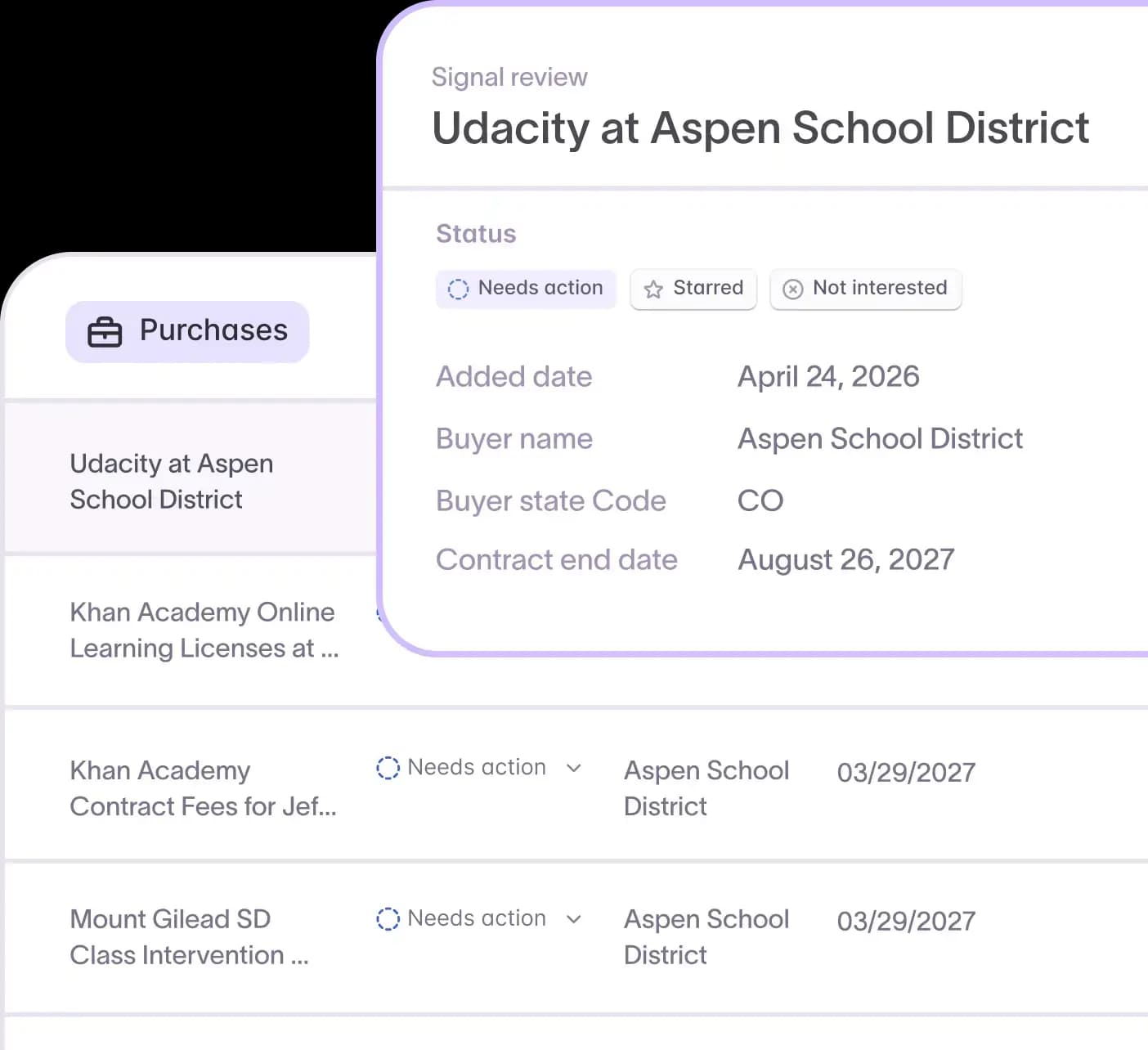
After deploying Starbridge, Frontline Education found that what used to take 20-30 minutes of manual research per account is now available instantly. The team managed to cut account research time by 90% and gave reps full visibility into account priorities, competitive context, and spend history.
Pursuit is investing in procurement intelligence with a different approach
Pursuit positions procurement intelligence as a core pillar as well. Pursuit has been expanding its FOIA capabilities since its Summer 2024 release, with subsequent releases referencing expanded contract coverage.
Where the two platforms differ is in the depth of contract data available to reps. Starbridge’s FOIA automation surfaces full sales proposals, opt-out clauses, implementation fees, and revenue breakdowns. For teams that need to walk into a call knowing exactly what a prospect is paying a competitor and when that contract expires, the level of detail Starbridge provides through scaled FOIA operations is difficult to replicate from publicly available contract notices alone.
The bottom line
Starbridge gives teams the full picture of what accounts are spending, on what, and with whom, backed by FOIA automation with a proven track record.
Closing deals through contract vehicles
A buyer who has picked your product still has to purchase it, and above the sole-source threshold that means either an existing cooperative contract or a new competitive solicitation. A fresh solicitation can add months to the sales cycle. Selling through vehicles like NASPO ValuePoint, OMNIA Partners, or Sourcewell lets a ready buyer purchase on a contract that has already been competitively bid.
Starbridge builds the purchasing pathway into the platform
When a buyer is ready to move, Starbridge provides pre-approved access to every major contract vehicle, including NASPO ValuePoint, OMNIA Partners, Sourcewell, TIPS, and GSA. Starbridge manages the compliance, paperwork, and renewals, and one onboarding covers the major vehicles rather than per-vehicle applications.
Contract vehicle access has historically been gated by deal size. Resellers earn a percentage of the contract, so they may not engage until a six-figure deal is in hand. Starbridge makes contract vehicle access available as part of the platform, with no minimum deal size.
Because the platform already tracks each buyer's preferred purchasing channel, reps see the fastest compliant route from first signal to signed contract in the same place they found the opportunity.
Pursuit is an intelligence tool
Pursuit's platform surfaces opportunities and procurement data. Its Radar product gives teams early visibility into buying activity. Detecting a buyer and transacting with one are separate problems, though. As of July 2026, contract vehicle sell-through is not a stated capability on Pursuit's site. Starbridge pairs the intelligence layer with the purchasing pathway, so the same platform that surfaced the signal also carries the deal through a cooperative contract the buyer already trusts.
The bottom line
Pursuit helps teams find government and education demand. Starbridge helps them find it and transact on it, with contract vehicle access, compliance handled, and each buyer's purchasing channel mapped in the account.
Finding and responding to RFPs
If your team only finds RFPs after they are published, you are already behind. In government and education procurement, an RFP typically reflects months of internal planning during which vendors have been consulted, requirements have been shaped, and evaluation criteria have been influenced.
The vendor who helped write the spec has a significant advantage. An effective RFP strategy starts long before the solicitation appears and covers the full lifecycle from discovery through submission.
Starbridge combines an AI-scored RFP feed with a built-in proposal writer
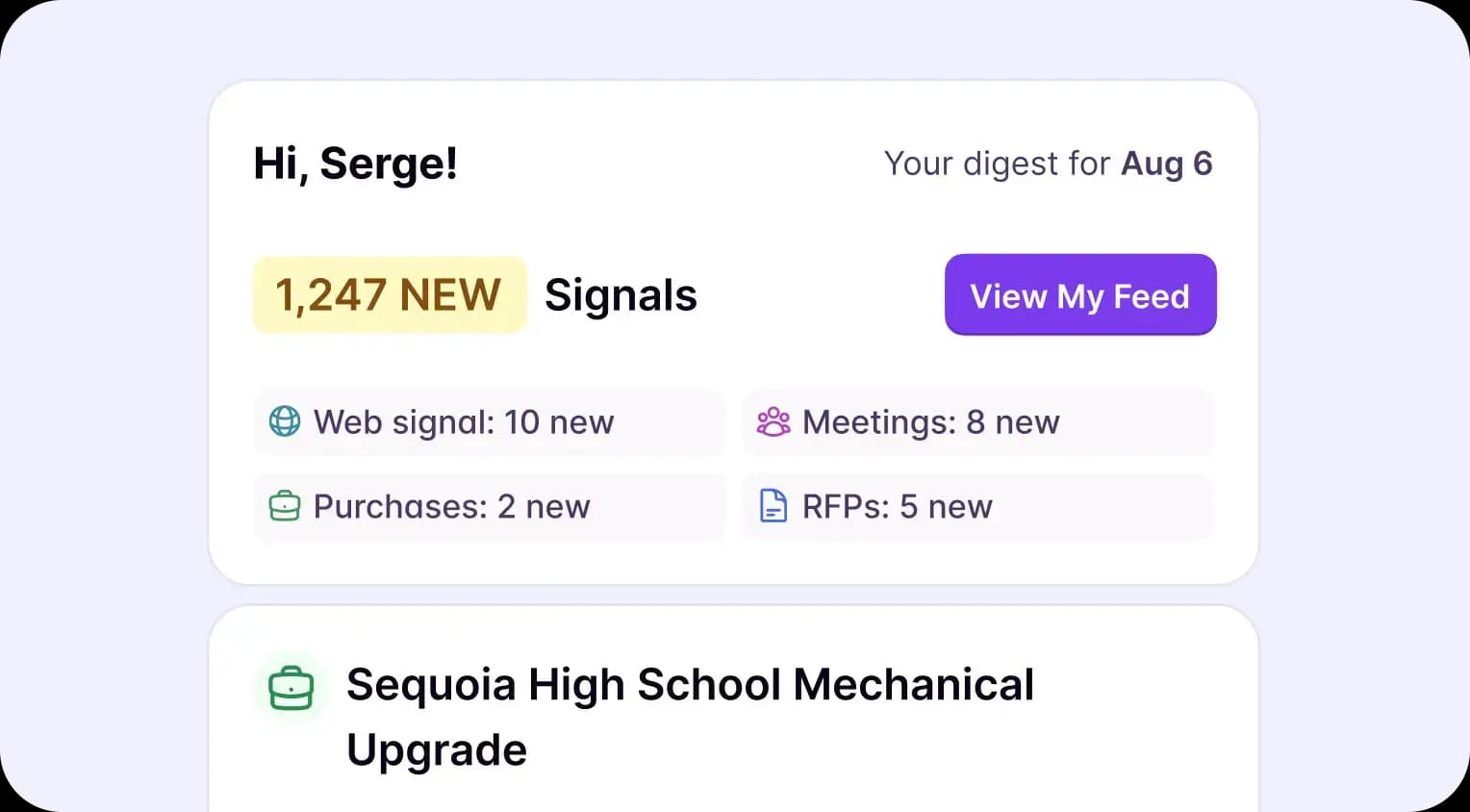
Starbridge’s AI RFP Finder & Proposal Writer centralizes thousands of state, local, education, and university bid portals into a single personalized feed. Every RFP is scored by product fit, region, and win likelihood, so teams focus on the opportunities where they have the best chance of winning.
The AI proposal writer drafts responses using the customer’s own product knowledge base, so proposals are accurate and specific from the first draft. A compliance matrix builder maps RFP requirements to response sections, and collaboration mode supports comments, tagging, and real-time refinement across the team. The platform also automatically flags RFPs that already mention a specific competitor by name, giving teams early insight into competitive dynamics.
In the first quarter using Starbridge, HousingCloud cut 8-10 hours from each RFP response and saw a 30% increase in RFP discovery rate.
RFPs are the last buying signal in the cycle, not the first. The Buying Signal Monitor ensures teams are already engaged with an account before the RFP drops, so when the solicitation appears, the team is positioned to win rather than scrambling to respond cold. That is how GovWell booked five meetings in their first week on the platform and now sources 15% of total qualified pipeline from Starbridge.
Pursuit approaches RFPs through signal monitoring and bias analysis
Pursuit’s Radar product surfaces RFPs as one type of signal it monitors. It does not have an RFP writer and/or procurement intelligence to help teams with the full cycle.
Starbridge takes a different approach by centralizing thousands of bid portals into a single AI-scored feed and pairing it with a native proposal writer. Where Pursuit helps teams evaluate RFPs they have already found, Starbridge is designed to handle the full lifecycle on one platform, from discovery and scoring to drafting and team collaboration.
The bottom line
Starbridge covers the full RFP lifecycle from discovery through submission, with a centralized AI-scored feed, a native proposal writer that drafts from the customer’s product knowledge base, and collaboration tools for team-based refinement. Pursuit offers RFP monitoring through Radar. For teams that need to find, score, and respond to RFPs from a single platform, Starbridge provides the more end-to-end workflow.
Which platform helps you close more deals?
For teams focused primarily on contact data and entity-level procurement data for a smaller set of government accounts, Pursuit offers a functional starting point with solid coverage across its core data infrastructure.
For the broader set of use cases that revenue teams in government and education actually face, Starbridge is the clear choice. The platform covers the full GTM workflow, from first signal to signed contract:
- Detecting buying intent early from board meetings, budgets, grants, and leadership changes
- Delivering verified contact data at 98% accuracy through proprietary web-agent technology
- Surfacing full competitor contracts through FOIA automation at scale
- Scoring and responding to RFPs from a centralized, AI-powered feed
- Closing through pre-approved contract vehicle access, with compliance, paperwork, and renewals handled
The Starbridge platform pushes intelligence directly into Salesforce, HubSpot, Apollo, and Outreach. All capabilities run on one AI sales intelligence platform built exclusively for companies selling to state and local government, K–12, and higher education.
If your team sells to government and education and you want to see how Starbridge turns those five solution areas into closed deals, book a demo.
Frequently asked questions
Explore our use case library
 Automate account research with AI agentsStop manually researching accounts. Starbridge AI agents automate account research by monitoring buying signals 24/7 and surfacing the right contacts.
 Identify competitor contract expiration datesThe RFP is usually a formality. Starbridge surfaces competitor contract expiration dates so your reps reach accounts before the renewal cycle closes.
 Create a conference campaignTurn conference badge scans into pipeline. Import your contact list, surface buying signals across every account you met, and follow up with context.