
Best RFP finders for public sector sellers in 2026
Compare five RFP finders for government and education sellers. See which surface opportunities before a solicitation posts, and which only alert you after.

Board agendas, budget votes, grant awards, and posted solicitations are all a matter of public record. For GTM teams selling into state and local government, K–12, and higher education, that transparency is the opportunity, and the right RFP finder is what turns scattered public information into a working list of accounts your reps can act on.
This guide evaluates five tools against the capability areas that decide whether an RFP finder actually closes more deals.
| Platform | Identifying opportunities before RFPs | Contact and account data quality | Vendor spend visibility | RFP discovery and response | Contract vehicle access |
|---|---|---|---|---|---|
| Starbridge | Monitors 320k+ entities for board minutes, budgets, grants, leadership changes, and more | 98% email accuracy from continuous crawls of official .gov and .edu sources | Full competitor contracts, pricing, and expirations via FOIA automation, with purchase order data for 77% of institutions out of the box | AI-scored RFP feed with a proposal writer that drafts responses | Shorten sales cycles with contract vehicle access across NASPO, OMNIA, Sourcewell and more. Free to start. |
| BidNet Direct | Matches active solicitations once agencies publish them | Plan-Holder List shows who downloaded a bid, rather than verified decision-maker contacts | Bid discovery and award tracking rather than spend analysis | Regional purchasing group bid notifications across all 50 states | Contract vehicle access is not part of the offering as of July 2026. |
| RFP School Watch | Alerts fire after a solicitation is published | Bid alerts rather than contact enrichment | Bid discovery rather than spend analysis | Category- and keyword-filtered bid alerts by daily email | Contract vehicle access is not part of the offering as of July 2026. |
| GovWin | Analyst-tracked federal pipelines surfaced years ahead of a solicitation | Market intelligence rather than verified contact enrichment | Contract awards, spending analysis, and labor rate data | Federal-focused bid aggregation with Ask Dela document summaries | GovWin offers access to federal contract vehicles, but it doesn’t offer access to contract vehicles for state, local and education as of August 2026. |
| Procurement Sciences | Activates once an opportunity is posted | Capture and proposal workflow rather than a contact database | Competitive capture research rather than agency spend data | AI proposal drafting with FAR and DFARS compliance checks | Contract vehicle access is not part of the offering as of July 2026. |
What to look for in an RFP finder tool
These five capabilities are the criteria that separate a bid alert service from a platform that turns a public sector RFP finder into repeatable pipeline.
- Identifying opportunities before they go to RFP. The best RFP finder doesn’t start at the RFP. It surfaces early buying signals such as board meeting discussions, budget line items, grant awards, and contract expirations, before a formal solicitation is posted. This matters because government and education buyers are rarely experts in the solution they need, so they consult vendors early to learn what is possible. The vendor who educates the buyer during that window ends up shaping the evaluation criteria a competitor would otherwise write.
- Contact and account data quality. This is the capability to reach verified decision-makers with accurate emails and phone numbers sourced for this specific market. Superintendents, procurement directors, and department heads rarely maintain commercial web profiles, so data built on LinkedIn and commercial sources goes stale and produces bounce rates in the 15 to 25% range. Every bounce is a quiet tax on the rest of the team’s deliverability and sequence performance.
- Visibility into what agencies and institutions are already buying. This is the capability to see incumbent vendors, contract values, pricing, opt-out clauses, and expiration dates for an account. A rep who walks into a discovery call already knowing the incumbent and the renewal window positions against real weaknesses instead of guessing. Purchase orders show what was bought and at what price, while full contracts reveal the implementation fees and renewal timelines that shape a displacement conversation.
- Finding and responding to RFPs efficiently. This is the capability to centralize bid portals into one scored feed and compress proposal drafting from days to hours. Reps otherwise lose hours hopping across hundreds of state, local, and education procurement sites. Worse, they burn time drafting responses to pursuits they were never positioned to win.
- Contract vehicle access that removes procurement friction. This is the capability to transact through cooperative vehicles like NASPO, OMNIA, Sourcewell, and more, so a won deal reaches a signed purchase order without a full competitive solicitation. Above a buyer’s sole-source threshold, a deal either routes through an existing vehicle or triggers months of added procurement. Teams without contract vehicle access watch won opportunities stall after the buyer has already said yes.
The five capabilities work as one connected motion, from an early buying indicator, to the right verified contact, to the spend context that shapes the pitch, to the RFP response, to the contract vehicle that closes the deal. No single capability outranks the others, because a gap in any one breaks the handoff to the next.
Where the platforms in this article differ is how much of that motion they cover end-to-end. Some go narrow and deep on a single stage, while others connect more of the chain. The rest of the work, across research, enrichment, outreach, and procurement, falls to your team to stitch together by hand.
1. Starbridge
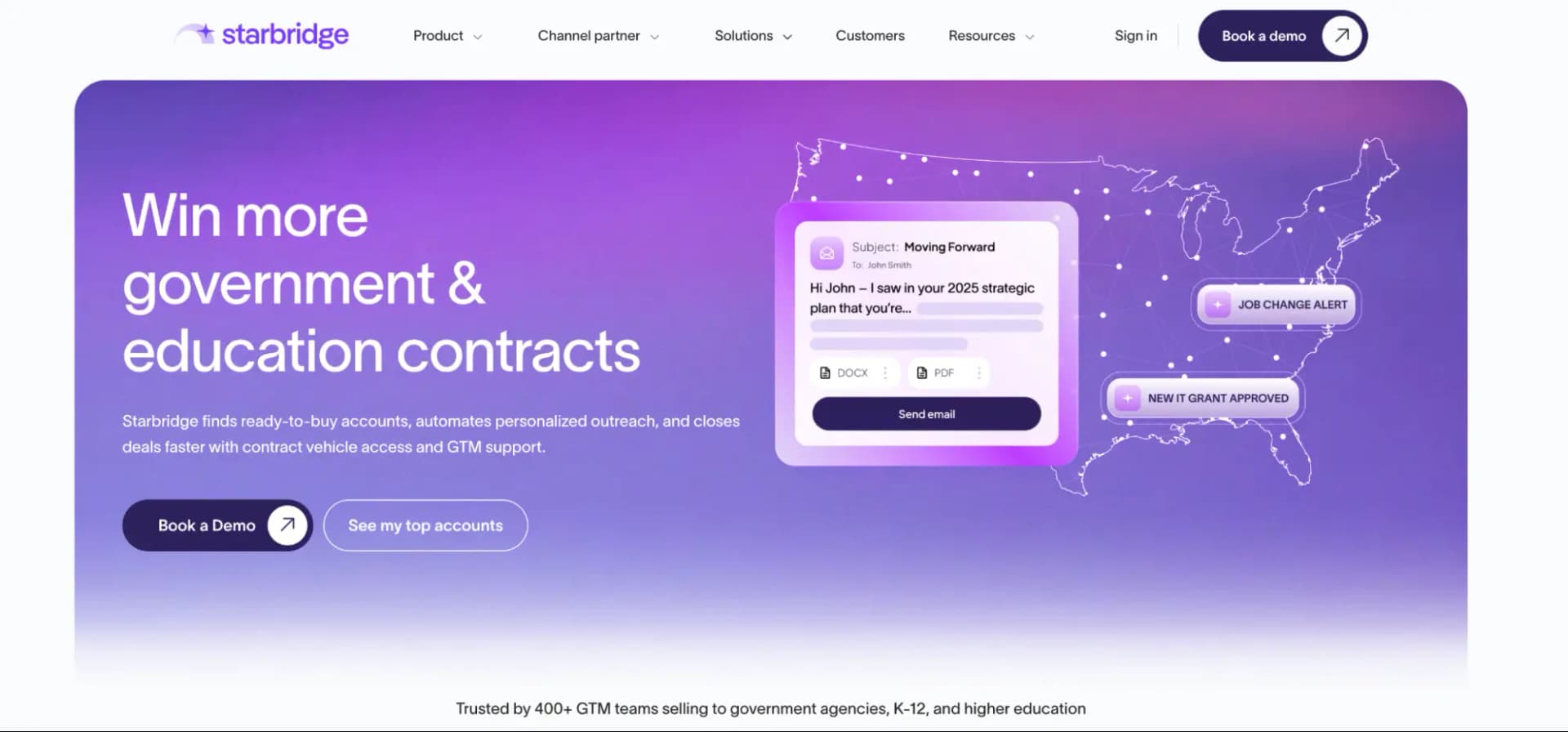
Starbridge is the AI sales intelligence platform built exclusively for companies selling to state and local government, K–12, and higher education. It is made for GTM teams that need ARR from this market, not a bid tracker bolted onto a commercial tool. Starbridge leads this list because it is the only platform here that carries a deal from an early buying indicator all the way to a signed contract, with RFP discovery and response as one part of a wider motion.
What Starbridge does well
Starbridge is built around five capabilities that cover the full government and education sales workflow, from an early buying indicator to a signed contract.
The motion starts with the Buying Signal Monitor, which addresses the pre-RFP timing problem head-on. Starbridge monitors 320k+ entities around the clock for board minutes, budgets, grants, leadership changes, contract expirations, and bids, then delivers each as a warm lead with a verified contact, the reason the timing is right, and AI-drafted outreach. This is where the signal-driven approach proves out in practice. inquirED, a K–12 curriculum company, drove $200K in new pipeline in its first quarter by replacing manual board-document research with signal-driven account scoring that showed which districts were preparing to adopt.
That signal is only as good as the contact attached to it, which is where Contacts & Company Data comes in. Starbridge runs continuous crawls of official .gov and .edu sources with proprietary web-agent technology, then waterfall-enriches and bounce-checks the results, delivering 98% email accuracy across a 14,000-email test against the 60 to 70% common with generic databases. Bi-directional Salesforce and HubSpot integrations sync, clean, and enrich records automatically, so the data reps rely on stays current. Contact accuracy is where Starbridge stands apart most for teams selling into a finite market where reputation travels fast. ClearGov saw that difference at scale. Consolidating a stack of separate data providers into Starbridge, its team enriched 65,000 accounts and added 71,000 net-new verified contacts at 99% deliverability.
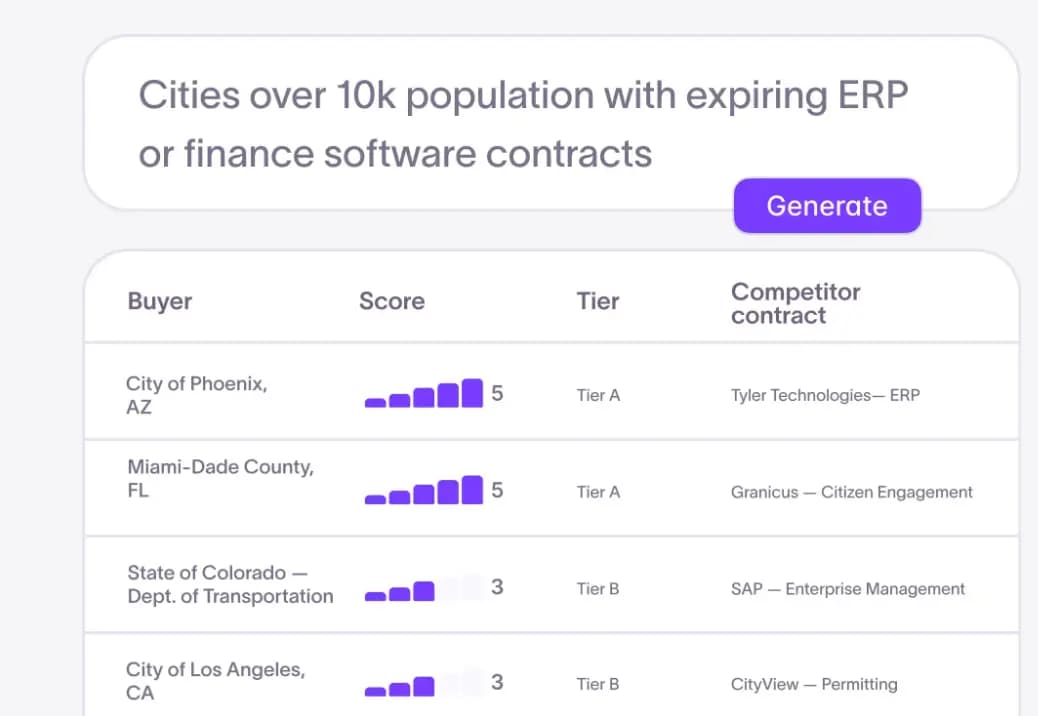
Once a rep has the contact, Public Spend Intelligence supplies the context that makes the conversation land. Starbridge surfaces full competitor contracts with pricing, opt-out clauses, expiration dates, and unredacted vendor proposals through FOIA automation, and it has purchase order data for 77% of state and local government, K–12, and higher education institutions out of the box. That turns hours of pre-call research into minutes. Frontline Education cut research time by 90%, with reps walking into meetings already knowing account priorities, competitive context, and spend history.
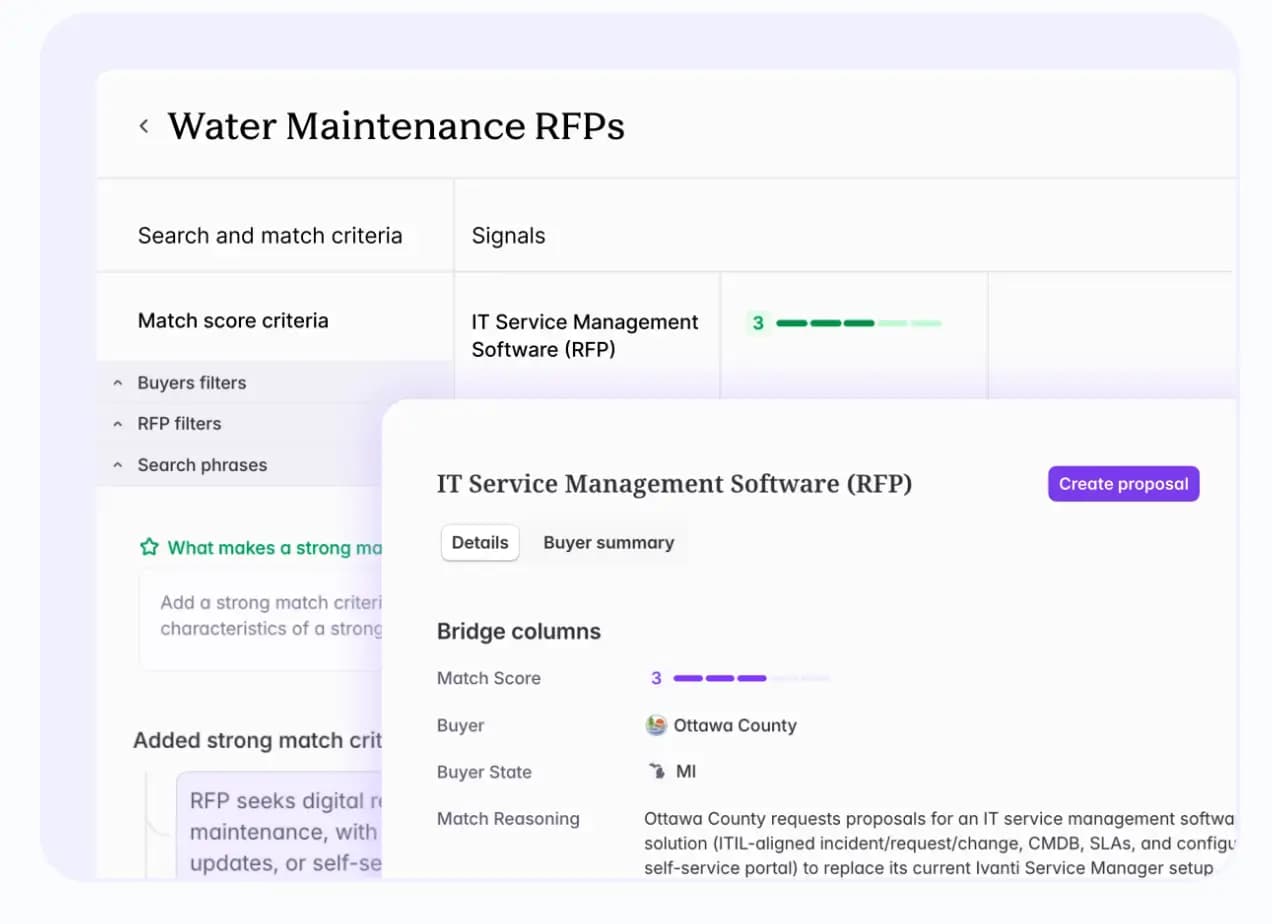
When a solicitation does appear, the AI RFP Finder & Proposal Writer handles the category this guide is built around. Starbridge centralizes thousands of state, local, education, and university bid portals into a single feed and scores each RFP by product fit, region, and win likelihood, then flags solicitations that already name a competitor so reps skip pursuits they cannot win. The AI proposal writer drafts responses from the team’s product knowledge base, cutting response time by up to 50% and saving 8 to 10 hours per RFP. RFP discovery works here as one stage of a larger motion rather than the whole job.
The motion ends where most tools stop short, at the signed contract, through Contract Vehicle & Reseller Access. Starbridge provides direct access to major cooperative vehicles, including NASPO, OMNIA, Sourcewell, TIPS, and more, and handles the compliance, paperwork, and renewals itself. This access is available as part of the platform. Once a buyer is ready, a won deal moves onto a vehicle the buyer already uses and reaches a signed purchase order in weeks rather than stalling in a full solicitation.
Where Starbridge falls short
Federal coverage is the lighter end of the platform. Starbridge is built for state and local government, K–12, and higher education, so its sales intelligence runs deepest there. Teams whose pipeline is mostly federal agencies will find less depth than a federal-first tool offers.
The AI proposal writer is lightweight by design. It accelerates a response and cuts drafting time meaningfully, but it will not replace a dedicated RFP or proposal hire on the most complex, high-volume solicitations. Teams that respond to a heavy federal proposal load should treat it as an accelerator rather than a full proposal shop.
Pricing sits at the premium end of the category. Starbridge is priced for enterprise and growth-stage GTM teams, which can put it out of reach for very early-stage companies still validating an outbound motion. The platform fits best where government and education selling is a real, resourced go-to-market motion.
Best for
Starbridge is best for enterprise and growth-stage GTM teams where state and local government, K–12, and higher education is a core go-to-market motion, and the goal is one platform that runs from an early buying indicator to a closed deal rather than a feed of posted bids. It’s a strong fit for teams that want to consolidate a fragmented stack of point tools into a single connected workflow. Companies selling technology or services into this market, from founder-led startups to enterprise sales teams, get the most value when the whole motion lives in one place.
2. BidNet Direct
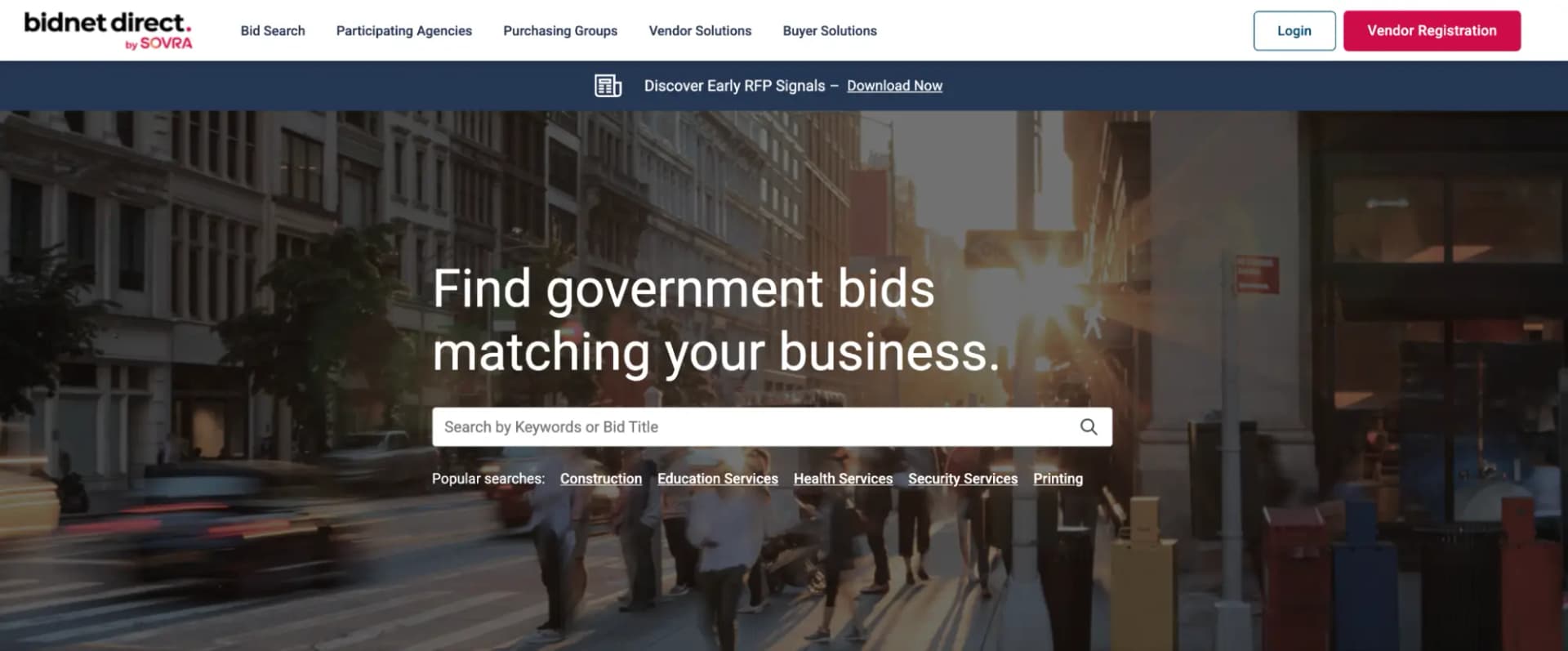
BidNet Direct, part of SOVRA, is bid-publishing and e-procurement infrastructure that has operated for more than three decades. It runs a network of regional purchasing groups across all 50 states, where thousands of participating agencies post solicitations, addenda, and awards.
What BidNet Direct does well
BidNet Direct’s core strength is direct agency relationships through regional purchasing groups. Participating agencies self-publish RFPs, addenda, and award information through the network, so vendors can access solicitations that may not appear on other aggregation platforms. Real-time addenda and award notifications come straight from the buying agency.
Coverage is broad across thousands of agencies nationwide. The wider SOVRA ecosystem extends into procurement management and spend optimization for government buyers, which supports a consistent feed of active solicitations across states and regions.
The bid-discovery experience is straightforward. Vendors register by region and industry and configure alert preferences without building complex search queries or keyword logic. That simplicity suits teams that want a reliable feed matched to their geographic and product focus without a steep learning curve.
Where BidNet Direct falls short
BidNet Direct matches active solicitations, so opportunities surface after they are formally published rather than during the earlier requirements-gathering window. In government and education procurement, early engagement often determines who makes the shortlist. As one G2 reviewer in education management noted, “sometimes it is delayed a few days from release. That can cause a rushed environment.”
The platform’s Plan-Holder List shows who downloaded a bid’s documents rather than a database of verified decision-maker contacts. Account scoring, CRM sync, and sequenced outreach sit outside its scope as of July 2026. Teams building proactive outbound campaigns may need separate tools to complete that motion.
Agencies also buy through cooperative vehicles like Sourcewell, OMNIA Partners, and TIPS when a vendor holds a seat. Access to those vehicles as a vendor route to sell is not part of BidNet Direct’s offering as of July 2026.
Best for
BidNet Direct is best for vendors whose primary motion is responding to published local government solicitations and who want broad nationwide bid notification through direct agency relationships. It suits teams that value a simple, reliable feed over a connected pipeline-building workflow.
3. RFP School Watch
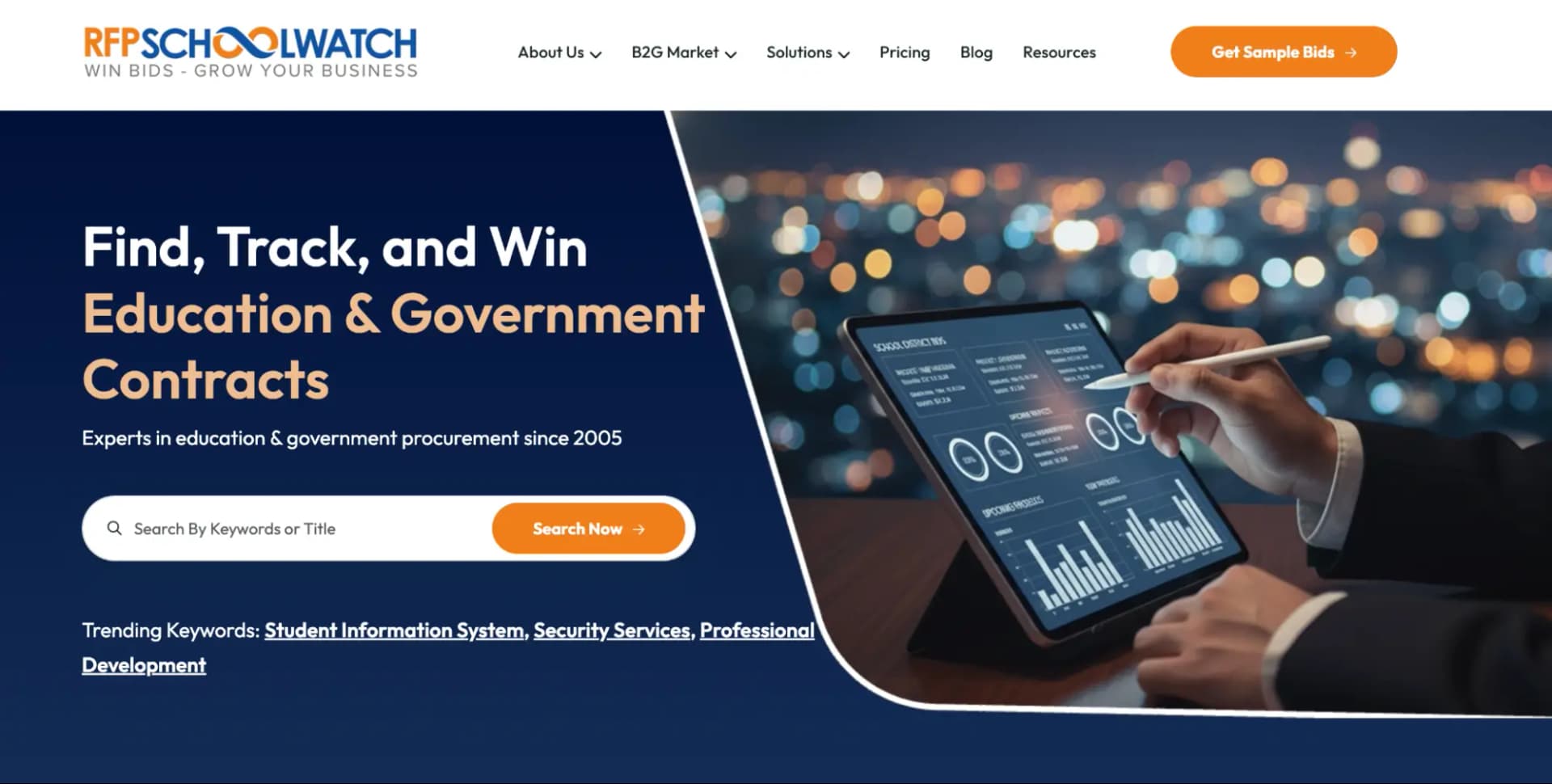
RFP School Watch is an education and government bid notification service founded in 2005 as a division of Education Intelligence, Inc. in Nashville, Tennessee. It aggregates and delivers customized bid alerts from K–12 districts, colleges, universities, and state and local government agencies across the United States and Canada.
What RFP School Watch does well
RFP School Watch scans thousands of sources daily across school districts, colleges, universities, government portals, and special boards. Vendors receive notifications filtered by keyword, region, industry, and target market.
Customer service is concierge-style. Dedicated account management, expert keyword setup, and ongoing support help vendors tune their alerts toward more relevant results.
Coverage spans education and the broader state and local government market rather than K–12 alone. That makes it a wider category-filtered bid feed than a district-only tracker.
Where RFP School Watch falls short
Alerts fire after a solicitation is published, and matching runs on keyword and category configuration rather than AI relevance scoring. Relevance depends on how carefully the account is tuned, so a poorly configured keyword set might bury the right bids in noise. Teams that want to engage before a procurement posts may need a source of pre-RFP buying indicators, which sits outside a posted-bid alert model as of July 2026.
Bids arrive through a daily email digest rather than a connected platform. Contact data, spend intelligence, account scoring, and CRM-connected outreach sit outside that model. Sales organizations that want those capabilities in one workflow may find the email-based approach does not match how their reps operate day to day.
Contract vehicle access as a vendor route to sell is also not part of RFP School Watch’s offering as of July 2026.
Best for
RFP School Watch is best for education and government vendors who want a hands-on, category-filtered bid alert service spanning K–12, higher education, and state and local agencies. It fits teams whose workflow centers on reviewing and responding to posted solicitations.
4. GovWin
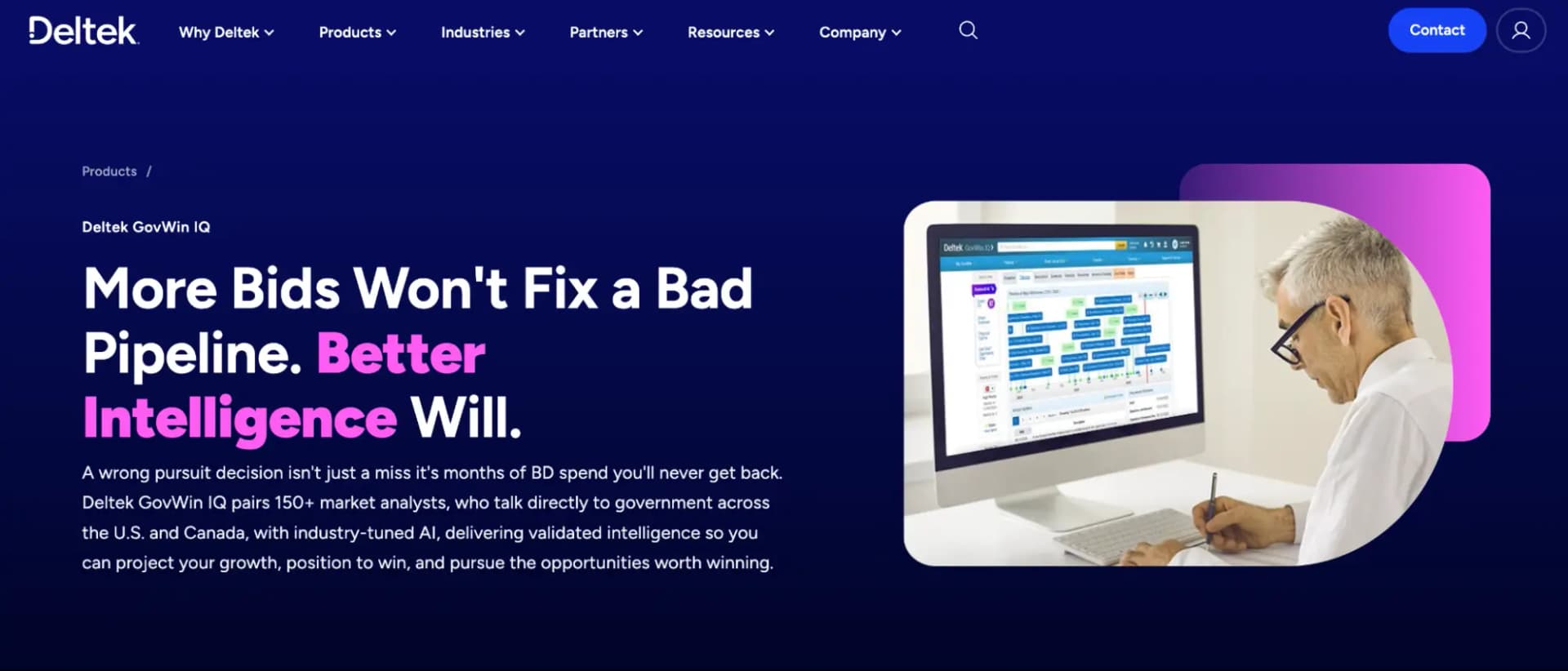
GovWin, a Deltek product, is a market intelligence platform for government contractors, backed by an analyst network and traditionally focused on the federal market with more recent state and local coverage. Its center of gravity is macro market trends and long-range forecasting.
What GovWin does well
GovWin’s main strength is analyst-driven federal opportunity intelligence. Analysts track federal procurement pipelines, recompete timelines, and agency spending patterns, surfacing federal leads years ahead of a public solicitation. That comes with insight into agency priorities and program funding trajectories.
The platform offers a comprehensive bid aggregation database with contract awards, spending analysis, and solicitation tracking, plus folder management and prioritization. Ask Dela, an AI feature, summarizes lengthy procurement documents so teams spend less time reading.
GovWin also delivers pricing and competitive intelligence for federal pursuits, including labor rate analysis, competitor identification, and teaming recommendations. It integrates natively with Deltek’s Costpoint and Vantagepoint, a fit for teams already in the Deltek ecosystem.
Where GovWin falls short
Search and navigation friction recurs in user reviews. As one G2 reviewerdescribed it, “searching outside of my saved searches is challenging. The filters are not user-friendly and can be difficult to find what I’m looking for. Lately postings have been missing attachments or have wrong dates.” For a team that depends on timing, a lag between an event and its appearance in the platform can matter.
GovWin IQ approaches contract vehicles as intelligence to track, such as GWACs and IDIQs. Getting a vendor onto a vehicle and selling through it is not part of the offering as of July 2026.
Best for
GovWin IQ is best for federal contractors who need analyst-backed opportunity intelligence, recompete tracking, and long-range market forecasting, with some visibility into state and local solicitations from the same platform. It fits teams whose center of gravity is the federal market rather than state and local districts and agencies.
5. Procurement Sciences
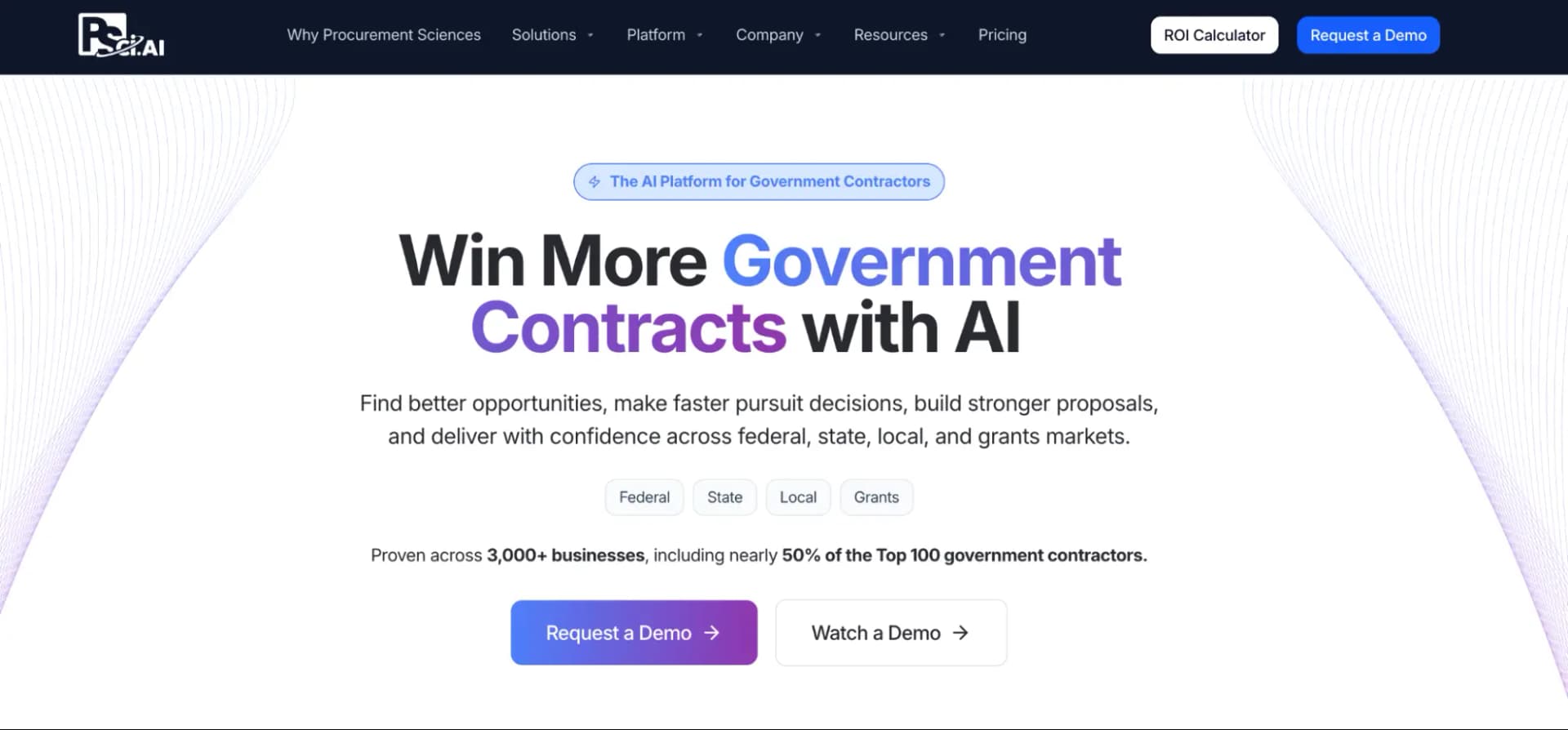
Procurement Sciences’ Awarded AI is a FedRAMP-authorized AI platform for government contracting, covering capture, bid/no-bid scoring, AI proposal drafting, pricing, and compliance workflows. It is traditionally used by federal GovCon teams and activates once an opportunity is posted, with more recent expansion into state, local, and education contracting.
What Procurement Sciences does well
Deep AI proposal drafting is the platform’s clearest strength. Teams upload an RFP and get a near red-team-ready draft quickly, with Section L and M, FAR, and DFARS compliance checks and bid/no-bid scoring.
Capture and competitive research round out the workflow. A deep-search capability gathers intelligence on competitors and potential clients during capture, and a knowledge base trained on past proposals and performance narratives speeds each new response.
The architecture is FedRAMP-authorized, with Azure GovCloud and CMMC and NIST 800-171 mapping. That security posture gives it credibility with compliance-heavy federal buyers.
Where Procurement Sciences falls short
Procurement Sciences leans towards federal GovCon capture and proposal work. Its opportunity intelligence comes from federal contract data and forecasts, and its HigherGov acquisition adds state, local, and education records mostly at the posting and award level rather than the board minutes and budget workshops that show a district or agency is preparing to buy before an RFP exists.
Reviewers who otherwise rate the platform highly point to capabilities that are still maturing. OneG2 reviewer found that its “deep research option does not compare to ChatGPT, Claude, or even Gemini.” Another reviewerreported that “the Bid Capture component has been lagging.”
Contract vehicle access as a vendor route to sell is not part of the offering as of July 2026.
Best for
Procurement Sciences is best for federal GovCon teams focused on capture and AI-drafted proposal responses in compliance-heavy environments. It suits organizations whose primary need is winning solicitations that already exist rather than generating pipeline before they post.
Which RFP finder tool is right for you?
If you want a simple, reliable feed of published local government and education solicitations to respond to, BidNet Direct or RFP School Watch may be enough for your team. Both deliver posted bids to your inbox with minimal setup, and RFP School Watch adds hands-on account support along the way.
If your center of gravity is the federal market, GovWin or Procurement Sciences are worth a look. GovWin brings analyst-backed forecasting and long-range federal market intelligence, while Procurement Sciences automates capture and AI-drafted proposal responses for compliance-heavy environments. Each fits a team whose pipeline is primarily federal and proposal-driven.
If you need the full motion, from an early buying indicator through verified contacts, spend context, and RFP response to a signed contract, Starbridge is the clear choice. For GTM teams that live in the state and local government, K–12, and higher education markets, Starbridge’s end-to-end coverage is what turns public information into signed contracts.
Ready to see it in action? Book a demo to see how Starbridge helps your team find, engage, and win more deals across government and education.
Starbridge is the best fit for teams that want one platform to carry a deal from an early buying indicator to a signed contract across state and local government, K–12, and higher education. BidNet Direct works well for vendors who want broad nationwide notification of published local government bids, and RFP School Watch fits teams that want a hands-on, category-filtered alert feed across education and government. GovWin suits federal contractors who need analyst-backed forecasting, while Procurement Sciences fits federal GovCon teams focused on AI-drafted proposal response. The right answer depends on how much of the sales motion you need one tool to cover.
Look for five capabilities that work as one connected motion rather than a single bid feed. The tool should surface buying indicators before an RFP posts, reach verified decision-makers with accurate contact data, show what an account already spends, centralize and score RFPs with drafting support, and provide contract vehicle access that carries a won deal to a signed purchase order. Each stage hands off to the next, so a gap in any one breaks the chain. A platform covering only one or two areas leaves your team to stitch the rest together by hand across research, enrichment, outreach, and procurement.
Starbridge focuses its contact data on this specific market rather than borrowing from commercial databases. It runs continuous crawls of official .gov and .edu sources, then waterfall-enriches and bounce-checks the results, so reps reach superintendents, procurement directors, and department heads who rarely maintain commercial web profiles. Databases that draw heavily from LinkedIn and commercial sources tend to go stale against these buyers, which shows up as higher bounce rates and lower deliverability. For a team where government and education is the core market, contact accuracy is where the difference is most visible.
Starbridge is built to shorten the time between a qualified buyer and a signed contract, not just to surface opportunities. When a deal stalls in procurement after the buyer says yes, contract vehicle access gives it a pre-approved path to purchase. Starbridge provides direct access to vehicles like NASPO, OMNIA, Sourcewell, and TIPS, and handles the compliance, paperwork, and renewals itself as part of the platform. The other tools in this guide do not publicly state contract-vehicle sell-through as a capability as of July 2026, so they help find and respond to opportunities rather than close them.
Yes, but only if it monitors early buying indicators rather than waiting for a published solicitation. Starbridge surfaces board meeting discussions, budget line items, grant awards, leadership changes, and contract expirations months before a formal RFP appears. That lead time is what lets a vendor build a relationship and shape evaluation criteria while requirements are still being written. Tools that begin at the point of publication, such as posted-bid alert feeds, are useful for response but arrive after the window to influence the deal has largely closed.
Starbridge is priced for enterprise and growth-stage GTM teams, so a very early-stage company still validating an outbound motion may find it sits at the premium end of the category. Its federal coverage is also lighter than a federal-first tool, and its AI proposal writer accelerates responses rather than replacing a dedicated proposal hire. Where it earns the investment is for teams where selling to state and local government, K–12, and higher education is a real, resourced go-to-market motion. For those teams, consolidating a fragmented stack into one connected workflow is what makes the pricing pay off.
Frequently asked questions
Explore our use case library
 Automate account research with AI agentsStop manually researching accounts. Starbridge AI agents automate account research by monitoring buying signals 24/7 and surfacing the right contacts.
 Identify competitor contract expiration datesThe RFP is usually a formality. Starbridge surfaces competitor contract expiration dates so your reps reach accounts before the renewal cycle closes.
 Create a conference campaignTurn conference badge scans into pipeline. Import your contact list, surface buying signals across every account you met, and follow up with context.