
Best contract intelligence tools for public sector sellers in 2026
Compare six contract intelligence tools for government and education sellers on pre-RFP signals, contact data, spend visibility, and RFP response.

If you sell into state and local government, K–12, and higher education, you’re probably weighing a few contract intelligence tools to help your team close more deals. This article compares six platforms for government and education sellers across five capability areas:
| Platform | Identifying opportunities before RFPs | Contact and account data quality | Vendor spend visibility | RFP discovery and response | Contract vehicle access |
|---|---|---|---|---|---|
| Starbridge | Monitors board minutes, budgets, grants, leadership changes, and more across 320k+ entities | 98% email accuracy from continuous crawls of .gov and .edu sources with ongoing bounce-checking | Full competitor contracts with pricing, opt-out clauses, and expirations, plus purchase order data for 77% of institutions | AI-scored RFP feed across thousands of portals with a native AI proposal writer | Shorten sales cycles with contract vehicle access (NASPO, OMNIA, Sourcewell, and more - with compliance handled). Free to start. |
| GovSpend | Historical purchase orders, plus a newer AI-ranked Opportunities module and searchable meeting transcripts | Contacts sourced through agency relationships and record requests on variable refresh cycles | Line-item purchase order data across thousands of state and local agencies | RFP database with relevance ranking, and proposal drafting through a third-party partner | Contract vehicle access is not part of the offering as of July 2026. |
| Govly | Federal industry news, agency budgets, and policy moves, with state and local coverage drawing on solicitation and award data | Centered on channel-partner coordination rather than verified buyer contacts | Award and recipient data from public federal sources | Solicitation aggregation across SAM.gov and state and local sources with shared workspaces | Govly offers access to federal contract vehicles, but it doesn’t offer access to contract vehicles for state, local and education as of July 2026. |
| Sweetspot | Forward-looking signals oriented around federal award forecasts and budget data | Centers on opportunity and proposal workflows rather than verified buyer contacts | Federal award history for incumbent and competitive research | AI opportunity discovery across SAM.gov, FPDS, and other sources with an autonomous AI Form Fill agent | Contract vehicle access is not part of the offering as of July 2026. |
| GovTribe | Federal, state, and local opportunity, award, and recompete data with an AI query layer | Buyer and vendor contact profiles enriched from a broad industry audience | Searchable federal, state, and local award and spend data | Opportunity search and capture tools across federal, state, and local bids with proposal support | GovTribe partners with federal contract vehicles, but it doesn’t yet offer contract vehicles that help selling to state, local and education institutions as of July 2026. |
| GovWin | Analyst-backed forecasting, with bid and RFP alerts after a solicitation posts | Contact data from procurement listings and agency org charts | Contract award and spend tracking, strongest at the federal level | Large federal and state/local bid database with proposal-lifecycle tooling | GovWin offers access to federal contract vehicles, but it doesn’t yet offer contract vehicles that help selling to state, local and education as of July 2026. |
What to look for in a contract intelligence tool
When you evaluate a contract intelligence tool for the government and education market, five capabilities separate a platform that generates pipeline from one that only reports on activity that has already happened:
- Identifying opportunities before they go to RFP. The best platforms surface early buying signals from public sources before a solicitation is posted, such as a new grant, a budget line item, a contract about to expire, or a leadership change tied to purchasing. This matters because government buyers aren’t experts in the solutions they need, so they consult vendors early to learn what is possible. The vendor who engages before the RFP shapes the evaluation criteria and enters the process as the frontrunner.
- Contact and account data quality. You need verified names, emails, and phone numbers for the decision-makers inside agencies, districts, and institutions, kept current as people change roles. This is a finite market where sender reputation travels fast between buyers who talk to one another. Reaching out to a contact who left two years ago wastes rep time and drags down deliverability across the whole sequence.
- Visibility into what agencies and institutions are already buying. Access to purchase data, competitor contracts, pricing, and expiration dates tells a rep who the incumbent is and when the renewal window opens before a call. Knowing what a prospect already pays a competitor is what lets a rep position against that incumbent. It’s also what makes it possible to time a displacement play instead of guessing.
- Finding and responding to RFPs efficiently. A centralized, scored feed of relevant bids across fragmented state, local, and education portals saves reps from monitoring thousands of sites by hand. Drafting help on the response side turns a multi-day task into a manageable one. RFPs are scattered widely, and manual monitoring and drafting burn days a rep could spend in conversations.
- Contract vehicle access that removes procurement friction. A direct path to sell through cooperative and federal purchasing vehicles like NASPO ValuePoint, OMNIA Partners, and Sourcewell, with compliance and paperwork handled, keeps a won deal from stalling. A closed-won opportunity can still sit in procurement for months. Selling through a vehicle the buyer already uses turns “vendor of choice” into a signed purchase order faster.
These five capabilities work as one continuous motion, not a menu of separate tools. A buying indicator is only useful when it arrives attached to a verified contact and the account context to act on it, while spend visibility only converts when it feeds a timely conversation. The motion runs from an early signal to a booked meeting to a signed contract, with no single capability sitting above the others.
The platforms evaluated here diverge mainly in how much of the motion they cover all the way through, versus how much they leave teams to bring together manually across research, enrichment, outreach, and procurement.
1. Starbridge
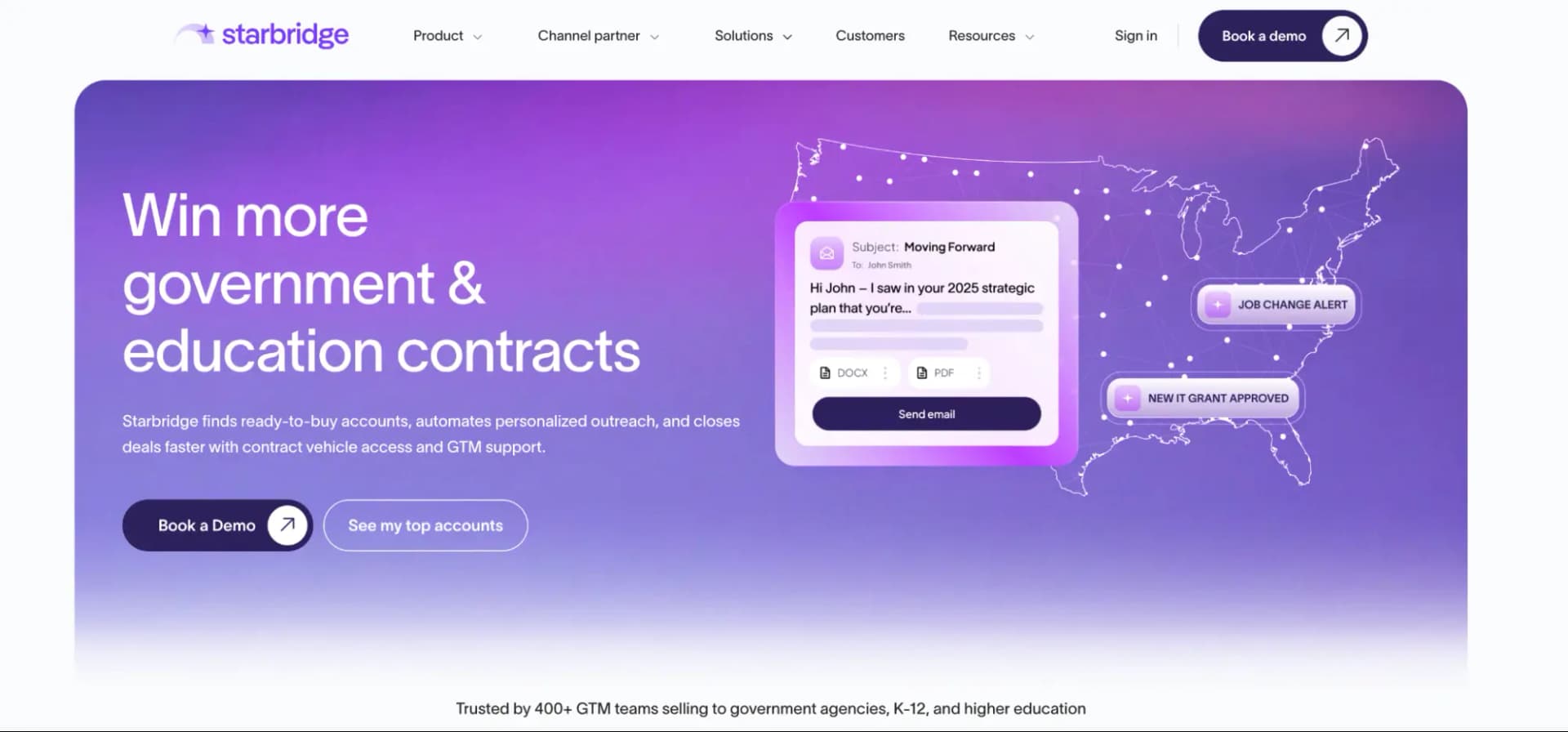
Starbridge is the AI sales intelligence platform built for companies selling to state and local government, K–12, and higher education, helping revenue teams identify, prioritize, and engage high-intent opportunities before the competition. It’s designed for companies running an outbound motion into this market who want one system that carries a deal from an early buying signal through to a signed contract.
What Starbridge does well
Starbridge is built around five capabilities that cover the full government and education sales workflow.
The first is the Buying Signal Monitor, which monitors 320k+ government and education entities for buying indicators buried in board minutes, budgets, grants, leadership changes, and contract expirations. When a signal fires, Starbridge delivers a warm lead with who to contact, why the timing is right, and what to say, often weeks to months before a solicitation posts. That pre-RFP lead time is the difference between shaping an evaluation and reacting to one. InquirED put this to work in the first quarter with Starbridge, replacing manual board-document research with signal-driven account scoring to find districts actually ready to buy. Starbridge generated $200K in new pipeline as a result.
Alongside those signals, Contacts & Company Data gives reps verified decision-maker contacts sourced from official .gov and .edu domains and agency directories. The records are waterfall-enriched and continuously bounce-checked to reach 98% email accuracy across a 14,000-email test, against a 60–70% range typical of generic databases. A bi-directional Salesforce and HubSpot integration syncs, cleans, and enriches the CRM so those records stay current where reps already work.
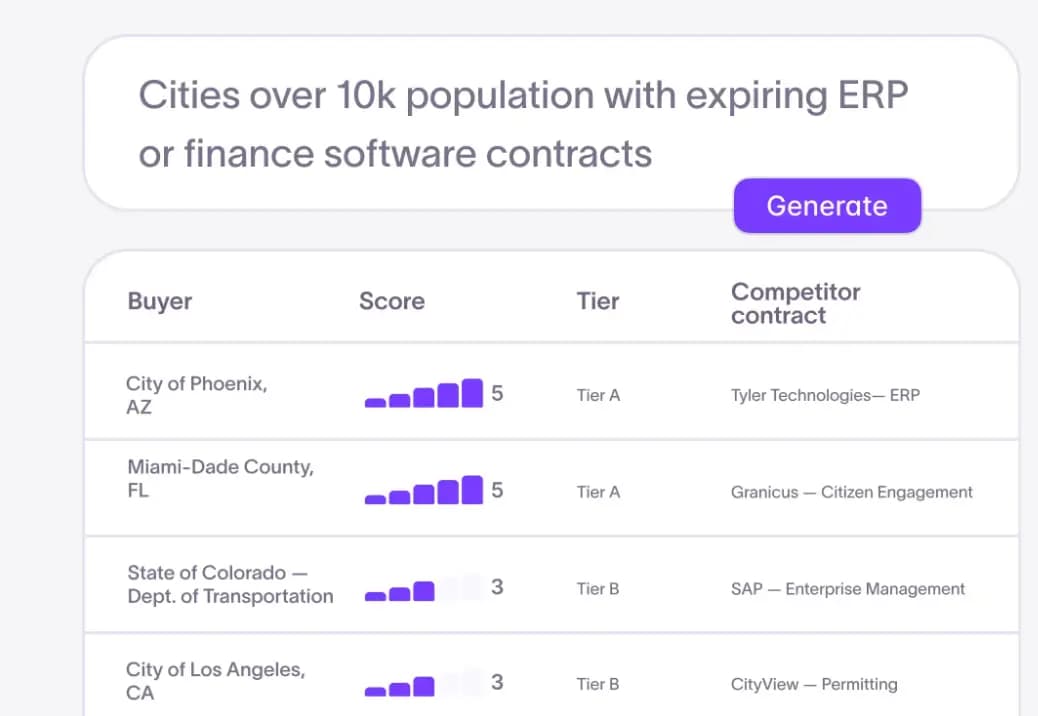
Building on that account data, Public Spend Intelligence gives reps full competitor contracts with pricing, opt-out clauses, and expiration dates, plus purchase data sourced through FOIA automation. Out of the box, Starbridge has the purchase order data for 77% of state/local government, K–12, and higher education institutions. A rep can walk into a discovery call already knowing what the prospect pays an incumbent and when that contract ends. Zencity, for example, sources 50% of its cold meetings from Starbridge, with reps using Ask Starbridge to enter first calls already knowing procurement pathways and past contracts.
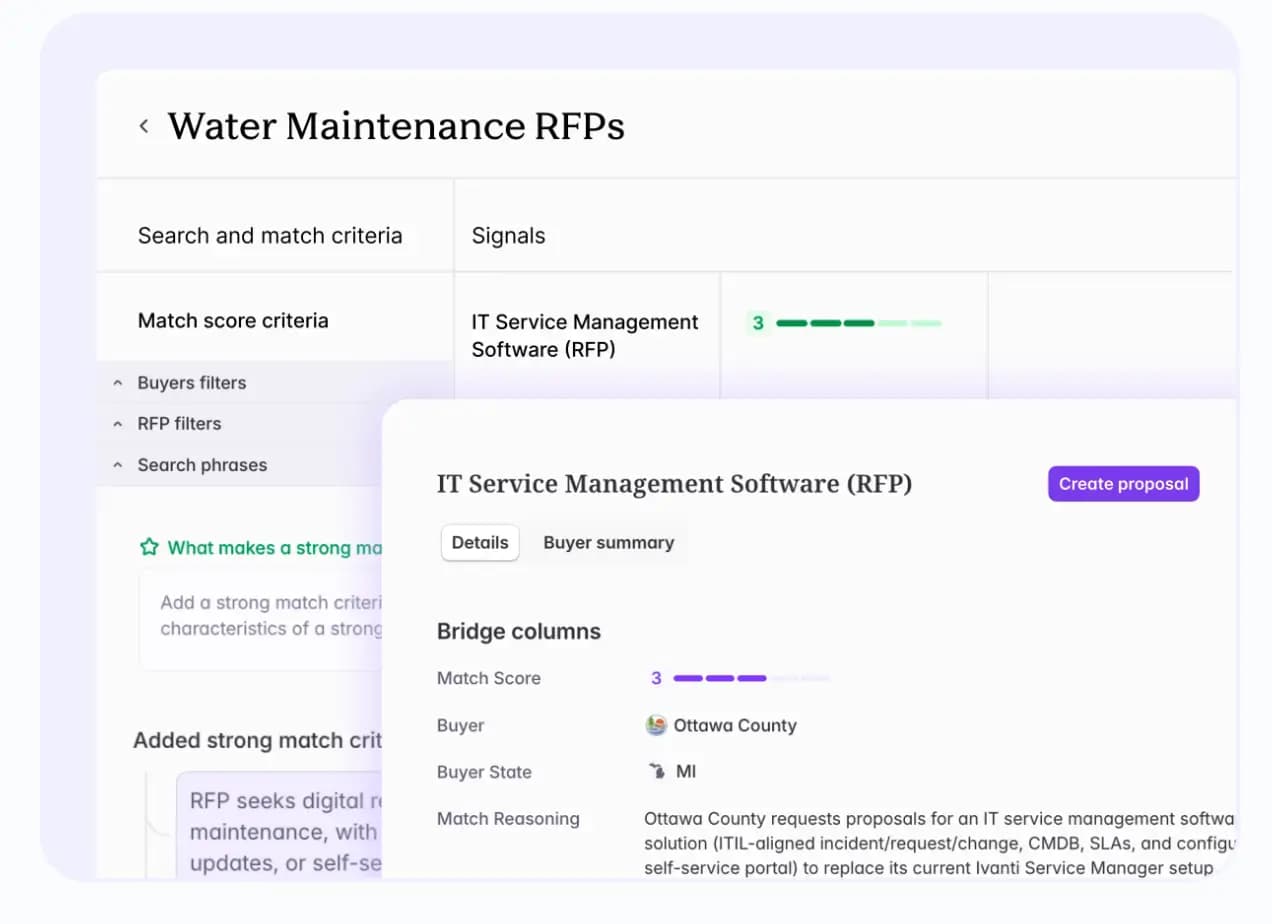
The fourth capability, the AI RFP Finder & Proposal Writer, centralizes thousands of state, local, and education bid portals into one personalized feed. It scores RFPs by product fit, region, and win likelihood, then drafts responses with an AI proposal writer. Reps find more best-fit RFPs and respond to them without burning the team on manual drafting.
The fifth capability, Contract Vehicle & Reseller Access, gives teams direct access to major cooperative and federal purchasing vehicles, including NASPO ValuePoint, OMNIA Partners, Sourcewell, and more, as part of the platform. Starbridge handles the compliance, paperwork, and renewals itself. A won deal moves onto a contract vehicle the buyer already uses and reaches a signed purchase order in weeks instead of months.
Where Starbridge falls short
Federal coverage is thinner than Starbridge’s state and local government and education data. Teams whose primary motion is federal will find deeper federal intelligence in tools built for that market. Starbridge is strongest where it is purpose-built, which is state and local government, K–12, and higher education.
The AI proposal writer is lightweight and meant to accelerate responses, not to replace a dedicated RFP hire. Teams running a high volume of complex proposals will still want that specialized role. The writer speeds up drafting rather than owning the full proposal function.
Pricing sits at a premium and suits established enterprise and mid-market revenue teams better than early-stage companies.
Best for
Starbridge is the strongest fit for enterprise revenue teams running outbound into state and local government, K–12, and higher education. These are teams that want one platform to carry a deal from an early buying signal through verified contacts, spend context, and RFP response to a signed contract. It fits companies that would rather consolidate the full motion than stitch together separate tools for research, enrichment, outreach, and procurement.
2. GovSpend
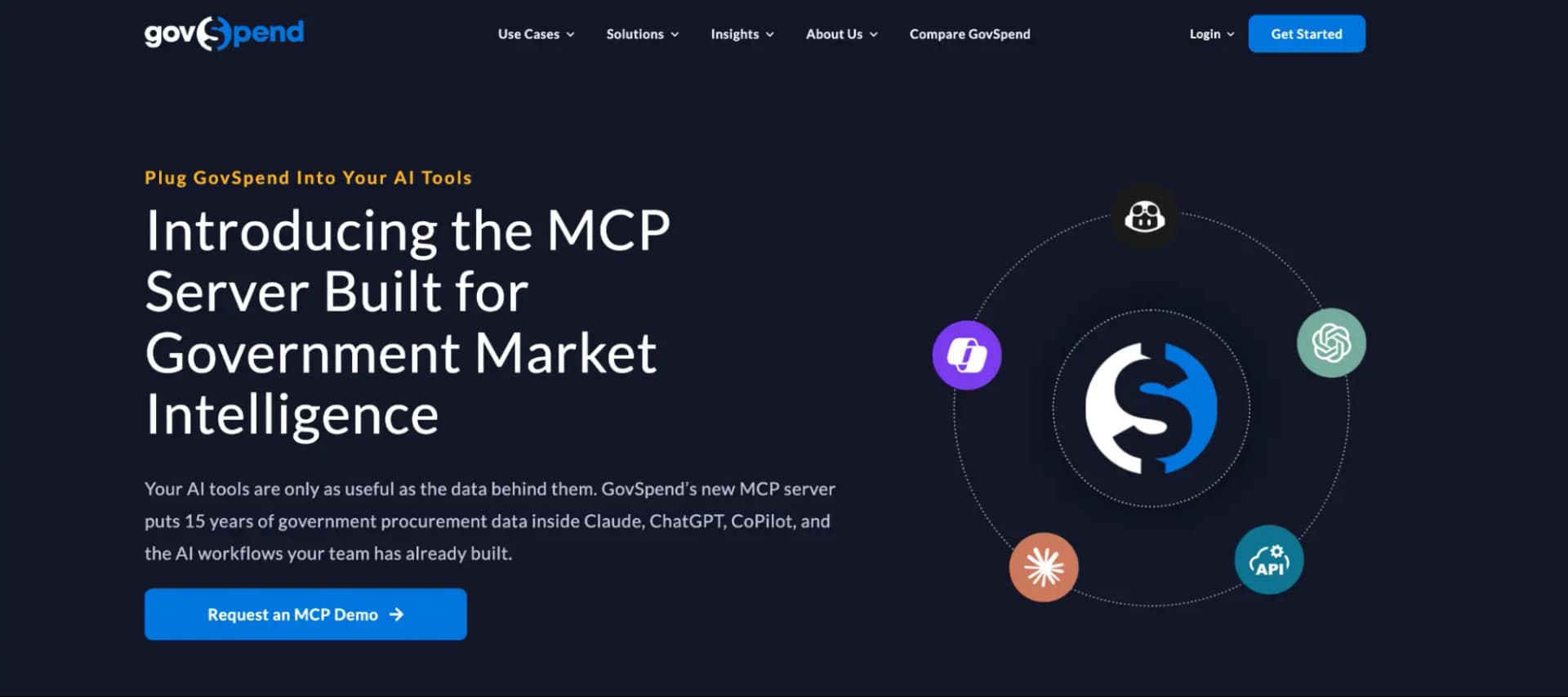
GovSpend is a procurement intelligence platform centered on historical purchase order data across state and local government and federal markets. It serves vendors, agencies, and consultants who want visibility into government purchasing activity.
What GovSpend does well
GovSpend’s core strength is historical line-item purchase order data across state and local agencies. That depth supports competitive displacement research, pricing benchmarking, and market sizing within a product category.
On top of that foundation, GovSpend has added new layers, including an AI-ranked Opportunities module and searchable meeting transcripts that surface activity entering the public record.
GovSpend also offers native Salesforce and HubSpot integrations that connect its procurement data to existing sales workflows. That connection lets teams pull spend records into the systems where they already manage accounts.
Where GovSpend falls short
Contact-data gaps are a recurring theme in user feedback, with one G2 reviewer writing that “that Govspend provides doesn’t even have business email addresses.” For a team trying to move from a spend record to an actual conversation, missing emails may mean the research doesn’t translate into outreach.
“Sometimes data seems outdated or requires additional verification,” another G2 reviewer noted, pointing to data freshness as a timing constraint. When outreach depends on catching a contract expiration or a displacement window, stale records push reps to the wrong moment. Freshness gaps compound when the whole play hinges on timing.
Contract vehicle access isn’t a stated part of the GovSpend offering as of July 2026. Its contracts module provides visibility into who holds current contracts and when they expire. That visibility supports research rather than a path to sell through a purchasing vehicle.
Best for
GovSpend fits teams focused on procurement research and historical spend analysis. It’s strongest when the primary use case is understanding what agencies have purchased to inform competitive positioning and pricing strategy in the state and local government market.
3. Govly
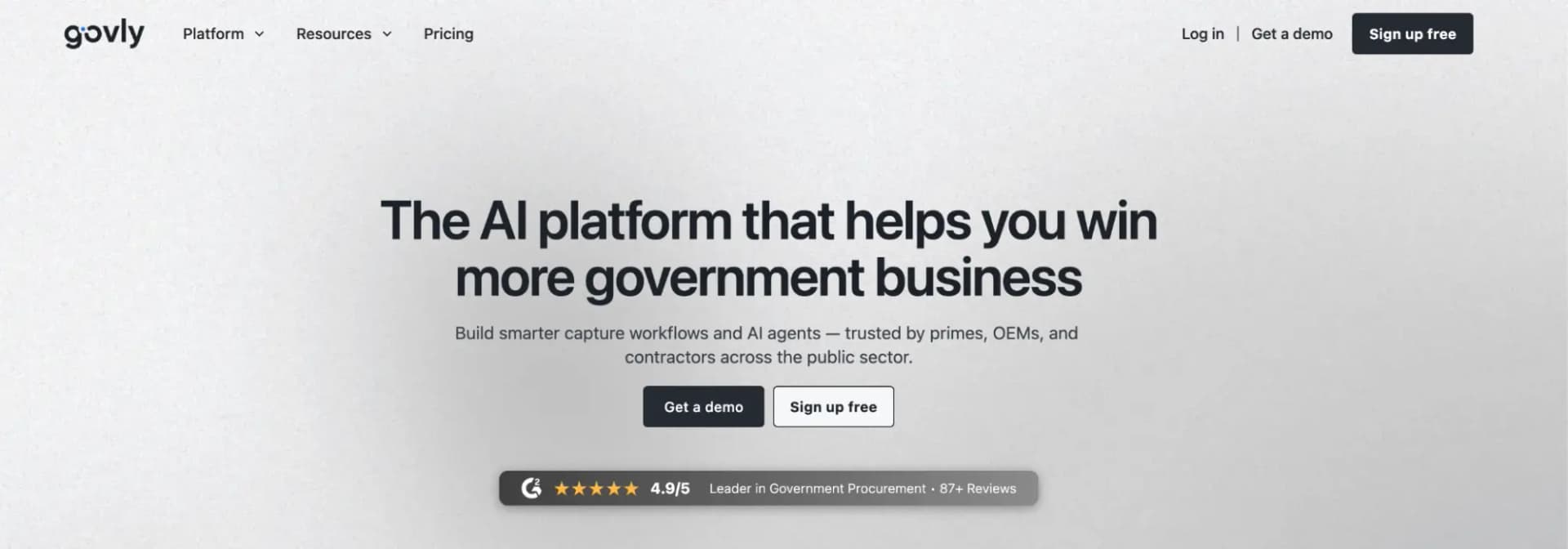
Govly is a market network for government contractors that connects OEMs, VARs, distributors, and prime contractors. It centers around federal contract vehicle visibility, with state and local solicitation tracking added as a secondary capability. It serves channel partners coordinating teaming and subcontracting relationships around federal opportunities.
What Govly does well
Govly connects OEMs (equipment makers), resellers, distributors, and prime contractors so they can coordinate on shared bids. HPE and CDW-G are among its notable customers.
The platform tracks federal contract vehicles across more than 40 programs, including SEWP and CIO-SP. Reps selling through a reseller network can see which of these vehicles a given deal is likely to run through.
Govly also pulls together solicitations from SAM.gov and thousands of state and local sources, with search and filtering to help teams manage responses in one place. Its shared workspace feature is meant for situations where multiple companies are responding to the same bid together.
Where Govly falls short
Govly focuses on federal GWAC and IDIQ tracking and channel-partner coordination, serving primes, OEMs, VARs, and distributors. The platform was built federal-first, and its state and local coverage came later.
Its signal layer centers on federal industry news, federal agency budgets, and policy moves. State and local coverage is built around solicitation and award data, which surfaces opportunities once they post. Govly does not market coverage of the board minutes, local budget documents, and strategic plans that often signal local government, K-12, and higher education intent well before a solicitation. Teams prioritizing pre-RFP entry will likely want those earlier indicators from another source.
Best for
Govly fits OEMs, VARs, and prime contractors selling federal through contract vehicles and reseller partners. These are teams that need teaming tools and GWAC and IDIQ opportunity visibility in one network. The value is highest for channel-driven federal motions where coordination among partners is the central job.
4. Sweetspot
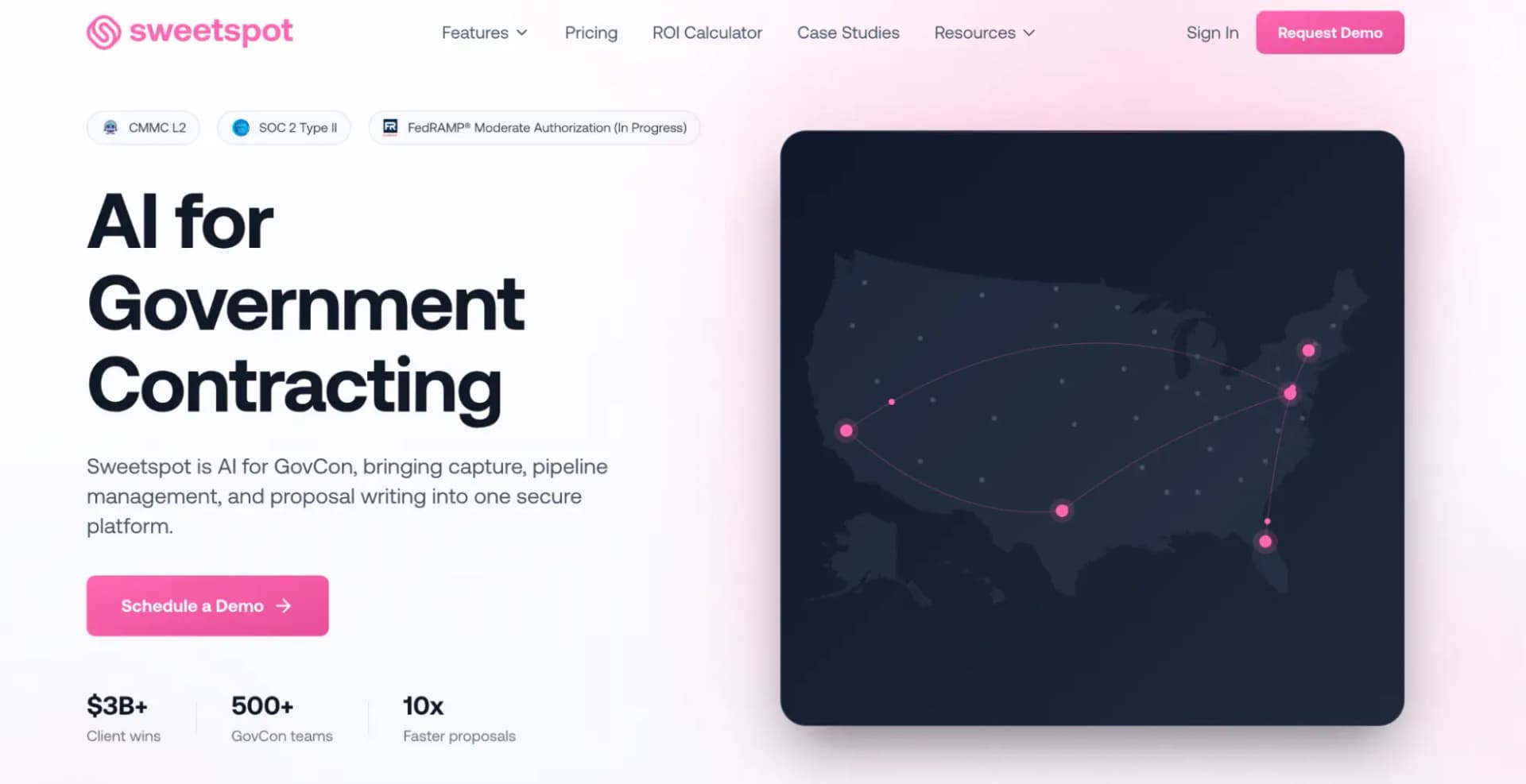
Sweetspot is an AI platform for government contracting that helps teams find, manage, and respond to contract opportunities, with a federal lean. It serves GovCon teams, especially federal small businesses, that respond to RFPs and recompetes.
What Sweetspot does well
Sweetspot offers AI-powered opportunity discovery across SAM.gov, FPDS, and state and local sources, with a search layer that helps teams find relevant contracts quickly.
The platform includes AI proposal automation, notably an autonomous AI Form Fill agent that completes RFIs, PPQs, and security questionnaires.
Sweetspot also carries an enterprise-grade security posture with SOC 2 Type II and CMMC Level 2 certifications, which makes it credible with compliance-heavy federal buyers. For teams selling into security-conscious agencies, that posture removes an early obstacle.
Where Sweetspot falls short
Sweetspot’s forward-looking signals are oriented around federal award forecasts and budget data rather than the state, local, and education indicators like board minutes, district budgets, and strategic plans. A team selling into schools and local agencies may find the earlier intent it needs sits outside that federal focus.
Sweetspot partially focuses on finding and responding to opportunities rather than mapping the decision-makers behind them. That leaves the contact side of the motion lighter for this market.
Contract vehicle access isn’t a stated part of the Sweetspot offering as of July 2026. The platform centers on opportunity discovery and proposal workflows. It helps teams win a posted opportunity rather than route a won deal through a purchasing vehicle.
Best for
Sweetspot fits federal small businesses and GovCon proposal teams. These are teams that want AI-assisted opportunity discovery and faster, automated proposal and questionnaire drafting. The value is highest once an opportunity is posted and the work shifts to responding well. Teams whose core job is federal proposal response will get the most from it.
5. GovTribe
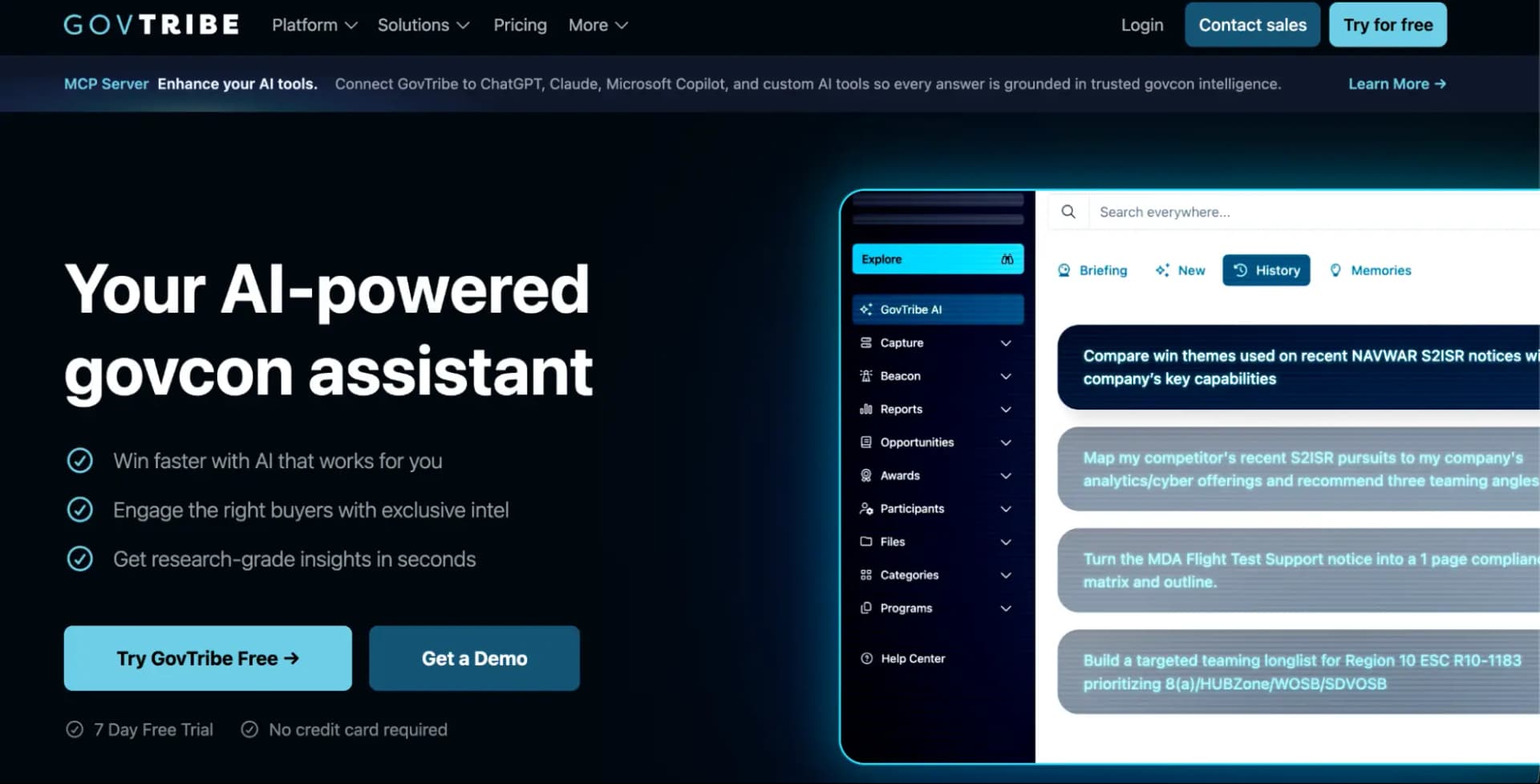
GovTribe is a market-intelligence platform for government contractors, a searchable database of opportunity, award, and spend data with an AI chat layer on top. It was founded in 2012 and acquired by GovExec in 2021, and its deepest heritage is in federal contracting. It serves capture and business development teams researching opportunities, awards, and contractor past performance.
What GovTribe does well
GovTribe offers a searchable database spanning opportunities, awards, and spend, with an AI chat layer that makes it fast to research a market or an agency’s history.
Additionally, the platform provides contractor past-performance and award data for teaming decisions and incumbent research.
GovTribe also includes a capture management feature that centralizes opportunity tracking, proposal management, and collaboration through customizable pipelines. That gives teams a single place to move a pursuit from opportunity through proposal
Where GovTribe falls short
GovTribe’s deepest coverage sits in federal contracting, where it has operated since 2012, while its state and local data centers on posted bid opportunities and awards. Teams whose motion runs through school districts and local agencies will find the earlier indicators, like board minutes and district budgets, sit outside that posted-opportunity focus.
Much of GovTribe’s value may come after an opportunity or recompete has been identified in the public record, which suits capture research and bid or no-bid decisions. A company that wants to engage before a solicitation takes shape works against that orientation.
According to its advertisements, GovTribe’s contact data is enriched from a broad industry and buyer audience through its parent company rather than sourced from the specific agency, district, and institution directories a state and local seller works from. Reps may still need to confirm the exact decision-maker for a given account, since the research and the outreach target aren’t always the same step.
Best for
GovTribe fits capture and business development teams, with its deepest strength in federal contracting. These are teams that need fast, searchable research on posted opportunities, awards, and contractor past performance. The value is highest for market research and teaming decisions.
6. GovWin (Deltek)
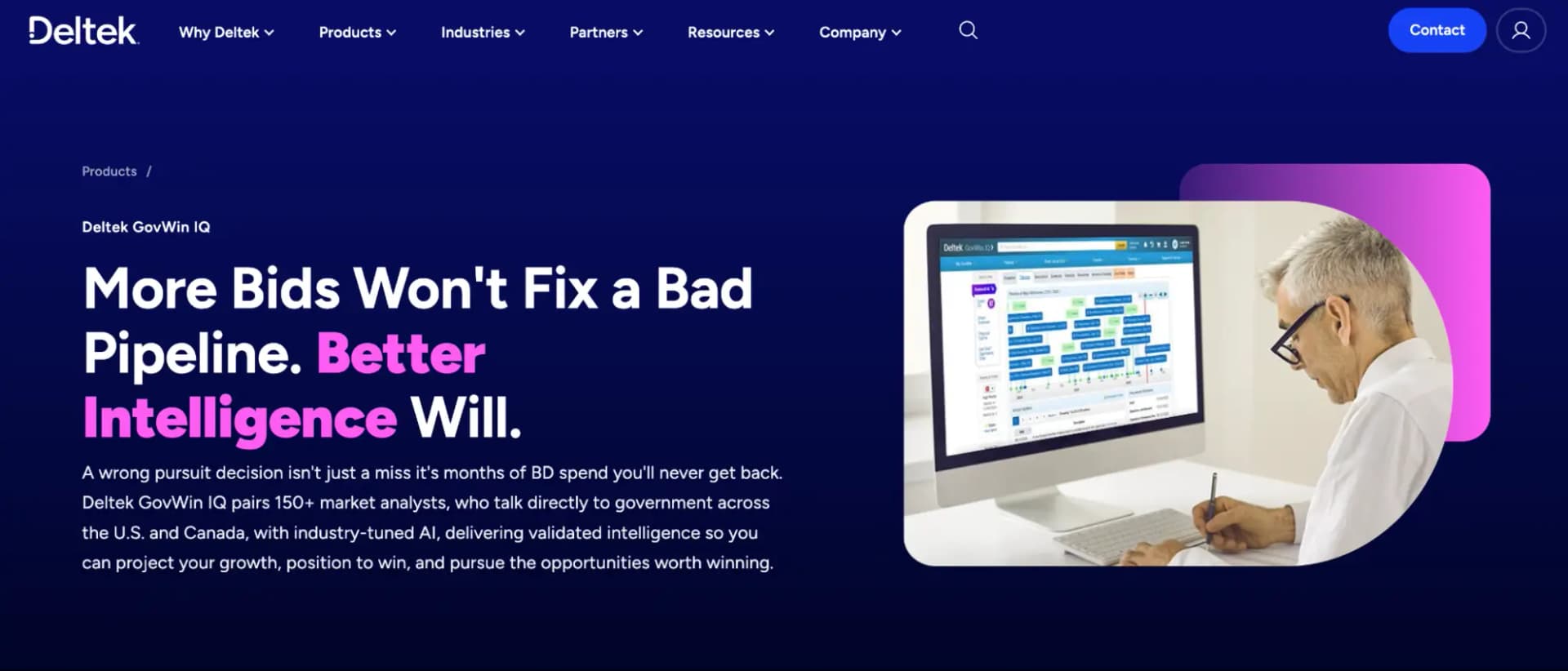
GovWin is Deltek’s market-intelligence platform for government contractors, pairing a large analyst team with bid, award, and contract data. It’s moving into proposal-lifecycle tooling and is federal-first with a secondary state and local line. It serves federal capture teams discovering and responding to opportunities.
What GovWin does well
GovWin offers analyst-backed market intelligence and long-range forecasting that helps teams understand broad government market trends and plan around federal spending years out. That macro view supports strategic planning more than day-to-day prospecting.
The platform provides a comprehensive bid database with folder management and prioritization, so teams can organize a high volume of posted opportunities in one place.
GovWin also includes proposal-lifecycle tooling such as Dela AI, Smart Fit Score, and a Compliance Matrix that supports the response side of a federal pursuit.
Where GovWin falls short
One G2 reviewer named “the delays in updates being posted to GovWin” as the platform’s main drawback. For a team that depends on catching an opportunity early, that lag may push engagement later than they’d like.
Another G2 reviewer described trouble searching outside of saved searches, noting that “the filters aren’t user-friendly and can be difficult to find what I’m looking for. Lately postings have been missing attachments or have wrong dates.” Teams selling primarily into local government, K–12, and higher education may find that the depth and accuracy of coverage doesn’t match what the platform delivers on the federal side.
Best for
GovWin fits federal capture teams and larger contractors. These are teams that want analyst-backed market forecasting and posted bid coverage across federal and, secondarily, state and local markets. The value is highest for federal planning and bid tracking at scale.
Which contract intelligence tool is right for you?
If you need comprehensive historical spend and purchase order research to inform pricing and competitive positioning, GovSpend may be enough on its own.
If your motion is federal proposal discovery and response, or federal channel-partner teaming, Sweetspot, GovTribe, and Govly are each worth a look for that specific job. Sweetspot leans into AI-assisted proposal work, GovTribe into searchable federal research, and Govly into channel coordination.
If you sell into local government, K–12, and higher education, you want one platform that carries a deal from an early buying signal all the way to a signed contract. A tool that covers verified contacts, spend context, and RFP response along the way, not just one piece of it. Starbridge covers all five capabilities end-to-end. Your team acts on early intent, reaches the right people, and closes through a vehicle the buyer already uses. That coverage is what turns intelligence into closed deals.
Ready to see how Starbridge helps your revenue team win more deals across government and education? Book a demo to learn more.
The best contract intelligence tool for public sector sellers depends on your market. For teams selling into state and local government, K–12, and higher education, Starbridge is the strongest fit because it carries a deal from an early buying signal to a signed contract in one platform. GovSpend suits teams that mainly need historical purchase order and spend research. Sweetspot, GovTribe, and Govly each fit federal-focused motions. GovWin fits larger federal capture teams that want analyst-backed forecasting and deep posted-bid coverage.
Look for five capabilities that work as one motion. Identifying opportunities before they reach an RFP, verified contact and account data, visibility into what agencies already buy, RFP discovery and response, and contract vehicle access that removes procurement friction. The strongest platforms connect these so a buying signal arrives with a verified contact and the context to act on it. Judge each option on how much of that end-to-end motion it actually covers.
Contact data quality is where platforms serving government and education diverge most, because generic databases draw heavily from LinkedIn and commercial sources that barely reach these buyers. Starbridge sources contacts directly from official .gov and .edu domains and agency directories, then waterfall-enriches and continuously bounce-checks them to reach 98% email accuracy across a 14,000-email test. Starbridge is happy to run a contact-data accuracy bakeoff against your current tool on your own list of contacts.
Starbridge is the option that helps you close government deals faster, not just find them, because contract vehicle access is part of the platform. A won deal can stall for months in procurement after the buyer says yes, so Starbridge lets teams move that deal onto a vehicle the buyer already uses, such as NASPO ValuePoint, OMNIA Partners, or Sourcewell. Starbridge provides this access directly and handles the compliance, paperwork, and renewals itself, available as part of the platform.
Starbridge sits at a premium price point, and it’s a stronger fit for established enterprise and mid-market revenue teams. Teams that only need a single narrow job solved, like historical spend lookups, may find a point tool enough to start. The value shows up when a full team is prospecting into government and education and wants research, enrichment, RFP response, and procurement in one system.
Frequently asked questions
Explore our use case library
 Automate account research with AI agentsStop manually researching accounts. Starbridge AI agents automate account research by monitoring buying signals 24/7 and surfacing the right contacts.
 Identify competitor contract expiration datesThe RFP is usually a formality. Starbridge surfaces competitor contract expiration dates so your reps reach accounts before the renewal cycle closes.
 Create a conference campaignTurn conference badge scans into pipeline. Import your contact list, surface buying signals across every account you met, and follow up with context.