
How to Find Government Contracts Before They’re Posted
Bid boards show contracts too late. Learn where government contracts live, how to find them before the RFP drops, and why expiring contracts are a power move.

By the time the RFP drops, the deal is already decided. Most advice on how to find government contracts points you to SAM.gov and a handful of bid boards, and that advice arrives too late. Researchers at Carnegie Mellon found that 44% of the U.S. government’s procurement budget in fiscal year 2015 was awarded to contracts that attracted exactly one bid. The winning vendors didn’t out-propose anyone. They built the relationship before the solicitation existed.
This guide covers the full picture. Where posted contracts actually live across federal, state, local, and education markets. How to spot opportunities months before the RFP is published. And why tracking contract expirations, with help from public records laws, is the most underused discovery channel in government sales.
If you sell to state and local governments, K-12 school districts, or higher ed institutions, this is the map. Bid boards are one layer of it, and they are the shallowest.
How Do You Find Government Contracts?
You find government contracts in three layers. Posted solicitations are listed on SAM.gov, state eProcurement portals, and bid aggregators. Awarded contracts sit in public award databases and become opportunities again as they approach expiration. Future contracts surface first in budgets, capital plans, and board meeting minutes, months before any RFP is published.
The three layers of contract visibility
Most vendors only ever work the first layer. They register on portals, set keyword alerts, and respond to whatever appears. That layer is real, and this guide covers it in detail below. It is also the layer where every competitor is looking at the same list on the same day.
The second layer is awarded contracts. Every contract a government signs is a public record with a value, a vendor, and an end date. When that end date approaches, the buyer has to renew, rebid, or replace, which makes award data a forward-looking opportunity map that most sales teams never open.
The third layer is intent that hasn’t become a solicitation yet. Government and education buyers document their plans in public. Budgets, capital improvement plans, board meeting minutes, and grant awards all describe purchases that are coming. Vendors who read this layer engage buyers 6 to 18 months before anyone else knows the deal exists.
Why bid boards are the last place opportunities appear
A solicitation is the end of a long, mostly public process. The agency identified the problem, discussed it in meetings, budgeted for it, and wrote requirements, often in consultation with a vendor. Prospects tell us versions of the same story constantly. Another vendor talked to the account before the RFP was released, and the RFP was written for that specific vendor.
That is why responding cold to bid board alerts produces so little. If your first touch is a proposal, you are often just filling out paperwork for someone else. Bid boards belong in your workflow as a confirmation layer, not as the source of pipeline.
Should You Target Federal or State and Local Contracts?
For most companies entering government sales, the state, local, and education market is the more accessible starting point. The federal market is larger per contract but structurally favors established contractors. The math below explains why.
One government versus 91,438
There is one federal government, and it advertises its opportunities in one place. The 2025 Census of Governments counts 91,438 local governments beneath the 50 states. That includes 3,031 counties, 19,489 municipalities, 16,184 townships, 12,535 independent school districts, and 40,199 special districts. Add hundreds of thousands of buying entities within them, individual schools, departments, and agencies, and the shape of the market becomes clear.
Centralization cuts both ways. Federal opportunities are easy to find and brutally contested. State and local opportunities are fragmented across thousands of sources, and vendors willing to solve the fragmentation problem face far less competition per deal.
Why the federal market favors incumbents
Federal contracting rewards infrastructure that new entrants don’t have. Past performance ratings, schedule contracts, security clearances, and capture teams that work opportunities for years. The single-bid data in the introduction is a symptom of that entrenchment. Most companies that succeed federally start as subcontractors and climb slowly.
State and local buying works differently. Purchases are smaller, decisions are made locally, and the decision-makers are reachable. A superintendent, a city IT director, or a county procurement officer will take a relevant meeting in a way a federal program office rarely does.
The market you’re narrowing into
Narrowing is not settling. State and local governments purchased $1.27 trillion in goods and services in 2025, according to Bureau of Economic Analysis data. That spend flows through state agencies, cities, counties, school districts, and higher ed institutions, each with its own budget and buying authority.
The rest of this guide uses “government contracts” to mean that market. The discovery tactics below apply to school districts and universities just as much as to city halls and state agencies.
Where Do Government Contracts Get Posted?
Posted solicitations are table stakes. You need visibility into them, and you need to stop treating them as the whole game. Here is where they live.
SAM.gov for federal opportunities
Federal agencies must advertise contract opportunities above $25,000 on SAM.gov. Registration is free, searches can be saved, and alerts are straightforward. If federal is part of your strategy, start there. If it isn’t, spend your energy on the sources below, because none of them feed into SAM.gov.
State eProcurement portals
Every state runs its own procurement portal where state agencies, and often local entities, post solicitations. Virginia has eVA, Texas has the Electronic State Business Daily, California has Cal eProcure, and New York publishes the Contract Reporter. Register as a vendor in each state you sell into and configure commodity-code alerts so relevant postings reach your inbox.
The registration work is tedious and worth it. Many states also require vendor registration before you can be awarded anything, so doing it early removes a closing-stage delay. Our guide to how to get state contracts walks through the state-level process step by step.
Local government and education sources
Counties, cities, and school districts post solicitations on their own websites, in regional purchasing groups, and in local legal notices. Some states aggregate local postings into the state portal. Most don’t. Commercial bid aggregators consolidate part of this activity, and even the best coverage has gaps at the district and small-city level.
This is the layer where teams end up manually searching, building lists in spreadsheets, and checking dozens of bookmarked procurement pages every week. The fragmentation is exactly why so many vendors retreat to federal-only advice, and it is also where the least contested opportunities sit. We cover this layer in depth in our guide to finding local government contracts.
Cooperative purchasing networks
Cooperative contracts let a government or education buyer purchase off a contract another entity has already competitively bid, skipping their own solicitation entirely. NASPO ValuePoint moved more than $24 billion in 2024 as the purchasing cooperative of all 50 states, and Sourcewell reported $5.85 billion in cooperative contract sales in fiscal year 2024, up 15.5% year over year.
Cooperatives matter for discovery in two directions. Winning a seat on a cooperative contract makes you findable by tens of thousands of eligible buyers. And browsing existing cooperative contracts in your category shows you which competitors hold them and when those contracts expire.
The contracts that never get posted
A large share of government purchasing never appears on any bid board. NASPO’s 2024 Survey of State Practices found that formal competition thresholds range from $10,000 in states like Massachusetts to $250,000 in Colorado, with a median of $50,000. Below the threshold, agencies buy through informal quotes or small purchases. Sole-source awards, justified in writing when only one vendor fits, skip competition at any size in most states.
This answers the “easiest government contracts” question honestly. The easiest contracts are the ones that never trigger an RFP. Purchases under the threshold, cooperative buys, and sole-source awards all close faster, and a full RFP adds months to the sales cycle. None of these purchases are discoverable on bid boards, which is the strongest argument for the earlier discovery layers in the next two sections.
Even a disciplined team burns hours on this layer. Each portal has its own registration, search syntax, and alert format, and the source list grows every time you enter a new state.
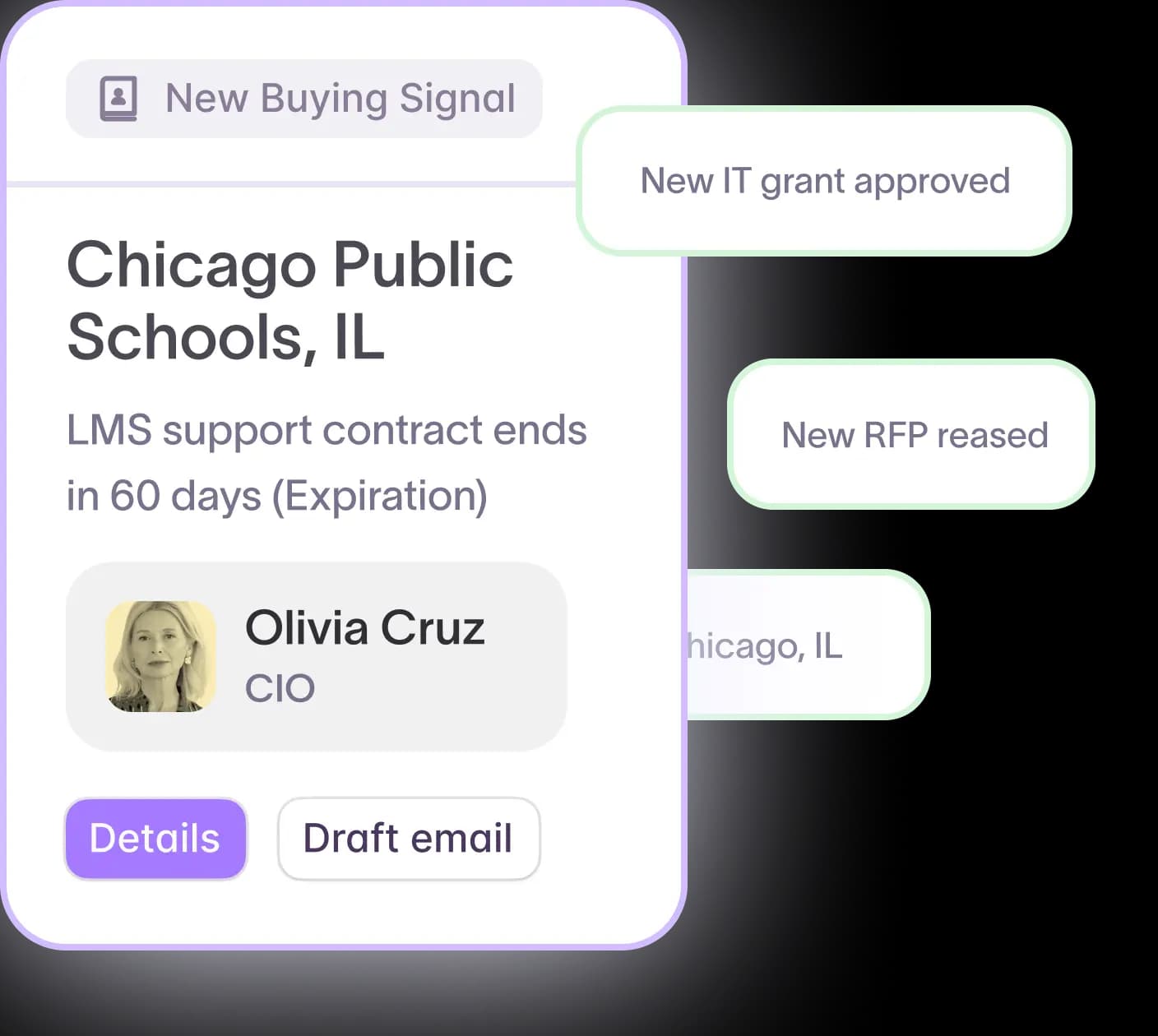
Starbridge, the AI sales intelligence platform for companies selling to the government, K–12, and higher education, helping teams prioritize the right accounts, engage the right people earlier, and identify high-intent opportunities before the competition, consolidates that work. Its AI RFP Finder monitors solicitations across federal, state, local, and education sources and scores each one against your offering, so reps evaluate real fits instead of scrolling portals.
MGT, for instance, cut procurement research from 20 to 30 minutes per query down to 5 to 10 minutes. Questions that used to mean digging across portals and PDFs get answered in one place.
Portal registrations still matter. But posted solicitations are the most visible, most contested layer of the market, and the vendors who win consistently are working the layers underneath.
How Do You Find Government Contracts Before the RFP Is Published?
Every solicitation is preceded by a public paper trail. Learning to read that trail is the single biggest upgrade a government sales team can make to its discovery motion.
Follow the money before the solicitation
Government money is planned in public. The Government Finance Officers Association recommends that state and local governments adopt multi-year capital plans covering 5 to 25 years, with projects identified, prioritized, and funded before procurement begins. Annual budgets go through public hearings and board votes before adoption.
That means funded purchase intent is sitting in published documents months to years before a solicitation exists. A budget line for “student information system modernization” or a capital plan entry for “water treatment SCADA upgrade” is a contract announcement in slow motion.
The buying signals that precede a solicitation
Budgets are one source among several. The highest-value government buying signals, roughly in order, are board meeting discussions of a problem, new budget line items, grant awards with spend-by deadlines, expiring competitor contracts, leadership changes, strategic plan language, and job postings that reveal a new initiative. A published RFP ranks last, because by then the buyer’s thinking is already shaped.
Board meeting minutes deserve special attention. School boards, city councils, and county commissions discuss problems in public session long before money moves. When a board spends twenty minutes on cybersecurity gaps or aging facilities, that conversation is the earliest observable form of the contract that follows.
When to engage
The window runs longer than most teams expect, and finding pre-RFP opportunities is a repeatable discipline rather than luck. Twelve to 18 months out, buyers are discussing the problem internally and consulting peers. Six to 12 months out, budget line items appear. Inside 6 months, requirements are being drafted, and if you are not already in the conversation, you are behind.
Engaging early does more than improve win odds. A buyer you reach before requirements are set can often purchase through a cooperative contract or under the sole-source threshold, which means the deal closes in weeks instead of the months a full RFP adds.
Reading board packets for one county is an afternoon’s work. Reading them for every entity in a three-state territory is a full-time job nobody has.
Starbridge’s Buying Signals Monitor does that reading continuously. It tracks board meeting minutes, budget documents, grant awards, and leadership changes across state and local governments, K-12 school districts, and higher ed institutions, then routes each buying signal to the right rep with the source excerpt attached.
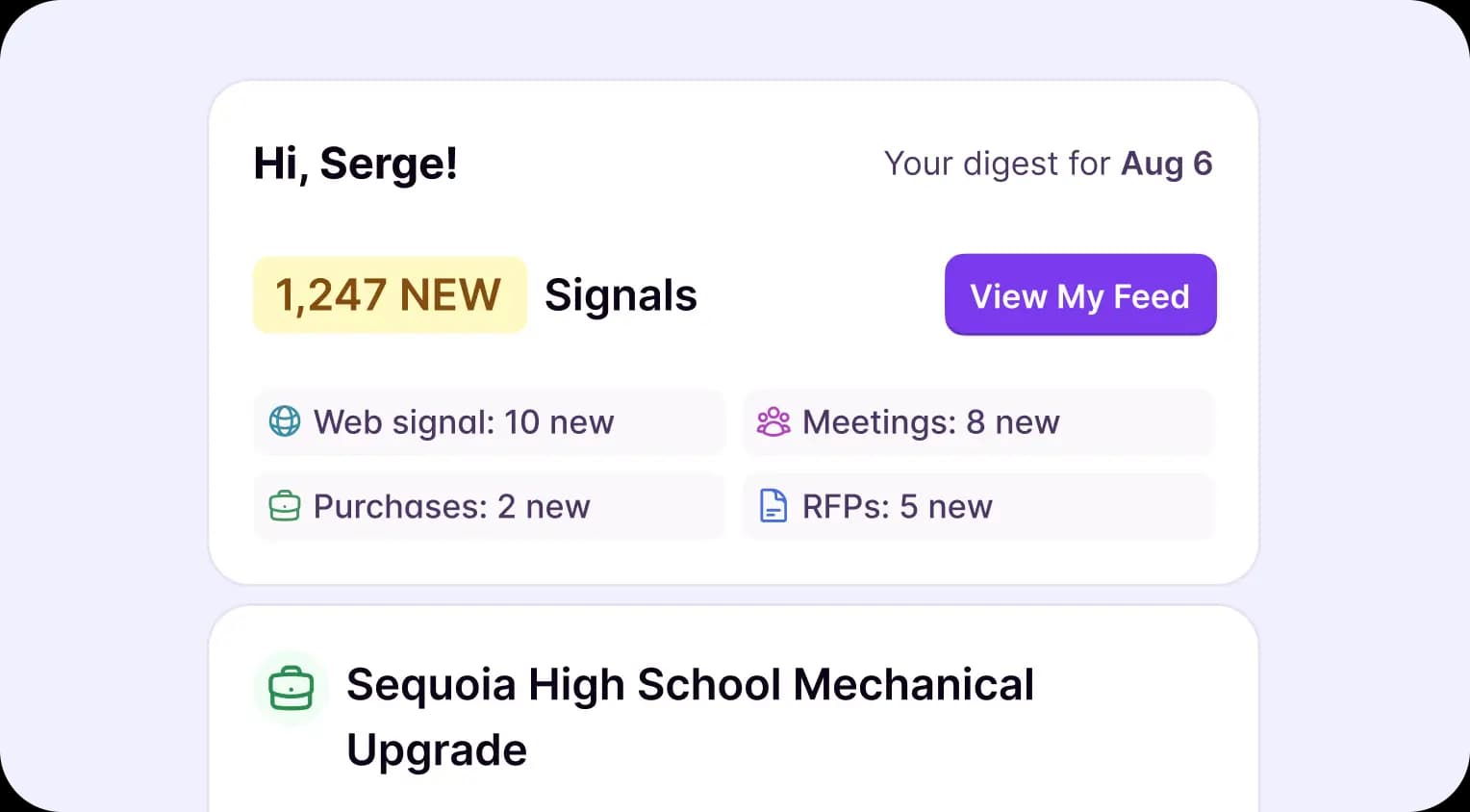
Zencity now sources 50% of its cold meetings from Starbridge. Enterprise reps pull a city’s priorities from recent council meetings in seconds and walk into discovery calls already knowing the procurement pathway and the right talk track.
The earlier you see the buyer’s conversation, the more options you have when the purchase takes shape. And one pre-RFP signal deserves its own section, because it comes with a date attached.
How Do You Find Contracts That Are About to Expire?
Every contract a government signs is a future opportunity with a predictable end date. Somebody won that deal, the term will end, and the buyer will face a renew-or-replace decision. Expiration tracking turns public award data into a pipeline calendar.
Why expiring contracts are the most predictable opportunities
Incumbents win most rebids, and the exceptions follow a pattern. Aliff Research’s analysis of federal services recompetes found incumbents retain 63% of contracts above $10 million, which still leaves 37% changing hands. The decisive variable is timing. Challengers who started working an expiring contract inside 12 months of the rebid won just 11% of the time. Those who started 18 to 24 months out won 38%.
The study covers federal data, and the principle applies directly to state, local, and education deals. Renewal decisions take shape months before expiration dates. The vendor who shows up early enough to frame the comparison wins a meaningful share, and the vendor who shows up at the solicitation stage is a checkbox.
Where award data lives
Federal awards are searchable on USASpending.gov, including vendor, value, and period of performance. Most states run transparency or “checkbook” portals that publish vendor payments and contract awards, and many counties and districts publish award notices from their board meetings.
Those databases tell you who won, for how much, and when the contract ends. They usually don’t include the contract document itself, with its pricing detail, renewal options, and opt-out clauses. For that, you request the record directly.
How FOIA works, and why you shouldn’t do it manually
Public records law is the mechanism that makes contract intelligence possible. Under the federal Freedom of Information Act, any person can request agency records with a written request that reasonably describes them. No special form is required, and agencies must respond, subject to nine exemptions covering things like trade secrets and personal privacy. Federal FOIA covers only federal agencies. State and local records fall under each state’s own public records law, and every state has one, with response deadlines and fees that vary.
Signed contracts, and in many states the winning proposals behind them, are generally obtainable. The catch is operational. Requesting competitor contracts from hundreds of agencies means hundreds of individually tracked requests, follow-ups, and fee negotiations. It takes so much time that almost no sales team sustains it manually.
Starbridge’s Public Spend Intelligence automates the entire workflow. Its FOIA automation surfaces full, unredacted competitor contracts, including pricing, opt-out clauses, and expiration dates, and calculates inferred renewal dates from historical purchase order and contract data. Reps see which accounts are approaching a renewal decision without filing a single request.
GovWell built its intent-based outbound motion on exactly this intelligence and booked 5 meetings in its first week. Starbridge now sources 15% of GovWell’s qualified pipeline, a consistent and repeatable channel.
An expiring contract is only an opportunity if you reach the buyer while alternatives are still on the table. That is a timing problem, and timing problems are solvable with the right data.
Where Should You Start?
Three moves cover most of the ground. First, narrow your focus to state and local governments, K-12 school districts, and higher ed institutions, where $1.27 trillion in annual purchasing is spread across buyers you can actually reach. Second, get the posted layer handled, with portal registrations, alerts, and cooperative contract visibility, and treat it as table stakes rather than strategy. Third, build your discovery motion around the earlier layers, the budgets, board meeting minutes, and expiring contracts that reveal opportunities 6 to 18 months before an RFP exists.
The vendors who consistently win government contracts are the ones the buyer already knows before procurement starts. Starbridge surfaces the buying signals, contacts, and contract intelligence that make that possible at scale. Book a demo to see it in your market.
Frequently asked questions
Search posted solicitations on SAM.gov for federal deals and on state eProcurement portals for state and local. Then work two earlier layers. Awarded contracts approaching expiration signal upcoming rebids, and budgets, capital plans, and board meeting minutes reveal funded purchases months before any RFP is published.
Federal contracts come from one government, post centrally to SAM.gov, and favor established contractors with past performance records. State and local contracts come from 50 states and 91,438 local governments, including school districts, each with its own rules and portals. The market is fragmented but far more accessible to new vendors.
Each state runs an eProcurement portal, such as Virginia’s eVA, Texas’s Electronic State Business Daily, and Cal eProcure. Counties, cities, and school districts post on their own procurement pages and regional purchasing groups. Purchases below formal competition thresholds, a median of $50,000 by state law, are often never publicly posted.
Read the public paper trail that precedes every solicitation. Adopted budgets, multi-year capital plans, board meeting minutes, grant awards, and strategic plans document funded purchase intent 6 to 18 months early. Vendors who engage during that window shape requirements instead of responding to them.
USASpending.gov covers federal awards, and most states publish contract awards on transparency portals. Award records show the vendor, value, and period of performance, which lets you calculate when a rebid is coming. The full contract, with renewal options and pricing, is obtainable through a public records request.
Any person can file a written request describing the records they want. The federal FOIA covers federal agencies, while state public records laws cover state and local entities, with deadlines and fees that vary. Signed contracts, pricing, and often winning proposals are generally obtainable, subject to exemptions.
The easiest contracts avoid full RFP competition. Purchases below a state’s formal competition threshold, a median of $50,000, close through informal quotes. Sole-source awards skip bidding when justified in writing. Cooperative contract purchases let buyers use pre-competed contracts. All three close in weeks rather than months.
Explore our use case library
 Automate account research with AI agentsStop manually researching accounts. Starbridge AI agents automate account research by monitoring buying signals 24/7 and surfacing the right contacts.
 Identify competitor contract expiration datesThe RFP is usually a formality. Starbridge surfaces competitor contract expiration dates so your reps reach accounts before the renewal cycle closes.
 Create a conference campaignTurn conference badge scans into pipeline. Import your contact list, surface buying signals across every account you met, and follow up with context.