
Government contracting pipeline: how to stage, forecast, and measure pre-RFP deals
State and local deals sit 6 to 24 months from a solicitation number. Here is what to put in the CRM, how to stage it, and how to forecast it honestly.

A government contracting pipeline can look healthy long after deals have stopped moving. Three of the five deals forecast to close this quarter may have shown no meaningful progress for six months, and none may even have a solicitation number.
This guide covers what opens an opportunity before an RFP exists and the exit criteria that hold at each stage. It also covers how to date a forecast against a budget calendar you do not control, and which pipeline metrics move before revenue does.
What is a government contracting pipeline?
A government contracting pipeline tracks opportunities to sell to government and education buyers. Unlike a B2B sales pipeline, government contracting pipeline stages often follow the buyer’s timeline and a defined paper trail. That means a deal can be active in your pipeline even if the contract will not be awarded for another 6 to 24 months.
How a state and local pipeline differs from a federal contracting pipeline
Federal sellers build a pipeline from a published forecast. Agencies post procurement forecasts, presolicitation notices, and historical award records to a small number of central systems, so a federal contracting pipeline can start with a central, public list.
State and local governments, as well as education institutions (SLED), publish nothing equivalent. Each one runs its own board meetings, its own budget process, and its own website. There’s no central place that clearly lists what any of them intend to buy next year.
What the latter SLED buyers do publish is the decision-making process itself: board meeting minutes, strategic plans, and capital improvement plans are public record, and each document carries a date. So do adopted budgets, grant awards, and contract expirations, and each one reveals a different kind of buying indicator.
For example, a city council debating a permitting backlog in March is the same input a federal seller gets from an agency procurement forecast. The difference is that the council discussion often appears earlier and is buried in meeting minutes rather than listed in a structured table.
What counts as a pipeline opportunity before an RFP exists?
An account you like is not a pipeline opportunity. A pipeline opportunity is an account where something dated has happened, you know who owns the problem, and you can say why this month is the right month to call (a clear reason to reach out).
An account becomes a pipeline opportunity only when three conditions hold together:
- A use case is apparent.
- A verified contact in the role that owns the problem.
- A specific reason exists to reach out now.
A record missing any of those fields is a lead rather than a forecastable pipeline opportunity.
Scoring uses the same evidence for a different job
The public records that open an opportunity are the same public records that rank a territory.
A predictive account scoring model weighs how many indicators an account has produced, how recent each one is, and whether budget language has appeared alongside problem language.
Scoring decides which opportunities a rep works first, while the entry test decides whether a record should exist at all.
The problem? Reading the public record across a full territory by hand does not scale. That’s one of the reasons we created Starbridge.
Starbridge is the AI GTM platform for companies selling to the government, K-12, and higher education, helping teams prioritize the right accounts, engage the right people earlier, and identify high-intent opportunities before the competition.
Starbridge’s Buying Signals Monitor watches 320,000+ government and education entities around the clock and delivers each buying indicator with its date, entity, and contact attached, so opportunity records arrive with entry fields filled.
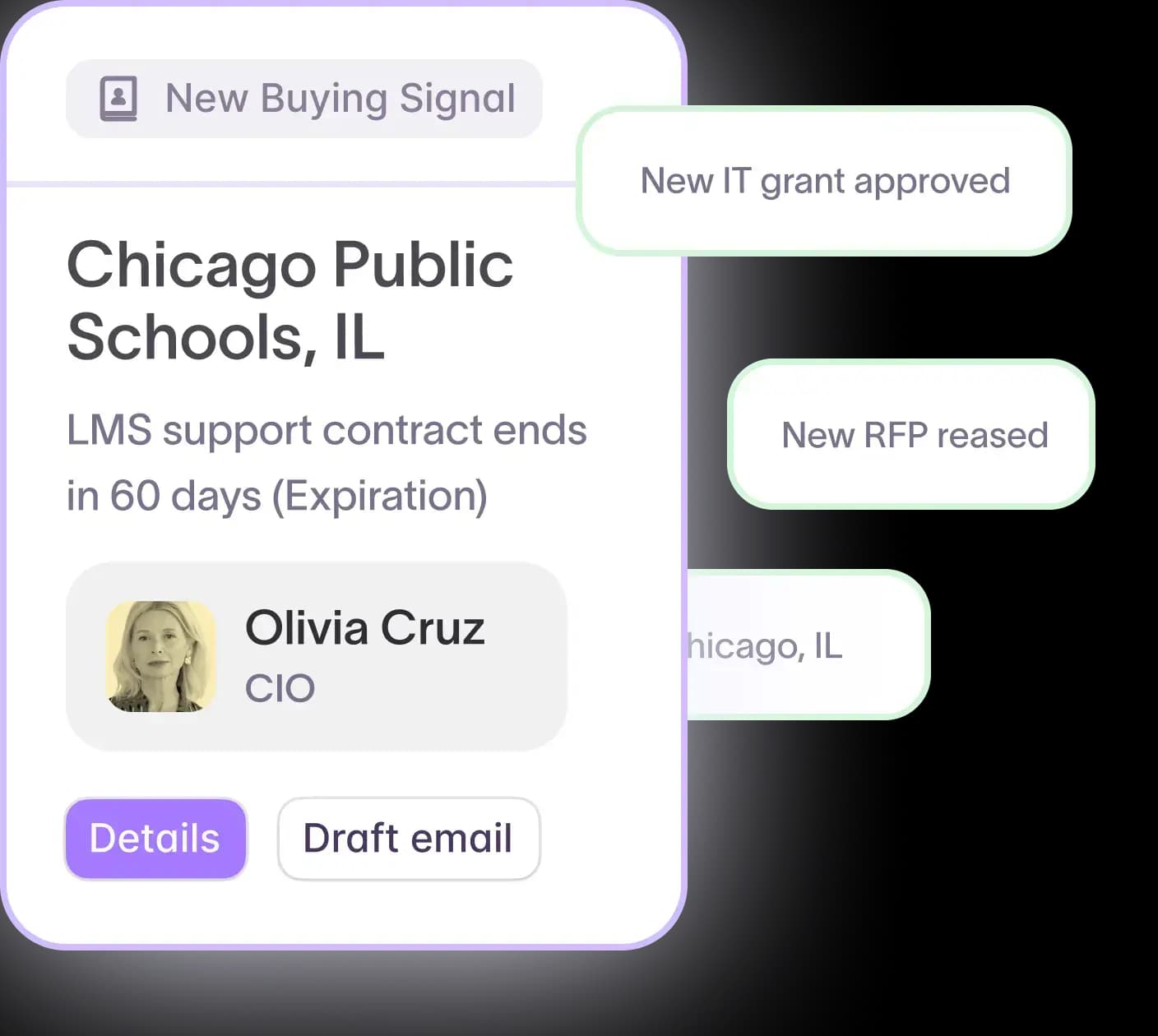
GovWell sources 15% of total qualified pipeline from Starbridge and booked five meetings in its first week, reaching buyers through contract expirations and council discussions while the requirement was still being written.
Government contracting pipeline stages and their exit criteria
Government contracting opportunities should move to the next pipeline stage only when there is evidence that the buyer has moved forward. A rep feeling confident about the deal or having a productive call is not enough. There should be an observable buyer action, such as discussing the problem publicly, allocating budget, or beginning to define requirements.
The table below maps to where the buyer actually is:
| # | Stage | Where the buyer is | Exit criteria |
|---|---|---|---|
| 1 | Opportunity created | A dated public record shows the problem | The buyer’s own words confirm the problem in a call or a reply, not only in a document |
| 2 | Interested | Discovery, 12 to 18 months out | The owner of the problem accepts a meeting. |
| 3 | Validated | Planning, 6 to 12 months out | The buyer states a funding path, whether through a budget line, a grant, or an expiring contract |
| 4 | Procurement | Procurement, 0 to 6 months out | The buyer asks for specifications, references, or a procurement path you can quote against |
| 5 | Close | Solicitation, sole-source, or cooperative order in motion | A document exists with your requirements, your price, or your contract vehicle in it |
Forecasting deals against a procurement calendar you do not control
In government and education selling, every opportunity carries an expected decision date, set by the buyer’s calendar.
Most state agencies and school districts run a fiscal year from July 1 to June 30, and budget planning starts around January.
- New initiatives at state and local agencies concentrate between October and March.
- K-12 purchases concentrate between January and May.
- April through June is the use-it-or-lose-it window, where a buyer with unspent allocation needs a procurement path that closes in weeks.
- Higher education runs on institution-specific calendars, and department budgets can move independently of central IT, which creates more than one possible approval date inside a single university.
An expected decision date therefore comes from the account’s own calendar rather than from the buyer’s apparent urgency.
Pipeline coverage math for a 6 to 24 month sales cycle
Government and education sales cycles commonly run 6 to 24 months, and a cycle that long against a business’s 12-month plan has a specific consequence:
The pipeline closing this year was built last year.
This means, for long government sales cycles, pipeline requirements should be calculated backward from the date you expect the revenue to close. Divide the annual target by average contract value to find the closed contracts required, then use win rate and stage conversion rates to calculate how many opportunities need to exist earlier in the pipeline.
That gives you a pipeline creation target. If you need 40 Validated opportunities and the sales cycle is 18 months, those opportunities must exist about 18 months before the revenue target. Miss that window, and a mid-year pipeline push is unlikely to close the gap.
Which pipeline metrics actually predict closed-won government deals?
Total pipeline value and win rate tell you about the pipeline you already have. To see whether future deals are actually progressing, track leading indicators tied to buyer activity.
Time from buying signal to first contact.
Measure how long it takes a rep to act after a relevant budget item, board discussion, grant, or other signal appears. If that delay grows, reps are finding opportunities too late.
Conversion from Interested to Validated.
Track the share of opportunities that move from an initial signal to confirmed buyer need and a credible path to funding. A low conversion rate suggests that many opportunities are weak signals rather than real demand.
Procurement readiness.
For opportunities in the procurement stage, track whether the buyer has received the security, implementation, and customer-reference information needed to evaluate the solution. Missing information can delay a deal even when buyer interest is strong.
These metrics depend on recording the date of the original buying signal in the CRM. If that date only appears inside a rep’s notes, you cannot reliably measure how quickly opportunities are found, acted on, or advanced.
Starbridge’s Salesforce and HubSpot integrations write each buying indicator to the account and opportunity record with its source, date, and contact attached, so evidence-to-contact intervals and stage-entry conversion come out of the CRM instead of a monthly spreadsheet rebuild.
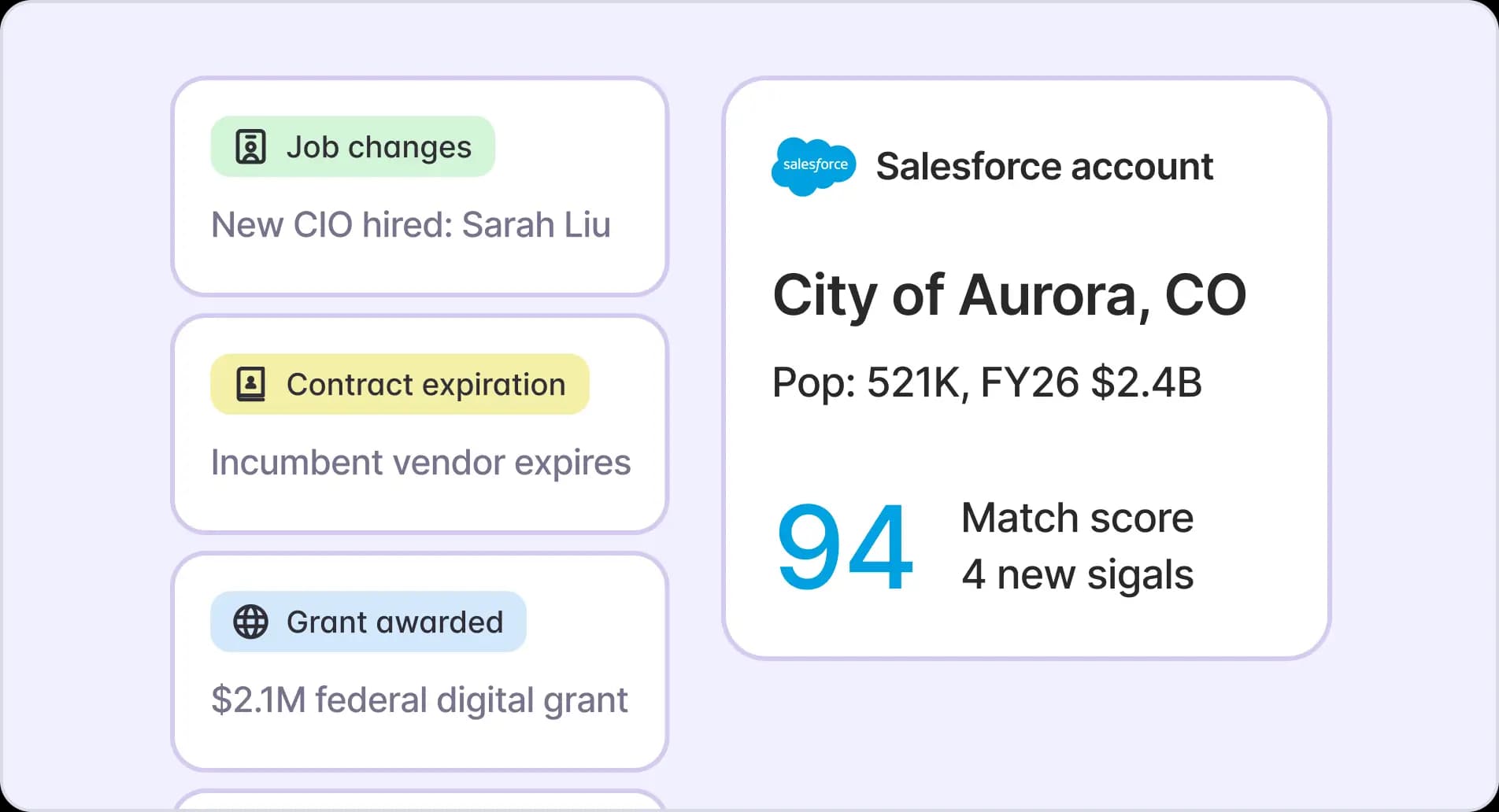
Kaizen Labs saw a 10 to 20 percent lift in monthly quota attainment after routing buying indicators into Slack, where reps checked ICP fit and pulled board meeting context without leaving the tool.
Conclusion
A government contracting pipeline fails at the definition long before it fails at the forecast. When an opportunity can open on a rep’s optimism, no stage means anything and no forecast holds.
Fix the definition first. Require dated evidence, a named owner, and a funding path before a record exists. Write exit criteria as buyer actions a second person can verify. Set expected decision dates from the buyer’s budget calendar with a delay allowance already inside them. Measure creation and stage-entry conversion instead of total value.
None of that requires more reps. It requires the record to be true. Starbridge gives teams selling to state and local government, K-12, and higher education the dated evidence to build that record, and the contract intelligence to carry it to a signed deal. Book a demo to see it against your own territory.
Frequently asked questions
A procurement pipeline is a list of purchases or solicitations a government agency expects to make in the future. It shows what the buyer plans to procure and, sometimes, when.
A government contracting pipeline, on the other hand, is the vendor’s version. A list of government opportunities the sales team is pursuing. Because many state and local agencies do not publish formal procurement pipelines, vendors often identify future opportunities from budgets, meeting minutes, grants, contract expirations, and other public records.
Remove it when the buyer has produced no new dated evidence for two full budget cycles and the funding path is gone. Demote rather than delete. A district that tabled a decision usually returns to it, and the record holds history that speeds the next conversation.
Explore our use case library
 Automate account research with AI agentsStop manually researching accounts. Starbridge AI agents automate account research by monitoring buying signals 24/7 and surfacing the right contacts.
 Identify competitor contract expiration datesThe RFP is usually a formality. Starbridge surfaces competitor contract expiration dates so your reps reach accounts before the renewal cycle closes.
 Create a conference campaignTurn conference badge scans into pipeline. Import your contact list, surface buying signals across every account you met, and follow up with context.