
How to track SLED grants as buying signals
Discover how to track SLED grant awards as buying signals, identify funded opportunities before an RFP, and time outreach around grant deadlines.

By the time the RFP drops, the deal is already decided. The winning vendor helped write the spec.
What few sellers know is that the money that funded that purchase was public months or years earlier, sitting in a grant award record. This guide explains how to track these SLED grants as buying signals.
It covers finding where awards appear in federal, state, and district records, deciding which ones are worth pursuing, and timing your outreach around each grant’s spending deadline.
Are SLED grant awards a reliable buying signal before the RFP?
Yes, because a grant award fixes two things at once:
- The budget: the money has already been awarded.
- The timeline: the grant’s period of performance sets a deadline for spending it.
All three are recorded in public documents before any requirements are written.
Where federal, state, and local grant awards become visible
Grant money leaves a trail at every level it passes through, and one award can appear three separate times before a purchase order exists.
Grant awards are one of several early demand signals in SLED, and they are the easiest to date.
The federal award and subaward record
Federal awarding agencies report prime grant awards to USAspending.gov, and prime recipients report their first-tier subawards to the same place.
That second reporting layer matters because state governments often take the prime award and then pass funding through to school districts, cities, and counties, according to the Congressional Research Service overview of federal grant tracking published in April 2025.
A prime award to a state education agency in March can become district money that nobody local has announced yet.
State agency award listings
State practices vary, so check before building a workflow around them.
The Texas Education Agency publishes a list of applicants for each competitive grant program after applicants are selected for funding. That listing includes the applications chosen, so the recipient and the project scope arrive together.
The New York State Education Department’s funding page lists open opportunities with no matching award listing, so the recipient must be found elsewhere.
District and council acceptance records
The district or council record is the one that names your buyer, and its form depends on local policy. Some boards vote to accept a grant in open session, which puts the award into an agenda packet with a dollar amount attached. Chicago Public Schools instead requires its Chief Financial Officer to accept grants on behalf of the Board, with a consolidated report going to the Board afterward.
Read the policy once for your largest accounts and you know which document to watch.
Reading three record layers for one account takes an afternoon. Running that check across several hundred districts, cities, and campuses is where the method breaks.
Starbridge is the AI GTM platform for companies selling to the government, K-12, and higher education, helping teams prioritize the right accounts, engage the right people earlier, and identify high-intent opportunities before the competition. The Buying Signals Monitor watches grant awards across 320k+ government and education entities and delivers each award with the account already attached.
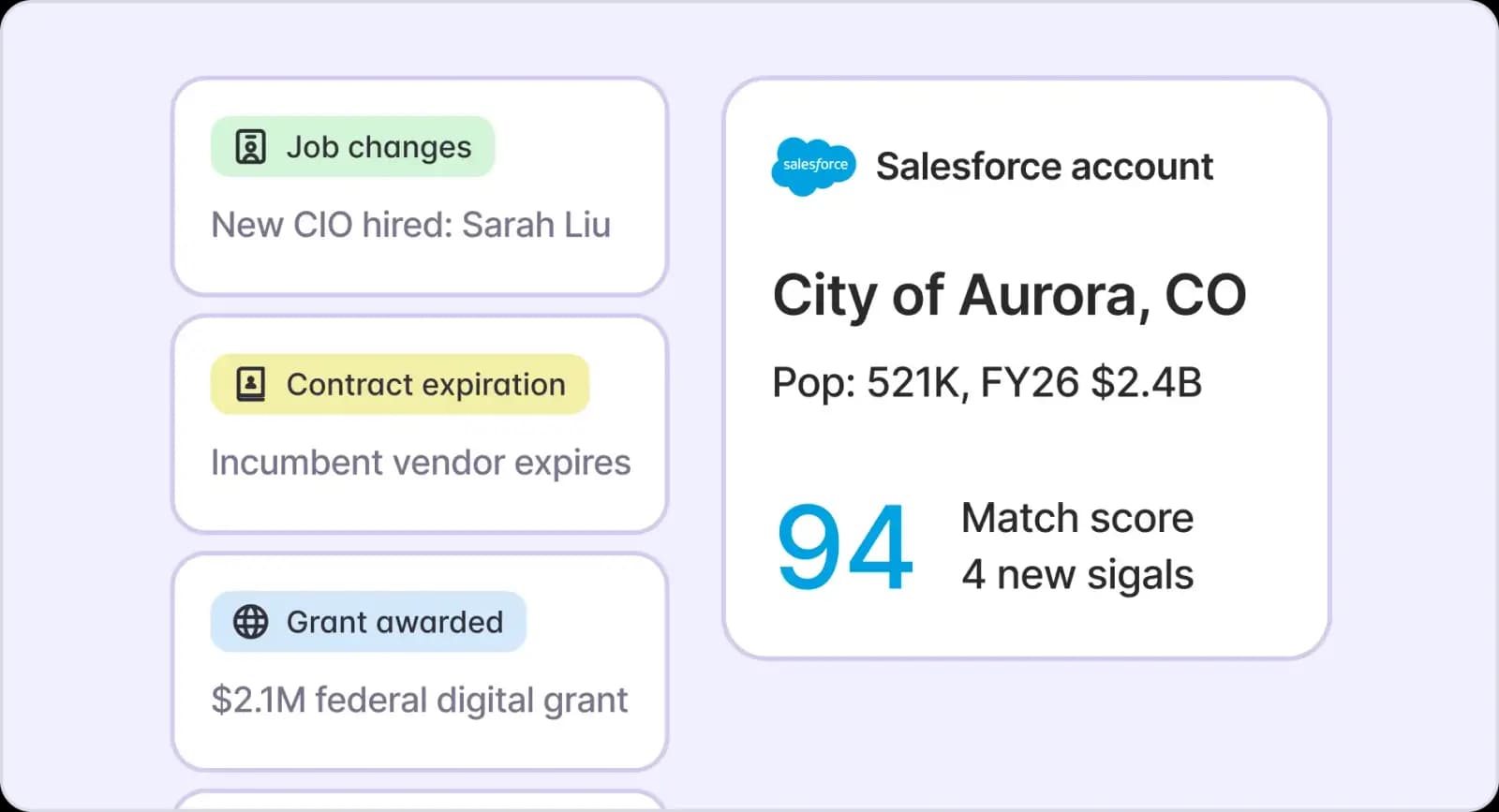
GovWell sources 15% of its total qualified pipeline from Starbridge, a repeatable channel rather than a one-time list.
Your reps engage the account while the requirements are still open.
How to tell which grant awards are worth acting on
Not every grant award deserves attention. Here’s how to tell:
- Where did the money come from?
- And, how much of it will be spent on a single purchase?
Formula, competitive, and pass-through funding
Formula funding arrives on a schedule and is divided among recipients according to a set calculation, so a formula award confirms a budget exists without revealing anything new about intent.
A competitive award is a stronger indicator, because the recipient wrote an application describing what they intend to buy and why.
Pass-through funding sits between the two. A state wins the prime award and subawards it, shifting the spending decision to the district or city receiving the subaward.
What the dollar amount may tell you about the buying path
For purchases made with federal award funds, the dollar amount determines whether an RFP is required at all. Under 2 CFR 200.320, formal procurement methods are required only when the transaction exceeds the simplified acquisition threshold.
- Those formal methods are sealed bids and proposals, and the threshold currently sits at $350,000 under FAR 2.101.
- Below that figure and above the micro-purchase threshold of $15,000, the buyer only has to obtain price or rate quotations from an adequate number of qualified sources.
- Below $15,000, a micro-purchase can be awarded with no competitive quotations at all, provided the buyer documents that the price is reasonable.
A recipient can also set its own micro-purchase threshold as high as $50,000 with the appropriate documentation in place.
State-funded and privately funded grants follow their own rules, so confirm the funding source before applying this test.
Grant spending deadlines and the outreach window they create
A grant award carries its own timeline, and that timeline is specified in the award rather than inferred from a budget cycle.
That deadline determines the outreach date.
The purchase has to be obligated within the period of performance, so the buying conversation has to happen well before the final months. For Department of Education discretionary grants, the Secretary may approve a project period of up to 60 months.
This means an award you read this year can be funding a purchase two or three years out. Check the period of performance before deciding an account is warm.
Reaching the people who control grant money
A grant award names an institution, not a person. The person who controls the money is often not the one who signs the purchase order, and the gap between those roles is where grant-based outreach usually fails.
Where grant spending authority sits
Three roles handle grant money, and only one of them cares about your category:
- The program lead who wrote the application owns the outcome the grant promised.
- A grants manager or finance officer owns compliance and the spending schedule.
- Procurement runs the transaction once a requirement is defined.
Start with the program lead, because the program lead has already written down the problem your product solves.
What the first outbound message should reference
State the name of the award, the dollar amount, and the outcome the application promised, then connect your product directly to that outcome.
A message that opens with the specific grant reads as research, while a message that opens with your category reads as a list purchase. Skip the compliance framing, because the program lead is measured on results rather than paperwork.
Finding the program lead for one award is straightforward. Finding that person for every grant-funded account in a territory, with an email address that still works, is what slows everything down.
Starbridge attaches verified contacts to each grant award, with 98% email accuracy measured across a test of 14,000 emails, so reps reach the person who controls the money instead of a general inbox.
TAM to Target reports Starbridge contact data is 3 to 4 times more valid than other vendors, which removed the manual verification step before every campaign.
Reaching the right person on the first try is what turns a public award record into a closed deal.
Conclusion
A grant award answers the questions a rep actually has: who has money and how much, what they said they would do with the money, and when it has to be spent.
Federal award data, state agency listings, and district acceptance records hold all of those answers, and none of them requires a relationship to access. Work the awards in your territory in order of their spending deadlines rather than by dollar amount, and start with the program lead who wrote the application.
Teams that work grant awards this way stop competing on proposal quality and start competing on timing, which is a much easier fight to win.
See how Starbridge turns grant awards into closed deals. Book a demo.
Frequently asked questions
No. Purchases above the simplified acquisition threshold still require sealed bids or proposals, so solicitations will continue to appear for the largest deals. Grant tracking changes when you enter those deals and tells you which smaller purchases will never reach a bid board at all.
SLED means state, local, and education. A SLED account is any state agency, city, county, special district, school district, or college that purchases with public funds. Our guide to what SLED means covers the market in more detail.
Explore our use case library
 Automate account research with AI agentsStop manually researching accounts. Starbridge AI agents automate account research by monitoring buying signals 24/7 and surfacing the right contacts.
 Identify competitor contract expiration datesThe RFP is usually a formality. Starbridge surfaces competitor contract expiration dates so your reps reach accounts before the renewal cycle closes.
 Create a conference campaignTurn conference badge scans into pipeline. Import your contact list, surface buying signals across every account you met, and follow up with context.