
Sales territory planning for government and education: from TAM to scored territories
How to turn a government and education TAM into assigned territories, then rank each one so a rep knows which accounts to work this quarter.

Most sales territories are drawn from what a company spends and the region it sits in. Public buyers sit in fixed places, publish their budgets, and buy on a calendar you can read months ahead.
So that changes what a territory is for, and it changes how you draw one:
TL;DR: what is sales territory planning in government and education?
Sales territory planning splits the public bodies you could sell to into books of accounts, then gives each book an owner. A good plan tells a rep what they own, how many accounts they can work, and who to call this quarter.
Your market is every school, college or agency that fits your profile. A territory is the slice one rep owns, and your queue is the handful inside that slice showing they are ready to buy now.
Why a commercial territory map breaks here
In B2B sales you usually split the account list by state or by company size. However, a state line tells you nothing about which kind of body runs the service you sell to.
For example, a seller of emergency dispatch software who splits by state will hand one rep 254 counties in Texas and another rep a New England state where towns run dispatch instead.
| What you use in B2B sales | What to use here | Where it is published |
|---|---|---|
| Company revenue | The budget the body passed, or what it spends a year | The body’s own budget papers |
| Headcount band | Student numbers, people served, or staff count | NCES, IPEDS, Census |
| Geography | The kind of body that runs your service | Census government counts |
| Renewal date | The end date on the current vendor’s contract | Purchase orders, award records |
| Account tier | The dollar line that forces a board vote | Purchasing policy |
The last row matters most: it sets the length of a deal more than anything else on the list.
That is because a deal below the vote line can be signed by one department head. So a deal above it waits for a board meeting on a fixed calendar.
The market, the territory and the queue
The market, the territory and the queue often get called the same thing. But a plan works when they stay apart.
- The market. Every school, college or agency that could ever buy what you sell. Changes about once a year.
- The territory. The slice of that market one rep owns. Changes when the team changes.
- The queue. The accounts inside a territory showing buying activity now. Can change weekly or even daily.
Combine the market and the territory, and a rep holds 4,000 accounts with no order to work them in. Combine the territory and the queue, and the team rebuilds who owns what every time a signal fires.
The ideal customer profile template builds the market, and the B2G lead generation playbook builds the queue.
So this guide builds the territory.
Drawing the territory
Start from the count of institutions, not from a geographical map. The K-12 count and the local government count are both published, so your starting number is a fact rather than an estimate.
Then cut the total count in this order:
- By the service or product you sell. Keep only the kinds of institutions that could benefit from your service or product. A fire district and a county need different things, so this cut usually removes most of the list.
- By budget. Keep the ones whose budgets fit your price. For example, a township of 900 residents will typically not sign a six figure contract.
- By capacity. Divide what is left by what one rep can possibly work.
Capacity is the step sales teams sometimes overlook: a rep who has to know where the money comes from, who sells there now and who has to sign can hold far fewer accounts than a rep working a flat list of companies.
So size the territory by the amount of manual research each account needs, and not by a round number that divides evenly.
Starbridge can help maximize the capacity of your reps by automating most of the manual research process.
So reps spend more time selling, and less time researching. If you want to learn more, book a demo today.
Scoring a territory
An assigned territory still has no order to it. So how do you decide which accounts to work first?
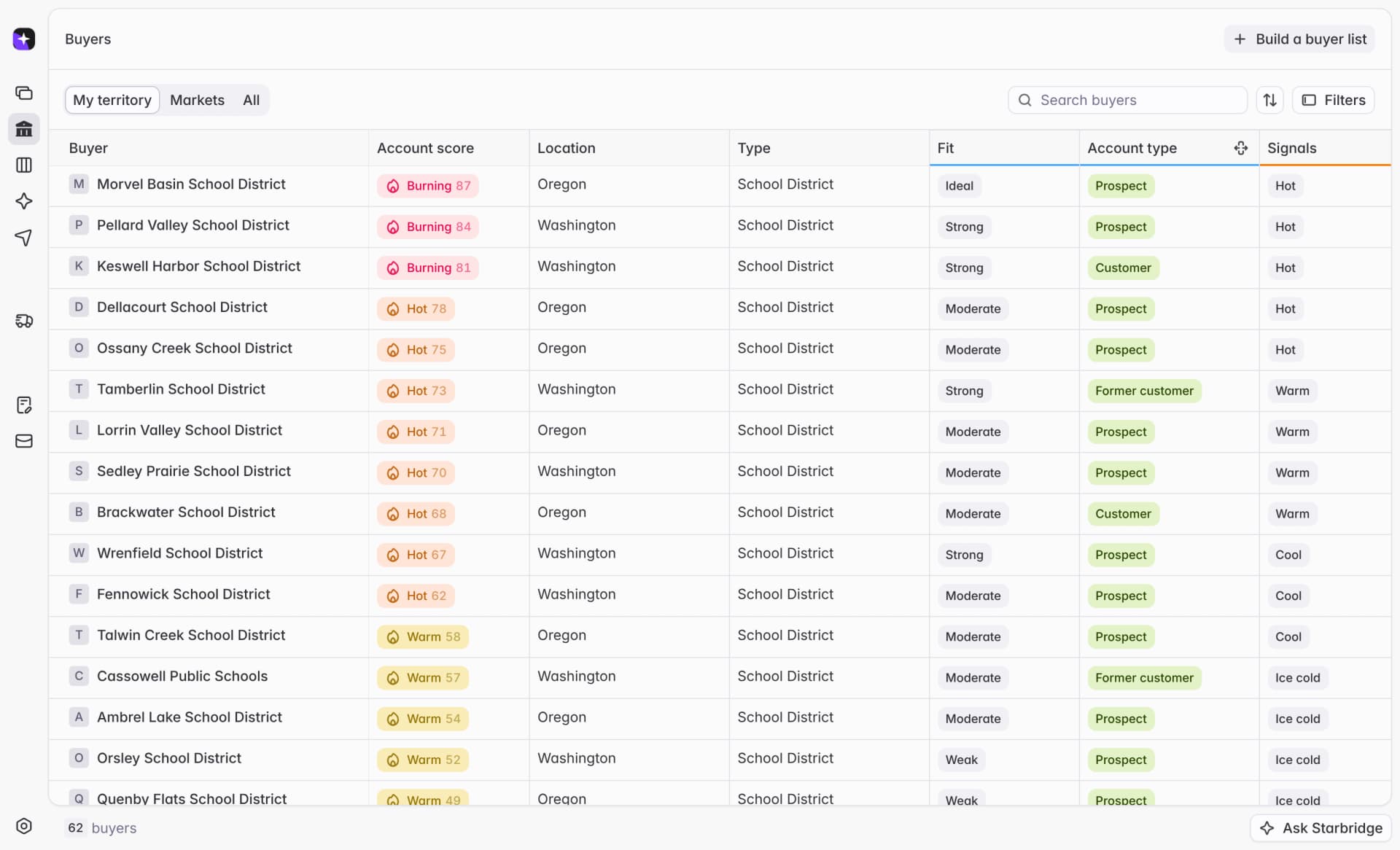
So the next step is ranking the accounts by the signs a buyer is moving now:
- A board or council discussed your category this quarter
- A job posting appeared for the work your product supports
- A rival’s contract ends within the year
- A budget line passed for the project
Those signs lose value as they age, so the ranking has to be rebuilt on a schedule. For example, a board mention from last month is worth more than one from last spring.
Keeping ownership honest in the CRM
A territory only works when the CRM and the prospecting tool agree on who owns what. Otherwise two reps work the same district, or an account sits in a territory nobody checks.
Starbridge reads account ownership back out of the CRM instead of keeping a second list.
Our Salesforce integration reads account ownership and account type into Starbridge, so each rep sees only their own territory. The HubSpot integration pulls company ownership, lifecycle stage and list membership to do the same job.
That direction matters. A manager makes the territory change in the CRM, so ownership should flow out of it instead of being typed in twice.
A team doing all of this by hand across a whole market moves slowly. The counts sit in federal files, the budgets sit on tens of thousands of separate websites, and the buying activity sits in board minutes that each body publishes on its own clock.
That’s where Starbridge can help.
Starbridge is the AI GTM platform for companies selling to the government, K-12, and higher education, helping teams prioritize the right accounts, engage the right people earlier, and identify high-intent opportunities before the competition.
Public Spend Intelligence shows what the bodies in a territory already buy in your field and when those contracts end. The data draws on purchase orders for 77% of institutions out of the box, across state and local government, K-12 and higher education.
InquirED drove $200K in new pipeline in its first quarter with Starbridge, automating its manual account research.
Book a demo today to see which accounts in your territory are already spending in your field.
Where to start
Start from the published, official number of institutions in your market before you buy a list of accounts from a data vendor. The number is free, and the same sources name the bodies themselves.
- How many school districts are in the US gives the number of K-12 institutions with its sources.
- How many counties are in the US does the same for local government.
- How many colleges are in the US does the same for higher education.
- The Starbridge buyer catalog lets you browse those bodies by type.
Write each territory down as a rule a rep can test an account against.
For example, “Oregon and Washington school districts of 1,000 to 24,999 students that draw Title I Part A (the federal money for schools with many low-income students)” tells a rep what to do. But “the Pacific Northwest” does not.
Review the boundaries once a year, after budgets are passed. Review the ranking inside them far more often, because the signals that order a queue change every week.
Frequently asked questions
A sales territory in public sector sales is the set of agencies, school districts or colleges that one rep owns and is measured on. The boundary is usually a mix of the kind of body, a size band and the region, because the service you sell is run by different kinds of body in different states. Your market is everyone who fits your profile, and your queue is the few showing buying activity this quarter.
That depends on how much research each account needs rather than on a standard figure. A rep who must know where the money comes from, who sells there now and who has to sign holds far fewer than a rep working a flat list of companies. The practical test is whether the rep can describe any account in the territory without looking it up first.
State lines are a reasonable starting point, and they are rarely enough on their own. The kind of body that runs a service changes from state to state, so a map drawn only on state lines gives one rep hundreds of counties and another a state where towns run the same service. Cut by the service first, then by budget, and use the map to balance what is left.
Redraw the boundaries about once a year, after budgets are passed, because the money and the size bands move on that cycle. Rank the accounts inside a territory far more often, since board mentions, job postings and contract end dates change weekly. Teams that redraw boundaries whenever a signal fires spend their time on the map instead of on the accounts.
The CRM should stay the place where ownership is set, and the prospecting tool should read it. Starbridge reads account ownership and account type out of Salesforce, and company ownership, lifecycle stage and list membership out of HubSpot, so a rep sees only their own accounts. A second ownership list in another tool is what puts two reps on the same district.


