
How many colleges are in the US, and how to turn that count into a TAM
Federal data counts 5,711 Title IV colleges in the US, plus 68 system offices. Here is what each sector holds and which ones belong in your TAM.

The federal count of Title IV colleges is 5,711. Build a higher education territory from that number alone and you may be selling to the wrong office.
This guide gives the count for each sector, with its source. It then helps you turn those counts into a list of buyers your team can work.
TL;DR: how many colleges are in the US?
The Department of Education counts 5,711 Title IV colleges, where students can use federal aid, plus 68 central or system offices, the head offices that oversee groups of colleges. These offices report separately and are not colleges themselves. A seller needs both numbers: students enroll at individual colleges, but a system office may sign contracts covering several campuses.
Where the number comes from
The count comes from IPEDS, the federal data every college taking student aid has to report to.
The published total is 5,779 reporting units. That figure covers two kinds of unit, and only the first is a college:
| Reporting unit | Count | What it is |
|---|---|---|
| Title IV colleges | 5,711 | Schools where students can use federal aid |
| Central or system offices | 68 | The office that governs several campuses |
| Published total | 5,779 | Colleges and system offices together |
A seller who quotes 5,779 is counting system offices (the head offices that oversee groups of colleges) as colleges. A seller who quotes 5,711 has the colleges, and has dropped the offices that may hold the contract.
The sectors, and which ones buy
Degree-granting colleges split by who runs them (private vs public) and how long the program is:
| Sector | Count |
|---|---|
| Private nonprofit 4-year | 1,545 |
| Public 4-year | 859 |
| Public 2-year | 818 |
| Private for-profit 2-year | 480 |
| Private for-profit 4-year | 291 |
| Private nonprofit 2-year | 121 |
Those sectors come to 4,114. The rest of the 5,711 are shorter programs, mostly trade schools.
A public 4-year college buys through a bid office, and often through a state contract. A private nonprofit college may sign at the dean’s level with no public bid at all.
For example, a learning platform at $60,000 a year faces about 1,700 public colleges that will likely run a public bid. The roughly 1,670 private nonprofit colleges may not.
The system office is a buyer, not an address
The 68 system offices are the part most commercial lists get wrong. A system office runs several campuses, and for some products it buys for all of the campuses at once.
Needless to say, this can be a big opportunity.
So a seller who maps only campuses may pitch the same product to nine schools in one system, while the decision maker may sit in an office that is not on the campus list.
So before you build the list, work out which office holds your category:
- Email, student records and other campus-wide software are often bought by the system office
- Course materials and department tools are usually bought by the campus
- Buildings and grounds can be either, depending on the state
The federal data names the system offices. A seller looks them up rather than guessing at them.
Size bands for higher education
Most sellers look at colleges by the number of students they have. That number is published for every college.
The Carnegie grouping draws its smallest 4-year band at under 1,000 full-time students. It draws its smallest 2-year band at under 500.
Student numbers aside, the college budget is actually the better focus when your price is high. IPEDS publishes total spending for each college, so you can look up what one school spends instead of guessing it from size.
Use student numbers to cut the list quickly, then check spending on the accounts that survive. A college of 4,000 students and a college of 4,000 students with a teaching hospital are not the same buyer.
Building the higher education account list
Build the list in these steps:
- Filter by sector. Keep the sectors that run the work your product supports.
- Decide campus or system. Work out which office buys your category, and build the list at that level.
- Narrow by budget. Keep the colleges whose spending fits your price.
- Rank by demand. Put the colleges showing buying activity this year above the ones that show none.
A college shows demand when one of these is true:
- A board of trustees discussed your category this quarter
- A job posting appeared for the work your product supports
- A rival’s contract ends within the year
- A budget line passed for the project
A rep tracking that demand by hand works slowly. Because the counts sit in federal files, and the budgets sit on thousands of separate websites. Board papers sit in agendas that each college posts on its own clock.
That’s one of the reasons we created Starbridge.
Starbridge is the AI GTM platform for companies selling to the government, K-12, and higher education, helping teams prioritize the right accounts, engage the right people earlier, and identify high-intent opportunities before the competition.
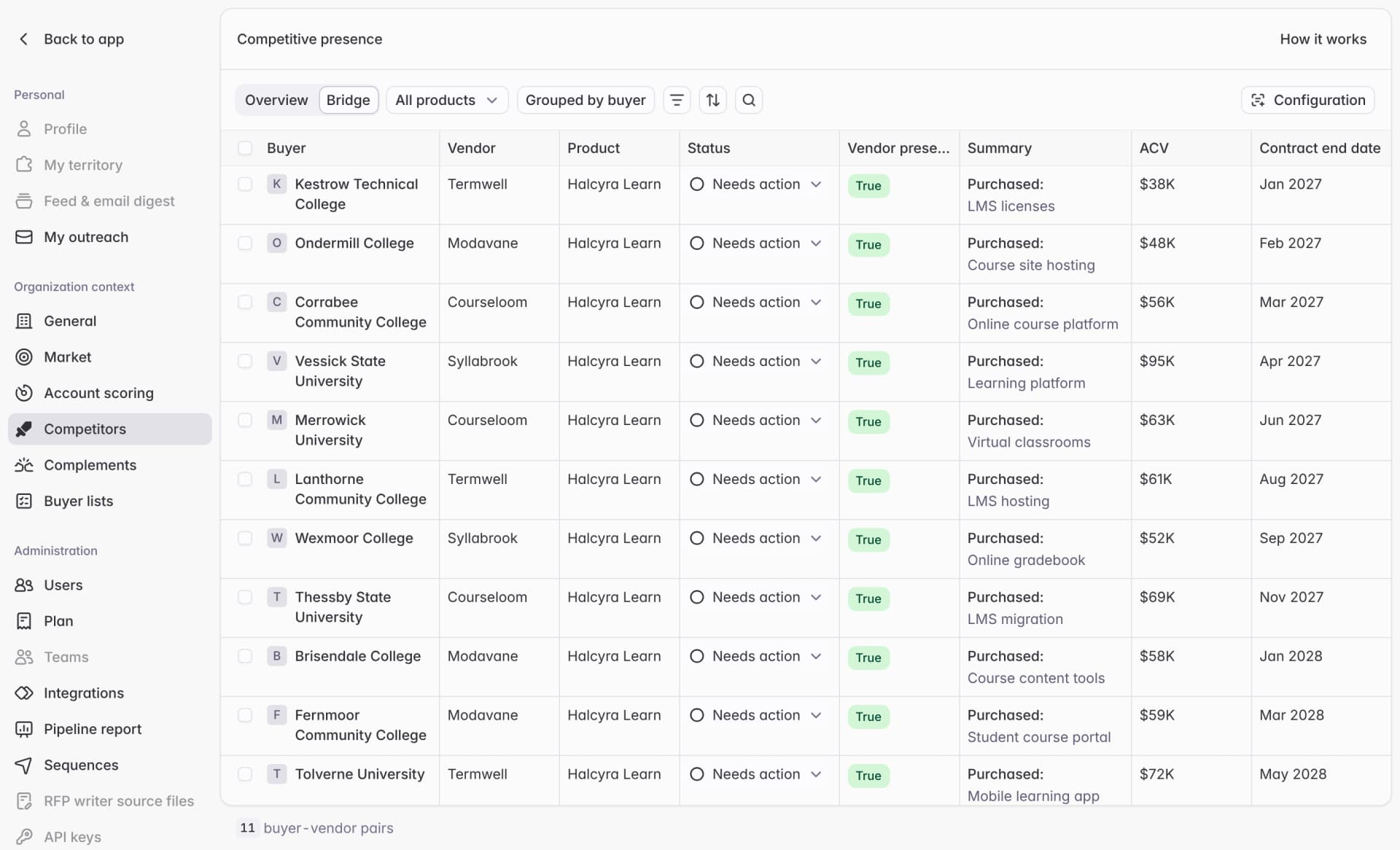
Public Spend Intelligence shows what a college already buys in your field and when the current contract ends. The data draws on purchase orders for 77% of institutions out of the box, across state and local government, K-12 and higher education.
InquirED drove $200K in new pipeline in its first quarter with Starbridge, automating its manual account research.
Book a demo today to see which colleges in your sector already spend in your field.
Which count belongs in your plan
Use 5,711 as the full list of colleges, and write down the sectors it breaks into. Add the 68 system offices to the plan as accounts of their own, because for some products they are the buyer.
Then work down to the accounts a rep can call this quarter. Sort on sector, who buys, budget and demand, in that order.
- The ideal customer profile template turns those attributes into a profile.
- How many counties are in the US does the same job for local government, and how many school districts does it for K-12.
- The Starbridge buyer catalog lets you browse colleges by type.
Frequently asked questions
The federal count is 5,711 Title IV colleges, meaning the schools whose students can use federal aid. The bigger figure of 5,779 adds the 68 system offices, which are not colleges and report on their own. Other counts differ because they draw the line elsewhere, so some add trade schools and some count a branch campus with its main campus.
A college is a campus where students enroll, and a system office is the head office that runs several campuses at once. The federal data counts them apart, and a seller should too, because one system office may buy software for every campus it runs. A list of campuses alone can send nine pitches into one system, while the person who decides never appears on it.
There are 859 public 4-year colleges and 818 public 2-year colleges, so about 1,700 public schools in total in the US. Public schools usually buy through a bid office, and often through a state contract, so their path is easier to guess than a private college’s, and usually slower.
Use student numbers to cut the list fast, because the figure is published for every college and it tells a 2-year school apart from a research university in one step. Then check spending on the ones left, since two colleges of the same size can spend very differently once a hospital or a research center is in the mix.
Each source draws the line somewhere different, so some count only schools that grant degrees, some add trade schools, and some count a branch campus with its main campus. Say which line your own number uses. A territory built on one count and a quota built on another will not agree.


