
Ideal customer profile for government and education sellers: a worked template
Discover an ICP template for government and education sales. The actual attributes in a customer that predict a deal and where to find each one.

An ideal customer profile in B2B may ask how many staff a company has, what it earns, and what software it already runs. However, if you ask a school district those three questions you learn almost nothing about whether it can actually buy from you.
This guide outlines the attributes that do predict a public sector deal and where each one is published.
TL;DR: what is an ideal customer profile in government and education sales?
An ideal customer profile (ICP) describes the government agencies, school districts and colleges that fit what you sell. To assess fit, ask three questions. Is the institution allowed to spend money on this type of purchase? Is its budget large enough? Who makes the buying decision?
A school district can fit your profile long before it shows interest. If it later issues a request for proposals with an award date this quarter, that tells you when it plans to choose a vendor.
Why a commercial ICP breaks here
Every attribute in a commercial profile has a public sector equivalent, but the equivalent is not always obvious.
For example, headcount is the usual trap, because a district with 900 students and one with 90,000 may run the same service and buy the same product.
| Commercial attribute | Public sector equivalent | Where it is published |
|---|---|---|
| Industry | Type of government and the service it runs | Census government counts |
| Employee count | Enrollment band, residents served, or operating budget | NCES, Census, adopted budget |
| Revenue | The funding line that pays for your category | Adopted budget, grant award lists |
| Tech stack | The incumbent vendor and the contract end date | Purchase orders, award records |
| Buying process | The dollar line that forces a board vote | Purchasing policy, board policy manual |
The funding line is arguably the most important attribute, and the one furthest from its B2B equivalent. A district may want your product, be the right size, and still have no budget to procure it.
In that case the public sector buyer is not a prospect this year, whatever the interest looks like.
The attributes that make up the template
Start with the details you can check quickly across many accounts:
- Institution type. Who runs the service your product supports? If you sell firefighting equipment, the buyer might be a city, a county, or an independent fire district.
- Institution size. What size institution can typically afford your product? Choose a measure that fits your market, such as student enrollment for school districts or the fire department’s annual budget for firefighting equipment.
- Funding source. Which budget line or grant can pay for this purchase? Record the source and check whether the institution has money available through it this year.
- Current vendor and contract end date. Who provides the product or service today, and when does the contract expire? Use the end date to work backward and estimate when the buyer may start evaluating a replacement.
- Purchase approval. Who can approve a purchase at your expected price? Record the spending threshold that triggers a board or council vote. If a vote is required, the meeting schedule helps you estimate how long approval could take.
Use institution type and size to build your target list. For each account on that list, track its funding source, current contract, and approval rules.
Revisit funding availability and contract dates when deciding which buyers to contact this quarter.
This profile answers whether a body could ever buy. Scoring answers whether it is about to. The B2G lead generation playbook covers the scoring half in full.
A worked ICP example
Take a vendor selling a literacy intervention program to K-12, at an average deal of $18,000 a year:
- Type of government. The buyer is a school district that operates schools. The NCES count of operating regular districts is 13,289.
- Size band. An $18k deal may be too large for the smallest districts to sign without a fight and too small to interest the largest. The middle, so districts with 1,000-24,999 students, is where I’d start first.
- Funding line. Literacy intervention is usually paid from Title I Part A, which goes to schools serving low income families. The vendor keeps only the districts whose allocation covers the deal, and that threshold is theirs to set rather than a national number.
- Incumbent and contract end. The vendor records which reading program each district runs now, and when that contract ends, from purchase orders and award records.
- Sign-off path. At $18,000 most districts in the middle band sit below the board vote line, so a curriculum director can sign, which is why the band was chosen.
The first two steps in this process above are public counts, and the third is a filter the vendor sets.
The fourth is not a filter at all, because an account with three years left on a contract stays in the profile and simply waits.
What to do once the profile is set
A finished ICP profile is a list, and a list is not yet a territory. Rank what is left by the signs that a body is moving now:
- It discussed your category at a board meeting this quarter
- It posted a job to run a literacy intervention program
- A rival’s contract ends within the year
- It passed a budget line for the work
Those four are readiness indicators, and as a result they’re temporary. For example, a board mention from last month is worth more than one from last spring, so the ranking has to be rebuilt on a schedule rather than once a year.
Doing that by hand for your entire TAM is almost impossible. The counts sit in federal files, and the budgets sit on tens of thousands of separate websites.
That’s one of the reasons we created Starbridge.
Starbridge is the AI GTM platform for companies selling to the government, K-12, and higher education, helping teams prioritize the right accounts, engage the right people earlier, and identify high-intent opportunities before the competition.
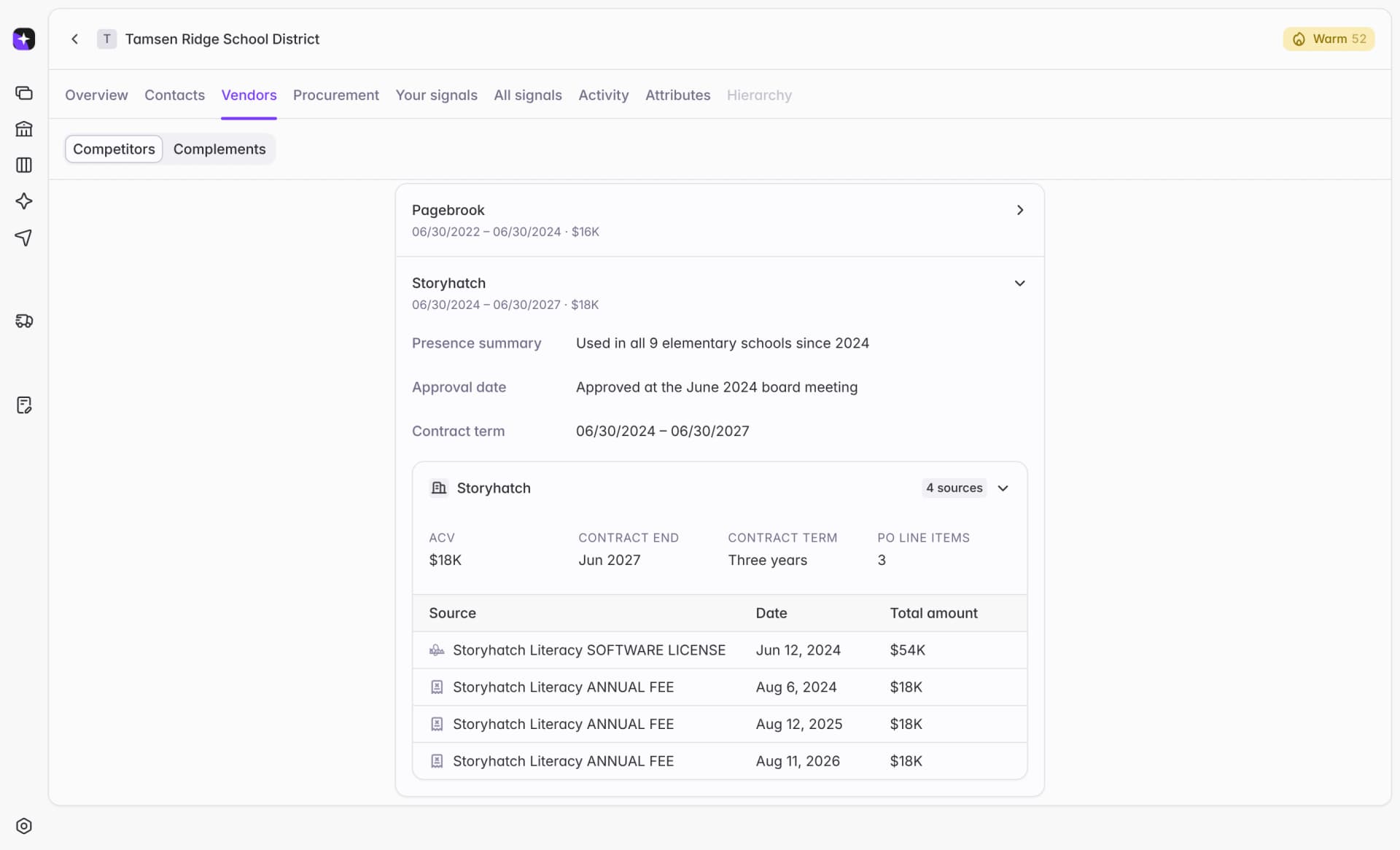
Public Spend Intelligence shows what an institution already buys in your field. The intelligence shows when the current contract ends, drawing on purchase order data for 77% of institutions out of the box. This covers state and local government, K-12 and higher education.
InquirED drove $200K in new pipeline in its first quarter with Starbridge, swapping hand research of board papers for signal-driven scoring.
Book a demo today to see which institutions in your profile are already spending in your field.
Where to start
Start from the official, published counts, before you buy a list of accounts from a data vendor. The counts are free, and the same sources list the institutions themselves.
- How many school districts are in the US gives the K-12 universe with its sources.
- How many counties are in the US does the same for local government.
- The Starbridge buyer catalog lets you browse those bodies by type.
Write the ICP profile down as a list of attributes, each with its source and its date, rather than as a sentence about who you sell to.
For example, a rep can act on "districts of 1,000 to 24,999 students that draw Title I Part A and sit below the board vote line." Nobody can act on "mid-sized districts that care about literacy."
Review it once a year, after budgets are adopted. Funding lines change. Districts cross from one size band into the next. The type of government that runs a service almost never changes at all.
Frequently asked questions
The ICP in public sector sales describes the institutions that can buy what you sell, and you write it as attributes you can look up rather than traits you infer. The useful attributes are the type of government, the size band, the funding line that pays for your category, the incumbent and contract end date, and the dollar threshold that forces a board vote. All five are published, which is why you can build a public sector profile from public records.
An ICP describes fit and changes about once a year, while scoring describes readiness, which can change weekly. Type of government, size band and funding line belong to the profile. Board mentions, job postings, contract expirations and new budget lines belong to scoring. Teams that merge the two end up rebuilding the whole list every time a signal fires, which is far more work than re-ranking a stable list.
That depends on your price and your coverage model rather than on a standard figure. The practical test is whether one rep can work the list, which means knowing the funding line and the sign-off path for each account rather than only the name. A profile that leaves thousands of accounts has usually skipped the funding line filter, because that is the attribute that cuts hardest.
Write one profile per type rather than one profile that covers them all. A county, a special district and a school district run different services, draw on different funding and sign at different thresholds, so a combined profile hides the differences that decide the deal. The attributes stay the same across the versions, and only the values change.
The adopted budget is the primary source, and every general purpose government and school district publishes one. Grant award lists cover the federal and state programs on top of it, such as Title I Part A for K-12. Both are public records, so the filter can be built without talking to anyone, though a buyer will usually confirm the line in a first conversation.


