
How a pre-RFP signal engine ranks government and education buying intent
A pre-RFP signal engine finds buying intent in public records before a solicitation. Learn how to score by buying stage and win deals earlier.

By the time the RFP drops, the deal is already decided. The vendor who helped write the spec has been in the account for months, and the relationship’s already set. A pre-RFP signal engine exists to get you into that account first.
This guide explains which public records the engine reads, how to score what it finds by buying stage rather than keyword match, and how to route the output so a rep acts on the account.
What is a pre-RFP signal engine?
A pre-RFP signal engine is a system that continuously reads government and education public records and extracts evidence that an entity is moving toward a purchase. It ranks each piece of evidence by how far the buyer has formally progressed, then routes the highest-scoring accounts to a seller before a solicitation is published.
Where government and education buying intent appears in the public record
Government and education buyers document their plans before they buy, because spending public money requires a public record. That record is where early demand signals live.
Long-term planning documents come first. In states such as Washington, statute requires the capital facilities element of a local comprehensive plan to include “at least a six-year plan that will finance such capital facilities within projected funding capacities and clearly identifies sources of public money for such purposes”.
A project listed there is a stated need with a funding source attached, years before any vendor gets a call.
Board and council meeting minutes come next, and they carry the most usable detail. A school board that spends a full agenda item on student information system frustrations has told you what it wants replaced, who is unhappy, and roughly when.
Adopted budgets confirm the money. Grant awards add a spending deadline. Contract expirations force an evaluation whether or not anyone at the agency wants one. Leadership changes reset vendor preferences that took years to build.
Each document type answers a different question, and the full catalog of government buying signals maps what each one proves.
Why bid boards and RFP alerts arrive too late to influence anything
Think about the last time you hired someone for a home repair. The first roofer you speak with does more than give you a quote. They teach you what questions to ask, which materials matter, what a reasonable price looks like, and what separates a good contractor from a bad one.
Every roofer who comes after is now being evaluated against criteria the first conversation helped establish.
Public sector buying works similarly. Before an RFP is published, buyers are already learning about the problem, comparing approaches, talking to vendors, developing requirements, and deciding what matters in the evaluation.
In short: The specification, the criteria, and the weighting all exist before the notice publishes.
In addition, the time window to apply is too tight:
- For example, Delaware requires a request for proposals to be issued at least fourteen calendar days before proposals close. Maine allows a minimum of fifteen calendar days from the final day of advertising.
- New Jersey sets the floor at seven business days.
Two weeks is enough time to write a proposal against criteria someone else influenced. It is not enough time to change what the buyer is asking for, meet the people who will score the response, or become a name they recognize.
That is why an RFP so often reads as though it were written for one specific vendor, and why arriving at publication means competing on price against a specification built for somebody else.
How does a pre-RFP signal engine score and rank what it finds?
Reading the public record is hard. But even harder is deciding which signals are strong enough for a rep to act on.
The most reliable ranking input is the buying stage, meaning how far the buyer has moved in the purchase process.
This works, because public bodies cannot move money without leaving an ordered paper trail, and each step is a recorded act.
A need mentioned during a committee meeting is an early signal. If that need later appears in an adopted capital plan with an identified funding source, it becomes stronger. An approved appropriation is stronger still. By the time a solicitation is published, the purchase has reached the final procurement stage.
This makes the buying stage more reliable than the actual words used in the record.
The engine does not have to infer whether a statement sounds serious, it can score the formal actions the buyer has already taken.
Signal density beats any single buying indicator
One buying indicator tells you an account has a topic. Several arriving on the same account within a quarter tell you the account has a project.
For example, a district carrying a technology line item in its adopted budget, a board discussion naming the current vendor, and an expiring contract in the same category are not three separate leads.
Together they are one deal at three stages of confirmation, and that account should outrank every account showing a single mention.
Contract expirations and inferred renewal dates
An expiration date is the rare buying indicator with a calendar attached, which makes it the most schedulable input in the model.
Most agencies never publish one. The date has to be inferred from the award record, the original term, and any exercised options, then re-checked when an amendment appears.
A renewal date deserves weight in proportion to how it was derived.
A date read off a signed contract is evidence. A date estimated from a purchase order with no stated term is a guess, and scoring the two identically is how a model starts lying to reps.
What separates a passing mention from a funded intention
False positives come from matching words instead of acts.
- A council that mentions cybersecurity while thanking an IT team has produced nothing.
- A council that mentions cybersecurity while approving a transfer into an IT capital account has produced a fundable project.
The filter that matters asks what the body did in the same agenda item, not what it said. Anything that fails that test belongs at the bottom of the queue rather than in a rep’s inbox.
Starbridge is the AI GTM platform for companies selling to the government, K-12, and higher education, helping teams prioritize the right accounts, engage the right people earlier, and identify high-intent opportunities before the competition. Its Buying Signals Monitor applies that ranking across 320k+ government and education entities, with 77% of state and local, K-12, and higher education purchase orders covered out of the box.
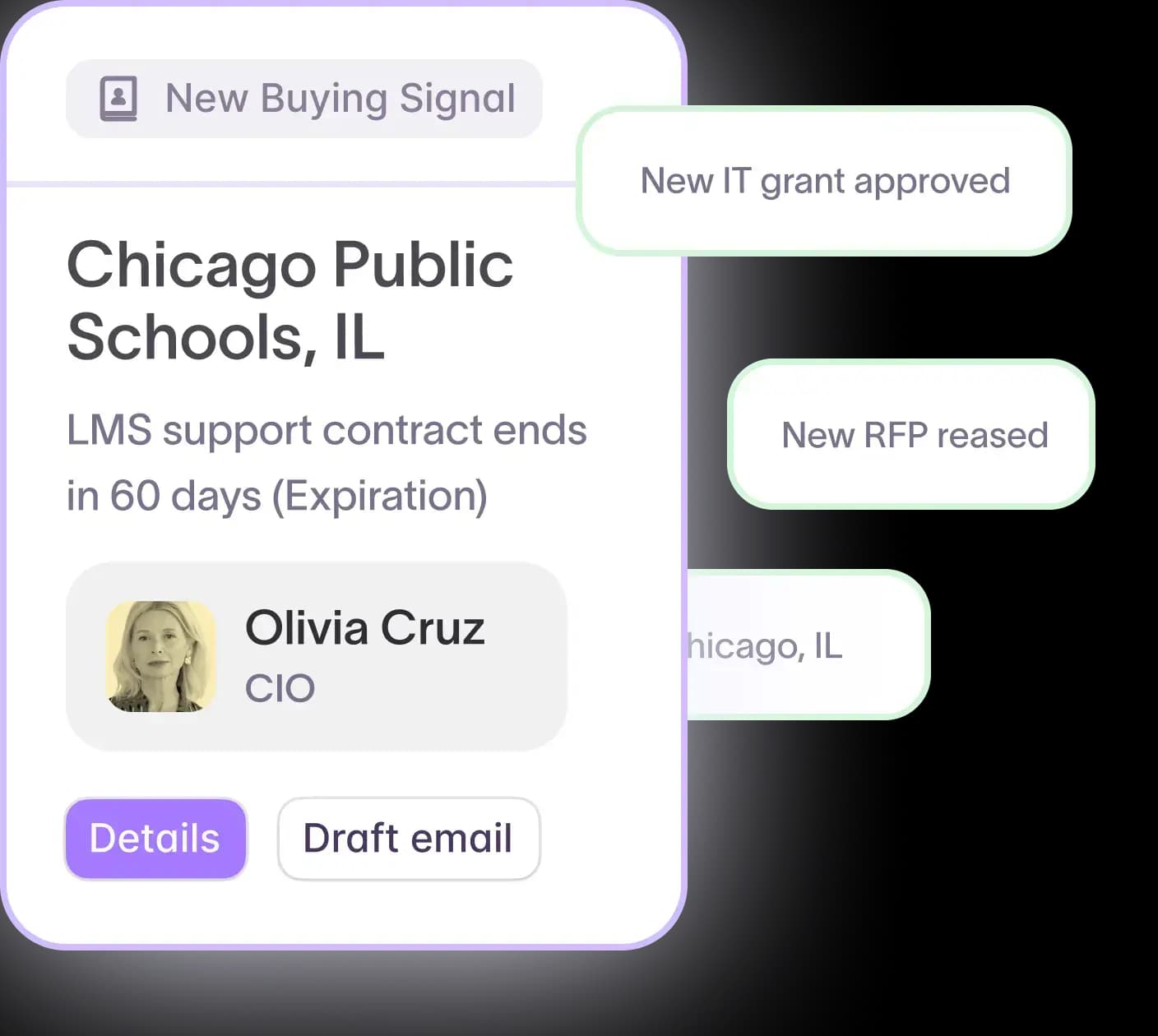
InquirED drove $200K in new pipeline in their first quarter, replacing manual board-document research with signal-driven account scoring that identified which districts were actually ready to buy.
If your reps are reading documents instead of working a ranked list, the scoring layer is the gap.
Turning a buying signal into pipeline
A ranked account list still fails if nobody uses it.
The handoff is where most monitoring projects stop working.
A buying indicator becomes workable when it arrives with a verified contact and a concrete reason to reach out.
- The account-level indicator says something changed.
- The verified contact says who to call.
- The outreach context says why the call makes sense this week.
Starbridge’s qualified-lead standard requires all three together, because an indicator without a contact becomes a research task, and a contact without context becomes a bad cold email.
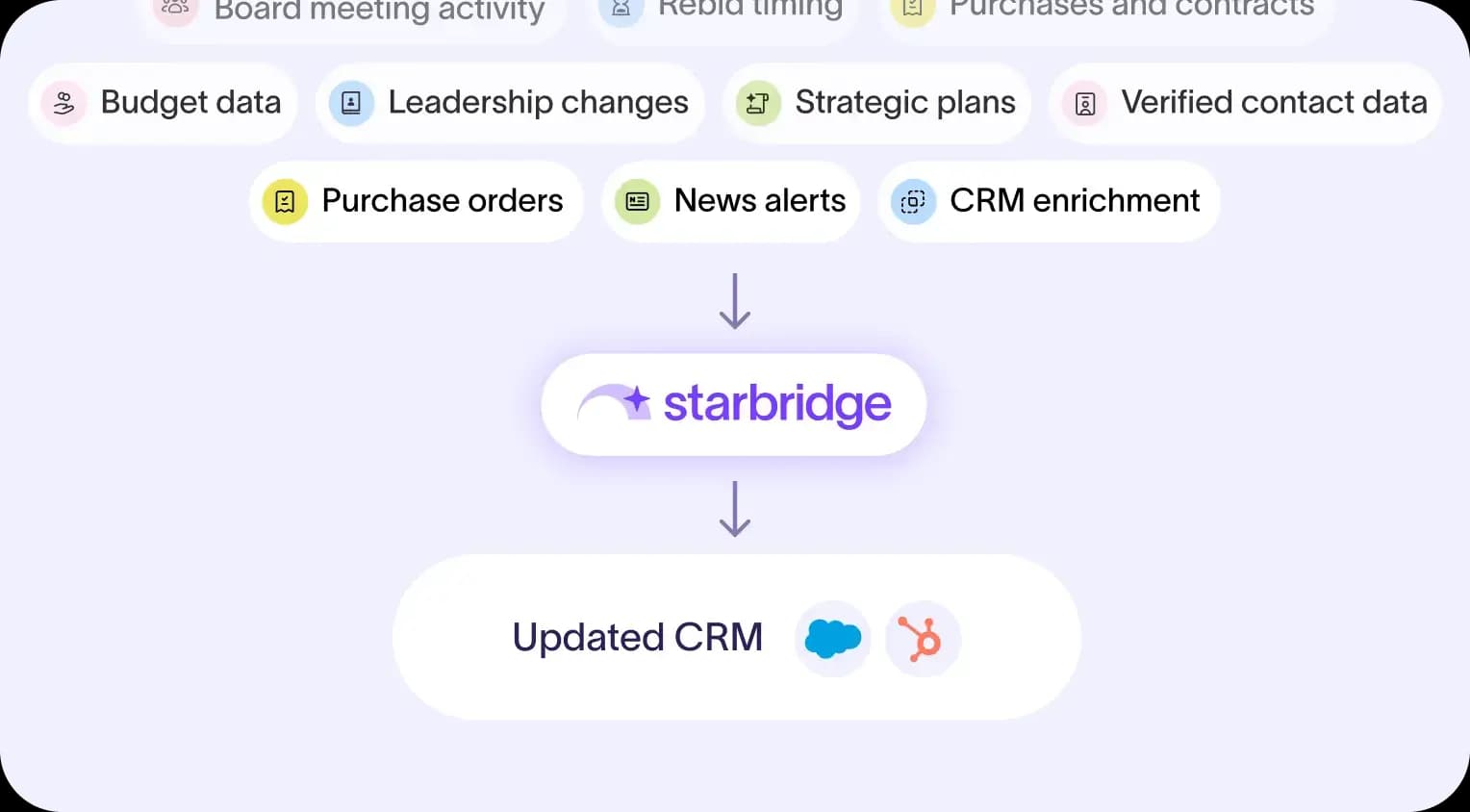
Routing decides whether that qualified lead survives the handoff. The record should land in the CRM against the account rather than in a digest nobody opens, carry the source document so a rep can quote it, and name a single owner. Stamp the date the document was published rather than the date it was ingested. Territory rules should resolve ownership automatically, because an unassigned high-scoring account is the one that ages out.
It’s about timing. A buying indicator loses value as the buyer moves stages, so a queue ordered by score alone will bury a two-week-old appropriation under a fresh committee mention. Order by score and recency together, and set an expiry so nothing sits unworked past the stage it described.
Starbridge pushes ranked accounts and their source documents into Salesforce and HubSpot, and into the sequencer where the team already works.
Build the ranking layer before the next budget cycle
The public record already contains clues about which accounts are most likely to buy next year.
- Contract expirations show when existing agreements may come back to market.
- Budgets and capital plans show where money is being allocated.
- Strategic plans show which initiatives an organization expects to pursue over the coming years.
Those long-term signals are the foundation of account scoring. Instead of ranking accounts by how often a keyword appears, rank them by the strength and timing of the evidence that a purchase is likely to happen.
The result is a prioritized account list built around future buying potential, so reps can focus on the organizations most likely to enter the market before an RFP is published.
Book a demo to see how Starbridge ranks buying intent across government and education accounts, and how teams use that ranking to win deals earlier.
Frequently asked questions
Building is feasible for a narrow territory. It stops scaling when coverage becomes the constraint, because thousands of separate agencies publish on their own schedules and in their own formats. Read our build versus buy analysis for public sector sales data before committing engineering time.
The earliest documented intent appears in multi-year capital plans. In states such as Washington, statute requires at least a six-year capital facilities plan naming its funding sources. The latest useful moment is the statutory notice window, which can be as short as seven business days in New Jersey.
A bid alert fires when a solicitation publishes. By law that document already contains the specifications, the evaluation criteria, and the scoring weights. A pre-RFP signal engine reads the planning record before those are fixed, so the distinction is whether anything is still malleable, rather than how fast the alert arrives.
Explore our use case library
 Automate account research with AI agentsStop manually researching accounts. Starbridge AI agents automate account research by monitoring buying signals 24/7 and surfacing the right contacts.
 Identify competitor contract expiration datesThe RFP is usually a formality. Starbridge surfaces competitor contract expiration dates so your reps reach accounts before the renewal cycle closes.
 Create a conference campaignTurn conference badge scans into pipeline. Import your contact list, surface buying signals across every account you met, and follow up with context.