
Local government procurement: how cities and counties actually buy
Each city and county sets its own bid threshold, so the number that decides your deal changes from town to town. Here is how local government procurement works.

Two towns in the same state can buy the same software on different terms, because each town sets its own bid threshold.
A purchase under the town’s threshold can go to one vendor after a few quotes. A purchase over it, on the other hand, has to be posted as a municipal bid.
This guide covers how a city or county buys, who starts a purchase, and what decides which side of that line your deal lands on.
TL;DR: what is local government procurement?
Local government procurement is how a city, county, town or district buys goods, services and software. City procurement and municipal procurement are the city-level part of it. State law often sets the highest the bid threshold can be, and each body then adopts its own purchasing ordinance under it. So each city sets the dollar threshold that decides whether a purchase goes to bid, and neighboring towns set it differently.
The Census Bureau counted 19,489 municipal governments and 3,031 counties in 2026, inside 91,729 local governments in all. Each city, township and county on that list sets its own purchasing rules.
The stages of a city or county purchase
A local government purchase moves through roughly the same stages every time. The later you arrive, the less of the spec you may influence:
- A department feels the problem. Public works, finance or the clerk decides something has to change.
- The spec gets written. A spec is the written list of what the buyer wants, and whoever helped them think it through tends to recognize the wording.
- The purchasing route gets chosen. Staff work out whether quotes are enough, whether an existing contract covers it, or whether the purchase has to be bid.
- The bid runs, or the quote is accepted. A bid posts, the responses are scored, and staff recommend an award.
- The council or board votes. In most cities the award is approved in a public meeting, on a published agenda.
- The contract is managed. Staff watch performance and eventually renew or rebid.
It’s worth paying special attention to stage three, where the purchasing route gets chosen. That route decides whether you are in a race with every registered vendor or in a conversation with one buyer.
The council vote is what separates a city from a state agency. A state agency signs an award in an office, while a city approves one in a public meeting on a published agenda.
Who starts a purchase inside a city or county
A purchase typically starts in the department that has the problem rather than in the purchasing office. Purchasing joins once the department has money budgeted for it.
The spec writer is the person worth calling. The purchasing officer chooses the route the purchase takes, but rarely chooses the product.
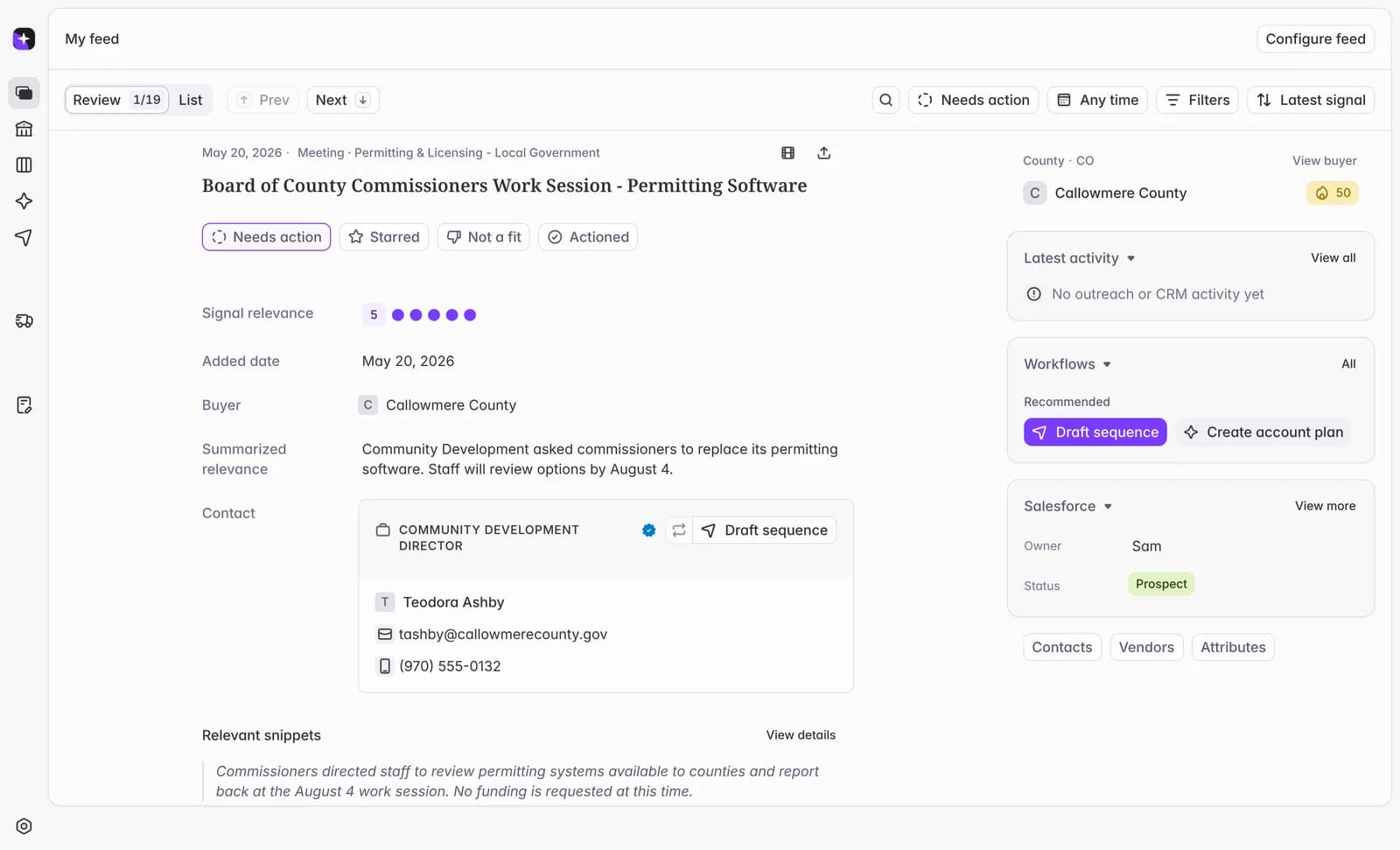
The people worth knowing in a mid-sized city are:
- The department head who owns the problem
- The finance director who finds the money
- The purchasing officer who picks the route
- The manager or administrator who sets the agenda
- The council or board members who vote
Our guide to how local governments buy software follows that path in more detail for a technology purchase.
What decides whether your deal goes to bid
A local purchase is governed by three rulebooks at once. The strictest of them sets the rule the buyer has to follow.
| Rulebook | Who it binds | What it means for you |
|---|---|---|
| State purchasing law | Cities, towns and counties as creatures of the state | Sets the upper limit, and in some states fixes the award to the lowest responsive bid |
| The body's own ordinance | The city or county that adopted it | Can be stricter (lower) than the state limit, and is where the local threshold actually lives |
| Grant terms | Any purchase made with grant money | Travels with the money and can override the local rule |
The local ordinance holds the number that decides the deal, and it is the rulebook vendors most often skip. Thresholds run from about $5,000 to $150,000 depending on the state, the municipality or the district.
For example, one city might bid anything over $25,000 while its neighbor waits until $50,000. So a $45,000 price can close in a month in one city and trigger a full RFP in the next one.
A purchase priced under the line doesn’t need a new RFP. Staying under the line is the first route around a bid.
A cooperative contract vehicle is the second route around a new full RFP. The city buys through a contract another agency has already put out to bid.
A third route runs through a reseller that already holds a contract the city can buy from. It’s worth asking a buyer which of these routes they already have open.
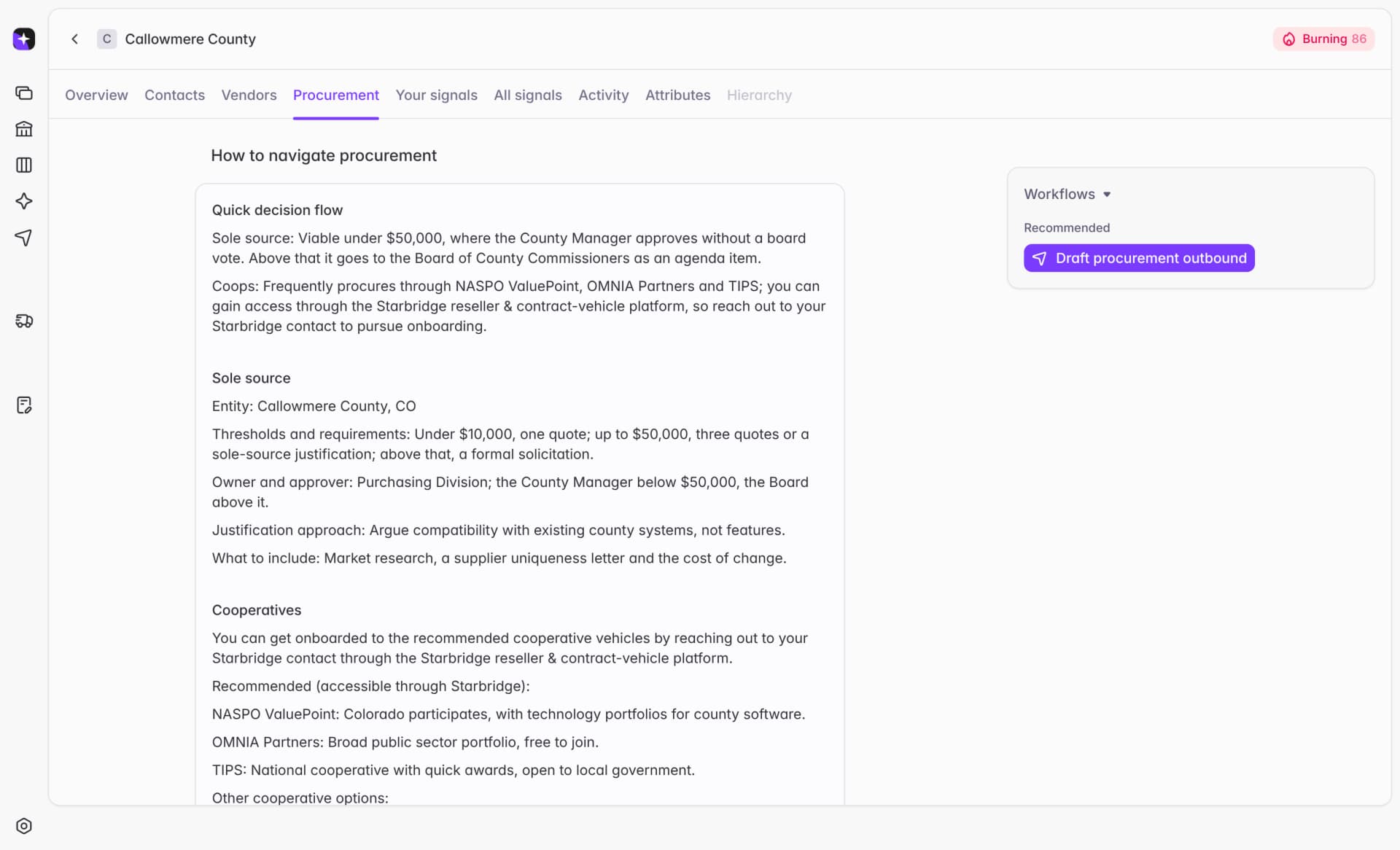
Price the proposal after you know the threshold, not before. Talking to government buyers before the RFP covers which of these conversations are open to you and when.
How county procurement differs from a city’s
A county usually runs courts, jails, elections and county roads, which adds departments to the list and raises the typical contract size.
| A city or town | A county | |
|---|---|---|
| Typical departments | Police, fire, parks, utilities, permitting | Courts, jail, elections, health, roads, social services |
| Who approves | City council, often with a manager | A board of commissioners or supervisors |
| Scale | Smaller contracts, faster cycles | Larger contracts, more formal process |
The practical difference is coverage. A vendor who works only cities misses the county department buying the same thing on a bigger budget.
A few cities and counties have consolidated into a single government. There the same buyer handles both the city purchases and the county ones.
Counties often pay for purchases with grant money, so grant terms (the third rulebook mentioned above) apply more often.
How to sell into a city or county
Work the account rather than the bid board. The useful question is not what posted today but which bodies are about to spend in your category and what they are running now.
A city publishes almost everything that decides the deal:
- Council and board agendas, where the need is raised
- Budget documents, where the money appears
- Capital improvement plans, which schedule the big projects
- The purchasing ordinance, where the threshold sits
- Purchase orders and awards, which name the incumbent
- Contract end dates, which set the date to come back
Our guide to finding local government contracts works through those sources one by one.
A rep can read all of that for one city in an afternoon. However, a single rep usually can’t keep up across a whole territory.
So most teams fall back to the bid board, which tells them what every other vendor already knows.
That’s one of the reasons we created Starbridge.
Starbridge is the AI GTM platform for companies selling to government, K-12 and higher education, helping teams prioritize the right accounts, reach the right people earlier, and spot high-intent opportunities before the competition.
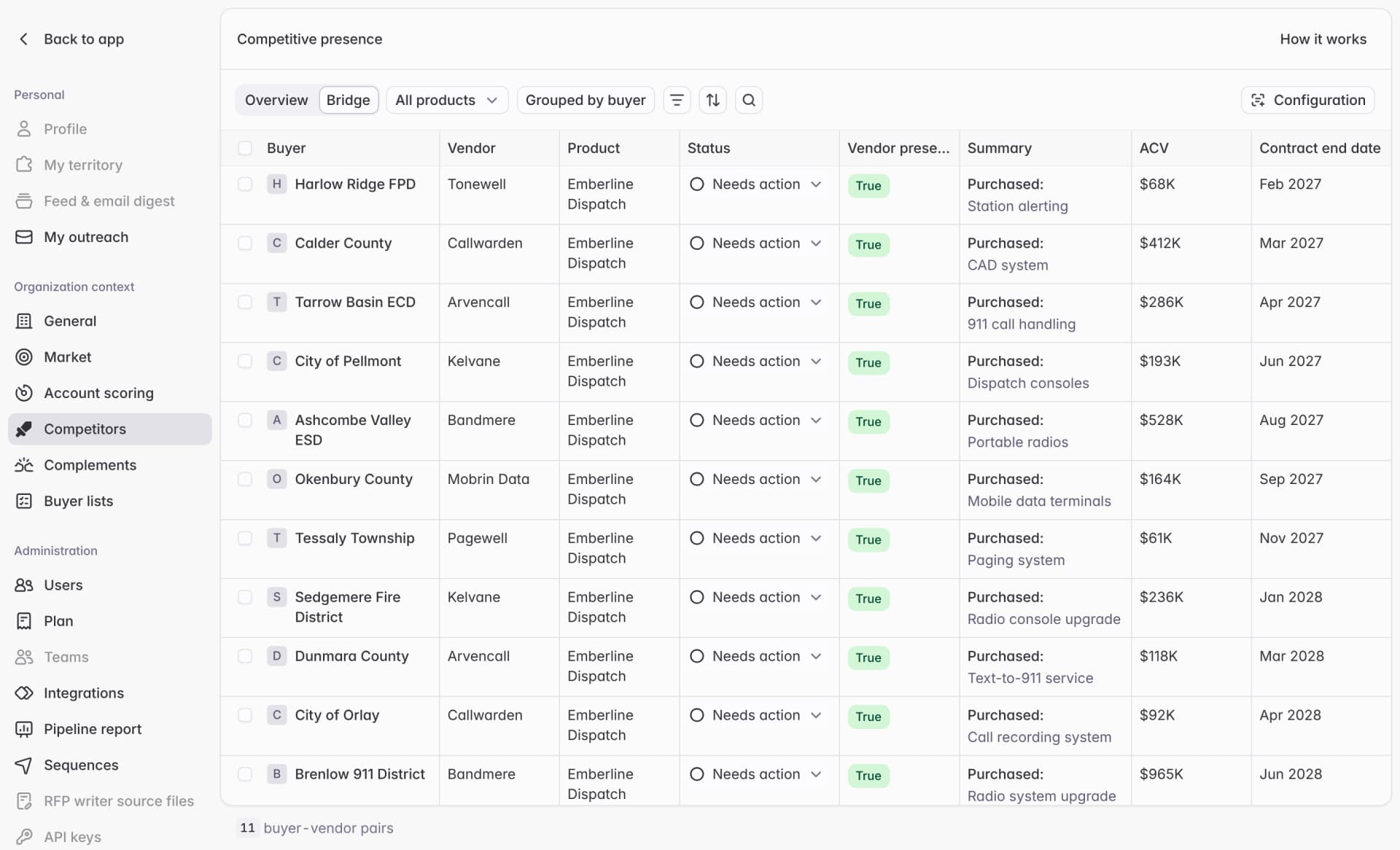
Public Spend Intelligence draws on purchase orders for 77% of bodies out of the box, and the record reaches more than 320,000 government and education bodies. ClearGov built $16.4M in new pipeline ARR with Starbridge in twelve months.
Book a demo today to see which cities and counties in your market are already spending in your category.
Where to start
Pick one county and the cities inside it, then read the record before you price anything. The threshold, the incumbent and the contract end date are the three facts that decide whether you are selling or bidding.
The rest of the series covers the other buyers: public sector procurement for the overview, school districts, and colleges.
Frequently asked questions
Yes. Municipality procurement and city procurement both describe how a city or town buys goods, services and software. Local government procurement is the wider term, because it also covers counties, school districts and other special districts.
A municipal contract is an agreement between a city, town or county and a vendor to supply goods, services or software. The body awards it under its own purchasing ordinance, often with a council or board vote on the record for anything above a set dollar amount.
It depends on the city, which is the point. Thresholds run from roughly $5,000 to $150,000 depending on the state, the municipality or the district, and a city can set its own below whatever limit state law allows. Check the purchasing ordinance for the specific body before you price.
The rules work the same way, but the departments do not. A county runs courts, jails, elections, health and roads, so it often buys things a city does not, and on larger contracts, approved by a board of commissioners rather than a city council.
Often, yes. A purchase under the local threshold can go ahead on quotes, and a city with access to a cooperative contract vehicle can buy through an agreement another public body already competed. Approvals still apply, and most purchases above the threshold still go to bid.
Each city posts its own municipal bids, usually on its website and sometimes on a state or regional portal. So a vendor typically watches a handful of portals and still misses the cities they never signed up to.
Months, because the discussion happens in public first. A council agenda raises the need, a budget document funds it, and a contract end date says when the current vendor’s deal runs out, all before any bid posts.


