
Best contact database for public sector sellers in 2026
Compare five contact databases for government and education sellers. See which reach the decision-makers commercial data misses, and at what verified accuracy.

The people who hold purchasing authority in state and local government, K–12, and higher education rarely live in the commercial databases most sales teams already own.
This article evaluates five contact databases against the five capability areas that drive pipeline in this market.
| Platform | Identifying opportunities before RFPs | Contact & account data quality | Vendor spend visibility | RFP discovery & response | Contract vehicle access |
|---|---|---|---|---|---|
| Starbridge | Monitors 320k+ entities for board minutes, budgets, grants, leadership changes, and more | 98% email accuracy from continuous crawls of official .gov and .edu sources | FOIA-automated competitor contracts with pricing and expiration dates, plus purchase order data for 77% of state and local government, K–12, and higher education institutions out of the box | AI-scored feed across thousands of bid portals with a native proposal writer | Shorten sales cycles with contract vehicle access across NASPO, OMNIA, Sourcewell and more. Free to start. |
| MDR Education | Educator engagement data rather than procurement monitoring | Verified K–12 and higher education educator contacts across role-based segments | Educator audience data rather than procurement or contract intelligence | Managed marketing campaign execution rather than bid discovery | Contract vehicle access is not part of the offering as of July 2026. |
| Agile Education Marketing | EdIntel adoption tracking across LMS, SIS, and assessment tools at the institution level | Human-verified education contacts across K–12, higher education, and libraries, rebuilt weekly | Institution-level adoption data rather than procurement spend | List building and campaign services rather than a scored RFP feed | Contract vehicle access is not part of the offering as of July 2026. |
| ZoomInfo | Commercial B2B web intent from IP-to-organization pairings and publisher networks | Large commercial database that draws partly from LinkedIn and commercial web sources | Firmographic and technographic company data | Commercial intent signals, with RFP response handled through general sales engagement tools | Contract vehicle access is not part of the offering as of July 2026. |
| Apollo | Commercial buying intent via a third-party partner across public web, social, and technology-install activity, refreshed weekly | All-in-one B2B database that draws partly from LinkedIn and commercial sources | Firmographic and technographic filters for commercial accounts | Built-in sequences and dialer for outreach rather than a scored RFP feed | Contract vehicle access is not part of the offering as of July 2026. |
What to look for in a contact database for public sector sellers
These five capabilities are the criteria that separate a contact database that just lists names from one that moves government and education deals forward.
- Identifying opportunities before they go to RFP. Look for the ability to surface early buying signals, such as a new grant, a budget line item, or a contract about to expire, before an opportunity is public. Government and education buyers are not experts in every category they evaluate, so they consult vendors early to learn what is possible. The vendor in that conversation often shapes the evaluation criteria before the RFP is ever written.
- Contact and account data quality. Look for verified, current names, emails, and phone numbers for the decision-makers who actually hold purchasing authority. Superintendents, procurement directors, and agency department heads rarely maintain LinkedIn profiles, and their roles turn over on election, budget, and academic cycles that commercial data misses. Source matters as much as volume, because databases that draw heavily from LinkedIn and commercial sources reach these buyers with far less reliability.
- Visibility into what agencies and institutions are already buying. Look for access to competitor contracts, pricing, and expiration dates across the market. A rep who knows the incumbent vendor and the contract end date can time a displacement play 9 to 12 months out instead of reacting to a renewal. That context changes how a first conversation opens.
- Finding and responding to RFPs efficiently. Look for a single scored feed of relevant state, local, and education bids, paired with support drafting a compliant response. Best-fit RFPs are scattered across thousands of portals, and manual drafting burns 8 to 10 hours per response. A scored feed points reps at the bids they can actually win.
- Contract vehicle access that removes procurement friction. Look for direct access to the cooperative and federal purchasing pathways buyers already use, so a won deal becomes a signed purchase order without a full RFP. Above a buyer’s sole-source threshold, a deal either routes through an existing cooperative contract or triggers a full competitive solicitation that can add months. A chosen vendor can still lose that time to procurement after the buyer says yes.
The challenge in this market isn’t that any one capability is hard to find, but that they rarely come connected. A buying signal points a rep to the right account, verified contacts and spend context tell them who to call and what to say, and the deal moves from first touch through a scored RFP response to a signed contract on a vehicle the buyer already uses.
When a platform covers only one or two of these areas, the team stitches research, enrichment, and outreach together by hand, then handles procurement as a separate step. Every hand-off is a delay, and delay compounds in a market where early access is the primary advantage.
1. Starbridge
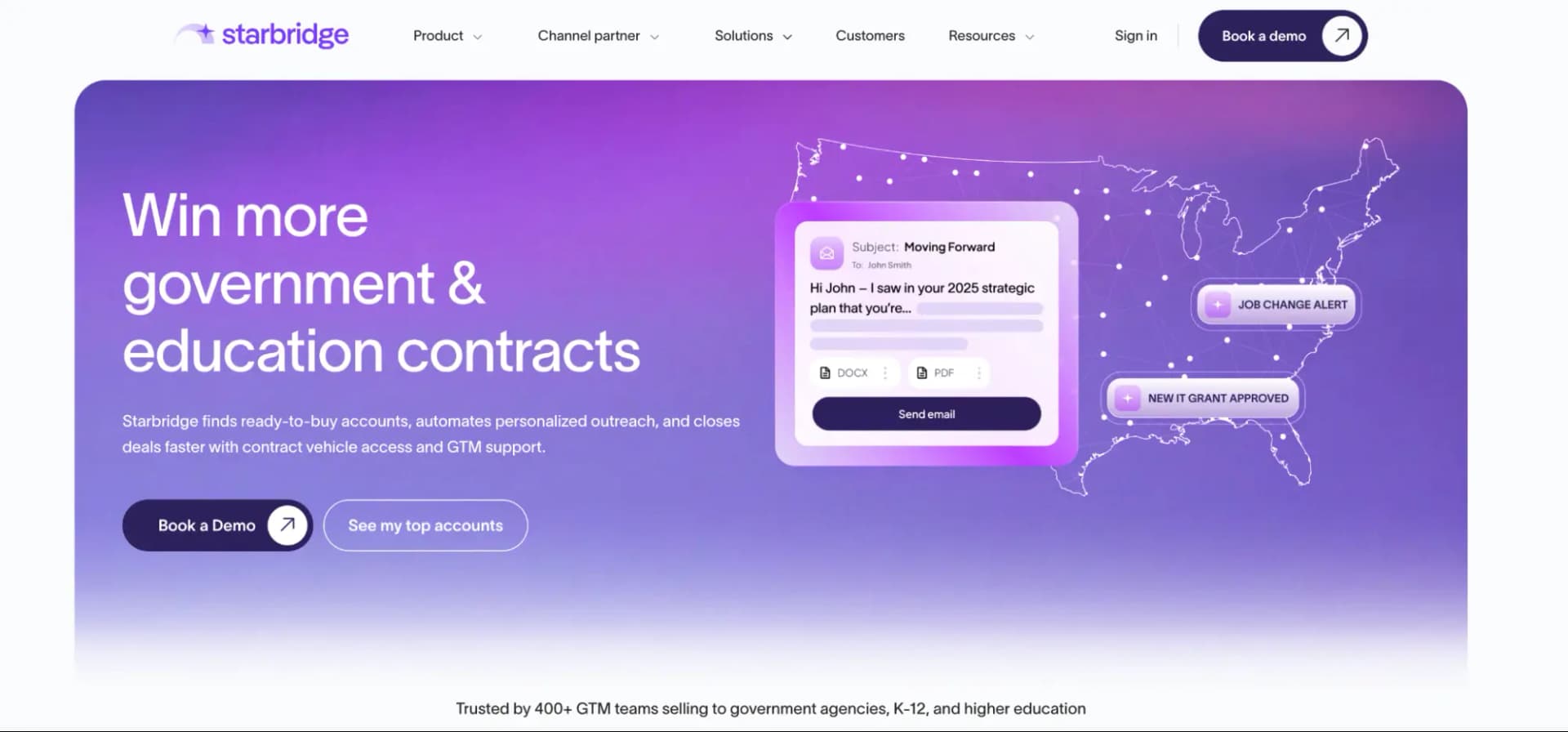
Starbridge is the AI sales intelligence platform built exclusively for companies selling to state and local government, K–12, and higher education. It pairs verified contact and account data with the buying signals, spend intelligence, and procurement access that turn a name into a signed contract. Accurate contacts are the floor in this market, not the ceiling, which is why Starbridge is designed to carry a rep from first signal to closed deal. It’s trusted by more than 500 GTM teams selling into government and education.
What Starbridge does well
Starbridge is built around five capabilities that cover the full government and education sales workflow, from the first buying signal to a signed contract.
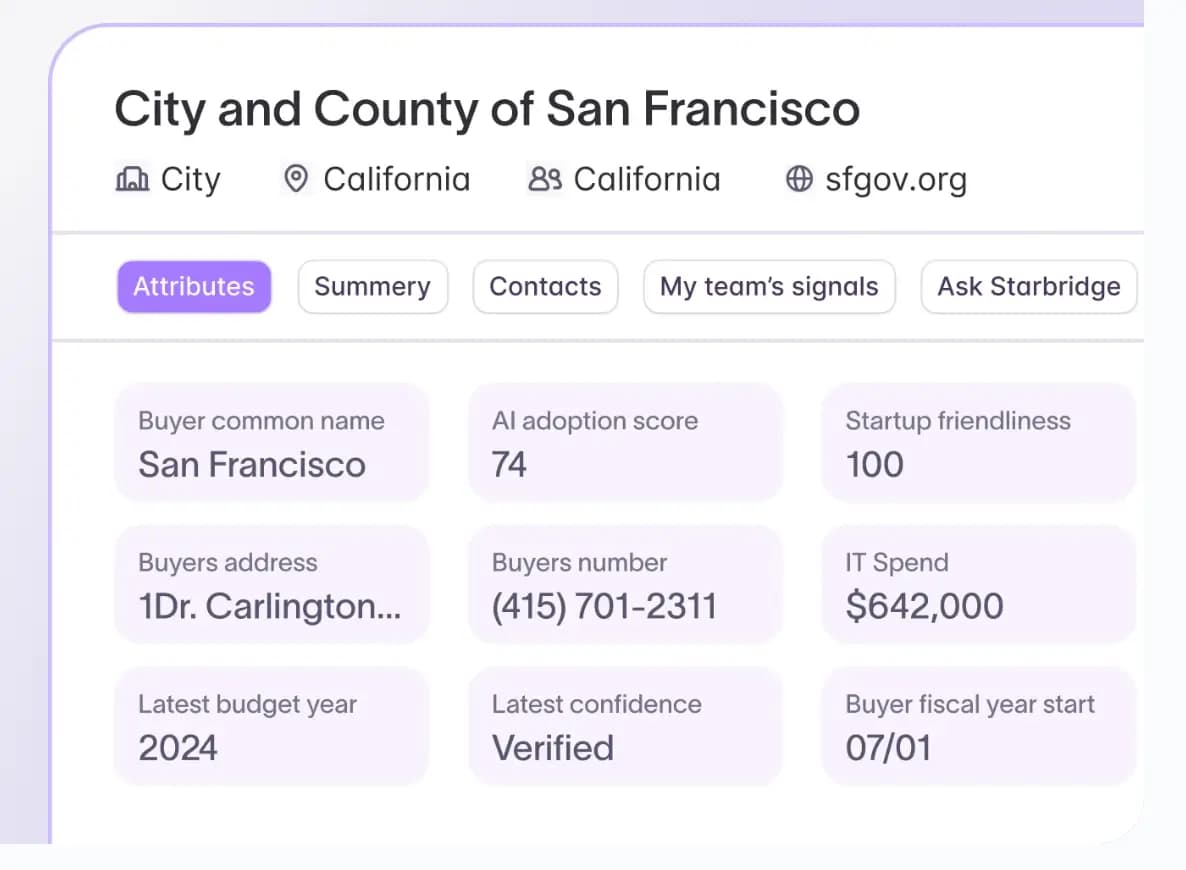
Accurate contacts are the foundation of any outbound motion, and Starbridge’s Contacts & Company Data capability is built for this market specifically. Using proprietary web-agent technology, it continuously crawls official government department sites, school district portals, and board minutes, then waterfall enriches and bounce-checks every record. That approach delivers 98% email accuracy, validated across a 14,000-email test, with a 2% bounce rate against the 15 to 25% typical of databases that draw heavily from LinkedIn and commercial sources. Bi-directional Salesforce and HubSpot integrations sync, clean, and enrich those records automatically.
Verified contacts matter most when a rep knows which account to call, and that is the job of the Buying Signal Monitor. It watches 320k+ government and education entities for buying signals such as a new grant, a budget line item, or a contract about to expire, all of which surface before an RFP is ever published. When a signal fires, the rep gets a warm lead with the contact, the reason the timing is right, and AI-drafted outreach ready to send. GovWell now sources 15% of its qualified pipeline directly from Starbridge by replacing static lists with signal-driven outbound targeting incumbent vendors and renewal timelines.
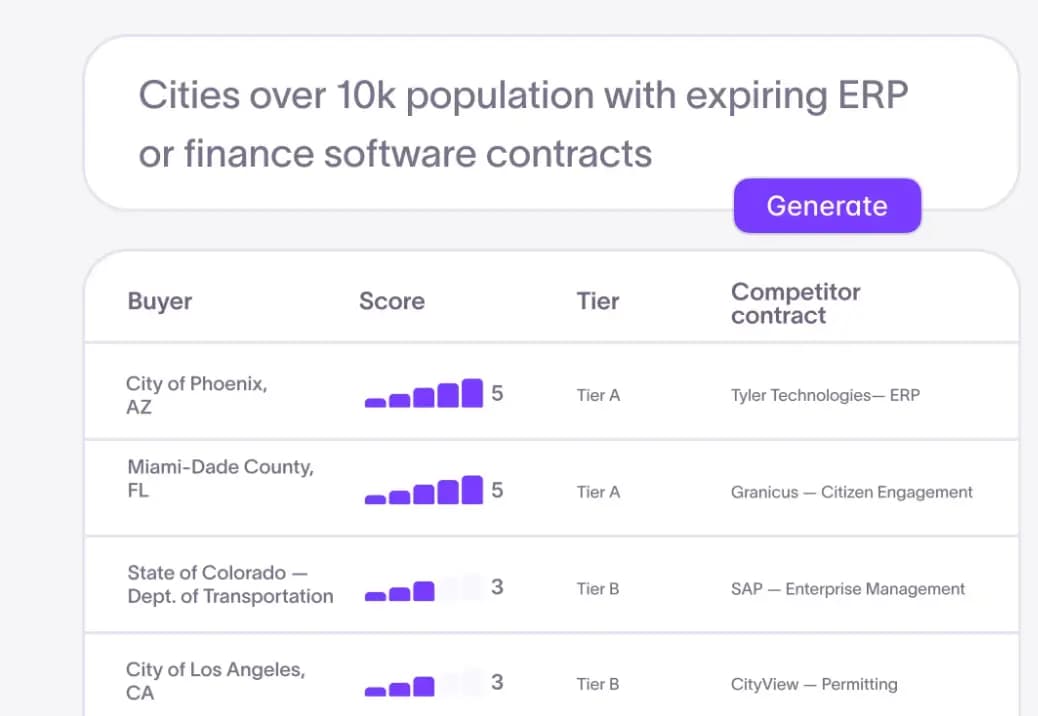
Before a discovery call, reps also need to know what an account is already spending, and Public Spend Intelligence surfaces it. Starbridge automates FOIA requests at scale to deliver full competitor contracts, including pricing and expiration dates. Out of the box, Starbridge has purchase order data for 77% of state and local government, K–12, and higher education institutions. Reps walk into discovery already knowing the incumbent vendor and the renewal window, instead of spending hours piecing it together.
When an opportunity reaches the RFP stage, the AI RFP Finder & Proposal Writer keeps the workflow in one place. It centralizes thousands of state, local, and education bid portals into a single personalized feed. Each RFP is scored by product fit and win likelihood, so reps focus on the bids they can actually win. A native proposal writer then drafts responses from the team’s product knowledge base, saving 8 to 10 hours per RFP.
Even after a buyer says yes, procurement can stall a won deal for months, which is where contract vehicle access closes the gap. Starbridge provides Contract Vehicle & Reseller Access directly as part of the platform, spanning major cooperative and federal purchasing vehicles including NASPO ValuePoint, OMNIA Partners, TIPS, and Sourcewell. Teams move a won deal onto a vehicle the buyer already uses and reach a signed purchase order without triggering a full RFP. Starbridge handles the compliance, paperwork, and renewals, turning vendor of choice into signed revenue in weeks instead of months.
Where Starbridge falls short
Starbridge delivers deeper coverage for state and local government and education than it does for federal. Teams whose primary motion is federal contracting will find more depth in platforms built around federal procurement databases and analyst networks.
The RFP proposal writer is lightweight and accelerates repetitive sections well, but it will not replace an experienced proposal hire. Teams responding to complex, high-stakes solicitations will still need someone to own the final submission. It’s a drafting accelerant, not a full proposal shop.
The 98% accuracy, FOIA automation, and continuous enrichment come at a higher price point than tools built on less expensive data sourcing. Early-stage teams working from a tight budget may find the investment better suited to a scaling or enterprise revenue team. The value tracks with the volume and complexity of a real government and education motion.
Best for
Starbridge fits enterprise and scaling GTM teams whose entire go-to-market motion is selling to state and local government, K–12, and higher education. These are teams that want verified contacts plus the signals, spend intelligence, and procurement access to carry deals all the way to signed contracts in one platform. It’s the strongest fit when accurate contacts are a starting point for a full pipeline motion, not the finish line.
2. MDR Education
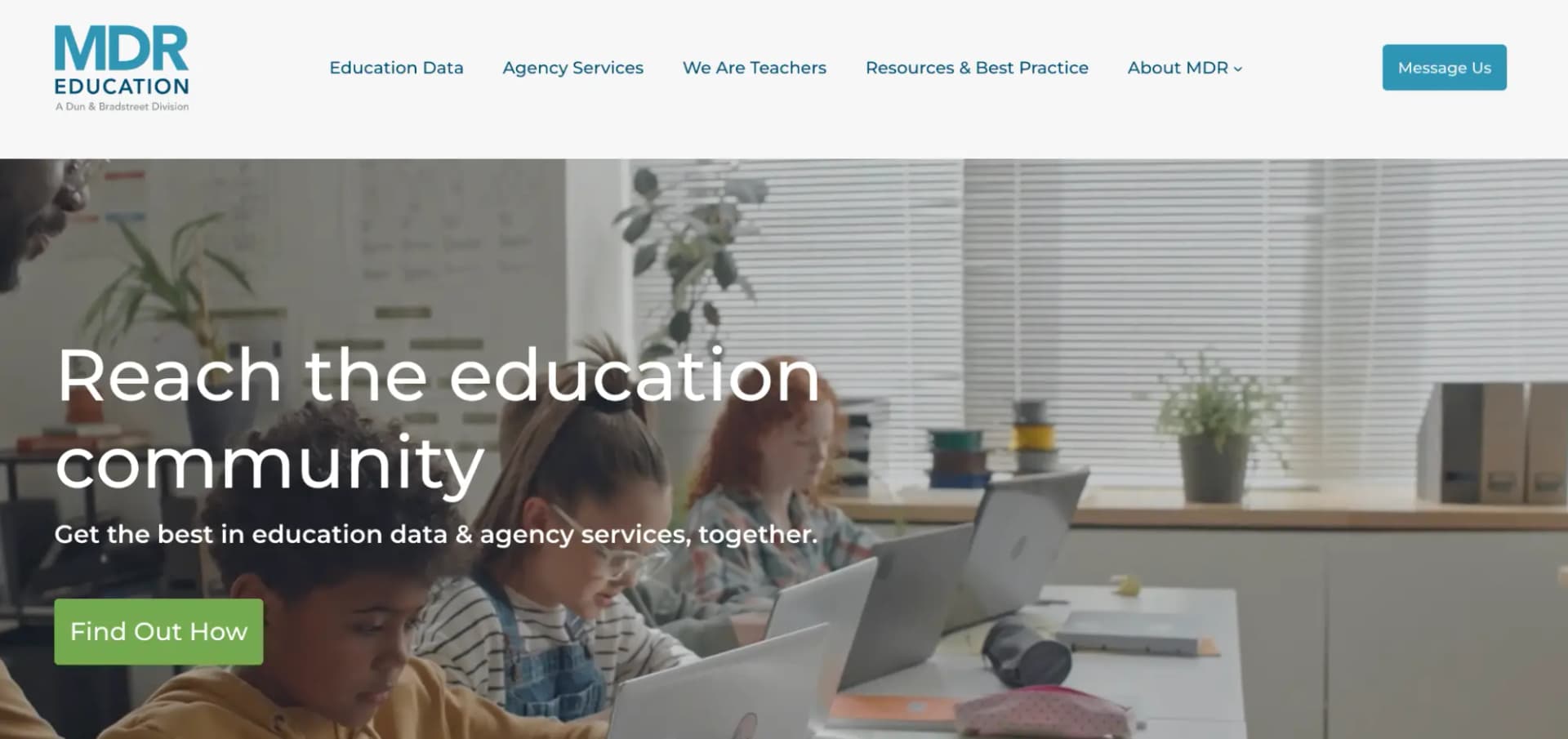
MDR is a K–12 education marketing agency and data provider, and the education division of Dun & Bradstreet. It has more than 50 years in the education market and operates through its ConnectED Cloud platform. It licenses verified educator contact data and runs managed multi-channel campaigns for education brands. It primarily serves marketing-led education teams that want outreach run for them rather than a self-serve tool.
What MDR Education does well
MDR maintains deep, education-specific contact data across K–12 and higher education. Coverage spans teachers, administrators, and hundreds of role-based segments, refreshed continuously through the school year and backed by Dun & Bradstreet.
MDR also runs full-service campaign execution. Email, display, and direct mail campaigns are created and managed by education marketing experts, which suits brands that want outreach run for them rather than a self-serve tool. Many of its staff are former educators, which informs how campaigns are shaped.
Data hygiene and CRM syncing round out the offering, with integrations for Salesforce, HubSpot, and Marketo. Audience reach through the We Are Teachers media property gives marketing-led education teams an additional channel to activate.
Where MDR Education falls short
MDR licenses access to educator contacts and runs managed campaigns, so it functions as a research and marketing-list layer rather than a system that flags which accounts are about to buy. The lists tell teams who to contact rather than when or why an account is showing intent.
Coverage is concentrated on K–12 and, to a lesser extent, higher education. Teams also selling into cities, counties, and state agencies would source that part of the market from a separate provider.
Contract vehicle access is not part of the offering as of July 2026.
Best for
MDR Education fits K–12-focused marketing teams that want done-for-you campaign execution and licensed educator lists rather than a rep-facing prospecting platform. It suits brands whose primary motion is marketing to educators at scale. Teams that want a partner to run the campaigns get the most from it.
3. Agile Education Marketing
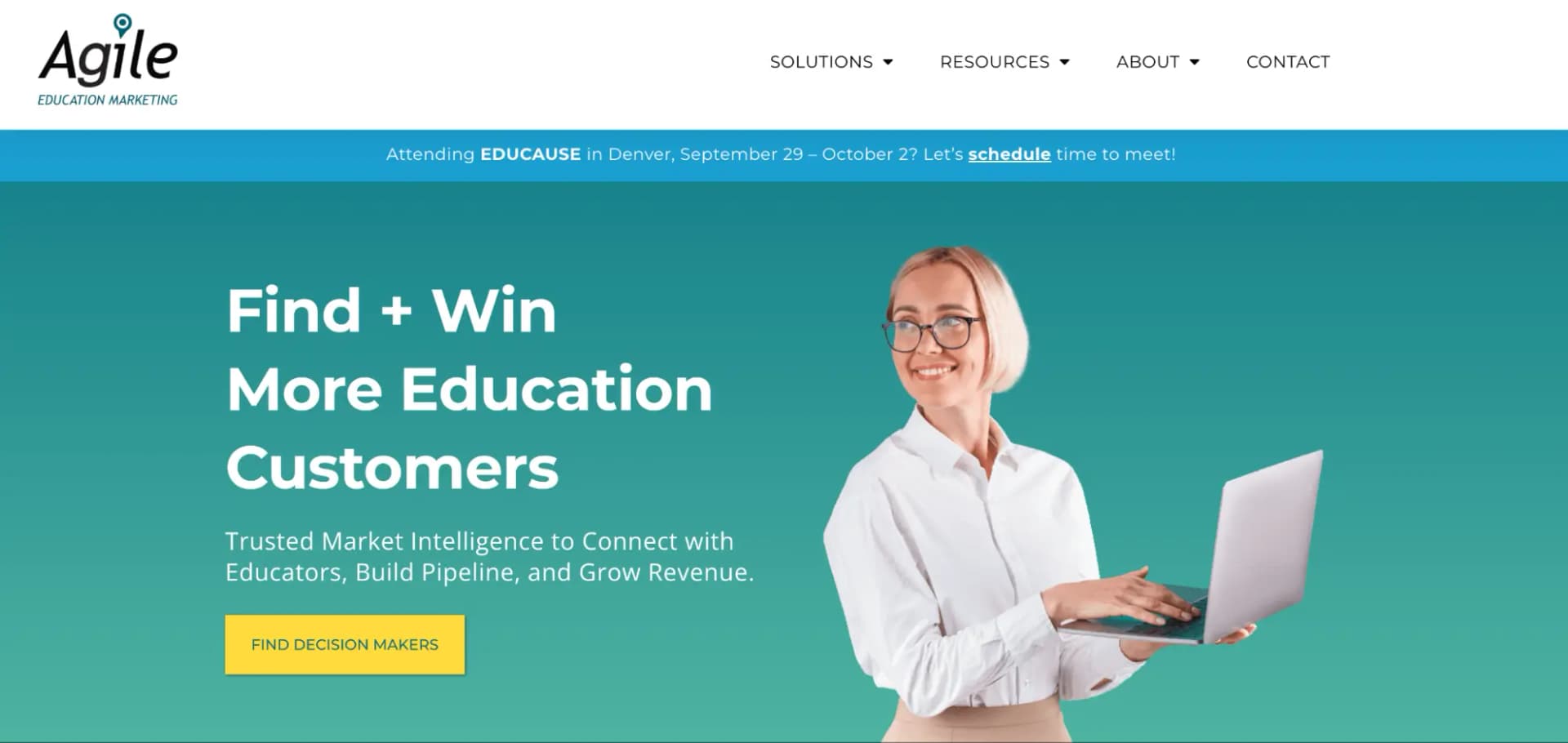
Agile Education Marketing is a market intelligence and licensed-data partner focused exclusively on the education sector. It has served education solution providers since 2009. It licenses educator contact data, offers an EdIntel market-listening add-on, and pairs data with consultative account management. It primarily serves marketing-led education teams that want a strategic partner alongside the data.
What Agile Education Marketing does well
Agile provides education-only contact data across K–12, higher education, and public libraries. The records are human-verified and rebuilt weekly, with role, grade, and geographic targeting for precise list building.
EdIntel, its market-listening add-on, tracks product, system, and methodology adoption across LMS, SIS, and assessment tools at the institution level. That gives education marketers a view into what tools an institution already uses.
Agile also offers hands-on consultative support with a dedicated account manager. CRM and marketing-automation integrations with Salesforce, HubSpot, and Marketo, plus form-fill enrichment, fit marketing-led education teams that want a strategic partner alongside the data.
Where Agile Education Marketing falls short
Agile partially focuses on licensed contact lists. That model tells teams who to reach in education rather than surfacing a live feed of board discussions or contract expirations that indicate an account is about to buy.
Coverage is education-only, spanning pre-K through higher education and libraries. Teams pursuing state and local government accounts would need to add a separate source for that segment.
Contract vehicle access is not part of the offering as of July 2026.
Best for
Agile Education Marketing fits education-focused marketing teams that want accurate K–12 and higher education lists, institution-level adoption data, and hands-on consulting for list-based campaigns. It suits teams that value a consultative partner alongside their data. Marketing-led education motions get the most from it.
4. ZoomInfo
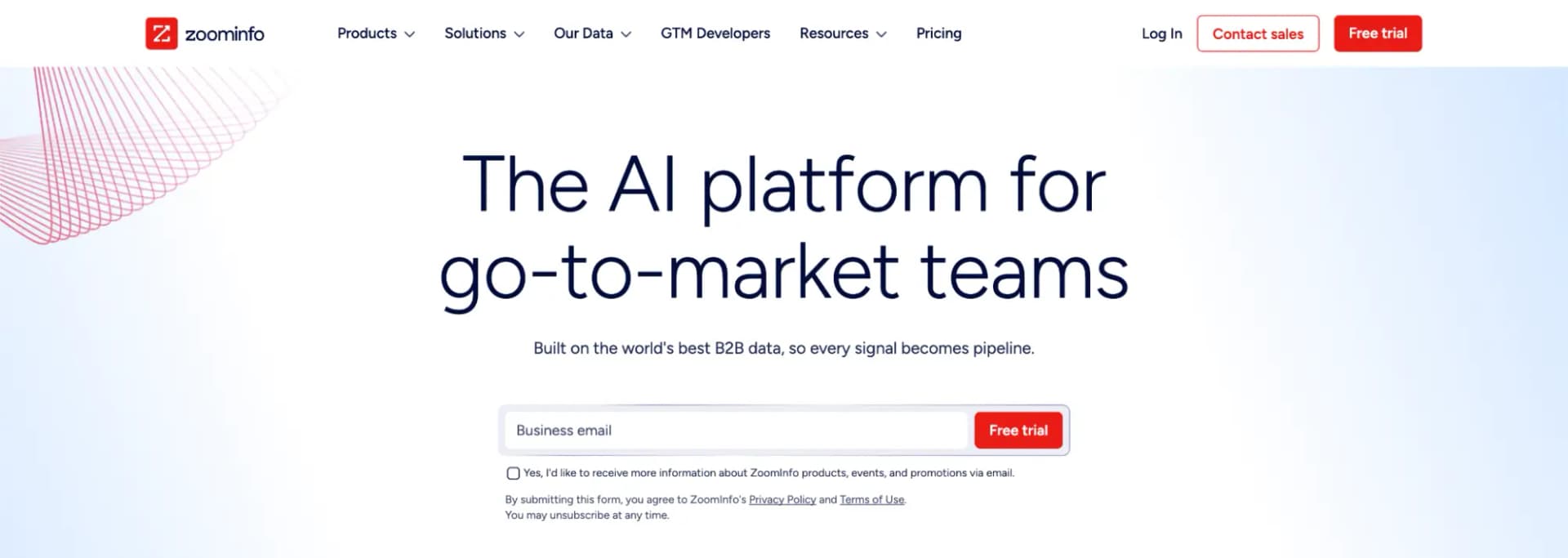
ZoomInfo is a horizontal B2B contact database and sales intelligence platform for commercial sales teams. It maintains one of the largest contact databases on the market and layers intent data and CRM integrations on top. Its data draws partly from LinkedIn, along with contributed records and commercial web sources. It primarily serves enterprise and mid-market teams prospecting corporate accounts across many industries.
What ZoomInfo does well
ZoomInfo’s commercial contact and company coverage is deep. Strong firmographics, technographics, and org charts make it a proven starting point for building targeted prospect lists across many industries.
Its intent data, drawn from IP-to-organization pairings and publisher-network content consumption, gives commercial sales teams a timing signal when a company is researching a topic online. When digital research activity correlates with purchase intent, that layer surfaces accounts worth prioritizing.
A broad integration ecosystem connects ZoomInfo to Salesforce, HubSpot, and a wide range of sales engagement tools. Enterprise teams benefit from established workflows, robust support, and a single source of truth for commercial prospecting.
Where ZoomInfo falls short
The buying indicators that drive government and education deals live elsewhere, in board minutes, budget line items, and contract expirations in the public record. Those sources sit outside the commercial web behavior these signals track.
Platforms that rely on commercial data have a hard time keeping government and education contacts fresh, because superintendents, procurement directors, and agency department heads rarely maintain the LinkedIn profiles that data draws partly from. One G2 reviewer noted that “contact quality is decreasing - cell number is wrongly input or wrong information is updated. Email addresses get removed after a few days if we double-check.” Another G2 reviewer flagged “lots of data gaps that need enrichment” and said “it’s difficult to know what emails and phone numbers are accurate - leading to bounce rates and wasted time.”
Contract vehicle access is not part of the offering as of July 2026.
Best for
ZoomInfo fits teams where government and education is a small slice of a broader commercial motion, and wide B2B contact coverage across many verticals is the primary need. Its breadth and automation are strongest when most territories are corporate.
5. Apollo
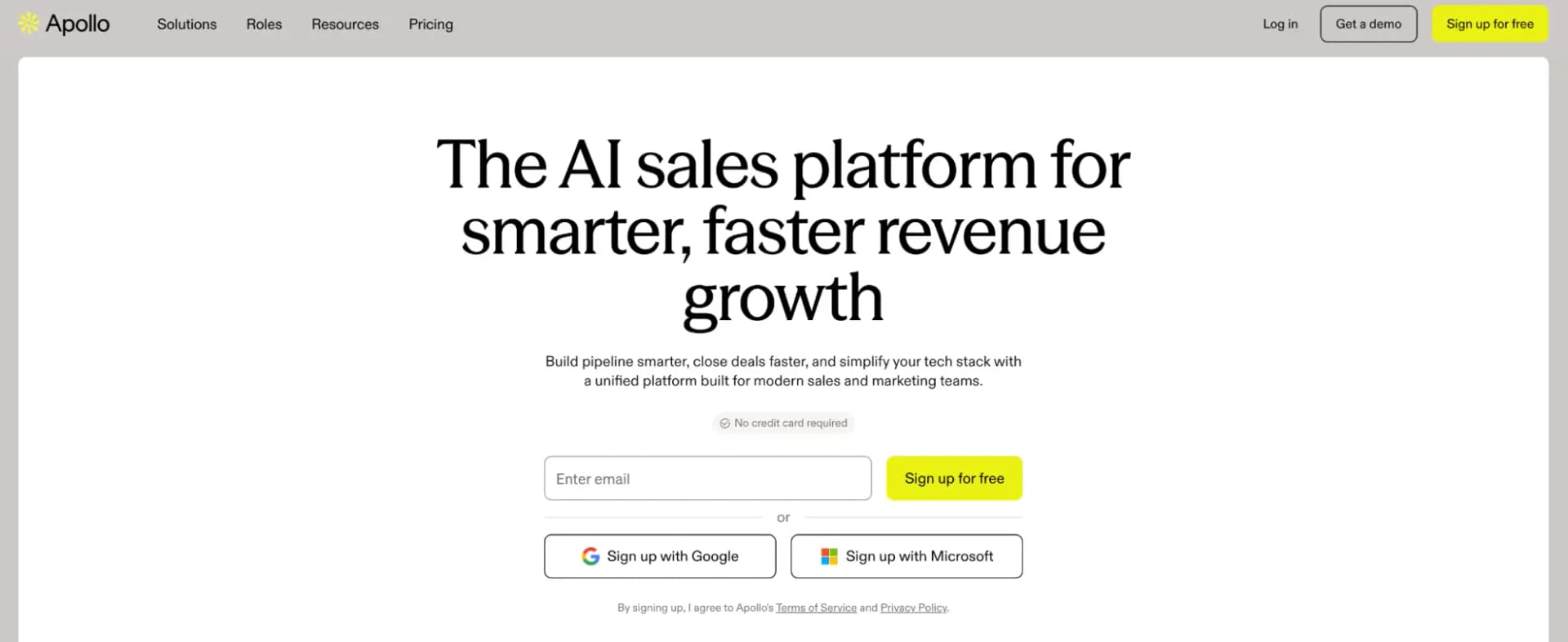
Apollo is a horizontal sales intelligence and engagement platform with a large B2B contact database and built-in outreach automation. It pairs contact data with sequences, a dialer, and campaign tools in a single workflow. It primarily serves small and scaling commercial teams that want data and outreach in one tool.
What Apollo does well
Apollo offers a large B2B contact and company database with verified emails and phone numbers. Advanced filtering by title, seniority, and industry, plus waterfall enrichment and AI lead scoring, makes it a capable prospecting engine across the commercial market.
Built-in engagement tooling sets Apollo apart for smaller teams. Sequences, a dialer, and multi-touch email campaigns run inside the same platform, so prospecting and outreach live in one workflow rather than separate tools.
Accessible, self-serve pricing lowers the barrier to entry. A free tier plus low per-seat plans, combined with native integrations to Salesforce, HubSpot, and Outreach, make Apollo fast for small and scaling teams to adopt.
Where Apollo falls short
Apollo’s buying intent is collected through a third-party intent partner across public web, social, and technology-install activity, refreshed weekly. Government and education demand shows up instead in board discussions, budgets, and contract expirations in the public record. In a market where these buyers rarely maintain a commercial web presence, that gap may show up as bounces and dead ends.
One G2 reviewer noted that “Apollo.io’s data inaccuracies can lead to negative outcomes in outreach efforts.”
Contract vehicle access is not part of the offering as of July 2026. Apollo is a data and engagement platform, so a won government or education deal still has to clear procurement separately. The path from a booked meeting to a signed contract sits with the seller’s own procurement effort.
Best for
Apollo fits budget-conscious and early-stage teams selling mostly into commercial markets that want an all-in-one prospecting and outreach tool with a low entry price. The free tier and self-serve plans make it fast to adopt. It is a practical first platform for teams building an outbound motion on a limited budget.
Which contact database is right for you?
If the need is K–12 or higher education lists for marketing campaigns with hands-on execution, MDR Education and Agile Education Marketing are worth a close look. Both pair verified educator data with consulting and campaign services. They suit marketing-led teams running list-based outreach in the education vertical.
If broad commercial B2B coverage is the priority and government and education is a secondary motion, a horizontal database like ZoomInfo or Apollo can carry most of the load. Apollo is the lighter-weight, lower-cost entry point, while ZoomInfo brings more enterprise depth and automation. Both fit teams whose territories are mostly corporate.
If contact data quality is important for you, Starbridge is the clear choice. One platform pairs verified contacts with the buying signals, spend intelligence, and contract vehicle access that carry buying signals through to signed contracts.
Book a demo to see how Starbridge helps your team win more deals in government and education without adding headcount.
Frequently asked questions
Explore our use case library
 Automate account research with AI agentsStop manually researching accounts. Starbridge AI agents automate account research by monitoring buying signals 24/7 and surfacing the right contacts.
 Identify competitor contract expiration datesThe RFP is usually a formality. Starbridge surfaces competitor contract expiration dates so your reps reach accounts before the renewal cycle closes.
 Create a conference campaignTurn conference badge scans into pipeline. Import your contact list, surface buying signals across every account you met, and follow up with context.