
Higher education email marketing: a guide for companies selling to colleges
New to selling into higher ed? Learn who buys on campus, where accurate .edu contact data comes from, what records law allows, and when to send.

A college directory may show you hundreds of faculty and staff contacts, but it doesn’t tell you who can actually buy what you sell. Load those names into a sequencer and the bounce notifications start before the first reply. The addresses that do go through often belong to people with no purchasing authority.
This guide explains who within a college or university holds a budget, where accurate contact data comes from, what state records law allows you to write, and when during the academic year the money is available.
What is higher education email marketing for companies selling to colleges?
Higher education email marketing can mean two different things. Either colleges email prospective students, current students, and alumni or companies email the faculty and administrators who purchase software, services, and equipment for those campuses.
This guide covers the second role: reaching the people inside a college or university who purchase goods and services from businesses.
Who to email inside a college or university
At a college, spending authority is often delegated to specific people within departments, each with a defined dollar limit for purchases they can approve without additional financial approval.
The numbers vary at every institution. The structure remains the same, and it tells you who your buyer is before you write anything.
Price your entry offer below the delegation threshold and the person who can say yes works inside a department.
That might be a business manager in a dean’s office, a director of a student services unit, or a lab or center administrator who runs a real operating budget.
Price the same offer above the threshold and the conversation escalates into central procurement. The path a purchase takes through higher education procurement changes at that point, and the timeline stretches by months.
One campus therefore contains many buyers rather than just one. A research university runs hundreds of departments, institutes, and administrative offices, and a large share of them hold delegated authority. Two people at the same institution can be entirely unaware of each other’s vendors.
The useful question therefore is: ”Which office within a university controls a budget large enough to buy what you sell, yet small enough to purchase it independently?”.
Where accurate higher education contact data comes from
A campus directory is free, public, but incomplete.
Directories list the people an institution wants the public to reach, so a department’s front-desk contact appears, while the person who approves purchases often does not.
Directory entries can also lag behind reorganizations by months.
Purchased education lists are incomplete and quickly become outdated. A file compiled once and resold reflects the institution as it existed on the compilation date, which is why so many addresses bounce. Building the same list by hand is accurate on the day it is created and stale by the next semester.
Keeping university contact data current in your CRM
Employee churn in higher education is concentrated where vendors sell.
CUPA-HR places the highest likelihood of leaving in research and sponsored programs at 28%, academic affairs at 27%, and student affairs at 26%.
A campus contact record therefore needs a refresh cycle rather than a one-time import. Also, someone who changes roles within the same institution keeps a working address, so the email is delivered and the wrong person reads it.
Constantly keep an eye on your bounce rate. It’s the number that tells you how good your contact data is.
Starbridge holds a 98% email accuracy rate measured across a test of 14,000 emails, against 60% to 70% from generic databases, and a 2% bounce rate where general B2B enrichment runs 15% to 25%.
Continuous crawls of university websites, department pages, and board minutes produce those addresses and every result is bounce-checked on an ongoing basis.
Starbridge is the AI GTM platform for companies selling to the government, K-12, and higher education, helping teams prioritize the right accounts, engage the right people earlier, and identify high-intent opportunities before the competition.
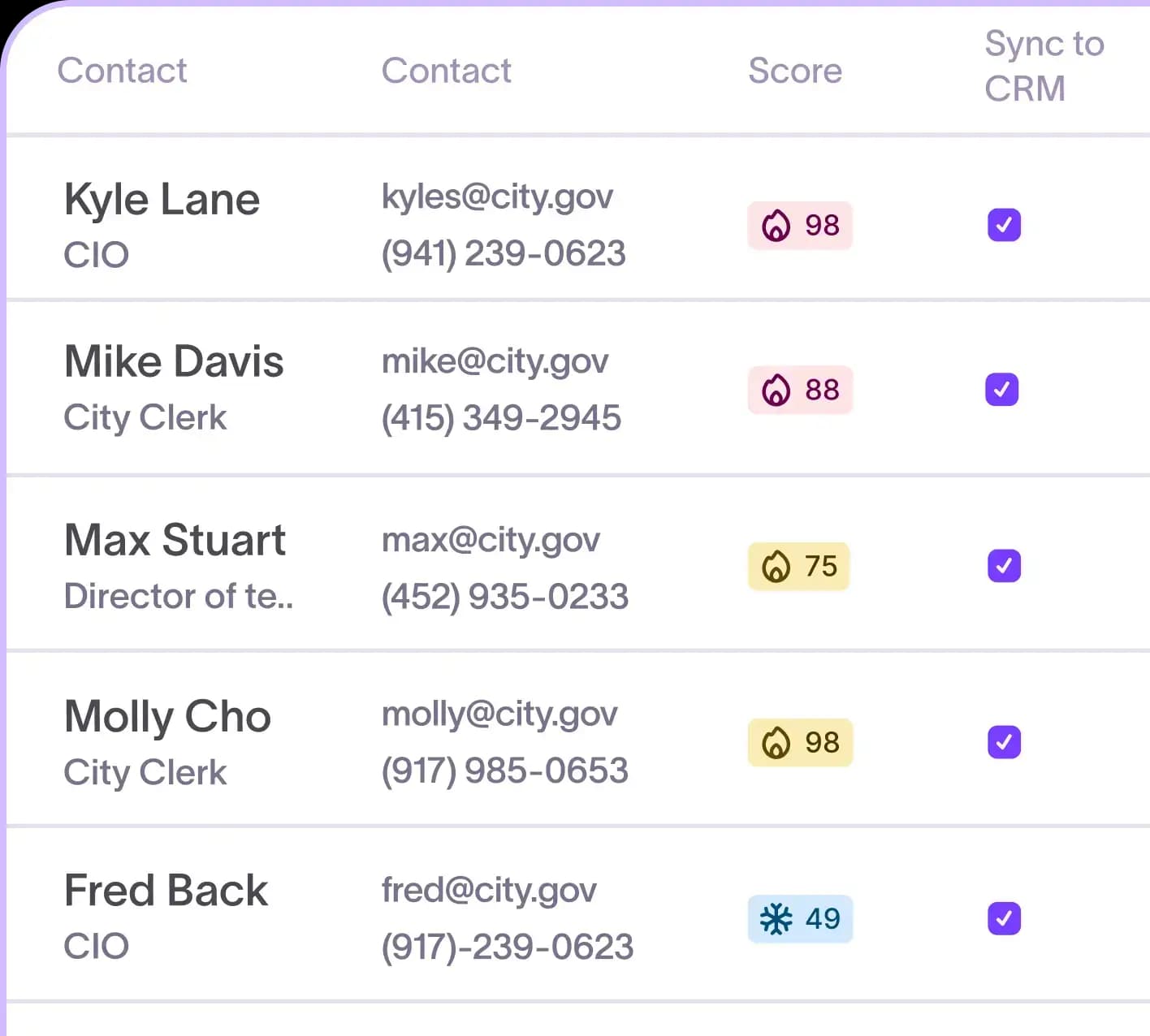
Mantra Health tripled its data enrichment coverage with Starbridge through bidirectional Salesforce sync, enriching more than 3,000 accounts and giving every rep week-to-week visibility into what each campus is investing in.
Finding higher education accounts that are ready to buy
Campus buyers publish their reasoning before they act, and a public university’s governing board publishes its reasoning on a set schedule.
That publication schedule before a purchase is what makes ranking possible.
- A campus that has approved a strategic plan naming a capability you sell is in a different position from one that has not.
- The same is true of a new grant award or a competitor contract listed as expiring on an agenda.
Rank based on that evidence rather than sheer university enrollment size.
The problem? Reading every agenda across your TAM takes hours your reps might not have.
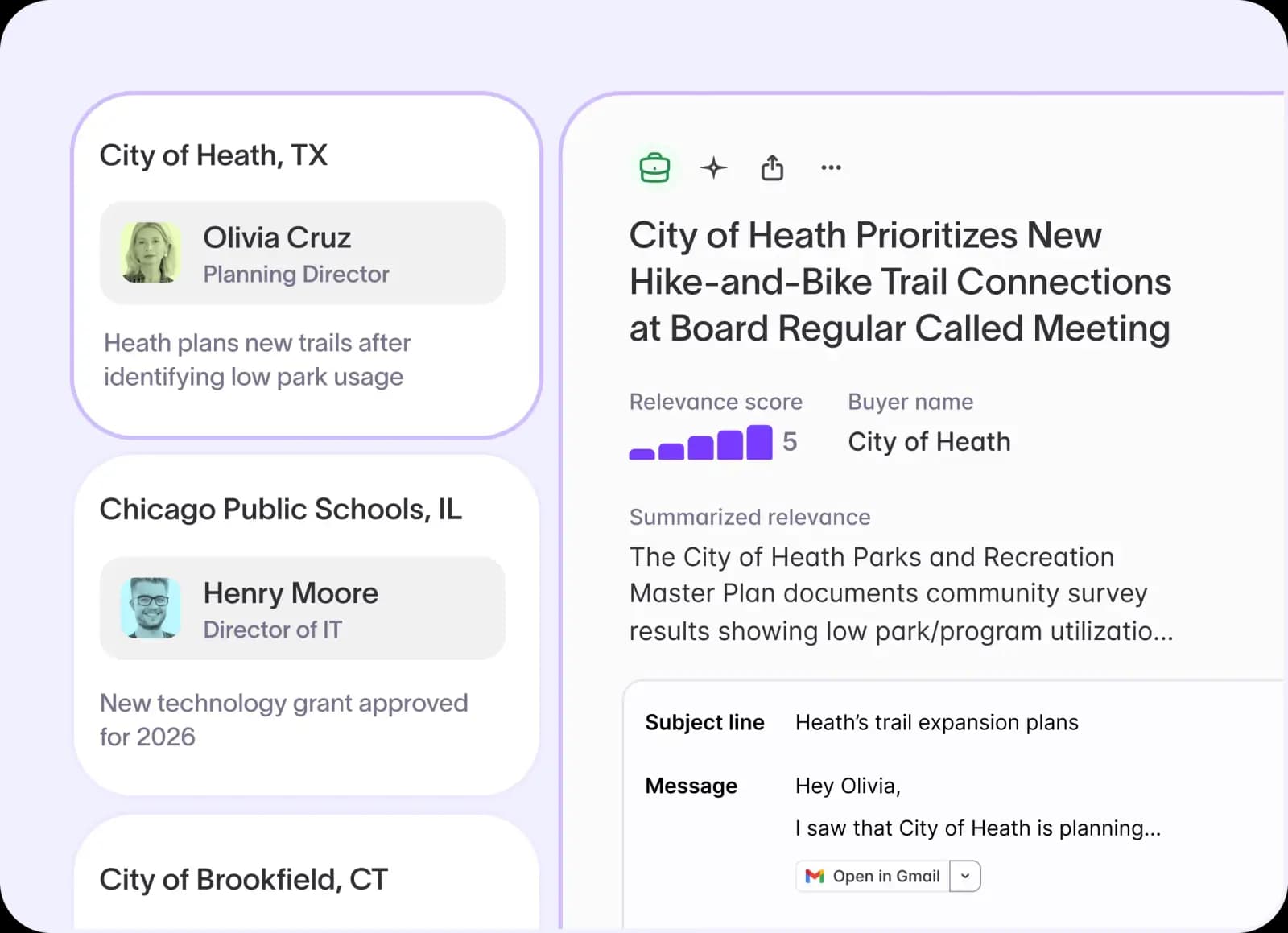
Starbridge’s Buying Signal Monitor watches more than 320,000 government and education entities around the clock and surfaces buying indicators from board meeting minutes, strategic plans, budget data, and grant awards.
Each warm lead arrives with the document that triggered it, who to contact, and what to say, so an account reaches a rep already ranked by how ready it is to buy.
ClearGov generated $300,000 in pipeline from a single email campaign built on Starbridge intelligence.
Timing your email to higher education buyers around the campus budget year
A public university’s funding follows a set schedule, and that schedule does not align with the calendar year. A university’s fiscal year typically runs from July 1 through June 30 of the following year.
What matters for outreach is how early that year is decided.
- UMass Dartmouth begins planning in mid-August of the current fiscal year for the following one. Deans meet with the provost about department needs in late July and early August.
- The budget office and departments are in constant communication from August through early January. Trustees approve the result in early June, and the year takes effect July 1.
So timing matters in your email marketing.
A message arriving in June that asks a department to fund something in the coming year has missed the cycle.
The productive window opens in late summer, when a department is deciding what to request, and closes when the request leaves the department. Arriving inside that window means being part of the request rather than a line item nobody budgeted.
What a cold email to a university should say
The email that works on campus is short, addressed to a budget holder, and anchored to something the institution has already said in public.
Open with the document rather than with your company. A subject line built from the institution’s own language does the qualifying work – something like “Your November board packet and the advising software line.”.
This works because an administrator recognizes their own agenda item immediately.
Keep the body short. Name the specific item you read and where it appeared. Connect that item to an outcome the reader cares about, using their own language rather than your feature names. Then ask for a fifteen-minute conversation.
Leave out anything you would not want disclosed. Exclude discounts and competitive comparisons from any message sent to a public institution.
Conclusion
Higher education email marketing works when the list is built around budget holders rather than institutions. The delegation threshold tells you which office can buy what you sell without escalation. Contact records for those offices decay continuously and need regular refresh cycles.
A public institution’s inbox is subject to disclosure. The campus budget year determines in late summer what it will fund the following July.
Get those right and a campaign stops being a volume exercise. Executing them across an entire territory is the part that needs help. Starbridge tracks the documents that reveal campus intent, keeps contact records current, and puts both in front of your reps so more of those conversations turn into closed deals.
Book a demo to see what your higher ed location territory looks like with buying indicators attached.
Frequently asked questions
Bounces usually mean the address is outdated, because campus roles change and directories lag behind. Spam placement usually means the sending domain has no history with that institution’s filter. Warm up the domain, keep volume low per institution, and send from a person rather than a generic alias.
You can, but the file starts aging the day it is compiled. Purchased lists provide coverage without freshness, so a vendor relying on one inherits every role change since the compile date. Use a continuously refreshed source or verify the file before every send.
Explore our use case library
 Automate account research with AI agentsStop manually researching accounts. Starbridge AI agents automate account research by monitoring buying signals 24/7 and surfacing the right contacts.
 Identify competitor contract expiration datesThe RFP is usually a formality. Starbridge surfaces competitor contract expiration dates so your reps reach accounts before the renewal cycle closes.
 Create a conference campaignTurn conference badge scans into pipeline. Import your contact list, surface buying signals across every account you met, and follow up with context.