
Starbridge vs Procurement Sciences: which AI proposal writer fits your bids?
Both platforms draft proposals with AI. Compare what each one writes from, which buyers it covers, and when in the buying process the work starts.

A seller bidding federal work and a seller covering school districts can both want an AI proposal writer and still need different products.
The proposal is often the last step in a public sector purchase. Months earlier the need was raised in a board meeting, and the money was set aside in a budget line.
Procurement Sciences, whose platform is Awarded AI, is traditionally used for federal capture and proposal work. The company describes itself as a platform for GovCons, meaning companies that sell to the federal government.
Starbridge is the AI GTM platform for companies selling to government, K-12, and higher education.
This comparison covers what each platform drafts a proposal from, which buyers it covers, and when in the buying process the work starts.
| Capability | Starbridge | Procurement Sciences |
|---|---|---|
| Buyers covered | State and local government, K-12, and higher education, across more than 320,000 bodies, plus federal | Federal contracting, per the company's own description of its market |
| What a proposal is drafted from | Your answer library, plus what the buyer has already published about the need | The solicitation in front of you, with compliance checks against it |
| When the work starts | Months before a solicitation exists, from board minutes, budget documents, grant awards and contract end dates | When a bid is posted |
| Finding the right bids | Thousands of state, local, education and university bid portals in one feed, each bid scored against what you sell | AI bid search and bid tracking across its own database |
| Compliance review | Fit scoring, and draft review against your answer library and the buyer's published rubric | The compliance requirements a federal solicitation sets out |
| Buying the contract | Cooperative vehicles including NASPO ValuePoint, OMNIA Partners, Sourcewell and TIPS, with the paperwork run through Starbridge | Not part of what the company documents |
Read the first row above (buyers covered) before the rest, because the buyers row decides whether the other five matter.
Procurement Sciences covers federal agencies and the contractors bidding to them. Starbridge covers school districts, counties, colleges and state agencies, plus federal.
Which buyers each platform covers
Procurement Sciences describes itself as a platform for GovCons, so its buyers are federal agencies and the contractors bidding to them. Its compliance work points the same way, at the requirements a federal solicitation sets out.
Starbridge reads the public record across more than 320,000 government and education bodies.
A school district, a county, a community college and a state agency are each an account. Each one has a budget, a contract calendar and people who sign.
The solicitations themselves read differently.
A federal solicitation arrives with a compliance matrix.
A district solicitation arrives with a board calendar, a purchasing threshold and sometimes a cooperative route that lets the buyer skip the solicitation altogether.
So start with the buyers row. Check whether a platform already tracks the districts, counties, colleges and agencies you sell to.
This is important because you can only draft a proposal for a solicitation that reached you in the first place.
What each platform drafts a proposal from
Procurement Sciences drafts from the solicitation in front of it. Starbridge drafts from your own answer library and what the buyer has already published.
Procurement Sciences
Awarded AI finds bids, scores them bid or no-bid, and drafts the proposal with compliance checks. A proposal is written against the solicitation document and reviewed against the frameworks that solicitation cites.
One G2 reviewer notes that "The deep research option does not compare to ChatGPT, Claude, or even Gemini."
The same reviewer likes that the platform runs several models in one place. So the complaint is about how deep the research goes, not about running several models.
Starbridge
Starbridge drafts from your answer library, where you have already written down:
- Product descriptions
- Security answers
- Setup and implementation detail
- Past responses you were happy with
The draft also carries what the account has published about the need. So the response can name the project rather than restate the solicitation back at the buyer.
For example, a district’s spring board packet may set aside money for a student information system and describe the problem it wants solved. Your draft can then open on that decision rather than on a restated requirement.
Each bid in the feed is scored against what you sell, so you can tell early whether a draft is worth starting.
HousingCloud ran discovery, fit scoring and drafting in one platform, cut 8 to 10 hours per RFP, and raised its RFP discovery rate by 30%.
Bottom line
Procurement Sciences writes a compliant answer to the document. Starbridge writes an answer that draws on your own library and the buyer’s own record.
So if the solicitation is all you have, Awarded AI’s draft is the faster start. If the buyer has been publishing about the project for months, the Starbridge draft already carries that.
Your editing time then goes into the case for your product rather than into describing the buyer’s situation back to them.
When the drafting work starts
A proposal written the week a solicitation posts is answering requirements somebody else finished writing.
Procurement Sciences
Awarded AI searches bids that are already posted, so your work on a bid starts the day it posts.
Starbridge
Starbridge reads what a public body publishes about its own plans, which arrives on its own schedule and often months earlier.
| What the record is | What it tells you |
|---|---|
| Board minutes | The need has been raised out loud |
| Budget documents | The money is set aside |
| Grant awards | Outside funding has landed |
| Contract end dates | A rebid is due |
Board minutes, the top row, are the earliest of these buying signals. For example, a board minute can appear months before the solicitation it leads to.
A contract end date, by contrast, tells you the rebid month the day you find it, so you can book the follow-up straight away.
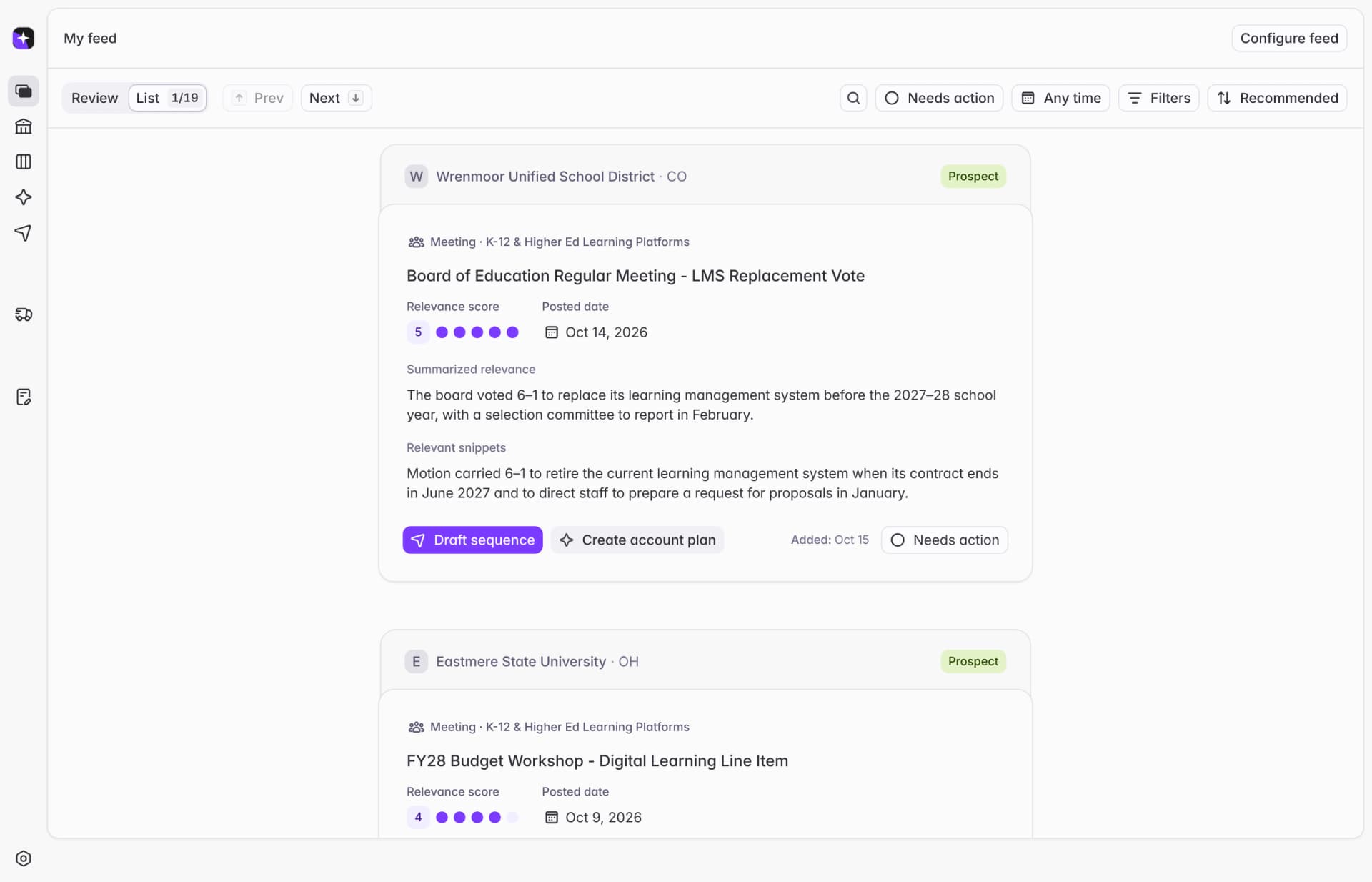
The months before a solicitation posts are the only part of the process where you can still shape what that solicitation asks for. However, the rules on talking to government buyers before the RFP set what you may say in that window.
Bottom line
Starbridge shows the deal in the months before the solicitation posts, and Awarded AI picks it up once one is published.
So those months are when you can still talk to the people writing the requirements. Once the solicitation posts, you are answering a document somebody else finished.
Compliance review on a federal proposal
Compliance review is what Awarded AI does best. If you bid federal work, this is the section I would read twice.
Awarded AI checks a proposal against the compliance requirements the solicitation sets out, including how the response must be structured and how it will be scored.
The company also markets government-cloud hosting and on-premise deployment, and describes an architecture mapped to the security standards a federal buyer asks about.
If you respond to federal solicitations and the compliance matrix is what sinks your bids, that is the work Awarded AI is known for.
Starbridge reviews a draft against your own answer library and the rubric the buyer publishes. When school districts and local governments score RFPs on a board-approved scale, that published rubric is what your proposal gets marked against.
What happens after the award
A buyer can pick you and still not be able to buy from you. In government and education, a committee can choose your proposal and the district still cannot issue a purchase order to you.
A district that has chosen you still needs a purchasing route its policy allows. For example, a cooperative contract lets the buyer purchase through an award someone else already ran.
Starbridge customers sell through cooperative vehicles, available as part of the platform:
- NASPO ValuePoint
- OMNIA Partners
- Sourcewell
- TIPS
Starbridge handles the compliance, the paperwork and the renewals, and surfaces each buyer’s preferred purchasing channel on the account.
Historically, sellers reach a cooperative vehicle through a traditional reseller, who typically wants a six-figure deal already in hand. However, Starbridge sets no minimum deal size.
Contract vehicle access is not part of what Procurement Sciences documents, which fits a federal capture and proposal platform.
Which one fits your team
Procurement Sciences fits a federal GovCon team whose hardest problem is producing a compliant federal proposal under deadline. The deadline is a real constraint. Awarded AI is known for producing a compliant federal proposal under one.
Starbridge fits a team whose buyers are the government and education bodies that publish their own plans:
- School districts
- Counties and cities
- Community colleges and universities
- State agencies
- Special districts
For those buyers a proposal is one step in a longer sale: the board minutes come first, the purchase order comes last, and you sell through everything in between.
Starbridge covers that sale from end to end: the capture management work before the solicitation, the answer library behind the draft, and the purchasing route the buyer uses to sign.
A team selling to federal agencies and to districts, counties and universities can run Awarded AI for the federal compliance work. Starbridge then covers the state, local and education accounts. Its federal coverage is still expanding.
Frequently asked questions
Yes. Starbridge covers federal bids alongside state and local government, K-12 and higher education. The depth is in the government and education market. There it reads the published record of more than 320,000 bodies and tracks budgets, contract end dates and board decisions for each account.
An evaluation committee scores what you wrote, not how fast you wrote it. A scoring rubric rewards an answer to the stated criteria, backed by evidence a committee can check. An AI draft gives you the compliant structure and your own past answers fast. So the hours you would spend retyping security and setup answers go into pricing and win themes instead.
A GovCon is a company whose business is selling to the federal government. The work usually runs through formal bids. Many GovCons bid as a prime contractor or join a larger federal program as a subcontractor. The term is standard in federal work and is rarely used for firms selling to school districts.
Yes. A federal solicitation usually cites a formal set of structure and scoring requirements. A district or county runs on its own purchasing policy, a published scoring rubric and often a board vote on the award. A cooperative contract is sometimes an alternative route.
A team selling to federal agencies and to state, local and education buyers can run both, because Awarded AI works the federal solicitations and Starbridge works the state, local and education accounts. A team selling only to districts, counties and universities pays for federal compliance work it will not use.


