
New superintendent playbook: how to earn the first meeting in 90 days
A new superintendent reviews the contracts they inherited. Here is how a vendor earns the first meeting before that window closes.

A superintendent arriving in a new district inherits every contract their predecessor signed, but no loyalty to any of them. For a few months, the question of what the district buys, and from whom, is genuinely open.
A vendor who treats the hire as news rather than as a schedule misses those months, and the schedule is the part that gets published.
TL;DR: how do you earn a meeting with a new superintendent?
Track the entry plan rather than the hire. A new superintendent publishes one, listens to staff and community, reports back to the board, and turns that report into goals that shape their first budget. Match your message to the stage the district has reached, and arrive with evidence during the listening phase rather than a product introduction.
Why a new superintendent’s first 90 days are a buying window
Plenty of things protect an incumbent vendor. A leadership change reaches two of them:
- The people who chose the product are still in post.
- Nobody has had a reason to revisit the decision.
A new superintendent often owes nothing to those people, and the entry plan is where the decision gets revisited.
For example, a superintendent hired from outside did not choose the student information system, did not negotiate the transportation contract, and was not in the room when the last curriculum decision was made.
Yet they are accountable for all of it.
A superintendent promoted from within inherits the same obligations with more history behind them, and usually with views already formed. The entry plan is one of the few points when a district openly asks what is working, and the answers come from staff who have been living with the gaps.
The entry plan is why the sales window is real, and goal setting is why the window is narrow.
Priorities set during goal setting tend to hold for years, because they become the board’s measure of the superintendent’s performance.
- A vendor whose category is named in those goals is inside the budget conversation before any requirements are written.
- A vendor who arrives afterward is responding to a specification that reflects someone else’s answers.
A review of inherited contracts is rarely announced. It happens in the ordinary course of a new leader asking their staff which systems cause the most complaints, and the answer reaches the board as a line in a goal rather than as a decision to switch vendors.
This window after entry of a new superintendent is not an invitation to pitch.
It is a period when a district is deciding what its problems are, and the vendors who are heard are those who make that decision easier rather than noisier.
Where a superintendent transition shows up in public records
Most stages of the superintendent transition leave a dated record. This lets a rep place a district on the calendar from public documents:
- The board agenda approving the contract. A superintendent is hired by a vote, and the agenda and minutes carry the date, the start date, and often the contract itself. This is usually the earliest public confirmation, and it frequently precedes any press coverage.
- The entry plan. Many new superintendents publish one, sometimes as a board presentation and sometimes on the district site. It names what they intend to examine and in what order, which is the closest thing to a published buying agenda a district ever produces.
- The listening-tour report. When the superintendent reports back to the board, the themes they name are the problems the district has agreed it has. A vendor reading that report learns which categories are live and which are not.
- The goal-setting agenda. The board and superintendent set goals, often at a retreat with published materials. These become the measures the superintendent is judged on, and they drive the first budget.
- The agenda approving cabinet appointments. New superintendents commonly reorganize their leadership team, and each appointment is approved in open session, so the chief technology officer or director of operations who owns your category may change a few months after the superintendent does.
- The superintendent’s own contract. Approved in open session and usually available on request, it carries the start date and the term, which tells you how long the district expects this leader to be in place and when their first full budget cycle begins.
Time your outreach to the entry plan, not your quarter
Each stage of the transition asks a different question, and the message that earns a meeting answers the question being asked that week.
Before the start date, a superintendent hired from outside is usually still finishing a job somewhere else, and anything you send competes with that. An internal promotion is different, because that person is already in the district and already has views about what needs fixing.
Use this period to learn the district: what the board minutes say about your category, what the previous administration bought and when those contracts end.
During the listening phase, the superintendent is collecting problems, not solutions. The useful message here is evidence: what peer districts of similar size found when they looked at the same issue, or what the district’s own board materials already say about it.
No product, no demo request. The goal is to be a source rather than a vendor.
At goal-setting, the district is converting themes into commitments, and this is when a specific conversation is welcome. A rep who can show how a named goal has been met elsewhere, with what it cost and how long it took, is answering a question the superintendent has been asked by their board.
Knowing when to reach out and what to say is key when a new superintendent arrives. The problem is that monitoring public records and timing the outreach is a tedious manual task that can’t be done across your entire TAM.
That’s one of the reasons we’ve created Starbridge.
Starbridge is the AI GTM platform for companies selling to the government, K-12, and higher education, helping teams prioritize the right accounts, engage the right people earlier, and identify high-intent opportunities before the competition.
Starbridge’s Buying Signals Monitor helps turn job changes into pipeline by tracking leadership changes across 320,000+ public sector entities. A job-title filter and a start date on every new hire let your sales team identify and reach out to newly appointed superintendents across your entire TAM, without manual research.
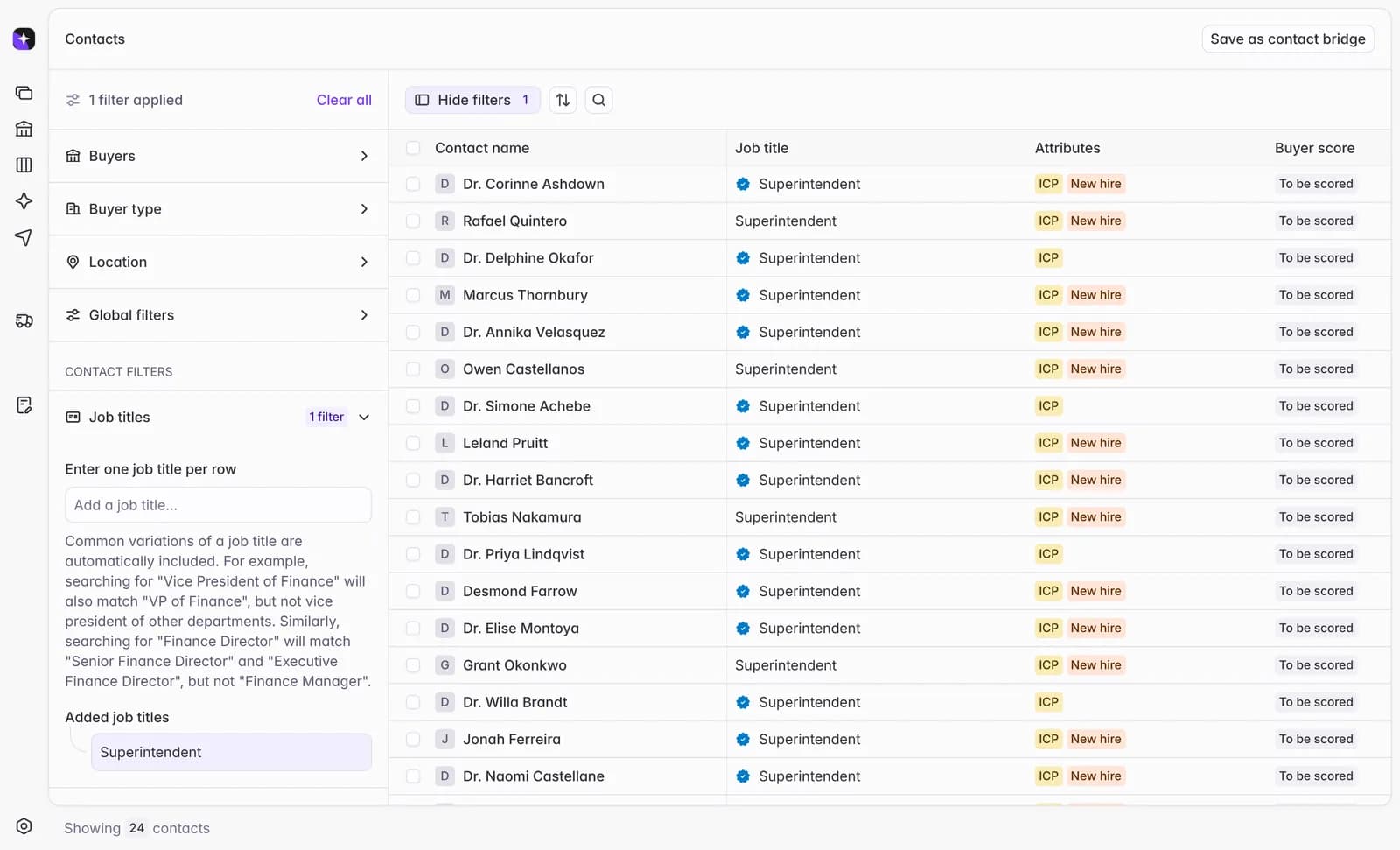
Frontline Education cut account research time by 90% using Starbridge, with reps walking into meetings already knowing the account’s priorities, competitive context, and spend history. Book a demo today to see which districts in your territory are mid-transition right now.
What costs vendors the first meeting
- The first failure is pitching a new superintendent when they’re in a listening phase. A superintendent three weeks into the job is being asked what they will fix, and a sales pitch tries to answer a question nobody has asked yet.
- The second failure is contacting a district while a solicitation that affects your category is open. Procurement rules on communication during an open solicitation are strict and vary by state, and even a well-intentioned email to the superintendent can disqualify you from the bid their staff are running. Check for open solicitations before sending anything, every time.
- The third failure is treating the transition as a reset of the relationship rather than of the decisions. Your champion in the business office probably still works there, and the people who use your product probably still use it. A new superintendent reviewing an inherited contract will ask the staff around them whether it works, and that answer was being written long before the hire.
- The fourth failure is arriving with a generic congratulations. They arrive together, in the same week, and they say very little. If you have nothing specific to offer, it is better to wait for the listening-tour report and arrive with something substantive.
- The fifth failure is writing only for the superintendent. They set direction, but the people who evaluate, budget for, and implement a purchase are the cabinet and the directors below them. A superintendent who is interested will pass your message to exactly those people, so write it to survive that handoff: be specific about the problem, honest about what it costs, and useful to someone who has to defend it internally.
None of these failures are about the product. They are about showing up with the wrong thing at a moment that was clearly foreseeable.
Your territory is always mid-transition somewhere
Superintendent changes are not rare events to be handled one by one. Across a territory of any size, some district is usually between a hire and a goal-setting retreat.
Treated one at a time, each is a scramble. Treated as a repeating pattern, the transition is one of the few moments in K-12 selling when an incumbent’s position is genuinely contestable and the district is openly stating what it wants to fix. The work is knowing which districts are in a transition, which stage each has reached, and what that stage is asking for.
Book a demo today to see the districts in your market that changed leadership this quarter.
Frequently asked questions
Over five years, on average. The California School Boards Association, reporting on AASA’s 2025-26 Superintendent Salary and Benefits Study, says superintendents report an average tenure of over five years in their current roles, set against a pre-pandemic figure of about six years.
Contacting a public official is not restricted in itself, and board materials and contact details are public. The constraint is procurement, not the hire. Procurement rules commonly restrict vendor contact while a solicitation is open, and they differ by state and often by district, so check the rule that applies to that district rather than assuming one. The safest practice is to check whether anything in your category is currently out for bid before you send.
Often the cabinet changes. New superintendents frequently reorganize their leadership team in the first year, which can move or replace the chief technology officer, the chief financial officer, or the director of operations. The person who owns your renewal may change several months after the headline hire, which is why tracking only the superintendent misses the changes that reach your renewal.
Keep the relationship, and stop treating it as a path to a decision. An outgoing superintendent is usually not signing anything new, but they know why decisions were made and who really owns them. That context is worth more than one more meeting, and the way you handle the exit is remembered by people who move between districts.
The board minutes name it. Interim appointments are usually identified as interim in the motion, and they are frequently barred by board policy or by their own contracts from committing to new multi-year spending. An interim period is for learning the account, not for working a deal, and the search timeline that runs alongside it indicates when the real window opens.


