
How to read government job postings for buying intent
A government job posting is normally a position that was funded before anyone could advertise it. Learn which fields predict a purchase, and when.

A government job posting is normally for a position that was funded in an adopted budget before anyone was allowed to advertise it. It is easy to read a posting as a hiring notice and move on, leaving the evidence unused.
This guide explains why a public job posting includes budget evidence that a private one does not, which fields of a public posting predict a purchase, and when the department behind that posting will actually spend the money.
TL;DR: what do government job postings tell you about buying intent?
A government job posting normally advertises a position that was approved and funded before recruiting could begin. The posting shows that an agency set aside money for a specific kind of work, and it names the department that will spend that money. Treat it as budget evidence for one department, dated to the funding vote, not as a general sign of growth.
Why a public job posting carries budget evidence
Where an agency publishes its hiring procedure, that procedure normally prevents advertising a position until funding exists. Clackamas, Laramie and Washington counties each publish that requirement, so a seller can confirm funding.
- According to its position allocation and job requisition procedures, Clackamas County, Oregon allows recruitment to begin only after a position has been allocated to a department and funded in an approved budget.
- Laramie County, Wyoming writes the same condition into its recruiting procedure, which requires that positions be authorized by the board of county commissioners and funded in the respective department budget.
- Washington County, Maryland separates the two cases that matter to a seller. If a position already exists and the current fiscal year’s budget already pays for it, the county administrator and the human resources director can together approve filling it. If the position does not yet exist, the elected commissioners must approve creating it before any recruiting can begin.
The posting worth watching is the one for a position that an elected body has just created, not the one for a position the agency has funded for years.
Who signs off differs by agency.
In Washington County a new position goes to the Board of County Commissioners before any recruiting can begin, while in Clackamas County a new position raised outside the annual budget adoption process goes to the county administrator. Either route produces a dated approval that names the department.
To put this in perspective, a private company can open a role, pause it, or cancel it without offering any explanation. Where an agency publishes its hiring procedure, a posting for the same kind of role shows that the work was funded first, and names the department whose budget pays for it.
The fields in a job posting that predict a purchase
The evidence in a posting sits below the job title. Each of the five fields below the title answers a different question about the purchase that may follow.
1. The department. The department named in the posting identifies the budget the salary is paid from and the director who controls that budget. A data analyst in the finance department and a data analyst in public works are likely to buy different things, paid for out of different line items, on the recommendation of different people.
2. The salary grade and step. In Washington County, a department that wants to advertise a position submits a form listing the department name, the job title and the salary grade and step, and human resources circulates that form for approval. The grade records the seniority and scope the department budgeted for. A senior grade points to work the agency expects to run over time rather than a single task, and to a larger purchase behind that work.
3. The funding source. Some postings name the funding source, and a grant is the one worth looking for. The agency has to account for that money separately and spend it inside the grant period, so a grant-funded role carries a spend-by deadline that a general-fund role does not.
4. The start date. The start date tells a seller when the new employee becomes responsible for spending the budget behind the position. The funding decision happened months earlier, but the new hire is normally the person who will direct that spending once the agency fills the position.
5. The named duties. The duty list is the part of the posting that tells a vendor what the agency will buy. When the duty list requires the hire to implement, administer or manage a named system, the agency expects to run software in that category. A posting asking someone to “administer the district’s student information system” shows the district already runs such a system. The district most likely licenses that system from a vendor, so check when that contract expires. A posting asking the hire to implement a student information system points to a purchase the district has not yet made.
The full taxonomy of government buying indicators compares a hiring signal with board minutes, contract expirations and grant awards.
Reading a posting against the budget calendar
A posting is evidence of a funding decision already made, not of a purchase. For a position included in the annual budget, the department asked for the money and the governing body approved it in the annual budget, which closes before the fiscal year begins.
Check the adoption date rather than the posting date to see how old the decision is.
Washington County’s procedure handles the two cases differently.
- A position the annual budget review already approved needs no further vote.
- A new position outside that review goes to the Board of County Commissioners.
For a position the review did approve, the funding decision is months old by the time a seller sees the posting, and the fiscal year that decision belongs to is already underway.
For a rep, the fiscal year the position was funded in and the date the hire starts both matter more than the actual posting date.
Operating appropriations typically lapse at the end of the fiscal year, so check whether the money behind the position carries forward. On the hire’s start date, the new employee becomes responsible for the work the agency funded, and starts asking vendors questions.
Where a posting falls in the fiscal year changes how a vendor should approach the account. A role funded and posted early in the year signals a program the department expects to launch over the following months, which gives a vendor time to shape what the new hire evaluates.
A role posted in the last quarter may mean the department wants it filled before the appropriation lapses. A hire who starts late in the year has only weeks or months of fiscal year left to spend the money, so the department decides faster.
Outreach timed to the posting date reaches a hiring manager in the middle of interviews. Outreach timed to the start date reaches the new hire before they have settled on a vendor for that work. Fiscal years differ by state and by agency type, and government fiscal year calendars give the start and end dates of the fiscal year for each state and each type of agency.
Which job postings to ignore
Some job postings look like evidence of new demand, but none of them tells a seller that a purchase is coming:
- A backfill. In Washington County, a backfill of an already budgeted position never reaches the elected commissioners. No new position was created or funded, so the posting tells a seller only that someone left.
- A seasonal or temporary role. In Washington County, seasonal and temporary roles are approved by the human resources director rather than the commissioners. Treat a seasonal posting as a repeat of an existing allocation unless the adopted budget shows otherwise.
- A repeatedly reposted vacancy. Repeated advertisements usually mean the agency is struggling to fill the role. The money may genuinely be allocated, but until the agency fills the role nobody is doing the work it pays for, so the purchase that work would drive is likely to wait.
If the adopted budget lists authorized position counts by department, a position added this year raises the count and a backfill does not. If you cannot check the adopted budget, assume the position is new when the agency has never advertised the title before, or when the duty list describes a system the agency does not yet run.
Turning a hiring signal into an account action
A genuinely new job posting tells a rep which department to approach, what to reference, and when to get in touch. The reason to call is the funding, not the vacancy:
- Write to a public works director about the asset management program the board funded when it approved the posted role, and you are discussing the budget that director now controls.
- Write about the open position, and you are discussing the director’s recruiting problem. Identify the department and the director who owns that budget line.
Note the start date and reach out just after it. When you reach out, describe the work the duty list names in the agency’s own words, and attach a document the new hire will need early on.
The problem is a rep cannot realistically carry out those steps by hand for every posting in a territory.
Postings are scattered across individual careers pages and shared job platforms, they come down when they close, and the budget document behind a position sits somewhere else. A rep covering an entire state ends up acting on hiring evidence mostly for the accounts they already watch.
If you want to automate this manual process, consider Starbridge.
Starbridge is the AI GTM platform for companies selling to the government, K-12, and higher education, helping teams prioritize the right accounts, engage the right people earlier, and identify high-intent opportunities before the competition.
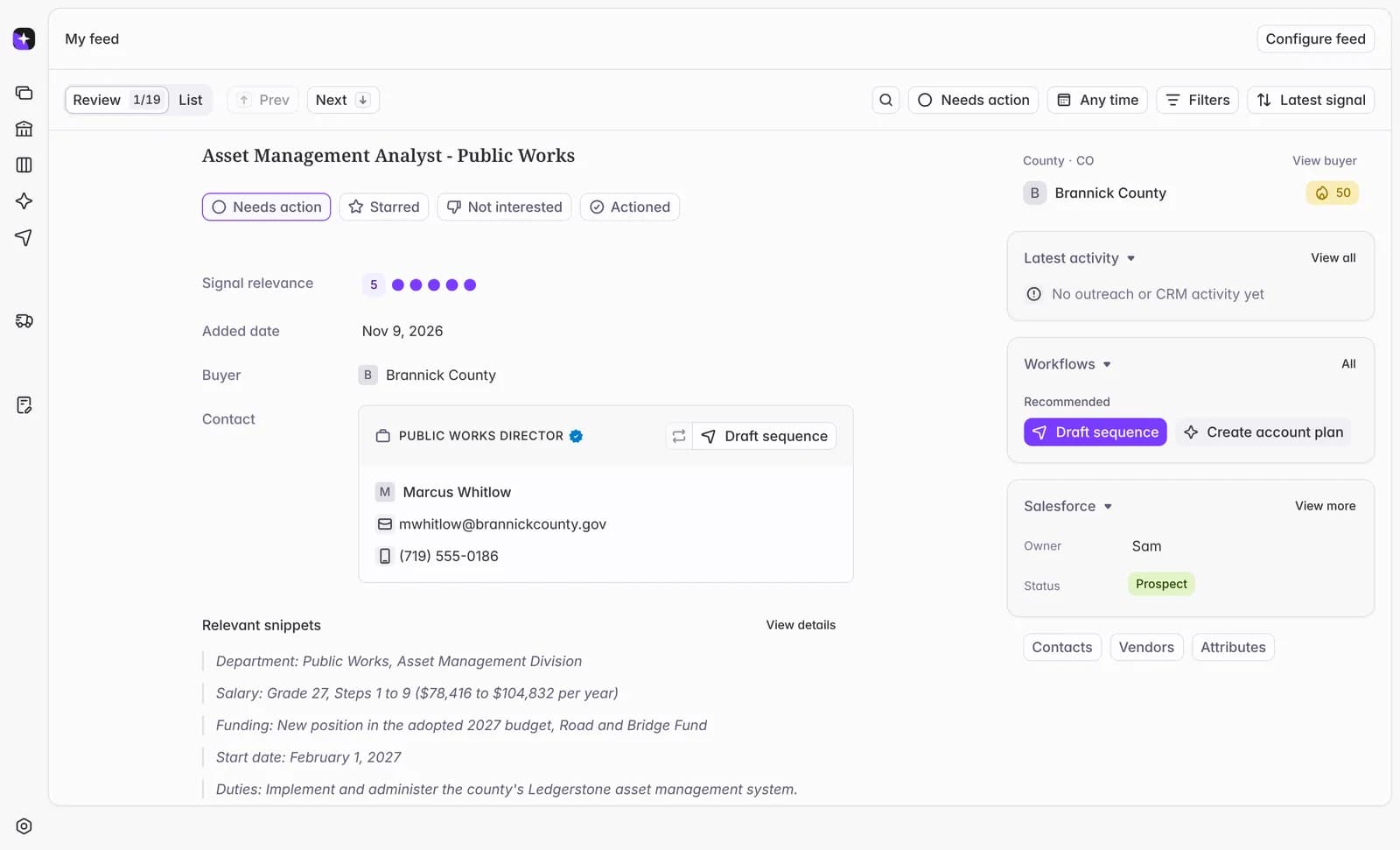
Starbridge’s Buying Signals Monitor watches job postings alongside board minutes, budget documents, grant awards and contract expirations across the 320,000+ entities. It then delivers each posting with the account context a rep needs to act on it, including the department, the funding evidence and who to contact.
Motimatic tripled its average contract value by using Starbridge to track job changes at target accounts, identifying when new decision-makers entered roles at districts and campuses already in its pipeline.
Book a demo today to see which departments in your territory have posted roles that an elected body funded this year.
What to do with the next government job posting you see
Take the next posting in your territory and read beyond the title. Identify the department and the budget the position is paid from, note the salary grade and any funding source, and check whether the duty list describes a system the agency already operates or one it intends to purchase. Determine whether the role is new or a backfill, then plan outreach around the start date rather than the posting date.
Reading a posting this way turns a hiring notice into dated budget evidence for one department, and that evidence is a far better reason to call than a job vacancy.
Frequently asked questions
Yes. A government job posting is published by the agency itself, so it is already public and no records request is needed to read one. Adopted budgets and board minutes are usually public too, so you can often trace the funding line and the approval date without filing a records request.
Usually, for a new position. Approval routes differ, so check the agency’s own policy. For example, Washington County sends a new position to its commissioners, while Clackamas County routes an out-of-cycle one to the county administrator.
There is no fixed interval. Time outreach to the start date, because that is when the new hire starts directing the money the position was funded from. Before then you are writing to a hiring manager in the middle of interviews, who is not the person who will choose a vendor.
Usually not directly. Once an agency has an active solicitation in your category, the agency normally requires you to communicate through a named procurement contact.
Talking to government buyers before the RFP explains which conversations you can still have and which ones you have to stop.


