
8 B2G marketing strategies for driving leads and meetings
Discover 8 B2G marketing strategies to prioritize the right accounts, track buying signals, personalize outreach, and book more meetings before RFPs drop.

Selling to state and local governments, K-12, and higher education is one of the largest market opportunities in the U.S. It’s also one of the hardest to crack. Buying cycles stretch 2 to 18 months. Decision-makers don’t show up on LinkedIn. By the time an RFP hits a portal, a competitor has already shaped the criteria.
The core problem is data infrastructure. Most B2G vendors operate with fragmented contact lists, generic enrichment tools built for commercial sales, and bid databases that surface what already happened.
The teams building the most pipeline have replaced bad data and gut-feel prospecting with signal-driven intelligence. They know which accounts are showing buying intent right now, who to contact, and they’re engaging months before procurement begins. This article breaks down eight B2G marketing strategies built around that principle.
1. Score and prioritize accounts using government buying indicators
When your total addressable market (TAM) includes thousands of school districts, cities, counties, and universities, “spray and pray” is not a strategy. Most teams default to firmographic proxies like enrollment size or population, but those attributes alone don’t predict whether an account is ready to buy.
A 50,000-student district with no budget is a worse target than a 5,000-student district that just received a state safety grant and has an expiring competitor contract.
Build a scoring model with five to seven attributes per account type to surface opportunities worth pursuing.
For school districts, score on:
- Competitor usage
- Per-pupil spending
- Relevant grant funding
- Enrollment and year-over-year enrollment trends
For state and local government, score on:
- Competitor presence
- Contract expiration timelines
- Funding environment
- Population and operating budget
The two questions that matter most are (1) is there a use case for your product, and (2) is there a budget? Use this framework to assign priority scores.
| Priority | Use Case & Pain | Budget & Capacity | Competitive Signal |
|---|---|---|---|
| High (9–10) | Strategic plan or board minutes explicitly name your category as a top priority. | Budget shows a specific line item or a hiring spree in the relevant department. | Incumbent contract expiring in under 12 months, or documented pain with current vendor. |
| Medium (5–8) | High-level goals suggest a need, but no specific project is named. | Large operating budget or “Open to Spend” status, but no specific line item. | Competitor present but contract not expiring soon. |
| Low (1–4) | No evidence of your use case in recent public documents. | Budget freezes, layoffs, or cost-cutting mandates in recent news. | Competitor just signed a long-term deal. |
Your team needs the ability to prioritize the right accounts using comprehensive insights on buying indicators, directly in your CRM.
Starbridge’s Buying Signal Monitor tracks 100+ buying signals spanning spend, leadership, contracts, and grant awards across 320k+ public sector entities. Within the platform, configurable scoring workflows dynamically rank accounts based on the indicators that matter most to your team.
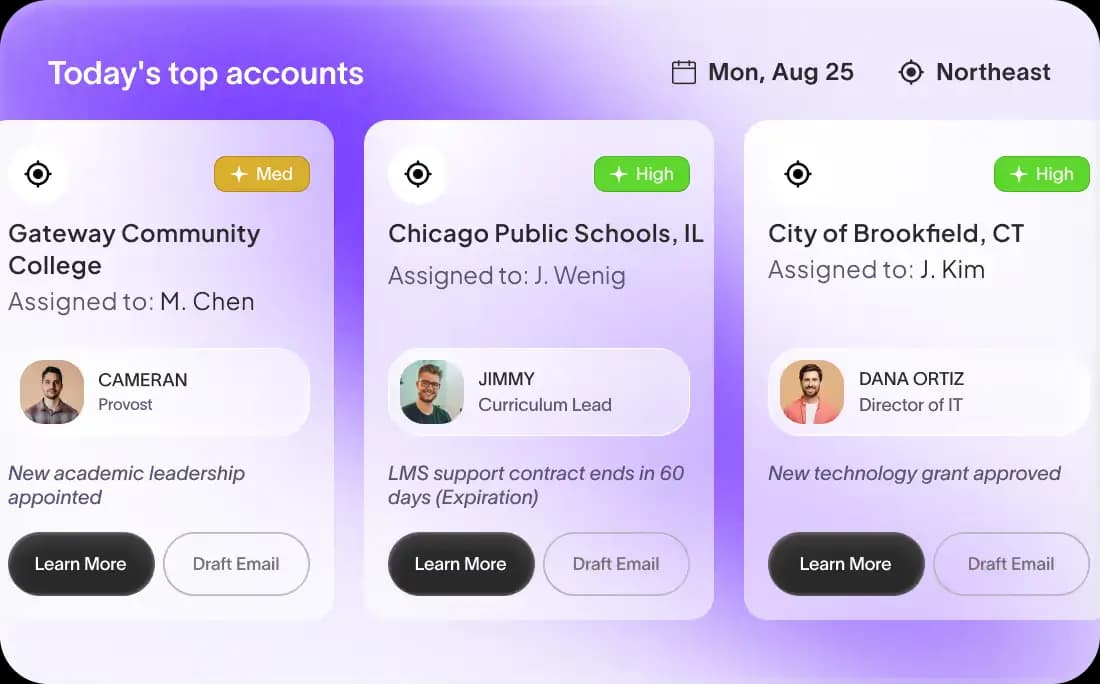
Scores update automatically as new intelligence surfaces. Native bi-directional CRM integration merges Starbridge intelligence directly into Salesforce or HubSpot. Territory-based alerts push priority changes to reps the moment they happen.
After connecting their Salesforce instance to Starbridge, Mantra Health achieved 3x data enrichment coverage across contacts, accounts, and intent signals.
2. Build a verified contact database from government sources
You cannot run outbound into government and education without accurate contact data. And the standard enrichment playbook fails here. Tools like ZoomInfo and Clay scrape LinkedIn and commercial databases, but government and education buyers often have minimal LinkedIn profiles and outdated listings.
Outdated contacts, role changes, and missing buyers lead to missed opportunities. Teams that rely on generic providers like ZoomInfo see bounce rates of 15-25%. Every bounced email means the research time a rep spent preparing that outreach was wasted. Scale that across a team running hundreds of contacts per week and the cost compounds fast. It also damages sender reputation and burns sending domains.
The fix is building your contact database from government and education sources directly. District and municipal websites publish staff directories, board rosters, and department pages. These are public records, updated by the institutions themselves.
Starbridge’s Contacts & Company Data capability solves this at scale. Proprietary web-agent technology continuously crawls government and education sites to source, verify, and enrich contact records. In a 14,000-email test, Starbridge contacts delivered 98% email accuracy with a 2% bounce rate, compared to the 60-70% accuracy typical of generic databases.
Storage Scholars had access to a fully enriched TAM database within days of Starbridge setup. The switch fully automated contact enrichment and replaced thousands of hours of SDR research.
3. Monitor buying signals to engage accounts before the RFP
Timing is everything in government and education sales. By the time an RFP drops, the deal is often already decided. The vendor who got there first built the relationship, shaped the spec, and influenced the budget.
You need to track buying signals that surface months before an RFP decision is made. Examples include:
- A new grant award
- A contract about to expire
- A budget line item for your category
- A leadership change tied to purchasing authority
The strategy is to monitor these indicators systematically and trigger outreach when a combination of signals suggests active buying intent.
Your team needs the ability to automatically act on early buying intent. Starbridge’s Buying Signal Monitor watches 320k+ public sector entities around the clock. It tracks job changes, board minutes, grants, contract expirations, and more indicators of emerging demand.
When relevant buying indicators fire, the platform delivers real-time alerts with notifications on buying activity across your target accounts. Every prospect comes with a clear explanation of why timing is right, plus AI-generated outreach copy. Intelligence routes to the right reps and pushes natively into Apollo and Outreach so teams act without switching tools.
Within their first week on Starbridge, GovWell booked five meetings sourced from buying signals tied to accounts showing early demand.
4. Create government-specific thought leadership content
Government and education buyers are risk-averse. They buy from vendors they trust, and trust gets built long before a sales conversation starts. Generic B2B content about “digital transformation” or “cloud migration” does not resonate with a school superintendent evaluating student safety software or a city manager exploring permitting modernization.
Create content that speaks to the specific workflows, regulations, and pressures your buyers face.
- Write about how districts are using federal safety grants
- Publish analysis of state budget trends that affect your category
- Break down procurement timelines so your prospects see you understand their world
The goal is not lead generation through gated whitepapers. The goal is earning enough credibility that when a buying signal fires, your outreach lands with a warm recipient who already sees you as a knowledgeable partner.
This is one strategy that does not require a platform. It requires subject matter expertise and a commitment to publishing consistently. Interview your existing customers. Attend industry webinars and synthesize what you learn. Reference real policy changes and real funding programs.
Government and education buyers respond to proximity. A nearby win, a case study from a similar district or city, and a point of view on a policy trend they care about will carry more weight than any product pitch.
5. Use public spend data to personalize outreach at scale
Personalization in government and education requires specific raw material. A prospect’s recent LinkedIn post or company funding round isn’t relevant. The buying indicators that move government buyers are budget allocations, contract terms, competitor pricing, and procurement history.
Most of that information is technically public, but it is buried across FOIA filings, procurement portals, and budget documents. Pulling together account, spend, and competitor data for a single account can take hours of manual research. Doing it for 100 accounts is unsustainable without automation.
The outreach itself needs to be specific. Emails that reference a contract expiration date, a budget line item, or a nearby win with a similar entity earn replies. Generic messages do not. Layering cold calls on top of email compounds the effect, with phone calls converting at roughly 10% connect-to-book compared to 1-2% for email alone.
However, none of that works if reps cannot access the context they need to personalize in the first place.
Starbridge’s Public Spend Intelligence eliminates this research bottleneck. It automates FOIA requests and surfaces full competitor contracts, including opt-out clauses, implementation fees, and proposals. The platform detects competitor presence with 96%+ accuracy by combining purchase orders, contracts, and web mentions in a waterfall approach. Reps know exactly who the incumbent is and when the relationship is vulnerable.
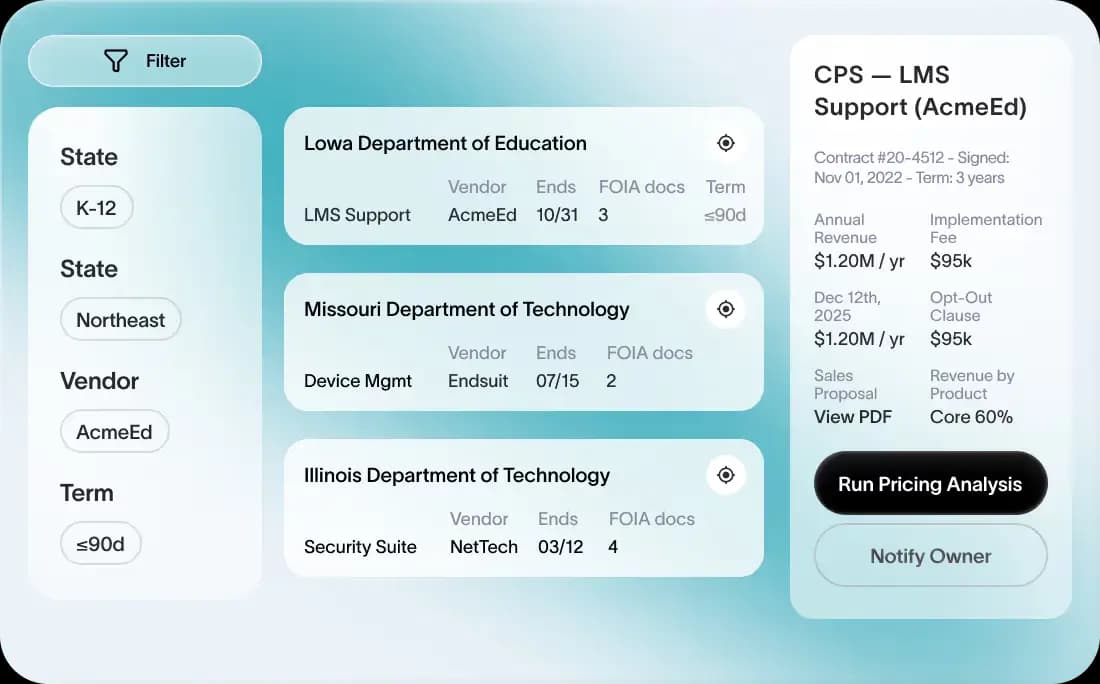
Ask Starbridge Chat lets reps pull buyer research with natural language queries. They get context-aware answers about any account or buying signal without switching tools. Reps can also access Ask Starbridge directly in Slack.
Frontline Education cut research time by 90% using Starbridge to surface account and competitive context instantly. Meanwhile, Abnormal AI has managed to cut research time by 10 hours per week per rep by replacing manual FOIA digging with Starbridge’s automated spend intelligence.
6. Run account-based campaigns aligned to the government contract lifecycle
Most account-based marketing frameworks are built around commercial buying cycles. They assume you can identify intent, run a sequenced campaign, and close within a quarter or two.
Government and education procurement does not work like B2B. B2G sales cycles typically range from 2 to 18 months after the economic buyer says yes, depending on deal size, procurement path, and the specific entity.
Map your target accounts against their contract lifecycle stage and align your approach accordingly.
- Expiring contracts (next 12 months). High-priority displacement targets. Lead with competitive positioning and reference customers.
- Active evaluation. Provide proof points, case studies, and reference customers from similar entities.
- Early planning. Focus on education and relationship-building. Share thought leadership and relevant policy analysis.
Align content, outreach cadence, and sales engagement to each stage rather than running a single campaign sequence for every account.
The challenge is executing this framework across thousands of accounts. Every target needs accurate contract data to be placed in the right stage, and that data changes constantly as contracts expire, renewals close, and new opportunities emerge.
This is where the intelligence layer from earlier strategies compounds.
Starbridge’s Buying Signal Monitor already tracks contract expirations across your full TAM. Your lifecycle stage mapping updates automatically as contracts approach renewal.
Public Spend Intelligence fills in the competitive details, like incumbent vendor, pricing, and opt-out clauses, so reps in the “expiring contracts” tier have what they need to build a displacement case.
All of this syncs natively into Salesforce and HubSpot, and reps can segment accounts by contract stage and trigger the right outreach cadence without manual tagging.
7. Turn conferences and industry days into a qualified pipeline
Government and education conferences are pipeline goldmines if you work them right. Most vendors waste the opportunity by staffing a booth, collecting badge scans, and sending generic follow-ups two weeks later. The result is a pile of unqualified contacts and zero meetings.
The highest-converting teams treat conferences like targeted account plays. That means knowing which attendees match your ICP before you arrive, scoring them against buying indicators, and walking in with personalized materials that reference each target’s strategic plans and nearby wins.
The bottleneck is prep time. Researching attendees, enriching contacts, building personalized handouts, and sequencing follow-up for 20-30 accounts can consume a full week before the event even starts.
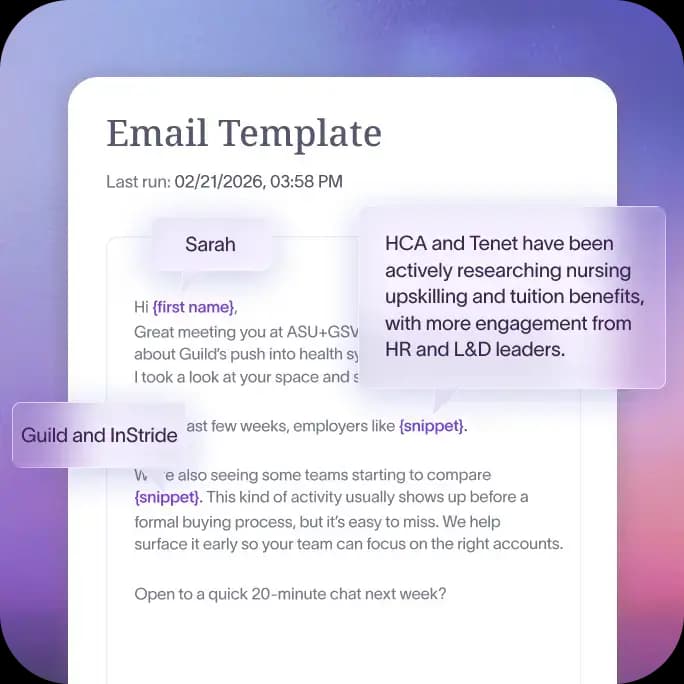
Starbridge’s Conference Intelligence compresses that week into an afternoon. It discovers relevant events and attendees, scores them by ICP fit, enriches attendee lists with verified contact data, and generates personalized follow-up sequences tied to each account’s buying indicators. Leads sync directly into your CRM, creating a conference-driven pipeline tied directly to revenue.
8. Push intelligence directly into your CRM and sequencer
The best intelligence in the world is worthless if it lives in a separate tab. Reps do not log into a second platform to check account scores or read buying signal alerts. They work across CRMs, email, spreadsheets, Slack, and whatever else keeps their day moving.
Every piece of account intelligence, every contact record, every buying signal alert, and every score update should flow directly into the tools your reps already use. No copy-pasting. No CSV imports. No manual data entry. The goal is turning insight into execution without adding steps to the rep’s workflow.
Starbridge’s native integrations push intelligence where reps already work.
- Salesforce and HubSpot. Bi-directional sync that cleans, enriches, and updates CRM records automatically.
- Apollo and Outreach. Buying signal alerts and AI-generated outreach pushed directly into active sequences.
- Slack and Zapier. Alerts routed to the right team channels, with Ask Starbridge Chat accessible directly in Slack.
- Daily digests. A prioritized pipeline view delivered via email to reps with a consolidated view of top accounts and opportunities.
Zencity, for example, now sources 50% of their cold meetings from Starbridge buying indicators pushed directly into their sales workflow.
From B2G marketing strategies to booked meetings
Every effective B2G marketing strategy starts with solving the data layer. You cannot score accounts without buying indicators. You cannot personalize outreach without contract and spend data. You cannot time your engagement without a system watching for signals across government and education entities.
Start by auditing your current government data infrastructure. If your team is using a horizontal enrichment tool like ZoomInfo for government and education outreach, your contact accuracy is likely sitting around 60-75%. Switching to a source built for this market can push that to 98%. This translates into a 1.3X response rate increase.
If your team isn’t tracking job changes at scale, consider this: the median tenure for a state CIO is now just above two years. That means roughly half of your CIO contacts are turning over within any given 24-month window, and each transition resets vendor relationships and opens a window for outreach.
If your current tech stack prevents you from discovering and acting on these insights, you have found the bottleneck.
Starbridge is the AI sales intelligence platform that can unblock your pipeline. It’s built on the most comprehensive dataset of public-sector buyers and buying signals, helping companies selling to state and local government, K-12, and higher education identify, prioritize, and engage high-intent opportunities before the competition. Book a demo to see how your team can turn signal-driven intelligence into booked meetings and a qualified pipeline.
Frequently asked questions
B2G marketing targets buyers in government and education who follow formalized procurement processes, operate on fixed budget cycles, and make purchasing decisions through multi-stakeholder committees. Unlike commercial B2B, where you can identify intent from website visits or content downloads, government buying intent is embedded in public records like board meeting minutes, budget documents, and contract filings.
Government and education contacts are underrepresented on LinkedIn and poorly covered by generic B2B databases. The most reliable sources are the institutions themselves. District websites, municipal staff directories, and board rosters contain verified contact information that is updated by the entities directly.
Starbridge’s Contacts & Company Data automates this process using proprietary web-agent technology that crawls government and education sites continuously, delivering 98% email accuracy.
A buying signal is an early indicator that a government or education entity is planning to spend. Examples include new grant awards, contract expirations, budget line items for a specific category, leadership changes, and strategic plan priorities. They matter because they surface purchase intent months before an RFP appears, giving vendors the timing advantage to build relationships and influence requirements rather than react to bids.
B2G sales cycles typically range from 2 to 18 months after the economic buyer says yes. The timeline depends on deal size, procurement path, and the specific entity. Smaller purchases under sole-source thresholds can close in weeks, while large formal procurements with RFP requirements can extend well past a year.
Track leading indicators alongside revenue outcomes. Meetings booked, accounts engaged before the RFP, and pipeline influenced give you a read on whether your marketing is working long before deals close. Attribution windows need to be longer than in commercial B2B. Marketing and sales alignment on account prioritization is essential for connecting early engagement to eventual revenue.
Build a scoring model based on buying indicators rather than firmographic size alone. Score accounts on two dimensions. First, is there evidence of a use case for your product in public documents like meeting minutes or strategic plans? Second, is there a budget or funding source? Accounts that score high on both dimensions with an expiring competitor contract are your highest-priority targets.
The biggest mistake is treating RFPs as the starting line when they are actually the finish line. By the time a bid drops, the winning vendor has often already built the relationship and shaped the requirements. Shift your strategy to pre-RFP engagement by monitoring buying indicators like contract expirations, budget releases, and strategic plan priorities. Reach accounts while they are still defining the problem, not after they have already written the spec.
Explore our use case library
 Automate account research with AI agentsStop manually researching accounts. Starbridge AI agents automate account research by monitoring buying signals 24/7 and surfacing the right contacts.
 Identify competitor contract expiration datesThe RFP is usually a formality. Starbridge surfaces competitor contract expiration dates so your reps reach accounts before the renewal cycle closes.
 Create a conference campaignTurn conference badge scans into pipeline. Import your contact list, surface buying signals across every account you met, and follow up with context.