
Starbridge vs ConstructConnect: which one covers your public sector deals?
ConstructConnect tracks the build; Starbridge tracks the public agency paying for it. See which fits what you sell, and when to run both.

A school district renovation and a school district software purchase are both public sector deals, and they show up in separate records.
ConstructConnect describes itself as a preconstruction platform for contractors and building product manufacturers.
Preconstruction is the stretch before anyone breaks ground, when the drawings get made and the work goes out to bid.
Starbridge is the AI GTM platform for teams selling to government and education.
This comparison covers what each one tells you about a public sector opportunity, from the first sign of it through to the purchase.
| Capability | Starbridge | ConstructConnect |
|---|---|---|
| What it tracks | The agency as a buying account, across more than 320,000 government and education bodies, with what it buys, who signs off and when its current contracts end. | Commercial building projects, public and private, with the drawings and the firms working on each one. |
| Where a deal first shows up | In the public record before any bid exists, as board minutes, budget documents, grant awards and contract end dates. | In the project record, which follows a build from early planning through to bid and award. |
| Who you can reach | Named staff at the buying agency, with the role that approves the purchase and an email that reaches them. | The companies on the project, including the design team, the bidders and the plan holders. |
| What you see about the money | What the agency has paid in your field, the vendor in place now and the date that contract runs out. Purchase orders are there for 77% of public bodies out of the box. | What the build itself is worth, and who won comparable work nearby. |
| Answering the bid | Each bid is scored against what you sell, and the response is drafted from your own product knowledge base. | Taking off and pricing a set of drawings, which is the real work on a building bid. |
| How the purchase closes | Cooperative vehicles including NASPO ValuePoint, OMNIA Partners and TIPS, with the paperwork run through Starbridge. | The building bid, from the invitation through to the award. |
What each platform tracks
ConstructConnect tracks construction projects, and Starbridge tracks the public bodies that buy.
ConstructConnect
ConstructConnect is built for contractors looking for building work to bid. Every record is a single project, so a seller sees the build, its drawings and the firms bidding it.
The project is the right unit for a contractor. For example, a plumbing firm wants to see the drawings and find out which builders are inviting bids on that job, not read the agency’s buying record.
Starbridge
Starbridge reads the public record across more than 320,000 government and education bodies. The unit here is the account, so a seller sees the body doing the buying rather than one specific job it has put out.
That is the right unit when the same buyer comes back. For example, a district that rebids a contract every three years is one account on a cycle rather than three unrelated jobs.
A public body also buys across several categories at once. So the agency putting out a building job this year can be the one replacing its software next year, and one record carries both.
That unit has a boundary worth naming. Starbridge reads government and education bodies, so a private developer or a commercial landlord is outside what it covers.
The account is also the thing that outlives the job. A build finishes and leaves the database, while the buyer keeps a budget, a renewal date and the same people signing off.
Bottom line
A project tells you that work exists. An account tells you who is paying for it, what they paid last time and when they will buy again.
Where a deal first shows up
Both platforms show a deal well before a contract gets signed. One shows it in the project record, the other in the agency’s own published record.
ConstructConnect
A project record appears early, because drawings, permits and planning steps leave a trail a project database can follow. So a contractor can watch a build move through planning over months.
Starbridge
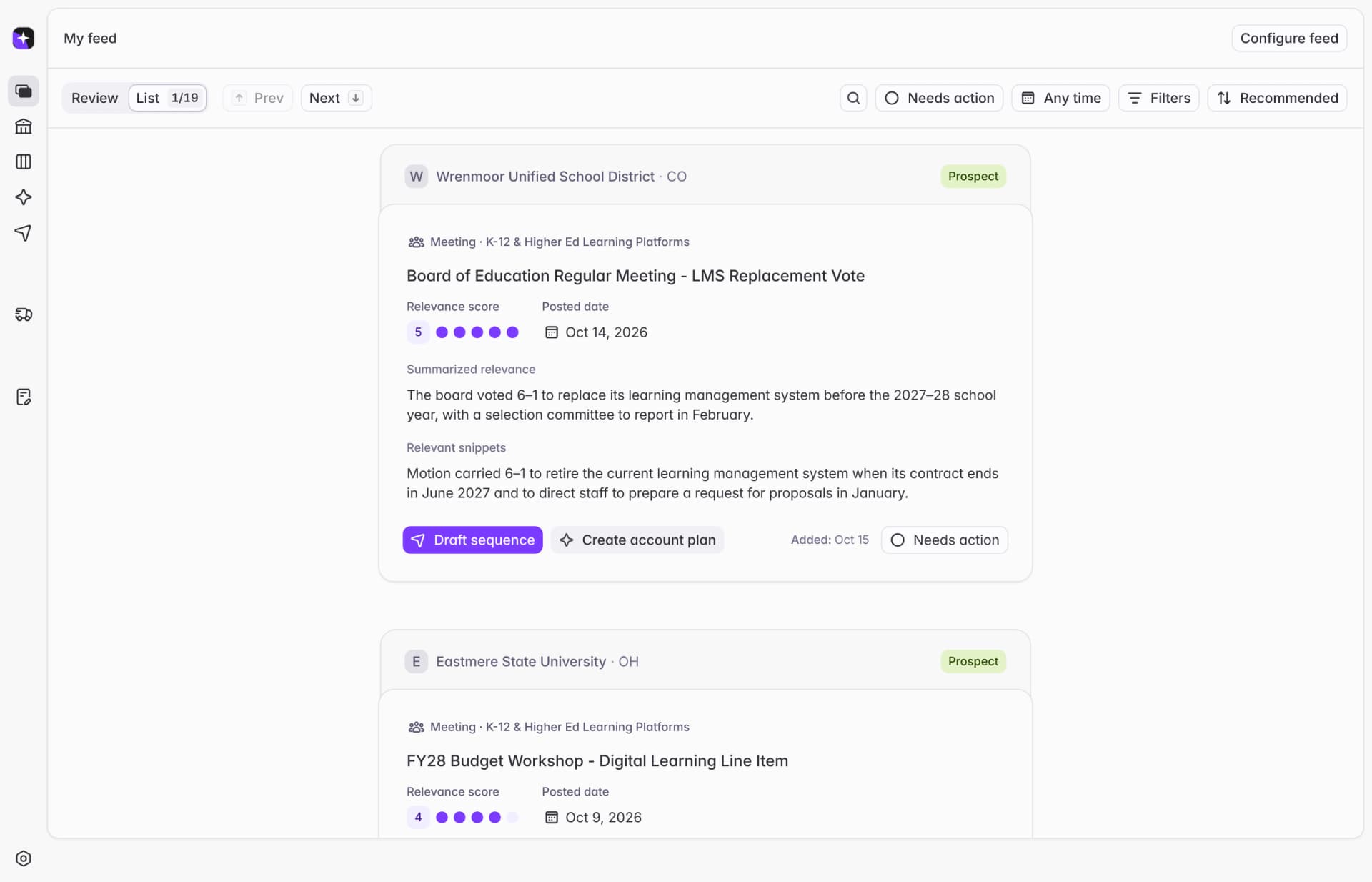
The documents a public body publishes about its own plans arrive on their own schedule, often long before a bid exists:
| What the record is | What it tells you |
|---|---|
| Board minutes | The need has been raised out loud |
| Budget documents | The money is set aside |
| Grant awards | Outside funding has landed |
| Contract end dates | A rebid is due |
Board minutes sit earliest. For example, a board can vote to replace a system months before the bid that replaces it reaches anyone’s inbox.
Bottom line
ConstructConnect’s record starts when a building is planned. Starbridge’s starts when an agency decides it needs to buy, which covers every purchase it makes and not only the ones with drawings.
Who you can reach
A deal needs a named person. One platform names the firms working the job, and the other names the staff inside the agency.
ConstructConnect
The names attached to a build are the firms doing the work. A plan holder, for instance, is a company that downloaded the bid documents, which tells a subcontractor who else is pricing the same job.
Starbridge
Starbridge names the staff inside the agency. A rep opening one account record sees:
- Verified contacts with their job titles
- The role that signs off at this size
- What the body spends in the category
- Which vendor holds the contract now
That list is the difference between knowing a job exists and knowing who to write to about it. How to personalize B2G outbound covers the work behind one of those messages.
Bottom line
ConstructConnect’s firm contacts tell you who is competing for this job. Starbridge’s agency contacts tell you who decides whether the job happens.
What you see about the money
Both platforms carry dollar figures. One figure is the cost of a build, the other what a buyer has spent.
ConstructConnect
A project record carries the value of the build. So an estimator can judge whether a job is worth pricing before opening the drawings.
Starbridge
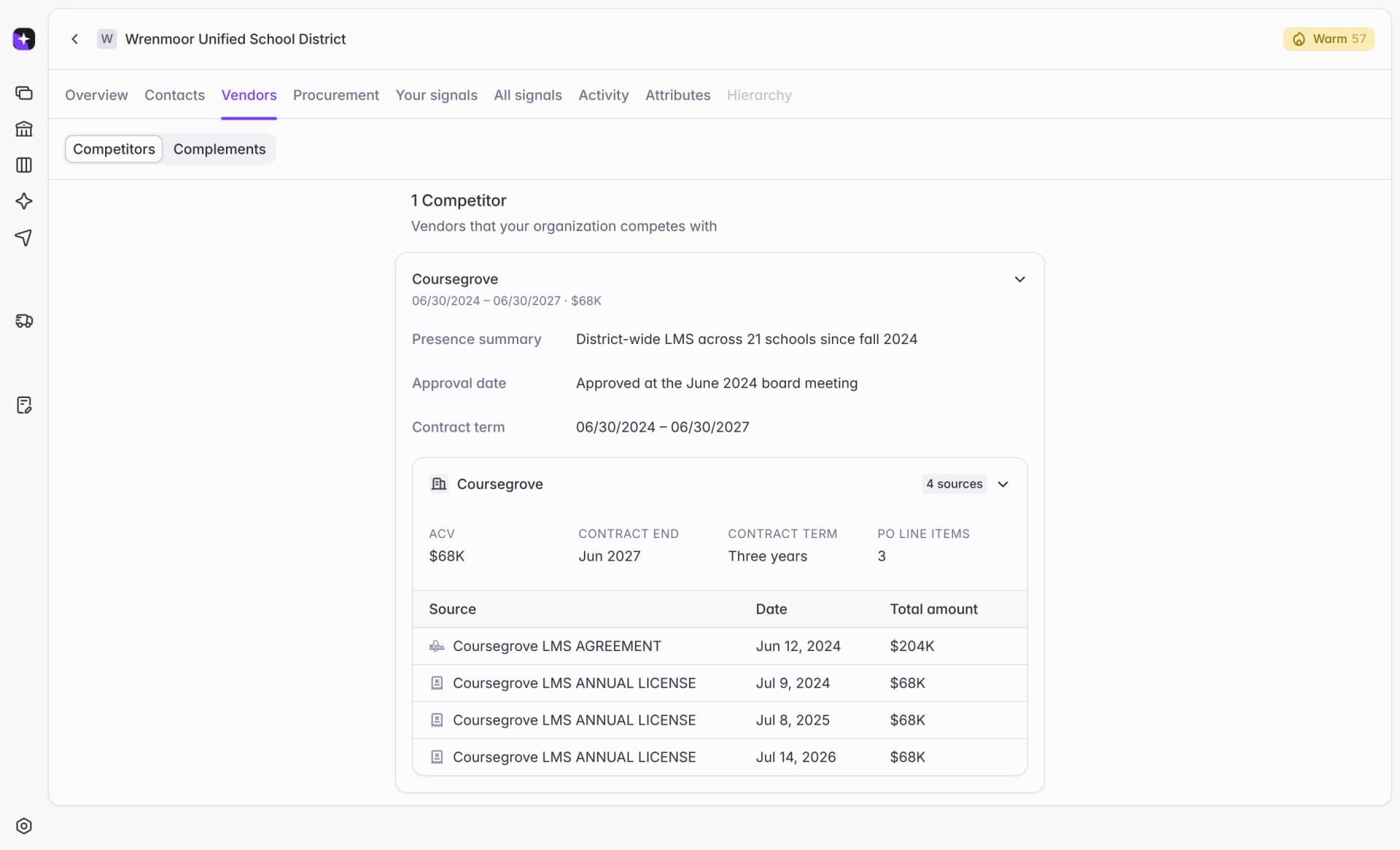
Public Spend Intelligence draws on purchase orders for 77% of bodies out of the box, across state and local government, K-12 and higher education. A seller reading one account sees:
- What the body has paid in the field
- Which vendor it pays today
- The date that contract ends
- The meeting where the board approved it
Our public spend data guide covers where those records live and how to pull them.
Bottom line
A project value tells you how big one job is. A buying record tells you how big the buyer is, which is what tells you whether to work the account at all.
Answering the bid
A seller wins public work by answering the bid well, and each platform helps with a different part of that answer.
ConstructConnect
An estimator prices a build by taking off the drawings, which means measuring the quantities and materials from the plans. An estimator doing that by hand works slowly, and ConstructConnect’s takeoff tools, including AI-assisted takeoff, do that measuring for them.
Starbridge
A software or services bid is answered in writing, and the first decision is whether to answer it at all.
The AI RFP finder and proposal writer scores each bid against what you sell and shows the reason for the score. So a rep drops a weak fit in a minute rather than an afternoon.
On the bids worth answering, the tool drafts the response and a rep finishes it with:
- Answers the team has already approved, from the product knowledge base
- What this buyer bought before, and what it is replacing
- A checklist of every requirement, so nothing the bid asks goes unanswered
- Comments and tags, so a colleague can fix a section in place
The draft still goes to a person. So a rep reads it against the spec and fixes what this buyer will notice before it is submitted.
Bottom line
The drawings tell an estimator what to charge. The buyer’s record tells a seller what to say.
So a response drafted from the account’s own record can name what the buyer spends now and what it is replacing. For example, a district replacing a system it has run for six years wants to see that you already know it.
How the purchase closes
A public body does not run every purchase the same way. The route it takes depends on what it is buying.
ConstructConnect
Building work typically goes to bid, and the bid is a formal process with its own rules. So a platform shaped around that process covers the route a build really travels.
Starbridge
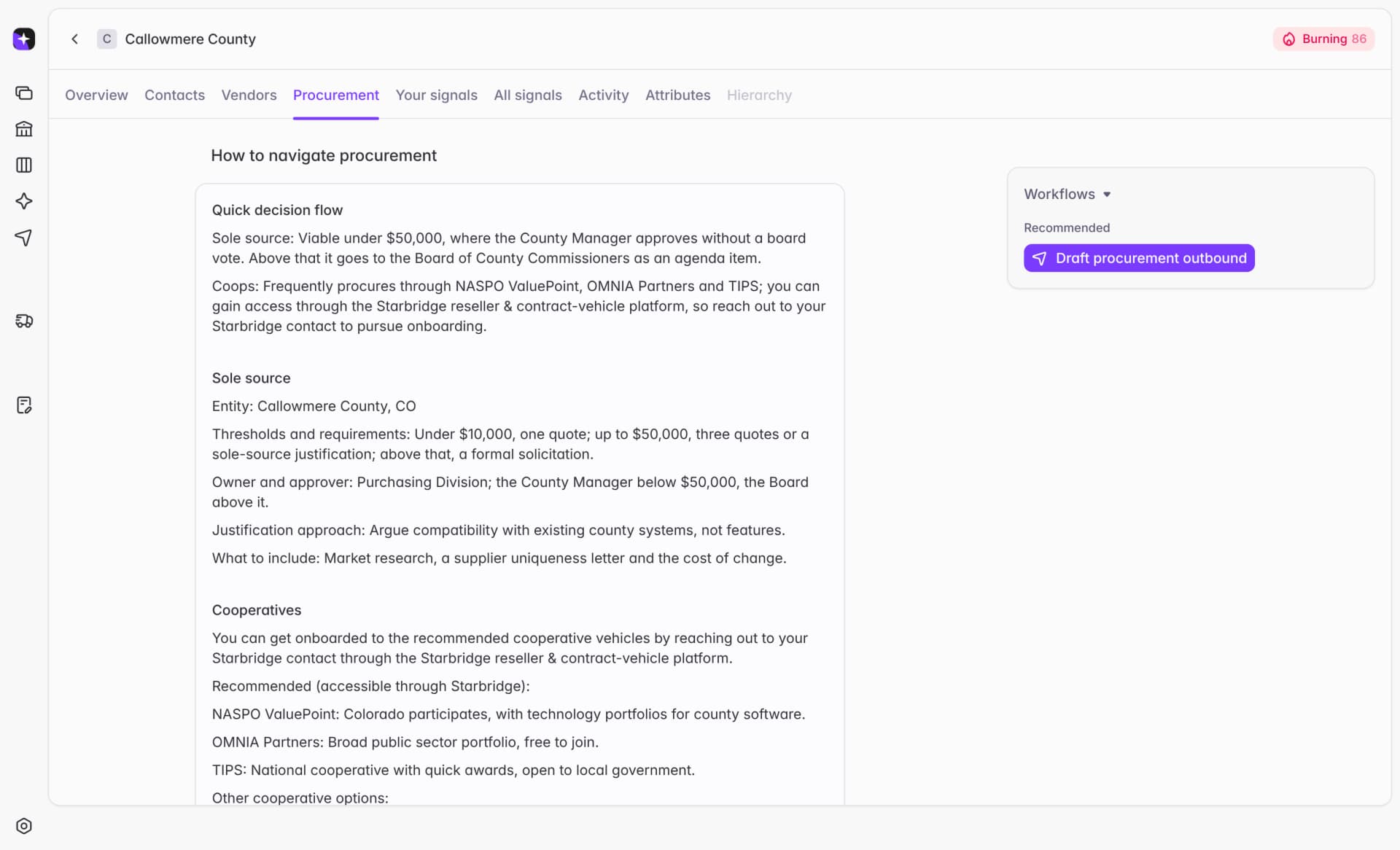
Other purchases can go through a cooperative contract vehicle, which is a deal another public institution already bid and then opened up for its peers to buy from. This often shortens the sales cycle considerably.
Starbridge gives sellers access to contract vehicles, including:
- NASPO ValuePoint
- OMNIA Partners
- TIPS
Access means a vendor of any size can sell through these vehicles, and Starbridge runs the paperwork. The cooperative still runs its own review on its own clock, so the route is quicker than a fresh bid rather than immediate.
Bottom line
A construction purchase typically goes to bid. For the rest, the question worth asking is which route this buyer already uses, because that tells you whether to write a response or a quote.
When to use both Starbridge and ConstructConnect
Some teams genuinely need both products. If your product gets installed in a building and a public agency pays for it, the build and the buying agency are two separate records you need.
| What you sell | What tells you about it | What you work from |
|---|---|---|
| Construction services or materials | The project record and its bidders | The drawings and the firms pricing them |
| Technology, software or services | The agency's own published record | The account, its spend and its contacts |
| Both, into public buildings | Both records, at different moments | The project for the job, the account for the relationship |
A firm whose product goes into school buildings is the clearest case. For example, the project record names the builder pricing the job, while the account record names the district staff who pick the product next time.
The account side of that pair is what we built Starbridge to cover.
Starbridge is the AI GTM platform for companies selling to government, K-12 and higher education, helping teams prioritize the right accounts, reach the right people earlier, and spot high-intent opportunities before the competition.
ClearGov built $16.4M in new pipeline ARR with Starbridge in twelve months. Book a demo today to learn more.
Starbridge or ConstructConnect: which should you choose?
Choose by what you sell, because that is what decides whether the project record or the agency’s buying record answers your question.
- Stay with ConstructConnect when you sell building services or materials, and the job is to find builds, price drawings and get invited to bid. Its coverage spans private commercial work as well as public, so a pipeline that is part private stays in one place.
- Choose Starbridge when your buyer is a public body, and the job is to find the accounts that are about to spend, reach the people who decide, and answer the bid when it posts. Starbridge reads government and education bodies only, so private buyers are not part of it.
- Run both when your product goes into public buildings and the money comes from a public budget, so you need the job and the buyer behind it.
Frequently asked questions
ConstructConnect is a building data and software company. The platform is traditionally used to find builds, price them and run the bidding around them.
Public building work, yes. As of November 2026, the stated coverage is commercial building work, public and private, which takes in public sites such as schools, water plants and fire stations. What a public body buys outside of building work, such as software or services, sits outside what the platform states it covers.
Not for a contractor. A team that prices drawings for a living needs a project database, and Starbridge does not price drawings. Starbridge covers the agency behind the spending, which is a different question and often a different team in the same company.
It depends which end of the deal you work. A firm bidding the build wants the project and the contractors pricing it. A firm whose product gets picked by the agency wants the account, because that choice is made inside the agency rather than on site.
Often months before a bid posts, because a public body talks about its plans in public first. Board agendas, budget documents and grant awards all appear on a published schedule. Talking to government buyers before the RFP covers which conversations are open to you in that window.


