
Bond elections: the K-12 buying signal most vendors miss
A passed school bond is a public list of the projects a district plans to fund. Here is how to read one, and when to act.

When a school district’s voters approve a bond, the district publishes the list of projects the money is meant to fund. Vendors who sell to districts usually learn about the bond from a news story on election night, by which time the project list is already set.
TL;DR: how should a vendor use a school bond?
Don’t wait for a school bond to pass. School districts plan construction and renovation projects before putting a bond on the ballot. Track those plans to identify sales opportunities early. If voters approve the bond, the district can borrow money to fund the projects listed in the measure. This gives vendors a public list of upcoming projects with an approved funding source. First, check whether bond money can legally pay for your product or service.
What school bond money can and cannot pay for
Bond proceeds are capital funds, so the first thing to check is whether what you sell counts as a capital expense, because that decides whether your category is in scope at all.
California is the clearest published example. Proposition 39 (a law passed in the year 2000) authorizes school bonds approved by a 55% local vote for the repair, construction, or replacement of school facilities and classrooms, and the Proposition 39 ballot record states that the measure prohibits the use of bond proceeds for salaries or operating expenses. Proposition 39 also requires annual performance and financial audits of how the money is used.
Read that restriction against what you sell.
- Infrastructure, fixed equipment, furniture, building systems, and technology installed as part of a facility tend to be fundable.
- A recurring software subscription, a managed service, and anything that looks like staffing tend not to be, because they are operating costs rather than capital assets.
Rules vary by state, and the distinction is not always clear at the margins, so confirm how your state treats your category before you build a sales plan around bonds.
Devices and classroom technology in particular fall near the boundary between capital and operating spending, and districts usually get advice before funding them with bond money.
Even when your category is not fundable, there is still a reason to pay attention to a district’s bond. A district running a large construction program has committed its facilities staff and a recurring share of its board agenda to that work. Knowing what work a district’s staff and board are already committed to changes how you forecast that district, just as knowing it has money to spend does.
None of that is a reason to ignore bonds.
It is a reason to be precise about which part of your offering a bond can pay for. A vendor selling a platform with an implementation component may find that the implementation is fundable when the subscription is not, and the district finance office will know how it has split those costs in the past.
The bond timeline, and the two windows that matter
A school bond follows a process that can take years, from early planning to construction. For vendors, there are two important opportunities: before the vote, when projects are being planned, and after the vote, when approved projects move toward purchasing.
- Facilities planning (first window). The district reviews its buildings, identifies needed repairs and improvements, and develops a list of projects. School boards and community members often help shape these plans. This is when vendors can identify opportunities early, before funding is approved.
- The board resolution. The school board votes to put the bond measure on the ballot. The resolution establishes the proposed measure and starts the formal election process.
- Public information and campaigning. The district explains the proposal to voters. Separate community groups may campaign for or against it.
- The vote. Voters approve or reject the bond.
- Funding and purchasing (second window). If the bond passes, the district moves forward with approved projects, finalizes schedules and budgets, and begins issuing bids and making purchases. Vendors can compete for contracts as projects move forward.
The two windows, meaning before the vote and after the vote, also involve different people.
- Facilities planning is run by operations and facilities staff with an architect or program manager working alongside them, often months before the finance office is involved.
- Post-passage purchasing is run by procurement based on a board-approved project list. A rep who knows only the instructional buyer will miss both the facilities planners and the procurement staff.
During the bond campaign, vendors should stick to answering factual questions rather than trying to influence the vote. Campaign involvement can create legal and reputational risks that last well beyond election day.
Find a bond before it reaches the ballot
School districts often plan projects months before putting a bond on the ballot. Much of that planning is public.
Facilities master plans identify needed repairs and upgrades. Enrollment studies reveal where schools need more space. Board agendas show discussions about projects, funding, and election dates.
For vendors, these documents reveal potential sales opportunities before budgets and purchasing decisions are finalized.
The challenge is tracking them across hundreds of districts. Board packets can run hundreds of pages, with important discussions buried in a single agenda item.
Can a vendor support a bond campaign?
Vendors can provide factual information, such as cost estimates, when requested by district staff.
Campaign contributions and advocacy carry greater risks. Laws vary by state, and even legal contributions can raise questions if the vendor later wins a contract.
The safest approach is to help districts plan, not influence voters.
Find early buying signals with Starbridge
Tracking school board documents across an entire sales territory is difficult to do manually.
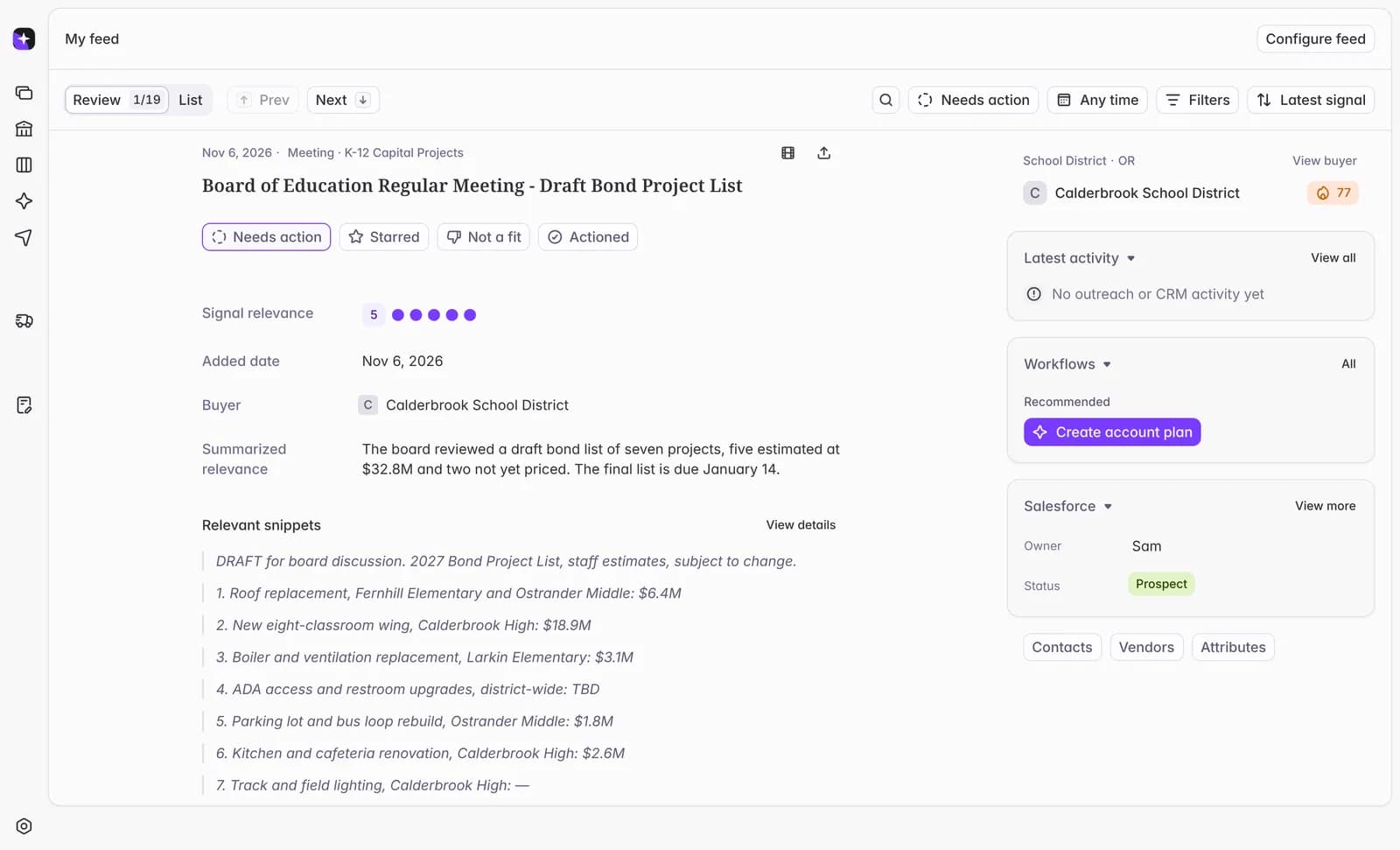
Starbridge’s Buying Signal Monitor tracks public board and council documents and highlights relevant buying signals.
Instead of reading hundreds of board packets, your team can discover facilities projects while districts are still planning them, before competitors spot the opportunity.
InquirED drove $200K in new pipeline in its first quarter with Starbridge, replacing manual board-document research with signal-driven scoring to find the districts that were actually ready to buy.
Book a demo today to see which districts in your territory are in facilities planning right now.
The list is public before the money moves
Sellers who follow a district’s planning over years do better on a bond than sellers who react to the election. The project list that will determine years of purchasing was drafted during a facilities planning process whose documents any seller could have read, and it became a ballot measure months before it became a result.
A rep who learns about a bond on election night is reading the end of a story they could have followed from the beginning. A rep who knows which districts in their territory are assessing facilities is watching the start of the next story.
Book a demo to see the capital planning already under way in your market.
Frequently asked questions
A failed bond usually comes back. Districts that fail a measure commonly revise the scope or amount and return at a later election, because the underlying need does not go away. A failed bond is a signal that a district has a documented capital problem and no funding yet, which makes it worth tracking rather than discarding.
Whether bond money can pay for software depends on the state and on how the purchase is structured. Bond money is capital money, and California’s Proposition 39 bars its use for salaries or operating expenses. Other states draw their own line between capital and operating spending, so confirm how yours treats your category.
Technology installed as part of a facility is more likely to qualify than a recurring subscription.
In two places. The district’s board agendas and minutes carry the facility master plan, the resolution calling the election, and the ballot language, while the county or state election authority publishes the certified result. The board material is the more useful of the two for a seller, because it appears first and names the projects.
Design and planning usually come sooner than equipment. Boards approve a program and phase the work, and each phase runs its own procurement under the district’s normal rules, so the sequence is driven by construction logic rather than by the election. The reliable way to know is to track the board’s approvals of individual projects rather than the election date.


