
Conference follow-up emails that work on government and education buyers
What to write to a public sector lead after a conference: enrich the badge list, find the buying indicator, then send the email it calls for.

Most conference follow-ups recap the booth conversation. A public buyer already knows what you talked about, and the recap gives them nothing to act on.
This guide starts from the account record of the buyer instead. Enrich the badge list, read what the record shows, then send the email that finding calls for.
TL;DR: what makes a conference follow-up email work on a public buyer?
Write it against something in the institution’s own record, not the booth conversation. A board agenda item, an ending contract, an adopted budget line or a job posting each tell you where the account stands, and each calls for a different type of email.
An account showing none of those is probably not buying this year. Send a short note naming the month you will look again, then look.
Start with the list, not the inbox
A badge scan gives you a name and a place of work. But neither tells you whether the institution can buy the product or service you offer this year.
So enrich the list before anyone writes a sentence, pulling a few things from the public record for each account:
- What it already buys in your category, and from whom
- When that contract ends
- Whether its governing body has discussed your category recently
- Whether its adopted budget funds your category
- Whether it is hiring for the work
Those come from purchase orders, award records, board agendas, adopted budgets and job postings, all of which are public documents. Our public spend data guide covers where each one lives, and how to get them in full detail.
Enrichment is what turns a list of names into a list you can actually write to, because you now know each account’s budget and use case.
A rep who leaves it out sends the same email to everyone. A rep who reads the record usually has something different to say to each account, which helps convert them much better.
The indicator decides the email
Once the list is enriched, each account shows one or more of a handful of indicators. Lead with the one that has a date on it. So the indicator, rather than the booth conversation, is what the email outreach after the conference should be about:
| What the record shows | What it means | What the email does |
|---|---|---|
| A board or council discussed your category | The need is named and the specification is not written | Offer what comparable institutions put in theirs |
| A contract is ending | A decision has a date on it | Say the date and offer the switch |
| A budget line passed | The money exists and is assigned | Offer what other institutions did with theirs |
| A job posting appeared | The work is funded and about to start | Offer what the first months need |
| Nothing yet | Not this year | Say so, and name when you will return |
The trigger-based outbound guide covers routing and sequencing these across a whole territory in full detail. This post covers the sentence you write when one of them lands on a badge scan.
Templates by indicator
Each template is short on purpose. The proof does the persuasion work, so the email’s only job is to point at it.
Rules for contacting a public buyer differ by state, by agency or district, and by the purchase in front of you. The templates below are not legal advice, so confirm the specifics with the procurement office involved, or with your own counsel, before you send anything.
The board discussed your category
Subject: [Category] on your [Month] agenda

Hi [Name], good to meet at [Conference].

Just seen [item] on your [Month] board agenda. We end up working with a lot of districts right at that point, before anything goes out to bid.

Want a look at what other districts put in their specs? 20 minutes, no pitch.
The agenda reference is the whole email. It says you read the thing they published, which few vendors actually do.
A contract is ending
Subject: [Incumbent] contract ends [Month]

Hi [Name], good to meet at [Conference].

Had a look and your [category] contract with [incumbent] is up [date]. Most districts start poking around a few months out, so figured the timing might be right.

Want me to send over what switching actually takes? Happy to just send it and leave you to it.
Use the end date rather than the renewal date. The decision happens months before the contract runs out, and the contract expiration guide explains how to work backwards from the end date.
A budget line passed
Subject: [amount] for [line item] in your budget

Hi [Name], good to meet at [Conference].

Just seen your board put [amount] behind [line item]. Most vendors never bother reading the budget, which is why you’re getting this now and not in spring.

Want to see what other districts did with theirs? Takes 10 minutes.
An adopted line is different from a proposed one. Reading a public budget covers the difference, and it decides whether this email is early or on time.
A job posting appeared
Subject: Your [role] opening

Hi [Name], good to meet at [Conference].

Just seen you’re hiring a [role]. Usually means the money is approved and the work kicks off pretty soon after.

Want me to send over what the first few months of that job usually bring up? No strings attached.
Nothing in the record yet
Subject: [Conference] follow-up

Hi [Name], good to meet at [Conference]. No pitch, promise.

I had a look through your public stuff and honestly can’t see anything saying you’re buying in my area this year. Rather be useful later than annoying now.

Your budget goes through in [Month]. I’ll check back then, and only get in touch if there’s actually something in it for you.
This one is worth sending. It costs a rep nothing, it is honest, and it earns a reply where a pitch would not.
What to leave out
A few habits travel over from B2B and do not survive in B2G:
- The booth recap. They were there. They know it. One line to say where you met is enough.
- The 24-hour rule as the whole plan. A short note in the first day or two is fine, but speed rarely opens a buying window on its own, and the conference pipeline guide covers timing against the account’s calendar.
- The attachment. A deck invites a forward to someone who did not meet you.
One more thing needs to be considered in B2G: A buyer inside an open solicitation may not be allowed to talk to you at all. So check the solicitation before you email anyone you met.
Talking to government buyers before the RFP sets out the conversations you can still have, and the ones you have to stop.
In B2G, no rep can leave enrichment out, even though it is slow. A rep who pulls the public record before writing turns the standard email that converts poorly into a predictable way to build pipeline.
That’s one of the reasons we created Starbridge.
Starbridge is the AI GTM platform for companies selling to the government, K-12, and higher education, helping teams prioritize the right accounts, engage the right people earlier, and identify high-intent opportunities before the competition.
Public Spend Intelligence shows what an institution already buys in your field and when the current contract ends. The data draws on purchase orders for 77% of institutions out of the box, across state and local government, K-12 and higher education.
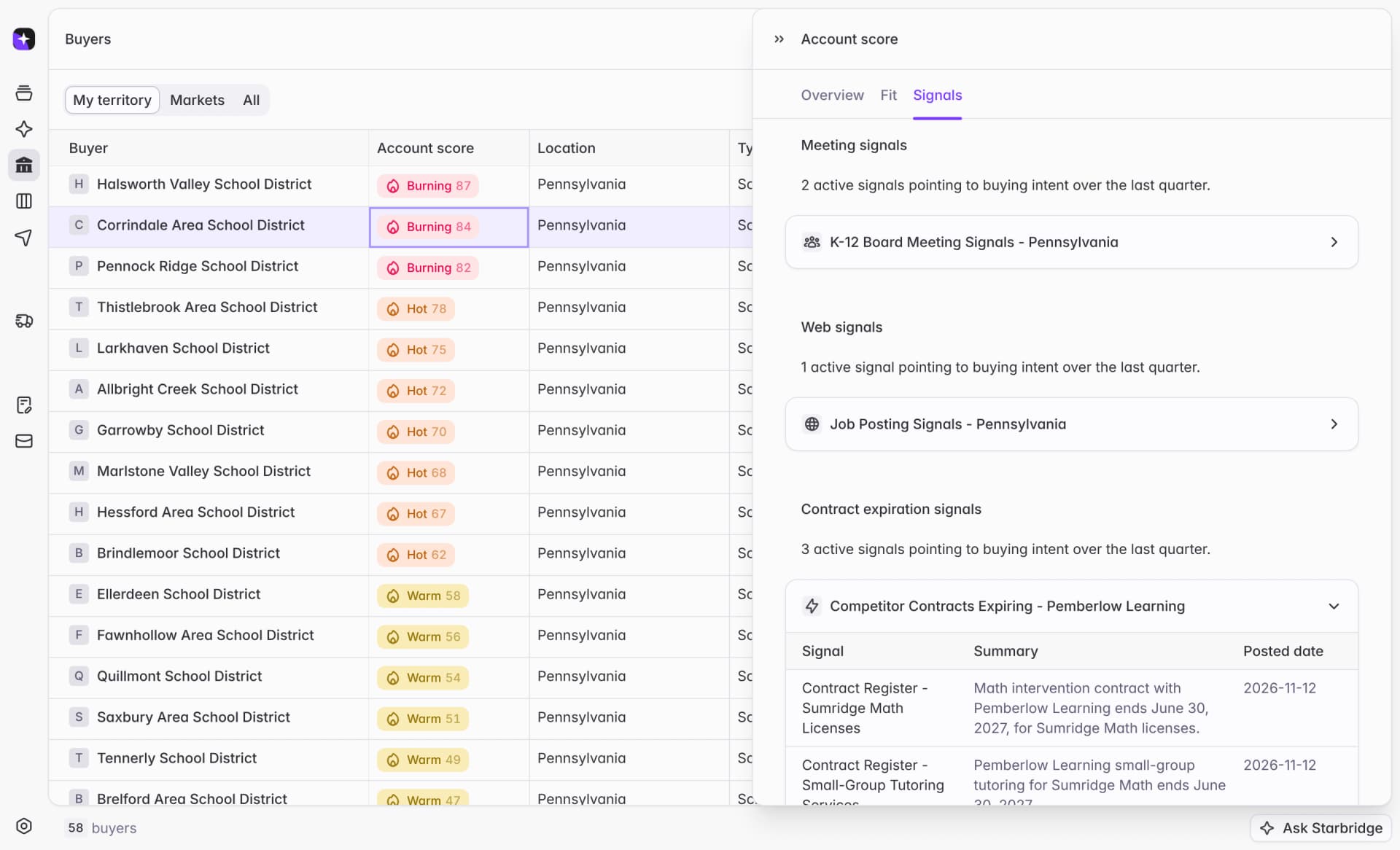
InquirED drove $200K in new pipeline in its first quarter with Starbridge, automating its manual account research.
Book a demo today to see which accounts from your last conference are already spending in your field.
Where to start
Take the badge list from your last event and enrich it before you write anything. Then sort it by what the record shows, and send each group the email its indicator calls for.
- How to use public spend data covers where contracts and purchase orders are published.
- Trigger-based outbound covers routing these indicators across a territory.
- How to personalize B2G outbound covers the research a rep does once an account is worth the hour.
The list from a single conference usually splits unevenly, with most accounts showing nothing yet. An uneven split is the normal result, and the “nothing yet” email is what keeps those accounts worth having next year.
Frequently asked questions
It should point at something in the institution’s own record rather than recap the booth conversation. A board agenda item, a contract end date, an adopted budget line or a job posting each give the email a reason to exist that the buyer can check. The recap tells them what they already know, so it gives them nothing to reply to.
Send a short note within a day or two, while the conversation is still fresh. Then time the real follow-up against the account’s own calendar, because speed rarely opens a buying window on its own. A district that adopts its budget in spring will typically not act on an October conversation that month.
Enrich the badge list first, then write one template per indicator rather than one per person. The evidence differs by account and the sentence around it does not, so a handful of templates covers a whole list. That keeps the research where it matters, which is finding the indicator rather than wording the email.
Often you cannot email a public sector conference lead during an open RFP. Many solicitations route every vendor contact through one named person for the whole process, and a casual follow-up to someone you met can disqualify a bid. Check the solicitation before emailing, and treat that check as part of enriching the list.
Send a short note that says so and mentions when you will look again. It costs nothing, it is more honest than a pitch they cannot act on, and it tends to earn a reply that the pushier versions do not. Most of a conference list falls in this group, so it is worth writing well.


